
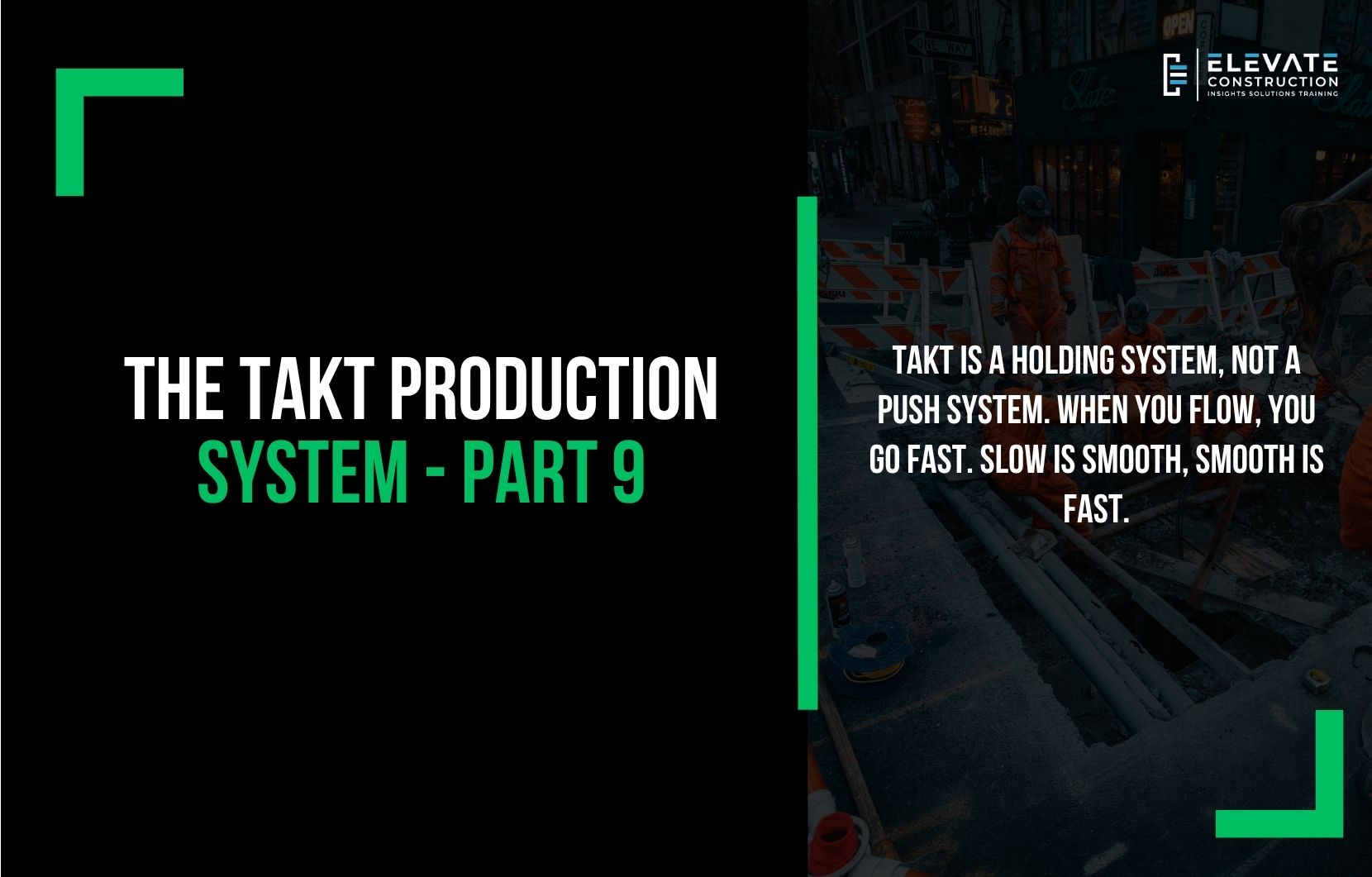
Are You Holding the Flow or Pushing Through Chaos?
Your foremen are distracted. They spend most of their time making weekly work plans from scratch. Tracking down misaligned procurement. Orienting an influx of different people week in and week out. That’s because your schedule is not visible, stable, and working in flow. When you implement Takt, foremen can spend their time with their people in the field. With the right materials. The right information. A steady and stable crew size. A predictable sequence. They’ll be able to control the site and the safety of their workers because they have the environment and capacity to do so. And you as a project team now have the capacity to enforce it on site. You will have flow. And when you can get flow, you can get safety. That’s the transformation. From chaos to control. From distracted foremen scrambling daily to focused foremen executing systematically. From safety problems to safety excellence. From pushing harder to holding flow. Because Takt is a holding system, not a push system. When people try to keep pushing, they lose the genius of the system. Holding means flow. When you flow, you go fast much like the Navy SEAL saying slow is smooth and smooth is fast. With lean, holding is smooth and smooth is fast.
Here’s what most teams miss. They implement Takt and immediately want to push. Start earlier. Work faster. Compress the schedule. And they destroy the flow they just created. One assistant superintendent kept trying to push the schedule instead of holding the Takt start dates. It caused friction with trade foremen. After three weeks of observing and coaching, they transferred him to a different project. Within two weeks, the entire site was in sync and the team was balanced. The lesson: you can’t push and hold simultaneously. Pushing creates chaos. Holding creates flow. And flow is what enables speed. Not pushing harder. Holding the rhythm. The moment you start pushing, you lose the genius of the system. The genius is in the holding. The stability. The predictable flow enabling foremen to control their work instead of reacting to chaos.
The challenge is most leaders think holding sounds slow. Passive. Not aggressive enough. Construction is about pushing hard, getting it done, making it happen. But that’s exactly what creates the chaos preventing success. Six weeks after implementing Takt at OneCare, Jeff visited the site and saw an entirely new jobsite. Clean bathrooms. Air-conditioned lunch area. Redesigned conference room. Every contractor working from one schedule with zero dollar change order. Meeting system planning next day and daily worker huddles. Less worker counts on site due to more flow efficiency. Clean areas crews controlled as part of sequence. Project team holding people accountable. Office team able to stabilize procurement with consistent dates. That’s what holding creates. Not pushing. Holding the flow. And the results speak for themselves.
The OAC Meeting: Admitting the Flow Problem
Olivia opens the meeting: “Today most of what we’re going to discuss is our response to some of the issues we’ve been having. We have a plan and we’d like to communicate it.”
Jeff responds: “Thank you, Olivia. I appreciate your prompt response to this. It’s only been two and a half weeks since we spoke, and I’m glad to hear you found a solution.”
Olivia: “Brad will run us through the plan, but I want to preface it by saying that our issue has been a lack of flow.”
Jeff: “What do you mean by flow?”
Olivia: “What I mean is that our schedule has not been enabling flow on the project, and we, unfortunately, allowed it to get out of our control.”
This is the breakthrough. Admitting the problem isn’t people. It’s flow. The schedule wasn’t enabling flow and they allowed it to get out of control. That honesty invites critique but also opens the door to solutions.
Jeff asks about safety: “How does this tie to safety incidents? And how are you going to improve the inspection walks with our insurance carrier? For me, safety is the top priority.”
Olivia promises they’ll cover it. Brad takes them through the presentation showing where they’d been, what they developed, where they’re going. He shows flow analysis of previous CPM schedule and how it was creating variation. He expertly explains current plan and how it aligns with design, procurement, and commissioning.
Brad’s Comprehensive Presentation
Brad covers the entire integrated production control system. His presentation includes:
- Pre-construction efforts and lean in contracts.
- Use of Last Planner System and Scrum.
- Prefabrication as standard approach.
- Winning over the workforce through better conditions.
- Team building on site and worker orientations.
- Visual interaction spaces supporting collaboration.
- Stable logistics and new meeting system.
- Procurement plan aligned with rhythm.
- Quality program and daily issue correction.
- Roadblock removal and zero tolerance policies.
- Contractor grading showing performance.
- How foremen would better control production and improve based on system.
Brad specifically spends more time on winning over workforce, safety orientations, zero tolerance, and contractor grading. He wants everyone knowing how this system supports and maintains better safety standards and practices. The positive reactions during the meeting are evident.
Olivia’s Key Statement: Flow Enables Safety
Olivia makes her statement with full confidence: “Our foremen have been distracted up until now. They have been spending most of their time making weekly work plans from scratch, tracking down misaligned procurement, and orienting an influx of different people week in and week out. That is because our schedule was not visible, stable, and working in flow.”
She continues: “When we implement Takt, our foremen will be able to spend their time with their people in the field, with the right materials, the right information, a steady and stable crew size, and in a predictable sequence. They will be able to control the site and the safety of their workers because they have the environment and capacity to do so. And we as a project team now have the capacity to enforce it on site. We will have flow. And when we can get flow, we can get safety. That is our plan.”
This is profound. Flow isn’t separate from safety. Flow enables safety. When foremen are distracted making plans from scratch, tracking procurement, and orienting new people constantly, they can’t control safety. When foremen have predictable flow with stable crews and right materials, they can control the site and protect workers. The system creates the environment enabling safety instead of hoping safety happens despite chaos.
Jeff admits: “I wasn’t anticipating a response like this. I can see your point in your plan, but I’m going to be vulnerable and say that I don’t fully understand it yet, but you definitely have our support. What is the timeline to implement it?”
Brad speaks up: “If we’re aligned here today, we’ll issue a zero dollar change order tomorrow and by Monday, everyone will be heading in the same direction. You’ll see results for safety immediately on the walks and systems should be aligned and stable in three weeks.”
The Implementation: Holding vs. Pushing
Within two weeks, everyone on the project was following the Takt plan. Brad followed through with commitments. Juan continued to support. Paul kept the team on track and accountable. Despite being stretched thin by other projects, Olivia stayed connected because the project was self-sustaining and successful and required so little of her time.
There were complaints from various trades during transition to Takt. They were disgruntled at having failures pointed out and often took it personally. But very quickly they started to have wins. Area by area they began to track more closely to schedule and develop rhythm. The fab shop for mechanical trade was able to keep up with schedule. Areas stabilized with cleanliness, organization, and safety. This was largely due to implementing morning huddles with workers and enforcing zero tolerance policies after improving worker conditions.
Progress was visible to the team now that they had trade flow. Only the tower section on levels 1 and 2 were still having difficulty. One assistant super running those floors kept trying to push the schedule instead of holding the Takt start dates. It caused friction with trade foremen. After about three weeks of observing and coaching, they transferred him to a different project. Within another two weeks, the entire site was in sync and the team was balanced.
The lesson: Takt is a holding system, not a push system. When people try to keep pushing, they lose the genius of the system. Holding means flow. When you flow, you go fast much like the Navy SEAL saying slow is smooth and smooth is fast. With lean, holding is smooth and smooth is fast.
Six Weeks Later: The Transformed Jobsite
When Jeff visited the site six weeks after the OAC meeting where they began implementing their plan, he saw an entirely new jobsite:
- Clean bathrooms.
- Air-conditioned lunch area.
- Redesigned conference room area.
- Every contractor working from one schedule with zero dollar change order.
- Meeting system planning next day and daily worker huddles.
- Less worker counts on site due to more flow efficiency.
- Clean areas that crews controlled as part of their sequence.
- Project team holding people accountable.
- Office team with more ability to stabilize procurement with consistent dates.
This transformation happened in six weeks. Not years. Not months of grinding. Six weeks of holding the flow instead of pushing through chaos. That’s the power of Takt when implemented correctly.
Scaling Company-Wide: From Project to Organization
The success at OneCare led to company transformation. Olivia was promoted to VP of Operations. Juan became VP of Scheduling. They began rolling out Takt company-wide with specific requirements for all future projects:
- Intentional pre-construction efforts following Evergreen First Planner System.
- Lean in contracts with Takt, LPS, and Scrum included in master subcontract agreements.
- Last Planner System standardized with modifications merging with Takt.
- Prefabrication as default for projects.
- Worker bathrooms, lunchrooms, barbecues, parking, smoking areas, morning huddles as standard minimum.
- Orientations onboarding workers and foremen to Takt, LPS, Scrum, and flow concepts.
- Monthly foremen training on these systems.
- Standardized interaction spaces supporting integration and collaboration.
- Company approach to zero tolerance coordinated with field ops.
- Contractor grading scaled generally with reporting enabling leadership to see trade performance.
David continued working with the leadership team improving organizational health and supporting the Takt journey. Early pilot projects were already seeing twenty percent time savings. Juan said: “Some of the early pilot projects are already seeing a 20% increase in time savings once they started using the formula he showed us. I’d never have thought it was possible.”
The System Failed You
Let’s be clear. When teams implement Takt and immediately start pushing instead of holding, it’s not entirely their fault. The system failed by teaching that construction is about pushing hard, getting it done, making it happen. Nobody showed that Takt is a holding system creating flow through stability, not a pushing system creating chaos through urgency. Nobody explained that slow is smooth and smooth is fast. Nobody demonstrated that holding the rhythm enables speed while pushing destroys flow. The system taught aggressive pushing as strength when actually holding flow is what creates results.
The system also failed by teaching that foremen should figure it out despite chaos. If your project needs superintendent coaching, project support, or leadership development, Elevate Construction can help your field teams stabilize, schedule, and flow. Foremen spend time making weekly work plans from scratch, tracking down misaligned procurement, and orienting constant influx of different people because schedules are not visible, stable, and working in flow. With Takt, foremen spend time with people in field with right materials, right information, steady crew size, and predictable sequence. They control the site instead of reacting to chaos. But teams never taught this keep expecting foremen to perform despite impossible conditions.
The system fails by teaching that flow and safety are separate. Flow enables safety. When foremen have environment and capacity to control the site, they can protect workers. When foremen are distracted by chaos, safety suffers. The system taught safety programs and policies when actually stable flow creates the conditions enabling safety. Without flow, safety remains reactive hope instead of proactive control.
The Challenge
Here’s your assignment. Stop pushing when you should be holding. Implement Takt as a holding system creating flow, not a pushing system creating chaos.
Hold the Takt start dates. Don’t compress them. Don’t start early because predecessors finished early. Don’t push trying to make up time. Hold the rhythm. Holding is smooth and smooth is fast. Pushing creates chaos destroying the genius of the system.
Give foremen the environment and capacity to control their work. Stop expecting them to make weekly work plans from scratch, track down misaligned procurement, and orient constant influx of people. Create visible, stable schedules working in flow. Provide right materials, right information, steady crew size, predictable sequence. Then foremen can spend time with people in field controlling the site.
Recognize that flow enables safety. It’s not separate. When you can get flow, you can get safety. Foremen can control the site and protect workers when they have environment and capacity to do so. Stable flow creates the conditions enabling safety instead of hoping safety happens despite chaos.
Implement the integrated production control system. Pre-construction efforts, lean in contracts, Last Planner/Scrum, prefabrication, winning over workforce, worker orientations, visual interaction spaces, stable logistics, new meeting systems, procurement alignment, quality programs, roadblock removal, zero tolerance, contractor grading. Create the complete system supporting flow.
Scale company-wide once you prove it works. Don’t keep success isolated to one project. Roll out Takt across organization creating consistent standards, training, and expectations. Early pilot projects see twenty percent time savings. That’s worth scaling.
Six weeks of holding flow transforms jobsites. Clean bathrooms. Organized areas. Stable crews. Predictable schedules. Controlled safety. Less worker counts. More efficiency. That’s what holding creates. Not pushing. Holding the flow.
On we go.
FAQ
What does “holding” mean in Takt planning?
Holding means maintaining the Takt start dates and rhythm instead of pushing to start early or compress schedule. It’s a holding system, not a push system. When people try to keep pushing, they lose the genius. Holding means flow. When you flow, you go fast. Slow is smooth, smooth is fast.
How does flow enable safety?
Foremen can control the site and protect workers when they have environment and capacity to do so. When foremen are distracted making plans from scratch, tracking procurement, and orienting new people constantly, they can’t control safety. Stable flow with predictable sequence, right materials, steady crews enables foremen to focus on safety instead of reacting to chaos.
How long does transformation take?
Six weeks at OneCare. Clean bathrooms, organized areas, stable crews, predictable schedules, controlled safety. Every contractor working from one schedule. Less worker counts due to flow efficiency. Project team holding people accountable. Office team stabilizing procurement. Six weeks of holding flow instead of pushing through chaos.
What happens when people push instead of hold?
One assistant super kept trying to push schedule instead of holding Takt start dates. It caused friction with trade foremen. After three weeks of observing and coaching, they transferred him to different project. Within two weeks, entire site was in sync and balanced. Pushing destroys flow. Holding creates it.
How much time savings do projects see?
Early pilot projects seeing twenty percent time savings once they started using Takt formulas. Not from pushing harder. From holding flow creating stability enabling efficient execution. Flow eliminates waste and variation that push-based approaches create.
If you want to learn more we have:
-Takt Virtual Training: (Click here)
-Check out our Youtube channel for more info: (Click here)
-Listen to the Elevate Construction podcast: (Click here)
-Check out our training programs and certifications: (Click here)
-The Takt Book: (Click here)
Discover Jason’s Expertise:
Meet Jason Schroeder, the driving force behind Elevate Construction IST. As the company’s owner and principal consultant, he’s dedicated to taking construction to new heights. With a wealth of industry experience, he’s crafted the Field Engineer Boot Camp and Superintendent Boot Camp – intensive training programs engineered to cultivate top-tier leaders capable of steering their teams towards success. Jason’s vision? To expand his training initiatives across the nation, empowering construction firms to soar to unprecedented levels of excellence.
On we go