
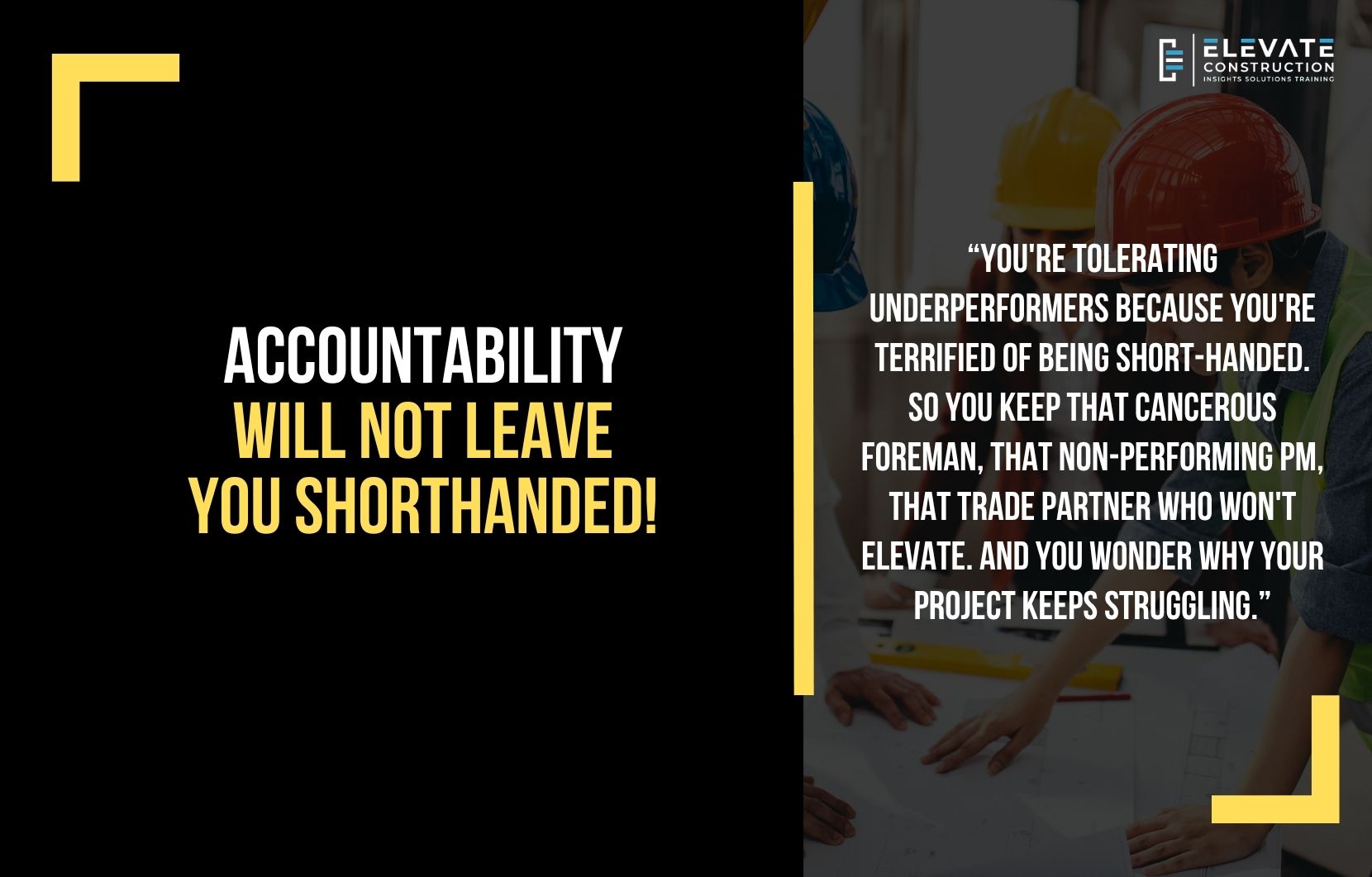
The Hostage Problem: Why Keeping Underperformers Because You’re Afraid of Being Short-Handed Guarantees You’ll Stay Short-Handed
You’ve got a foreman who’s not performing. He’s creating problems, undermining standards, bringing down team morale. Everyone knows he needs to go. But you’re keeping him because you’re terrified of being short-handed. You tell yourself you can’t afford to lose anyone right now. The project is too busy. The schedule is too tight. You’ll deal with it later. You’ll address it after this phase. You’ll have the hard conversation once things settle down.
So the underperformer stays. And the message goes out to your entire team: excellence is optional. Standards are negotiable. Performance doesn’t really matter because we’re too afraid of being short-handed to hold anyone accountable. Your best people see it. They’re carrying the load while the underperformer coasts. They’re meeting standards while he ignores them. They’re building the culture you say you want while he tears it down. And you’re letting it happen because you’re afraid.
Here’s what most superintendents miss. Keeping underperformers because you’re afraid of being short-handed is exactly what keeps you short-handed. Not temporarily, permanently. Because your best people leave environments where excellence isn’t required. Because your culture attracts people who want to coast instead of people who want to build. Because you’re spending leadership energy managing underperformance instead of developing capability. You think you’re protecting capacity by keeping everyone. Actually, you’re destroying it.
The projects with the strongest teams aren’t led by superintendents who never face people decisions. They’re led by people who understand that holding accountability won’t leave you short-handed if you’re recruiting, hiring, and training. Who recognize that you’re being held hostage by people who aren’t bought in. Who know that getting the right people in the right seats matters more than just filling seats. Who understand that sometimes you lose ten to fifty percent of your people when you establish real standards—and that’s exactly what needs to happen.
The Problem Every Superintendent Creates
Walk onto any struggling project and you’ll find the same pattern. There’s a foreman who everyone knows isn’t performing. A PM who’s not leading. A superintendent who’s creating more problems than he’s solving. A trade partner who won’t elevate to project standards. Everyone on the team knows these people need to go. But leadership keeps them because they’re terrified of being short-handed.
So underperformers stay in key seats. Projects limp along. Standards erode because enforcing them would require replacing people who won’t meet them. Excellence becomes impossible because you can’t build it with people who aren’t bought in. And the entire organization gets held hostage by the fear of losing capacity that isn’t really producing anything except problems.
Most superintendents don’t recognize they’re being held hostage. They think they’re being practical. Realistic about capacity constraints. Strategic about managing resources. They frame keeping underperformers as necessary compromise instead of recognizing it as the failure to make hard decisions that would actually build capability. They don’t see that their fear of being short-handed is the exact thing preventing them from building the team that wouldn’t be short-handed.
The pattern shows up everywhere in construction. The company running lean on superintendents, afraid to let anyone go, so they keep underperformers who destroy more value than they create. The project tolerating a cancerous foreman because finding a replacement feels impossible. The leadership team keeping a non-performing PM because they’re too busy to deal with the transition. The organization held hostage by people who aren’t bought in because leadership is too afraid of temporary disruption to create permanent improvement.
Think about what this creates. Your best foreman is executing at high standards. Your underperforming foreman is ignoring them. You’re tolerating both because you’re afraid of being short-handed. What message does that send? That performance doesn’t matter. That standards are optional. That excellence and mediocrity get treated the same. Your best people see it. They’re carrying extra load to compensate for underperformers you won’t address. How long do you think they’ll stay in that environment?
Meanwhile, you’re spending massive leadership energy managing the underperformer. Fixing their mistakes. Smoothing over conflicts they create. Working around their limitations. Compensating for their lack of capability. That energy should be developing your best people, building systems, creating flow. Instead it’s consumed by someone who shouldn’t be in that seat, who you’re keeping because you’re afraid of being short-handed for the weeks it would take to replace them.
The Failure Pattern Nobody Recognizes
This isn’t about being unreasonably harsh or eliminating everyone who makes mistakes. This is about recognizing that keeping underperformers because you’re afraid of being short-handed is exactly what keeps you short-handed permanently. That accountability without consequences teaches people consequences don’t exist. That your culture is defined by the worst behavior you tolerate, not the best behavior you celebrate.
Construction culture sometimes confuses loyalty with enabling. The superintendent who keeps people too long. The company that won’t make hard people decisions. The project that tolerates underperformance because “that’s just how he is.” These patterns can look like loyalty, like caring about people, like giving second chances. And they’re dangerous because they teach people that underperformance is acceptable, that standards are negotiable, that you don’t actually mean what you say about excellence.
So superintendents keep underperformers thinking it protects capacity. They avoid hard conversations thinking it maintains stability. They tolerate cancerous behavior thinking replacing people is too disruptive. They never recognize that keeping the wrong people in key seats destroys more capacity than temporarily having empty seats would. They don’t see that their fear of short-term disruption is creating permanent dysfunction.
The story always goes the same way. Project has underperformer in key seat. Everyone knows they need to go. Leadership keeps them because afraid of being short-handed. Underperformer continues destroying value. Best people get frustrated carrying extra load. Some leave. Project gets worse because now you’ve lost good people while keeping bad ones. Leadership still won’t act because now you’re even more short-handed. The dysfunction compounds. The project fails. And leadership never connects the failure to their refusal to make the people decisions that would have prevented it.
Nobody teaches superintendents that holding people accountable actually builds capacity instead of destroying it. That you won’t be short-handed if you’re recruiting, hiring, and training. That sometimes you need to lose ten to fifty percent of your people to build the culture that attracts the right people. That getting the right people in the right seats matters infinitely more than just keeping seats filled.
A Story From the Field About Making the Hard Call
When Paul Acres started his lean journey at FastCap, half the people left. Not a small percentage, half. Some quit because they didn’t like the new culture. Some were let go because they wouldn’t improve. Half the workforce gone. Most companies would panic. Most leaders would see that as catastrophic failure. Most would back off from the standards that created the exodus.
Paul didn’t. He held the line. The company established clear cultural expectations and process requirements. People who fit stayed. People who didn’t left or were invited to work elsewhere. And FastCap didn’t collapse from being short-handed. It thrived. Because the people who remained were bought in. They wanted to improve. They fit the culture. And that made all the difference.
The same pattern shows up on construction projects. A project was established with clear standards: clean, safe, organized, perfect, and beautiful. Five to ten percent of the workforce didn’t want to be there. Maybe one trade partner didn’t want to elevate to those standards. Difficult decisions came about. People who wouldn’t meet standards were invited to work elsewhere. And the project didn’t fall apart from being short-handed. It improved because everyone remaining was bought in.
Another example. A company terminated a project executive on a mega project because he was being cancerous and not leading the team. Everyone was afraid. Afraid they wouldn’t get work. Afraid of what would happen to the owner relationship. Afraid of what would happen to the job. They made the decision anyway. There was a little bit of fill-in that another person had to do. But it was great. They finished the project great. It all worked out for the best. The fear was unfounded. The hard decision was right.
There was a foreman removed on a project because he was cancerous. He wouldn’t fit in. Up until that point, he was totally destructive. That foreman and actually a superintendent on the project were removed. People were filtered around to the right seats. That project started jamming. Finished on time. The most common problem we have isn’t foremen themselves, it’s foremen being in the wrong seats on the bus, on the project site, and the project team not doing anything about it. If you have a cancerous non-performing foreman that is one of the most destructive things you can have on the project site.
Another example. The PM and the project executive on a two-hundred-fifty-million-dollar-plus project. They weren’t leading the project. No conflict resolution. They weren’t rallying the team. They weren’t performing. They were moved off the project. A new project executive came in. A new project manager came in. The team started jamming. They started hitting their dates. The whole project turned around. These are people-in-the-wrong-seat problems. Behavioral problems. Process and behavioral problems. We don’t blame the people for those things. We invite those people to go work somewhere else because their behaviors and actions might not fit into the overall culture of the project.
The lesson is consistent across every example. Make the hard people decision. Remove the underperformer. Get the right people in the right seats. And the project improves instead of collapsing. The fear of being short-handed is almost always unfounded when you’re recruiting, hiring, and training.
Why This Matters More Than Avoiding Disruption
When you keep underperformers because you’re afraid of being short-handed, you’re being held hostage. Not by market conditions or labor shortages or external constraints. By your own fear. By people who aren’t bought in. By the refusal to make hard decisions that would build the culture and capability you actually need.
Think about what Jim Collins teaches about the number one metric. In Beyond Entrepreneurship 2.0, he identifies one metric that towers above all others. One metric to track with obsession. One metric upon which the greatness of the entire enterprise hinges. And yet, ironically, for most companies, it’s rarely the metric first discussed. What’s that metric? The percentage of key seats on the bus filled with the right people for those seats.
Stop and think. What percentage of your key seats do you have filled with the right people? If your answer is less than ninety percent, you’ve just identified your number one priority. Not sales. Not profitability. Not project count. Getting the right people in the right seats. Because everything else flows from that. You can’t build excellence with people who aren’t bought in. You can’t create flow with people who won’t meet standards. You can’t establish culture with people who undermine it.
What makes a key seat? Any seat meeting one of three conditions. First, the person in that seat has the power to make significant people decisions. Second, failure in that seat could expose the entire enterprise to significant risk or potential catastrophe. Third, success in the seat would have a significantly outsized impact on company success. Foremen are key seats. Superintendents are key seats. Project managers are key seats. And if you’ve got underperformers in those seats because you’re afraid of being short-handed, you’re sabotaging your own success.
Here’s the question that reveals when it’s time to shift from develop to replace. Are you beginning to lose other people by keeping this person in the seat? If your best foreman is getting frustrated because you won’t address the underperforming one, you’re on the edge of losing capability to protect dysfunction. If your project team is demoralized because leadership won’t make the hard call, you’re trading future capacity for present avoidance. Do you have a values problem, a will problem, or a skills problem? Skills you can train. Values and will you can’t. What’s the person’s relationship to the window and the mirror? Do they look out and blame others or look in and own their part? Has your confidence in the person gone up or down in the past year? How would you feel if the person quit today? These questions reveal truth you already know but might be avoiding.
The principle is clear. Holding people accountable will not leave you short-handed as long as you are recruiting, hiring, and training. If you’re not doing those three things, you might be in trouble. But you could also reduce the annual volume of your business and actually do things right the first time instead of managing waste created by underperformers you’re afraid to replace. If your project needs superintendent coaching, project support, or leadership development to build teams where the right people fill the right seats, Elevate Construction can help your field teams stabilize, schedule, and flow.
Watch for These Signals You’re Being Held Hostage
Your project is vulnerable to the hostage problem when you see these patterns:
- Best people carrying extra load to compensate for underperformers leadership won’t address, revealing that fear of being short-handed is costing you the capability you’re trying to protect
- Standards eroding because enforcing them would require replacing people who won’t meet them, showing that culture is being defined by worst behavior tolerated instead of best behavior celebrated
- Leadership energy consumed by managing underperformance instead of developing capability, indicating resources are being spent on people who shouldn’t be in those seats
- Team morale dropping because people who execute well see people who don’t getting the same treatment, demonstrating that accountability without consequences teaches people consequences don’t exist
The Framework: Getting the Right People in the Right Seats
The goal isn’t eliminating everyone who makes mistakes or creating impossible standards. It’s understanding that you’re being held hostage by people who aren’t bought in. That keeping underperformers because you’re afraid of being short-handed is exactly what keeps you short-handed. That the right people in the right seats matter more than just filling seats.
Recruit, hire, and train at an accelerated rate before you need capacity. Don’t wait until you’re desperate to build bench strength. Expand your capacity before you expand your workload. Have people in development who can step into key seats when someone doesn’t fit. Companies that always have one or two or three people in development never get held hostage because when somebody ends up not being a cultural fit, they invite them to work somewhere else and put bench people into those spots. People who are doing work anyway, adding value, earning money. It’s shortsighted to not have enough people. Build capacity proactively, not reactively.
Blame the process and the behavior, not the people. This is a core lean principle. People structurally, for the most part, are doing everything they can to come in and do their best every day. Culture is the micro actions and beliefs and behaviors of a group. When someone isn’t performing, don’t blame them as a person. Look at whether the process failed them or whether their behaviors don’t fit the culture you’re building. Then make the decision clearly. Sometimes people fit better in different seats. Sometimes they fit better somewhere else entirely.
Work with your most bought-in players, not your resisters. Don’t spend massive time trying to convince people who don’t want to improve. Pour your development energy into people who are hungry for it. At field engineer boot camps, there are just as hungry people now as there were fifteen years ago. They want different things than previous generations. If you’re in a company focused on loyalty, in-office requirements, base salary incentive packages without bonuses, not a fun environment, it might be that these people are hungry—they’re just not hungry for you. Don’t blame people for being lazy. Look at whether your culture and process attract and develop the right people.
Decide your culture and enforce it consistently. Decide one hundred percent what your culture is. What processes you’ll follow. What behaviors you’ll follow. Then hold that line. When you establish clear standards—clean, safe, organized, perfect, beautiful projects, five to ten percent of the workforce might not want to be there. Some trade partners might not want to elevate to those standards. That’s okay. Let them go work somewhere they fit. You’re inviting people who can’t work there anymore to go somewhere they fit in. They don’t fit with excellence. That’s not blaming them as people. It’s recognizing that their behaviors don’t align with the culture you’re building.
Expect to lose ten to fifty percent when you establish real standards. Don’t think the lean journey is all butterflies and kittens. It’s a whole lot of “who’s on the bus and who’s not on the bus.” Paul Acres lost half his people. Large companies that identify core values and get firm with them see droves of people leave. Construction projects that establish real standards see five to ten percent of the workforce and maybe one trade partner leave. This is normal. This is expected. This is how culture gets built. If you’re not willing to take that risk, you can’t build the culture that attracts and keeps the right people.
The Practical Path Forward
Here’s how this works in practice. You’ve got an underperformer in a key seat. Everyone knows they need to go. You’re terrified of being short-handed. You need to decide whether to keep them or make the hard call.
First question: are you recruiting, hiring, and training? If no, start immediately. You can’t make hard people decisions without bench strength. If yes, you’ve already built the capacity to handle transitions. The fear of being short-handed is based on not having developed people ready to step in. Build that capacity first. Then the fear disappears because you have options.
Second question: is this person bought in or resisting? Skills problems you can train. Values problems you can’t. Will problems you can’t. If someone doesn’t want to improve, doesn’t fit the culture, resists the standards you’re establishing, development won’t fix that. You have a bus problem, not a seat problem. Help them find where they fit, which might be somewhere else.
Third question: are you losing other people by keeping this person? If your best foreman is getting frustrated because you won’t address the underperforming one, you’re about to lose capability to protect dysfunction. Make the hard call before you lose the people you actually want to keep. Your best people won’t tolerate environments where excellence and mediocrity get treated the same.
Make the decision clearly and act on it. Don’t let someone linger in a seat where they don’t fit. Decide whether they’re in the wrong seat or on the wrong bus. If wrong seat, help them find the right one. If wrong bus, help them find where they fit. Either way, act decisively. The longer underperformers stay in key seats, the more damage they do and the harder the eventual decision becomes.
Communicate the why to your team. When you make people decisions, your team needs to understand the framework. Not gossip about individuals, but clarity about culture and standards. “We’re building a culture where excellence matters. We help people find the right seats. When someone doesn’t fit, we help them find where they do.” Your best people need to see that performance matters, that standards are real, that you’ll make hard calls to protect culture.
Why This Protects Projects and People
We’re not just building projects. We’re protecting jobs, families, and futures from the dysfunction that underperformers create. And whether we make hard people decisions or avoid them because we’re afraid of being short-handed determines whether we build cultures that attract excellence or cultures that tolerate mediocrity.
When you keep underperformers, you’re not protecting jobs. You’re threatening them. Because underperformers destroy project success. Projects that fail cost everyone their jobs, not just the underperformer. Your best people leave environments where excellence isn’t required, taking their capability somewhere it’s valued. The underperformer you’re keeping to avoid being short-handed is exactly what’s making you short-handed by driving away the people you actually need.
When you make hard people decisions, you’re protecting everyone else. The project improves. Standards become real. Your best people see that performance matters. Culture attracts people who want to build instead of coast. Capacity grows because you’re developing bought-in people instead of managing resistant ones. Jobs become more secure because projects succeed when the right people are in the right seats.
This protects families by building cultures where people can thrive. When your best people are carrying extra load to compensate for underperformers you won’t address, they burn out. When they burn out, their families suffer. When you make the hard call and get the right people in the right seats, work becomes sustainable. Flow becomes possible. People can go home at reasonable hours because they’re not compensating for dysfunction you’re too afraid to fix.
Respect for people means making hard decisions that protect culture and capability. It means helping people find where they fit, even if that’s somewhere else. It means not forcing people who don’t fit to stay in seats that aren’t right for them. It means protecting your best people from the burden of carrying underperformers you’re too afraid to address. It means building cultures where excellence is required and rewarded, not just hoped for.
The Challenge in Front of You
You can keep avoiding the hard call. You can tolerate the underperformer because you’re afraid of being short-handed. You can let your best people carry extra load. You can watch standards erode. You can spend leadership energy managing dysfunction. You can let fear control your people decisions.
Or you can make the hard call. You can start recruiting, hiring, and training at an accelerated rate. You can build bench strength. You can get clear about your culture and enforce it. You can help people find the right seats or the right bus. You can accept that you might lose ten to fifty percent when you establish real standards. You can trust that the right people will come once you decide on your culture.
The projects with the strongest teams aren’t led by superintendents who avoid hard people decisions. They’re led by people who understand that holding people accountable won’t leave you short-handed if you’re recruiting, hiring, and training. Who recognize that you’re being held hostage by people who aren’t bought in. Who know that getting the right people in the right seats matters more than just filling seats. Who’ve made the hard calls and watched their projects improve instead of collapse.
You’ve got an underperformer in a key seat. Everyone knows it. You’re keeping them because you’re afraid of being short-handed. That fear is costing you more than the temporary disruption of making the hard call ever would. Your best people see it. Your culture is being defined by it. Your project is suffering from it.
Paul Acres lost half his people when he established real standards. His company thrived. Projects that removed cancerous foremen finished on time. The two-hundred-fifty-million-dollar project that replaced non-performing leadership started jamming. The fear was unfounded. The hard decision was right. Every single time.
Make the call. Get the right people in the right seats. Stop being held hostage by fear.
On we go.
Frequently Asked Questions
Won’t making hard people decisions actually leave us short-handed?
Only if you’re not recruiting, hiring, and training. The companies that are always developing bench strength never get held hostage because when somebody doesn’t fit, they have people ready to step in. Build capacity before you need it. Expand capability before you expand workload. Then people decisions don’t create crises because you have options. The fear of being short-handed is based on running too lean on development. Fix that first, then make people decisions from strength instead of fear.
How do you distinguish between someone who needs development and someone who needs to go?
Skills problems you can train. Values problems you can’t. Will problems you can’t. Ask: does this person want to improve? Do their behaviors align with our culture? Are they bought in? If yes, develop them. If no, help them find where they fit, which might be somewhere else. Also ask: are you beginning to lose other people by keeping this person in the seat? If your best people are getting frustrated, you’re protecting dysfunction at the cost of capability. That’s the signal to act.
What if we lose ten to fifty percent of our people when we establish standards?
That’s normal. That’s expected. Paul Acres lost half his people when he started his lean journey. Large companies that get firm about core values see droves leave. Construction projects that establish real standards see five to ten percent of the workforce leave. The people who remain are bought in. They want to improve. They fit the culture. And that makes all the difference. You can’t build excellence with people who don’t want it. Losing resisters to gain alignment is the trade that builds great companies.
How do we maintain capacity during transitions when people leave or are replaced?
This is why recruiting, hiring, and training at an accelerated rate matters so much. Have bench people in development. Have capacity built before you need it. Then when someone doesn’t fit, you’re not scrambling to fill the seat. You have people ready to step in. Companies that wait until they’re desperate to develop capacity get held hostage. Companies that build proactively never face that problem. The investment in development is what makes hard people decisions possible without creating crises.
What if the person has been with us a long time or contributed early on?
Loyalty to people who contributed early is real and important. But mercy cannot rob justice. Your obligation is to everyone on the team, not just one person. When someone who contributed early no longer fits, help them find where they do fit. Maybe a different seat. Maybe a different role. Maybe somewhere else entirely. Honor their contribution by helping them find success, even if that’s not in their current seat. But don’t sacrifice your best people and your culture to avoid making a hard decision about someone who doesn’t fit anymore.
If you want to learn more we have:
-Takt Virtual Training: (Click here)
-Check out our Youtube channel for more info: (Click here)
-Listen to the Elevate Construction podcast: (Click here)
-Check out our training programs and certifications: (Click here)
-The Takt Book: (Click here)
Discover Jason’s Expertise:
Meet Jason Schroeder, the driving force behind Elevate Construction IST. As the company’s owner and principal consultant, he’s dedicated to taking construction to new heights. With a wealth of industry experience, he’s crafted the Field Engineer Boot Camp and Superintendent Boot Camp – intensive training programs engineered to cultivate top-tier leaders capable of steering their teams towards success. Jason’s vision? To expand his training initiatives across the nation, empowering construction firms to soar to unprecedented levels of excellence.
On we go