
The Schedule on the Trailer Wall Is Not a Plan
Here’s the deal: most construction projects have a beautiful schedule. Detailed, color-coded, logically tied, updated weekly. And most construction workers have never seen it. Not because leadership is hiding it because nobody designed the system that would carry that information from the person who built it to the person who needs it. The schedule exists. The plan doesn’t reach the field. And that gap between a schedule existing and a plan being understood by the crew executing it is where most projects fail not in scope, not in budget, not in design. In the handoff.
Information does not flow by accident in construction. It flows by design. And when the design is missing, the schedule becomes what Jason Schroeder calls it directly: not worth the paper it’s printed on.
What Happens When the Chain Breaks
Every project team that has ever called an emergency coordination meeting in week fourteen has a version of the same root cause. Somebody made a decision based on incomplete information. A trade partner committed to a scope in a weekly meeting that their foreman never received. A crew showed up to a zone to do work that another trade was still occupying because the handoff sequence was never communicated below the superintendent level. A delivery arrived mid-zone because nobody told the worker that the logistics plan had changed.
None of these are execution failures. They are information failures. And they are predictable outputs of a system where the information chain was never designed to close the loop between the people making the plan and the people executing it.
I remember early in my career being on a project where the pull plan was beautiful done correctly, collaboratively, with all the right trades in the room. Zone-by-zone, handoff by handoff, the logic was sound. But by week three, the field wasn’t following it. When I walked the zones and asked foremen what the plan was for the week, the answers didn’t match the weekly work plan. Not because they disagreed with it because they had never seen it in a format they could use. The plan lived in a spreadsheet that the project coordinator updated every Friday. Nobody had designed how it moved from that spreadsheet to the foreman’s daily briefing. The chain was built halfway. The system failed. They didn’t fail the system.
The Five Links That Make Information Flow
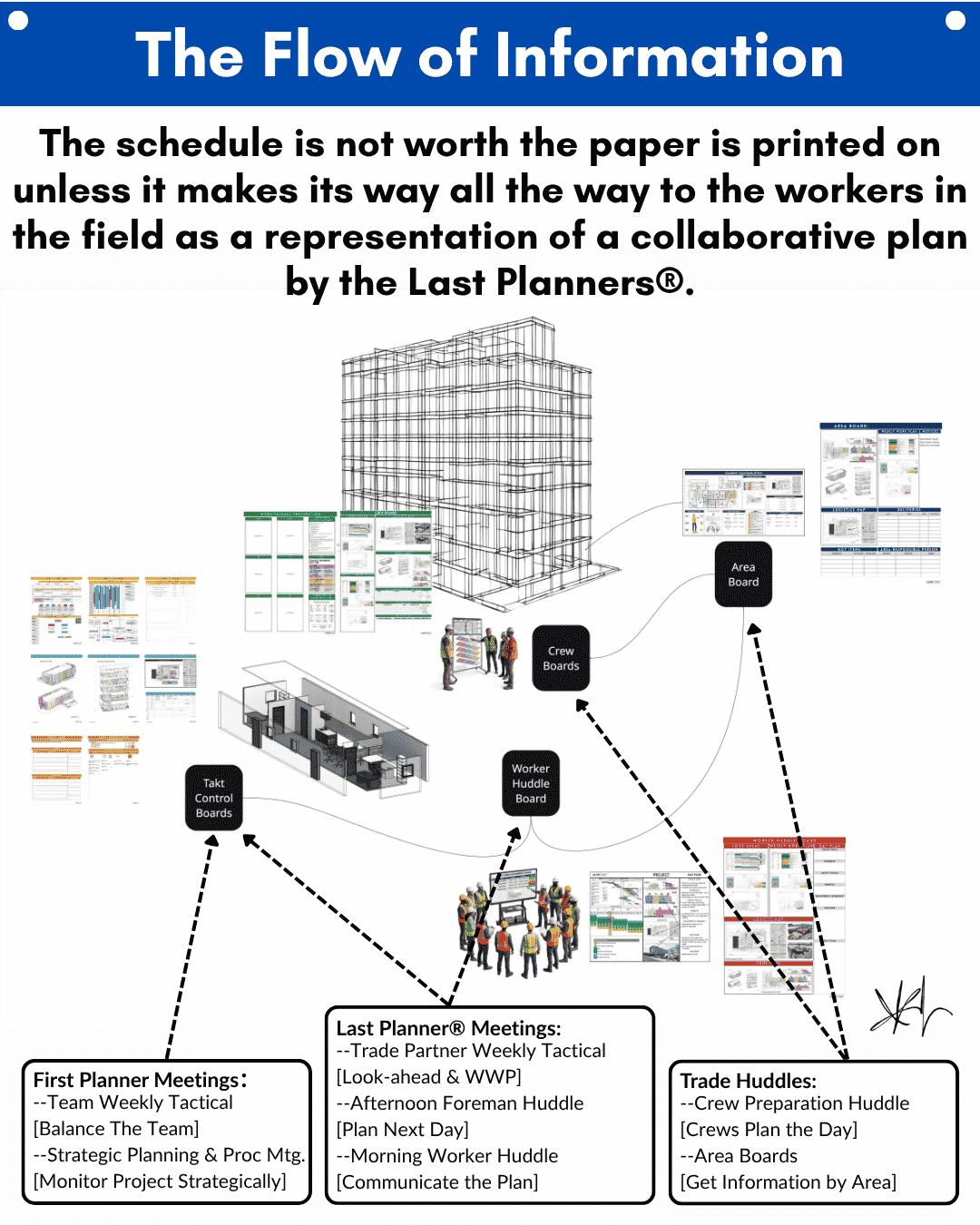
The image in this post shows the full information chain from the Takt control boards in the office to the crew board and area board at the zone level. Each meeting in the chain exists to make the next one possible. When all five links are in place, the plan reaches the worker. When one is missing, everything below it operates on assumptions instead of commitments.
The first link is the First Planner Meetings the team weekly tactical and the strategic planning and procurement meeting. This is where the long view is managed. Milestones, procurement lead times, manpower projections, phase transitions, constraint identification. First planners are the people at the beginning of the planning cycle: project managers, superintendents, engineers. Their job is to monitor the overall system, balance the team, and ensure the project stays on the right road strategically. These meetings are not about next week’s work. They are about the conditions that will make or break next month’s plan.
The second link is the Trade Partner Weekly Tactical the Last Planner meeting where foremen make commitments. This is where the look-ahead plan becomes a weekly work plan and where “we plan to” becomes “we will.” Last planners are the last people in the planning cycle the foremen and lead supervisors who are closest to the work. Their input is not just welcome in this meeting; it is the point of the meeting. A weekly work plan built without the buy-in of the foreman executing it is a schedule, not a commitment. And commitments, not schedules, are what move projects.
Watch for these signals that the information chain is broken on your project:
- Foremen create their own daily plan independently of the weekly work plan
- Workers cannot describe the coordination handoff happening in their zone this week
- The look-ahead and weekly work plan are built by the project team without foreman input
- The afternoon foreman huddle doesn’t exist, so tomorrow gets built on the fly
- Area boards and crew boards are outdated or don’t reflect the current week’s plan
The Afternoon Foreman Huddle: Where Tomorrow Gets Built Today
The third link is the afternoon foreman huddle one of the most powerful and most skipped meetings in the entire system. Jason Schroeder recommends that the foreman crew preparation huddle happen the afternoon before, specifically so that constraints surface while there’s still time to fix them. This is not a status update meeting. It’s a readiness check. Is the zone ready? Are materials staged? Are permits in hand? Are the pre-task plans ready? Is there anything that would stop the crew from starting productive work at 7:00 AM?
When the afternoon foreman huddle runs well, the morning starts clean. When it doesn’t happen, foremen walk into the morning worker huddle with gaps in their day plan that they’re still resolving while the crew is waiting to start. The afternoon is cheap for problem-solving. The morning is expensive. One conversation at 4 PM is worth an hour of crew downtime at 7 AM. Build the afternoon huddle. Protect it. It’s not optional.
The Worker Huddle and Crew Prep: The Last Hundred Feet
The fourth link is the morning worker huddle where the plan finally lands with the people doing the work. Every worker hears the safety focus, the delivery windows, the zone transitions, and the training topic for the day. The plan is no longer abstract. It’s specific. It’s visual. It’s in front of the people who will execute it within the hour. This is where the weekly work plan that was built collaboratively on Wednesday becomes real on Monday morning.
The fifth and final link is the crew preparation huddle what Jason Schroeder calls “the last hundred feet.” After the morning worker huddle, each crew disperses to their zone and gathers around the crew board. The foreman delivers a task briefing. The quality checklist comes out. The pre-task plan gets reviewed. Materials and tools are shaken out. The work package is opened. And the crew begins the day not with questions but with complete clarity about what they are building, to what standard, and how it connects to the handoff that follows.
This is where the schedule on the trailer wall becomes the plan in the worker’s hands. Not through a poster. Not through a reminder. Through a deliberate chain of five meetings that each carry the information one step closer to the person who needs it most.
Why the First Planner System Is Not Optional
Jason Schroeder teaches clearly: you can’t have a Last Planner System without a First Planner System. The Last Planner makes commitments based on milestones. If those milestones are built on CPM logic that doesn’t reflect real zone-based trade flow, the commitments are made against a false target. The look-ahead plans draw from a production plan that was never designed to be filtered into short-interval schedules. The weekly work plan gets recreated from scratch every week because there’s no Takt plan below the master schedule to filter from.
The Integrated Production Control System First Planner, Takt Production System, and Last Planner working together is what makes the flow possible. The First Planner designs the system. Takt creates the rhythm. Last Planner runs the commitments. When all three are connected, the information chain is coherent from the strategic planning meeting to the crew board. When they’re disconnected, the chain breaks somewhere in the middle and the field operates on whatever information it can piece together from fragments.
If your project needs superintendent coaching, project support, or leadership development, Elevate Construction can help your field teams stabilize, schedule, and flow. That stabilization starts with designing the information chain every link, from office to zone before the first trade mobilizes.
Build the Chain Before You Build the Building
Here is the challenge. Before your next project begins operations, map the five links of your information chain on paper. Who runs the team weekly tactical? What format does the weekly work plan take and how does it get to the foreman? Is the afternoon foreman huddle on the schedule? Who facilitates the morning worker huddle? What does the crew prep look like and where does it happen?
If you can’t answer any of those questions with a name, a format, and a time the chain has gaps. And wherever the chain has gaps, the information stops flowing and the field starts improvising. A schedule that isn’t delivered is just documentation. A plan that reaches the worker is the beginning of production.
Design the chain. Protect every link. And watch what happens when the plan finally reaches the person holding the tools.
As Jason Schroeder teaches: “The schedule is not worth the paper it’s printed on unless it makes its way all the way to the workers in the field as a representation of a collaborative plan by the Last Planners.” Build the system that makes that happen.
On we go.
Frequently Asked Questions
What is the difference between a First Planner and a Last Planner?
First planners are the first people in the planning cycle project managers and superintendents who set milestones and design the production system. Last planners are the last people foremen who make field-level commitments from those milestones.
Why can’t the Last Planner System work without the First Planner System?
Last planners make commitments against milestones. If those milestones are built on inaccurate CPM logic rather than real zone-based Takt flow, the commitments are made against a false target and the whole short-interval system produces unreliable plans.
What is the purpose of the afternoon foreman huddle?
It’s where tomorrow gets built while there’s still time to fix constraints. A problem found at 4 PM costs a conversation. The same problem found at 7 AM costs an hour of crew downtime.
How does the weekly work plan reach the crew?
Through the information chain: it’s filtered from the look-ahead in the trade partner weekly tactical, refined in the afternoon foreman huddle, communicated in the morning worker huddle, and broken down task by task in the crew preparation huddle.
What does “percent plan complete” measure and why does it matter?
PPC measures how many promised activities in the weekly work plan were actually completed as committed. It reveals the reliability of the system’s commitments and tracking the root causes of misses is how the team improves the plan over time.
If you want to learn more we have:
-Takt Virtual Training: (Click here)
-Check out our Youtube channel for more info: (Click here)
-Listen to the Elevate Construction podcast: (Click here)
-Check out our training programs and certifications: (Click here)
-The Takt Book: (Click here)
Discover Jason’s Expertise:
Meet Jason Schroeder, the driving force behind Elevate Construction IST. As the company’s owner and principal consultant, he’s dedicated to taking construction to new heights. With a wealth of industry experience, he’s crafted the Field Engineer Boot Camp and Superintendent Boot Camp – intensive training programs engineered to cultivate top-tier leaders capable of steering their teams towards success. Jason’s vision? To expand his training initiatives across the nation, empowering construction firms to soar to unprecedented levels of excellence.