
The 10 C’s for Superintendents: The Final Five That Define the Standard
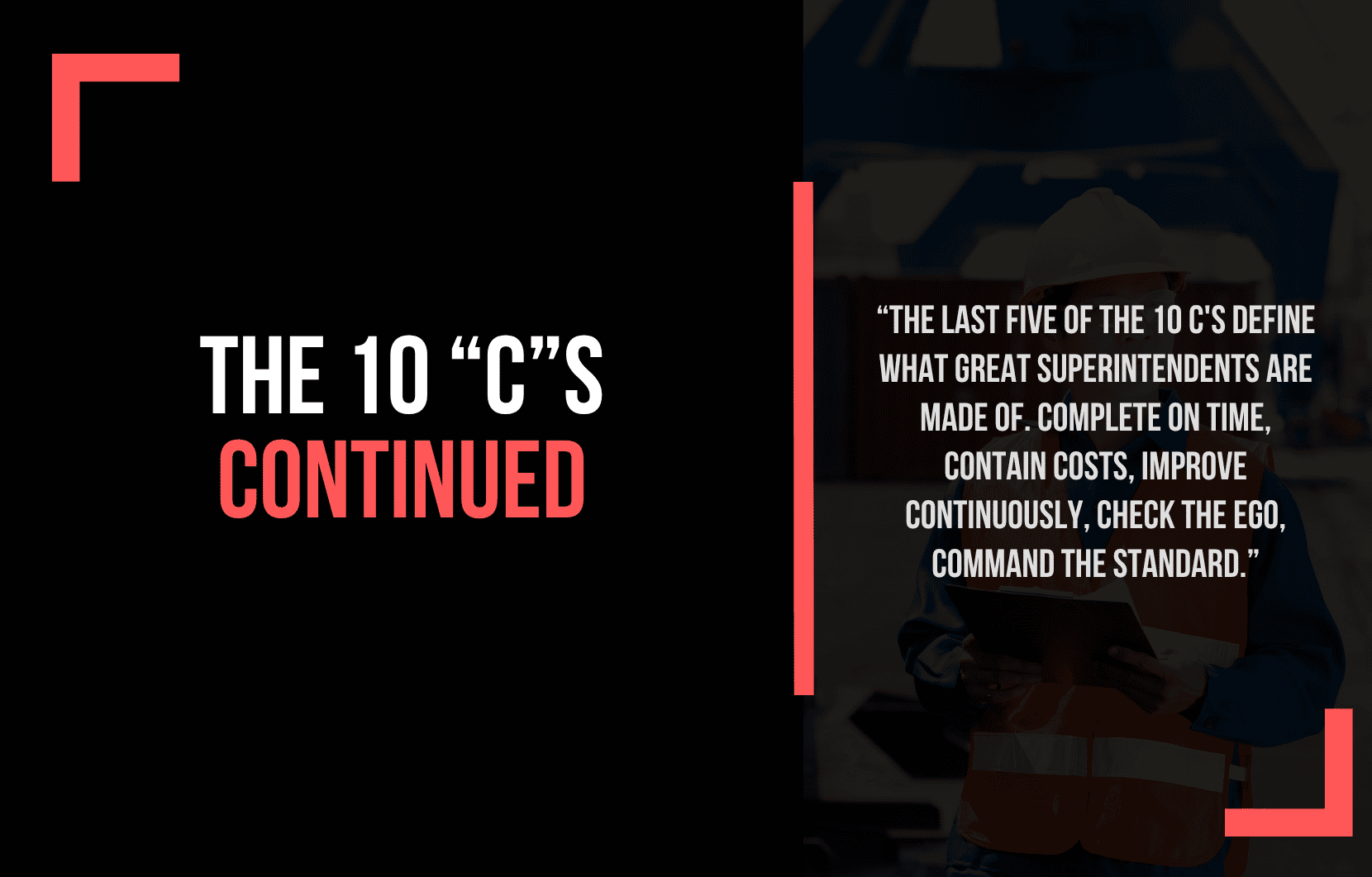
The first five of the 10 C’s create the plan, communicate the plan, clear the path, control the environment, and collaborate with the team are the daily practice. They are the standard work that a great superintendent runs every single day, the rhythm that holds the project together when everything else is trying to pull it apart. The last five are different in character. They are not daily tasks. They are the overarching goals, the mindset, and the code of the role itself. They are the answers to the question every superintendent should ask at the end of every project: did I actually do the job?
This conversation between Jason Schroeder and Joe Daugherty a seasoned superintendent with decades of field experience covers C6 through C10. What comes out of it is a framework that every superintendent can carry as a professional code, something to reflect on, return to, and measure the work against.
C6: Complete on Time
Everything else a superintendent does the planning, the coordination, the safety, the culture ultimately gets measured against one question. Did you finish? Not approximately. Not close. Did the project complete on time, and did it do so without burdening the trades to get there?
Joe puts it directly: the superintendent has to act with purpose. Not haste, not panic, but purposeful forward movement driven by a clear understanding of where the project stands today against where it needs to be next week and next month. A superintendent who only knows what is happening right now is already behind. The role demands looking two steps ahead at minimum anticipating the next constraint, the next procurement gap, the next handoff risk and removing it before the crew hits the wall.
The principle from the Patton framework is instructive here. There is a direct relationship between the time troops are exposed to enemy fire and the casualties they take. The rapidity of advance responsible, planned, purposeful advance is what reduces the window of exposure. In construction, the longer the project window stays open, the more opportunities surface for things to go wrong. A superintendent who drives responsibly forward, narrowing that window without creating chaos, is protecting the project and every person on it. That is not haste. That is leadership. And it is not achieved by starting more work. It is achieved by finishing what is in front of the crew before opening the next front.
C7: Contain Costs
Cost containment is not the same as penny-pinching. That distinction matters more than most people running budgets understand. Joe draws the line clearly: the things that look like costs proper sanitation, the right tools, materials in the right quantity to avoid a second run to the supplier are not the things that kill a budget. The things that kill a budget are waste. And waste, in the production sense, is everything the crew does that does not add value to the finished work.
Sending a worker to the store for hardware and buying exactly the right quantity is not savings. It is a productivity loss in waiting. Buying a few extra bolts and keeping them in the trailer is a cheap insurance policy against a costly stop and restart. The superintendent who understands this is making real cost decisions, not just managing line items. Real cost containment means eliminating the rework, the idle time, the trips back, the restarts, the inspection failures, and the coordination breakdowns that inflate the labor hours nobody ever budgets for because nobody wants to admit they’re going to happen.
This is also a shared responsibility. The superintendent and the PM own cost together, not separately. The superintendent’s instinct to solve problems quickly to go get the sink, drive to the supplier, resolve the blockage directly has to be balanced with the patience to let the PM do the due diligence that protects the project legally and financially. That tension, navigated well, is where good budget management actually lives.
C8: Continuously Improve
The most quietly dangerous sentence in construction is “I’ve got 30 years of experience.” Because 30 years of experience is only valuable if it means 30 years of constantly evolving, learning, reading, training, and improving. The alternative one year of experience repeated 30 times is not experience. It is habit that has never been examined. And the industry has plenty of both.
The great superintendents are always asking how the next project can be better than the last one. Not by working harder. By working smarter by capturing lessons, by investing in new tools and new systems, by being willing to look at a process they have run for decades and ask whether there is a better way. Joe’s example of building QR codes in Smartsheet for inspection calls is not a technology story. It is a continuous improvement story. It is a superintendent who looked at a friction point in the daily workflow and eliminated it by learning something new. That mindset, applied consistently, is what separates a superintendent with 30 years of compounding improvement from one with one year repeated 30 times.
The comparison to professional athletes is worth sitting with. Elite athletes train, compete, rest, and train again. Training is not the exception to the schedule it is the structure of the career. Construction managers have largely inverted that model: they work, then maybe fit in a small slice of training, then work again. Reversing that ratio is what the industry needs, and it starts with individual superintendents who take their own development as seriously as they take their daily production plan.
C9: Check Your Ego
Ego in the superintendent seat runs in two directions, and both are equally capable of destroying a project. The first direction is obvious: the super who believes the site exists to validate their authority, who leads by dominance, who mistakes control for leadership. That pattern is easy to identify and easy to critique. The second direction is subtler and probably more common: the superintendent who wants to be liked more than they want to hold the standard. Who softens the consequence because confrontation is uncomfortable. Who lets a safety violation slide because they don’t want to be the person who made the crew feel bad.
Both versions are ego at work. The need for significance and the need for approval are two sides of the same coin, and both of them, when they run the show, cost the project and the people in it. The ego that craves power loosens the grip on quality and safety to protect the relationship with authority. The ego that craves approval loosens the grip on standards to protect the relationship with the crew. Neither version is serving the job.
What Joe and Jason are pointing toward is not the elimination of ego that is not possible and probably not desirable. Ego is partly what drives a superintendent to care whether the project finishes on time, to feel the satisfaction of a clean site, to want to be the person the team can count on. The goal is not to erase it. The goal is to check it to notice when it is driving decisions, to examine what it is tied to, and to make sure it is not in control of choices that belong to the role rather than the person.
The superintendent who checks their ego accepts responsibility when things go wrong and shares credit when things go right. That combination is rarer than it should be, and it is the foundation of the trust that makes a great project team possible.
Warning Signs That the 10 C’s Are Breaking Down
Before the gap between intention and execution compounds into a project problem, look for these signals on your own site:
- The schedule is being driven reactively responding to delays instead of anticipating and preventing them which means C6 is failing upstream.
- Cost conversations are defaulting to penny-pinching on visible items while waste accumulates invisibly in rework, idle time, and second trips which means C7 is being misapplied.
- The team is running the same playbook they ran on the last three projects without ever examining whether it produced the best outcome which means C8 is absent.
- Standards are being held inconsistently, with consequences varying based on who the person is or how much the superintendent wants to avoid conflict which means C9 is controlling decisions it should not own.
- The site, the trailer, the superintendent’s appearance, and the quality of the work product all reflect a diminished standard that nobody formally lowered which means C10 has eroded quietly.
Any one of those signals is correctable. Naming which C is failing is the first step in the correction.
C10: Command the Standard
The superintendent sets the tone for everything on the project. Not by announcement. By presence. The way the trailer looks. The cleanliness of the truck. The collared shirt. The organized desk. The way a safety stop gets handled directly, humanly, without compromise. Every one of those signals communicates the standard to every person on the site, and every person on the site adjusts their behavior to match what they believe the superintendent will actually enforce.
Joe’s story of the painter on the metal roof without fall protection is a masterclass in how to command the standard without destroying the relationship. He called the painter down by name. He didn’t yell. He acknowledged what the painter thought he had under control and then named the unpredictable risk the bird, the slip, the thing nobody plans for. He said clearly and directly that it was not acceptable. He didn’t have the answer to how the work would get done safely in that moment. But he held the line: we are not starting back up until we know this is right. That is commanding the standard. Not from authority. From care.
The dichotomy Joe names is real and it is hard: intense about the standard, deeply empathetic about the person. Those two things can coexist, but they require the superintendent to be clear about which is which. The standard applies to behavior on site. The empathy applies to the human being inside that behavior. You can hold both without confusing them, and the project and the people on it are better for it when you do.
How the 10 C’s Become a Living Code
The 10 C’s are most useful not as a list but as a language. When a superintendent walks a look-ahead with the team and says “we need to clear the path on this” or looks at a cost trend and says “that’s a C7 problem,” the C’s have moved from a framework they know to a lens they see through. That is when they start producing real results not when they are memorized, but when they are so internalized that they surface naturally in the daily decisions that build or break a project.
Joe’s team reviews them when things go sideways, identifies which C is being violated, and works the problem from there. That is how a framework becomes a standard. Use it when things are going well to reinforce why. Use it when things go wrong to diagnose where the breakdown actually started. Make it the language of the trade partner meeting, the foreman huddle, the end-of-phase reflection. If your project needs superintendent coaching, project support, or leadership development, Elevate Construction can help your field teams stabilize, schedule, and flow and build the daily practice that turns the 10 C’s from a poster on the wall into the code the team lives by.
We are building people who build things. The 10 C’s are how we build the superintendents who build everything else.
A Challenge for Builders
Look at your current project and score it against C6 through C10 honestly. Is the schedule being driven forward purposefully without burdening the trades? Is cost being managed by eliminating waste rather than cutting what actually protects people? Is the team continuously improving, or running last year’s playbook? Is the superintendent’s ego checked neither dominating nor softening the standard to be liked? And is the standard on the site, in the trailer, in the work product being commanded with both intensity and care? Name the weakest C. Go work it. That is the job.
As Taiichi Ohno said, “Where there is no standard, there can be no improvement.”
On we go.
Frequently Asked Questions
What is the difference between the first five and last five of the 10 C’s?
The first five create the plan, communicate, clear the path, control the environment, collaborate are daily standard work, the practice a superintendent runs every day. The last five complete on time, contain costs, continuously improve, check the ego, command the standard are the overarching goals and mindset of the role itself.
What does “check your ego” actually mean for a superintendent?
It means noticing when ego either the need for power or the need to be liked is driving decisions that belong to the role. It does not mean eliminating ego, which is neither possible nor desirable. It means making sure ego is tied to the right things, like finishing on time and taking care of people, rather than to dominance or approval.
How does a superintendent “command the standard” without damaging relationships?
By being intense about the behavior and empathetic about the person simultaneously. The standard applies to what happens on site safety, cleanliness, quality, organization. The empathy applies to the human being inside that situation. Joe’s painter story is the model: call it by name, be direct and clear, hold the line without compromise, and do it all with care rather than contempt.
If you want to learn more we have:
-Takt Virtual Training: (Click here)
-Check out our Youtube channel for more info: (Click here)
-Listen to the Elevate Construction podcast: (Click here)
-Check out our training programs and certifications: (Click here)
-The Takt Book: (Click here)
Discover Jason’s Expertise:
Meet Jason Schroeder, the driving force behind Elevate Construction IST. As the company’s owner and principal consultant, he’s dedicated to taking construction to new heights. With a wealth of industry experience, he’s crafted the Field Engineer Boot Camp and Superintendent Boot Camp – intensive training programs engineered to cultivate top-tier leaders capable of steering their teams towards success. Jason’s vision? To expand his training initiatives across the nation, empowering construction firms to soar to unprecedented levels of excellence.