
When Trades Don’t Know Where They Are, the Project Pays for It
Here’s the deal: one of the biggest sources of wasted time on an active construction project isn’t a schedule gap or a material shortage or a coordination failure. It’s a worker standing in a corridor asking someone which area they’re supposed to be in. It sounds minor. Multiply it by fifty workers across a large footprint, every morning, for six months, and the number becomes significant not just in the time spent asking, but in the decisions made without the answer. Trades set up in the wrong zone. Work sequences get disrupted. Two crews try to occupy the same area because nobody could see where one ended and the other began.
This is a visibility problem. And visibility problems have visual solutions.
What Happens Without a Zone Sign System
Most large construction projects have zones. The Takt plan references them. The weekly work plan uses zone codes. The area boards post them. But the translation from zone name in a meeting to zone location in the field especially for workers who didn’t attend the coordination meeting, for new trades mobilizing mid-project, or for a crew entering a building section they’ve never worked in before is rarely supported by anything physical on the site.
The worker who knows the Takt plan says they’re in Zone B. The foreman who laid out the work says they’re in Bay 3. The subcontractor’s foreman says the drawings call it the South Building Foundation. Nobody is wrong. They’re all using the same production system from different reference points, with no shared spatial anchor that makes all three references point to the same physical location. In the gap between those references, workers wander, foremen repeat themselves, and coordination meetings relitigate decisions that visual management would have made permanent.
Jason Schroeder teaches that all Lean systems are seeing systems. You cannot manage what you cannot measure. You cannot measure what you cannot see. The Zone Sign System is what makes zone management visible at the place where the work is happening.
What the Zone Sign System Is Built Around
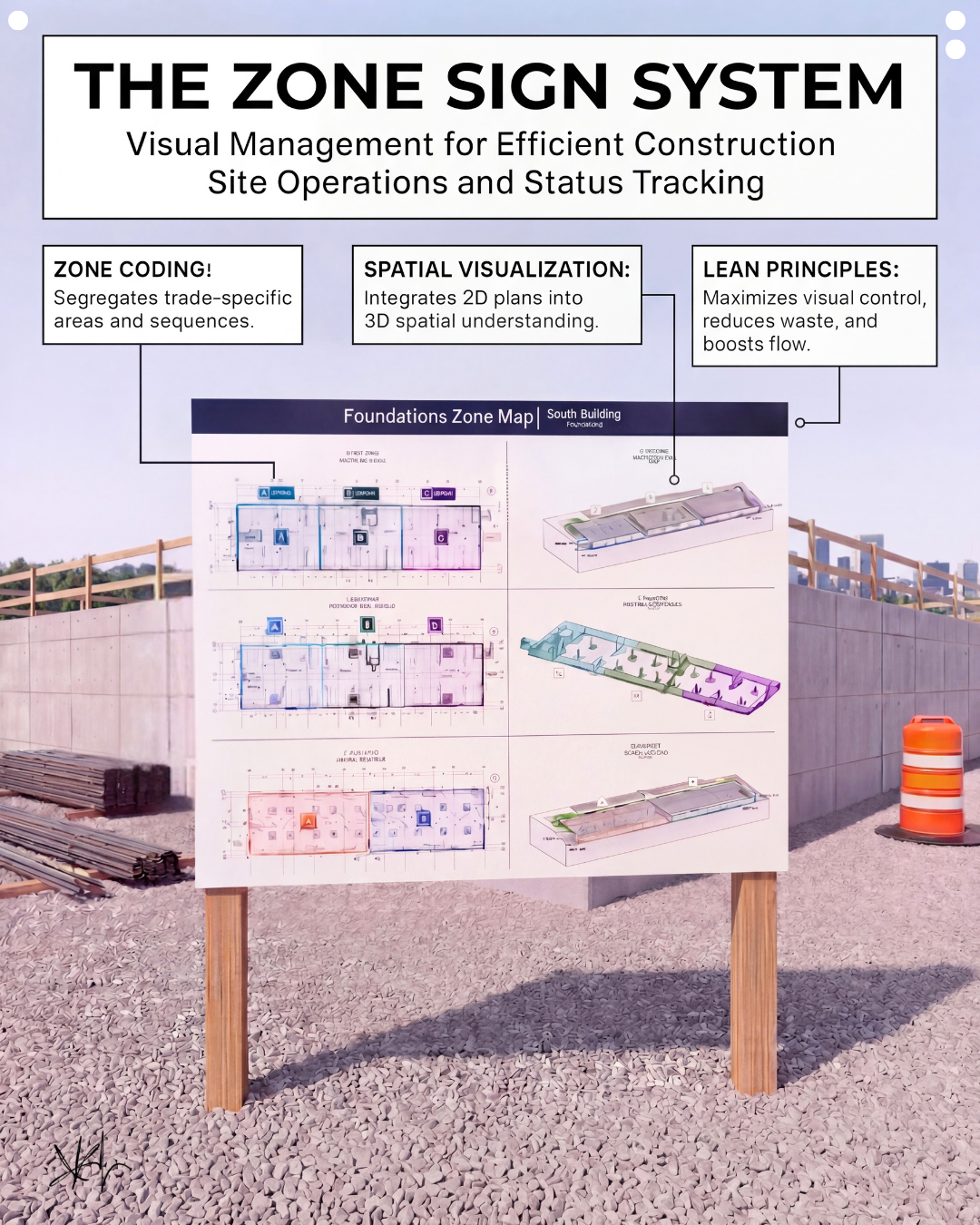
The image in this post shows the Zone Sign System applied to a foundations phase a large-format sign posted prominently at the site, displaying both a two-dimensional floor plan and a three-dimensional spatial view of every zone in the phase. This is not a laminated paper on an area board. It is a full site-sized visual reference that any worker walking onto that foundation can orient from immediately, without a conversation and without a trip to the trailer.
Zone coding is the foundation of the entire system. The site is divided into clearly defined zones, each tied to a specific trade sequence and phase of work. Every zone has a consistent name, color, and boundary that matches from the Takt plan to the logistics map to the sign at the site. Zone A on the sign is Zone A on the drawing, Zone A in the weekly work plan, and Zone A on the crew board. The color that identifies Zone A is the same color in every format. There is no translation required. What the plan says is what the sign shows.
Spatial visualization integrates two-dimensional plan views with three-dimensional spatial representations, so a worker who can read a floor plan and a worker who better understands three-dimensional spatial layouts can both orient correctly from the same sign. This is not a design preference it is an accessibility decision. Not every skilled tradesperson has equal confidence reading orthographic plans. A 3D representation of the zone layout communicates the same information to a broader range of workers, which means more people can self-orient without assistance.
Watch for these signals that spatial orientation is consuming productive time on your project:
- Trades setting up in the wrong zone and having to relocate before or after starting work
- Workers asking foremen for zone location clarification multiple times per day
- Different trades referencing the same zone by different names because there was never a unified sign system
- New or mid-project trade mobilizations causing confusion about where to work for the first one to two days
- Zone boundaries that exist in the Takt plan but are not physically represented anywhere on the site
The Lean Principle Behind the Sign
Jason Schroeder’s teaching on Lean visualization is precise: utilizing visual systems for total participation is one of the six pillars of Lean in construction. Visual management means creating a work environment that is self-ordering, self-explaining, self-regulating, and self-improving because of visual devices. When the zone sign is posted and maintained, workers can see as a group, know as a group, and act as a group. When it isn’t there, they can’t.
The Zone Sign System maximizes visual control, reduces waste, and boosts flow each of those outcomes is a direct result of workers spending less time orienting and more time installing. Reduced confusion at zone transitions means cleaner handoffs. Cleaner handoffs mean the Takt rhythm holds. A Takt rhythm that holds means the train of trades reaches the end of the phase on schedule instead of compressed. That compression is where overtime, quality failures, and safety incidents accumulate all traceable back to the small, daily frictions that visual management was designed to prevent.
The 3D spatial visualization on the sign does something else worth naming specifically: it makes the project legible to workers who are new to it. A trade crew joining in week six of a foundations pour has no institutional knowledge of how the zones were laid out. Without a visual reference, they spend their first few days oriented partly wrong executing scope while still building a mental map of the site that should have been handed to them on day one. The zone sign is that hand-off. It is the orientation tool that does not require a meeting.
Why Every Phase Needs Its Own Zone Sign
Zone signs are not a one-time investment at mobilization. They are phase-specific tools that must be updated as the project moves through its production plan. The sign that served the foundations phase shows a layout that becomes irrelevant when the project moves to structural steel and interior rough-in. A zone sign for the interior MEP phase shows a completely different zone map different sizes, different color coding, different trade sequence relationships.
Keeping zone signs current is part of the zone manager’s routine. When the phase transitions, the sign changes. When zone boundaries are revised in the Takt plan, the sign reflects the revision. The sign is the physical publication of the current production plan if it doesn’t match the plan, it creates the same problem as an outdated crew board or a stale area board: workers acting on old information with complete confidence that they’re right. Outdated visual management is not neutral. It actively produces wrong decisions.
If your project needs superintendent coaching, project support, or leadership development, Elevate Construction can help your field teams stabilize, schedule, and flow. The Zone Sign System is one of the simplest tools in the Lean toolkit and one of the highest-return investments a project team can make before a new phase begins.
Post the Sign Before the First Trade Arrives
Here is the challenge. Before your next phase mobilizes, build the zone sign for that phase. Use the Takt plan to define zone names, colors, and boundaries. Create a large-format sign that shows both a 2D floor plan and a 3D spatial view. Post it at the primary entry point to the phase work area before the first crew steps in. Update it at every zone boundary revision and every phase transition.
Then walk the floor on day three and ask a random worker to point to their zone on the sign. If they can do it in thirty seconds, the system is working. If they hesitate or can’t find it, you’ve identified a gap worth fixing.
Visual management only works when the visuals are there, current, and accessible to every person who needs them. Build the sign. Post it early. Maintain it through the phase.
As Jason Schroeder teaches: “All Lean systems are seeing systems. You can’t see anything in a dirty or disorganized environment. You can’t see constraints. You can’t see bottlenecks. You can’t see low morale. Make it visible and the rest becomes manageable.”
On we go.
Frequently Asked Questions
What is the Zone Sign System and who is it for?
It’s a large-format visual site sign that displays both a 2D floor plan and a 3D spatial view of all zones in the current phase, with consistent color coding. It’s for every worker on the project ensuring anyone can self-orient to their zone without needing to ask a foreman.
Why use both 2D floor plans and 3D spatial views on the same sign?
Different workers have different spatial literacy. 2D plans serve those comfortable reading drawings; 3D views serve those who orient better spatially. Combining both ensures the sign communicates accurately to the broadest possible range of workers on the crew.
How does zone color coding prevent confusion between trades?
When zone color is consistent across the Takt plan, logistics map, crew board, and physical sign, every reference point uses the same language. There’s no translation required Zone A in the meeting is the same orange area on the sign at the site.
When should zone signs be updated?
At every phase transition and at every significant zone boundary revision. An outdated sign is worse than no sign because it causes workers to make confident decisions based on wrong information.
How does the Zone Sign System connect to the Takt Production System?
Zone boundaries define where each trade works during each Takt window. When those boundaries are visually clear and spatially accurate on site, trades move in and out of zones on rhythm without spatial confusion protecting the handoff sequence that Takt depends on.
If you want to learn more we have:
-Takt Virtual Training: (Click here)
-Check out our Youtube channel for more info: (Click here)
-Listen to the Elevate Construction podcast: (Click here)
-Check out our training programs and certifications: (Click here)
-The Takt Book: (Click here)
Discover Jason’s Expertise:
Meet Jason Schroeder, the driving force behind Elevate Construction IST. As the company’s owner and principal consultant, he’s dedicated to taking construction to new heights. With a wealth of industry experience, he’s crafted the Field Engineer Boot Camp and Superintendent Boot Camp – intensive training programs engineered to cultivate top-tier leaders capable of steering their teams towards success. Jason’s vision? To expand his training initiatives across the nation, empowering construction firms to soar to unprecedented levels of excellence.