Why Logistics Kitting Is the Most Underused Productivity System in Construction
Walk onto most construction projects and within five minutes you’ll see it. Cardboard scattered across hallways. Materials piled near the stairwell that nobody ordered moved. A journeyman wandering two floors looking for a fitting that arrived three days ago but nobody knows where it went. The job is moving, but it’s grinding. And the crew doing the actual installing is burning time and energy on work that should have been solved before they ever picked up a tool.
That’s not a people problem. That’s a logistics problem. And it’s costing projects more than most teams realize.
What Most Projects Call Logistics
Here’s the honest picture on most job sites. A truck shows up. Someone calls the foreman. A couple of laborers get pulled off their work to help unload. The materials land in the nearest open space. The packaging stays on because no one has time to deal with it. The pallet gets broken down by whoever needs a piece first. And by the end of the day, what arrived as a complete delivery has been scattered across three floors, half of it still in cardboard, half of it missing from the count because nobody verified the delivery in the first place.
That pattern repeats every delivery day, on every project, until the site is a maze of material piles and packaging waste. Crews adapt by spending twenty minutes at the start of each task finding what they need. Leaders adapt by calling it normal. And the schedule absorbs the invisible hours as if they simply don’t exist.
They do exist. They show up as overtime, rework, and frustrated trades who feel like the project is working against them instead of for them. The system failed them. They didn’t fail the system.
A Different Way to See the Problem
Early in my career, I remember standing on a large federal project watching a crew stop installing mid-morning because the materials they needed for the next run were somewhere in the building but nobody could say exactly where. The foreman started walking. Twenty minutes later he came back with the wrong size. That’s a full-time tradesman fully loaded cost on the payrol burning half an hour on a logistics problem that a well-designed system could have solved the day before.
That moment crystallized something for me. The material delivery problem in construction is not a purchasing problem or a coordination problem in the traditional sense. It’s a system design problem. We have never intentionally designed how materials move from the truck to the hands of the worker. We just let it happen and then manage the chaos. That has to change.
What Advanced Logistics Queuing Actually Is
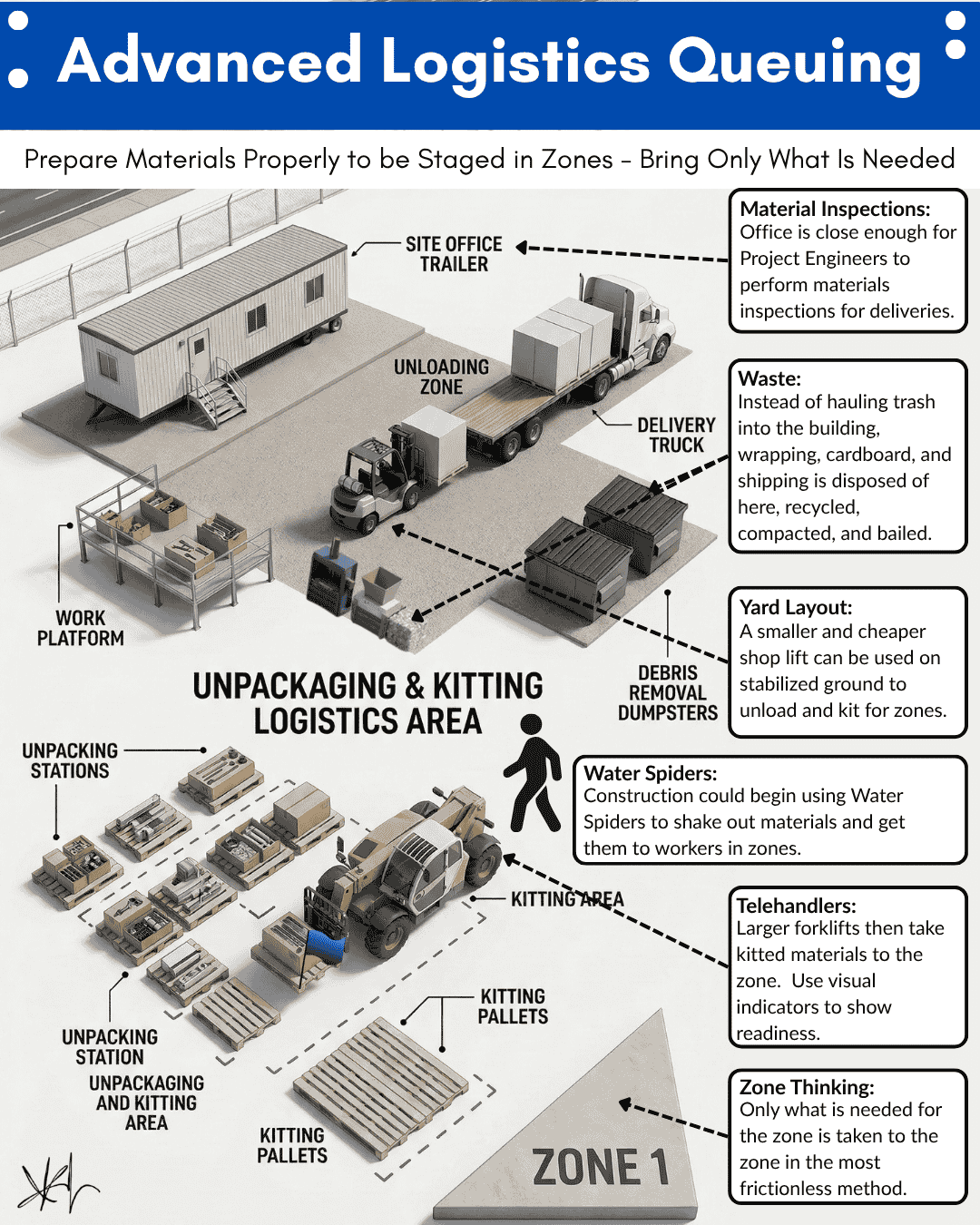
The concept is called advanced logistics queuing, and it treats the movement of materials from the delivery truck to the zone of install as a deliberate production system not an afterthought. The image at the top of this post maps it out clearly. Every element has a role and a location. Nothing is random.
It starts at the gate. Delivery trucks enter the project site and route directly past the project management trailer so that field engineers can perform materials inspections before anything moves. This is not a bureaucratic step. It’s a quality gate. Verifying materials at the point of entry checking counts, checking specs, identifying damage takes fifteen minutes and prevents three days of downstream problems. One project I worked on routed deliveries so they queued near the deck of the trailer, making it seamless for the office team to inspect before anything touched the yard. That one design decision eliminated weeks of RFI delays that used to come from wrong materials reaching the zone.
From there, materials move into the unpacking and kitting logistics area. This is where the real work happens outside the building. A yard forklift unloads the truck onto unpacking stations where the team removes all packaging, cardboard, and shipping materials. Debris removal dumpsters are staged in the yard for immediate disposal, compacting, and recycling. Nothing goes into the building wrapped in cardboard. Nothing carries packaging waste onto a finished floor. This is “nothing hits the floor” thinking applied to logistics the work area stays clean, and materials arrive in the condition they’ll be used, not the condition they were shipped in.
Here is where most projects stop and where great projects are just getting started.
Watch for these signals that logistics has not been designed on your project:
- Crews are breaking down pallets in hallways and stairwells
- Packaging and cardboard waste is accumulating inside the building
- Foremen are making unscheduled trips to staging areas mid-task
- Materials are staged by delivery date rather than by zone and crew need
- Workers are searching for materials that are somewhere on site but unlocated
Kitting: Putting the Right Materials in the Right Place Before Work Starts
After unpacking, materials are sorted and loaded onto kitting pallets. Each pallet is built for a specific zone. Zone 1 gets exactly what Zone 1 needs for the Takt window. Zone 2 gets exactly what Zone 2 needs. Nothing extra goes into the zone. Nothing gets sent early just because it arrived. The pallet is built the way a kit gets built completely, intentionally, in advance.
This is Point-of-Use Storage and Kitting in practice. Jason Schroeder teaches this as a core Lean principle: eliminate walking, searching, and re-handling by delivering complete work packages to the place of install. When kitting works, the crew doesn’t become the supply chain. The supply chain has already done its job before the crew touches a tool.
Once the kitting pallets are staged, telehandlers deliver them directly to the work area. Visual indicators on the pallets or the zone board communicate readiness, so trades know exactly what has arrived and where it sits before they walk to the zone. There is no guessing, no hunting, no forty-five-minute material chase to start the morning.
The Water Spider Role
The people who operate this logistics system are called Water Spiders. This is a formal role, not an informal assignment. Water Spiders are logistics specialists whose entire job is to feed crews what they need, just in time, at the place of work. They shake out materials, manage the kitting area, coordinate delivery sequencing, and keep the zones supplied so the trade workers can focus entirely on installing.
The principle behind the Water Spider is simple and powerful. Value-adding workers should be adding value. Installers should be installing. When an electrician, pipefitter, or carpenter spends a meaningful portion of the day doing logistics work moving materials, breaking down deliveries, searching for parts the system is robbing the project of its most expensive resource. The Water Spider absorbs that burden and returns it to where it belongs: a specialized logistics role that costs far less than the value it protects.
This is how Lean projects eliminate material chaos and create real installation flow. The procurement feeds production. The supply chain is zoned. Just-in-time means the crew has exactly what they need at the place of work when they need it. When logistics flows, production flows. When logistics breaks down, everything breaks down not because the trades failed, but because the system failed to feed them.
Why This Connects to Dignity and Flow
There is a human dimension to all of this that gets lost in the logistics conversation. When a skilled tradesperson spends hours every day searching for materials, waiting for deliveries, or working around packaging waste, that is not just inefficiency. It is disrespect. It says the system doesn’t value their time. It says their craft matters less than the chaos that surrounds them. It burns people out quietly, day by day, until they either check out or leave the trade entirely.
Protecting logistics is protecting people. When the system delivers exactly what the zone needs, when the zone needs it, crews can perform at the level they were trained for. They can take pride in the installation. They can finish the zone completely before moving to the next one. They can go home at a reasonable hour because the day wasn’t eaten by supply chain problems. If your project needs superintendent coaching, project support, or leadership development, Elevate Construction can help your field teams stabilize, schedule, and flow. That work starts with designing the system right from the gate to the zone.
Build the System That Feeds Your Crews
Here is the challenge I want to leave you with. Look at your next project during preconstruction and ask one question: have we designed how materials will move from the delivery truck to the hands of the installer? Not “where is the laydown yard?” That’s a location decision. The design question is: how does a material get inspected, unpacked, kitted by zone, and delivered to the place of work without a tradesperson ever having to leave the zone to find it?
If you can answer that question clearly before the project mobilizes, your crews will feel the difference on day one. LeanTakt and Elevate Construction have seen what happens when logistics is treated as a production system rather than an afterthought. The zones stay clean. The crews stay in flow. The schedule holds. Taiichi Ohno, the father of the Toyota Production System, said it best: “All we are doing is looking at the timeline from the moment the customer gives us an order to the point when we collect the cash. And we are reducing that timeline by removing the non-value-added wastes.” In construction, logistics waste is one of the biggest wastes we have. And it’s one of the most fixable.
On we go.
Frequently Asked Questions
What is advanced logistics queuing in construction?
Advanced logistics queuing is a deliberate system for moving materials from the delivery truck through inspection, unpacking, kitting, and zone delivery without bringing packaging waste or unorganized material into the building. It treats material flow as a designed production process, not a random site activity.
What is kitting and why does it matter?
Kitting is the process of sorting and staging materials onto zone-specific pallets before they enter the building. Each zone receives exactly what it needs for its Takt window. Kitting eliminates searching, re-handling, and crew downtime caused by missing or misplaced materials at the point of install.
What is a Water Spider in Lean construction?
A Water Spider is a dedicated logistics support role whose job is to supply crews with what they need, just in time, at the place of work. The role exists so that value-adding trade workers stay installing rather than doing logistics tasks. It’s a structural advantage that protects production pace and crew focus.
How does logistics kitting support the Takt Production System?
Takt requires trades to move through zones on a steady rhythm. If materials aren’t ready in the zone when the trade arrives, the rhythm breaks. Kitting by zone ensures the supply chain matches the Takt plan, so each zone is fed in the right quantity at the right time and the train of trades stays moving.
Where do material inspections happen in this system?
Inspections happen at the delivery entry point, before materials reach the unpacking area. Routing trucks past the project management trailer gives field engineers the opportunity to verify counts, check specifications, and identify damage before anything moves deeper into the site preventing downstream quality and schedule problems.
If you want to learn more we have:
-Takt Virtual Training: (Click here)
-Check out our Youtube channel for more info: (Click here)
-Listen to the Elevate Construction podcast: (Click here)
-Check out our training programs and certifications: (Click here)
-The Takt Book: (Click here)
Discover Jason’s Expertise:
Meet Jason Schroeder, the driving force behind Elevate Construction IST. As the company’s owner and principal consultant, he’s dedicated to taking construction to new heights. With a wealth of industry experience, he’s crafted the Field Engineer Boot Camp and Superintendent Boot Camp – intensive training programs engineered to cultivate top-tier leaders capable of steering their teams towards success. Jason’s vision? To expand his training initiatives across the nation, empowering construction firms to soar to unprecedented levels of excellence.
On we go