
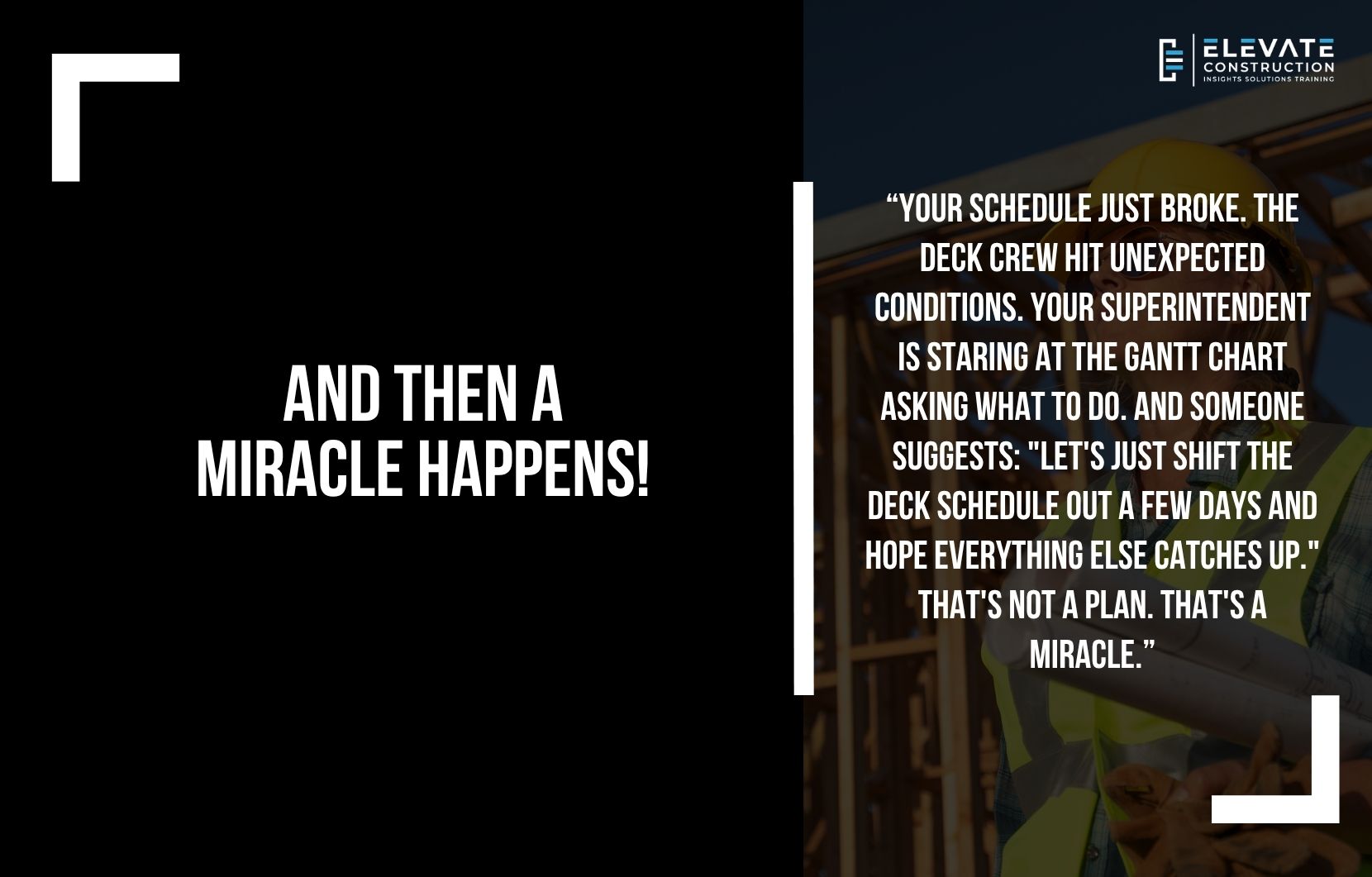
The Miracle Problem: Why “And Then a Miracle Happens” Is Not a Recovery Strategy
Your project hit variation. The deck pour ran into problems. The vertical concrete is behind. Materials didn’t show. Weather shut you down for three days. Now you’re staring at a schedule that doesn’t work anymore and everyone’s asking what the plan is. So you do what most superintendents do. You dissolve some logic in Primavera. You shift a few activities. You tell yourself it’ll work out. You’re banking on a miracle.
Here’s the cartoon that Keith Cunningham loved so much he bought it. Two people standing at a chalkboard. Math on the left side. An equal sign. More math on the right side showing the desired result. And in the middle, written on the board: “And then a miracle happens.” The professor reviewing the work says, “I think we need some more detail around step two.” That’s most construction schedule recovery. We do some things. Then we hope for the best. Then we expect success. We’re missing step two—the actual plan that follows production laws.
The projects that recover from variation aren’t led by superintendents who hope harder. They’re led by people who recognize the impact immediately, analyze it honestly, make a plan that follows production laws, and execute that plan without wishful thinking. Who understand that throwing manpower and materials at problems increases project duration instead of decreasing it. Who know that dissolving logic to make the schedule look better is the same as writing “and then a miracle happens” on your recovery plan. Who’ve learned that anything increasing variation will increase your project duration—and most “solutions” increase variation.
The Problem Every Superintendent Creates
Walk onto any troubled project and you’ll find the same pattern. Something went wrong. The schedule broke. And instead of following production laws to recover, leadership is hoping for miracles. They’re throwing more manpower at the problem thinking speed will increase. They’re shifting isolated pieces of the schedule thinking localized adjustments won’t ripple. They’re dissolving logic in the scheduling software thinking fake plans will somehow produce real results. They’re doing the construction equivalent of writing math on the left, “and then a miracle happens” in the middle, and the completion date they want on the right.
Most superintendents don’t recognize they’re hoping for miracles. They think they’re making practical decisions. Realistic adjustments to handle variation. Strategic responses to field conditions. They frame wishful thinking as planning instead of recognizing it as the avoidance of actual analysis. They don’t see that their “recovery strategy” violates every production law that governs how work actually flows.
The pattern shows up everywhere in construction. The concrete schedule hits variation on decks, so leadership shifts just the deck schedule out while leaving walls and columns where they were, never analyzing whether that creates more problems than it solves. The project falls behind, so they throw more crews at it, never recognizing that Brooks’s Law says adding manpower late in a project increases duration instead of decreasing it. The superintendent sees the critical path extended, so they dissolve some logic to make it look better, never acknowledging they just replaced a realistic plan with a fantasy. The team hopes harder instead of planning better.
Think about what this creates. Your concrete crew is running a rhythm. Columns on day one. Walls on day two. Decks on days three, four, and five. Hook time from the tower crane is scheduled. Procurement is sequenced. Handoffs are consistent. Then the deck schedule hits variation. Someone suggests shifting just the decks out a few days. Sounds reasonable. Isolated problem, isolated solution. Except now you’ve broken the rhythm. Different crane schedules. Different procurement times. Different manpower cycles. Different handoffs. You’ve increased variation trying to fix variation. And increased variation increases project duration.
Meanwhile, you’re congratulating yourself for “fixing” the schedule. You adjusted for the problem. You accommodated the reality. You updated the plan. Except you didn’t. You dissolved logic. You created inconsistent handoffs. You violated production laws. You wrote “and then a miracle happens” in the middle of your recovery strategy and called it planning.
The Failure Pattern Nobody Recognizes
This isn’t about never adjusting schedules or ignoring field realities. This is about recognizing that most “solutions” to variation actually increase variation instead of decreasing it. That throwing manpower and materials at problems extends duration instead of shortening it. That hope is not a strategy and dissolving logic is not planning.
Construction culture sometimes treats urgency as a substitute for analysis. The superintendent who makes fast decisions without checking production laws. The scheduler who dissolves logic to hit the date leadership wants to see. The project team that throws more resources at problems without analyzing whether that helps or hurts. These patterns can look like action, like pragmatism, like getting things done. And they’re dangerous because they replace systematic thinking with wishful thinking, production laws with hope, and actual plans with miracles.
So superintendents shift isolated pieces of schedules thinking it won’t create ripples. They add crews thinking more people equals more speed. They work overtime thinking hours equal productivity. They never recognize that these “solutions” violate production laws that govern how work actually flows. They don’t see that their recovery strategies are built on miracles, not math.
The story always goes the same way. Project hits variation. Leadership makes quick decision without analyzing production laws. Schedule gets “fixed” by dissolving logic or shifting isolated activities. Everyone feels better because the schedule looks better. Except the schedule isn’t realistic anymore. It’s fantasy. The fake plan fails. More variation occurs. More miracle-based solutions get applied. The dysfunction compounds. The project fails. And leadership never connects the failure to their refusal to follow production laws.
Nobody teaches superintendents that Kingman’s formula, Little’s Law, the law of bottlenecks, the law of variation, and Brooks’s Law actually govern how projects flow. That you can’t violate these laws and expect success any more than you can violate gravity and expect to fly. That when variation occurs, the right response is systematic analysis followed by a plan that respects production laws, not quick fixes that hope for miracles.
A Story From the Field About Following Production Laws
Felipe Engineer and Jason were at the St. Louis community of practice doing a four-and-a-half-hour introduction to the Last Planner System. Somebody asked: “When you’re talking about Takt planning and Last Planner, what happens when variation occurs?” Felipe nailed it. When variation occurs, when something happens, you immediately show the reality of what happens. Then you plan. You make a plan that makes sense that follows production laws that will ensure you either can hit the end date or you know what the situation is so you can be realistic and go get help.
You always want to widen your circle. You always want to get help. But you always want to tell the truth. Do not lie. Do not withhold the truth. Do not avoid showing an impact in a schedule. Do not avoid putting the impact in there. You have to show it. You’re not legally allowed to not show the impact. Once the impact is shown, then you make a plan. You can’t just dissolve logic in Primavera or Asta or Microsoft Project. You can’t fake a plan. That’s the same as saying one plus two plus and then a miracle happens equals the result you want. Wishful thinking never gets anybody anywhere.
Here’s a concrete example. Weston Woolsie at Okland taught Jason about smaller batch sizes and smaller crew sizes for concrete. Everything in a concrete plan should be Takt’d out. Everything. One hundred percent. Columns, walls, decks—all on consistent rhythms with consistent handoffs. Now somebody asks: what do you do when variation happens? What if variation just happens with the deck or just with the walls?
The instinct is to shift just that piece. Deck schedule hits problems, shift the deck schedule. Leave everything else alone. Sounds reasonable. But let’s test it against production laws. Does shifting just the deck schedule help with Kingman’s formula? Kingman’s formula says cycle time multiplied by capacity utilization multiplied by effective variation tells you overall process time. To improve that, you need consistent cycle times in a rhythm, reduced variation, and operation at one hundred percent capacity. Shifting just the deck schedule breaks the rhythm, increases variation, and disrupts capacity. So no, it doesn’t help with Kingman’s formula.
Does it help with the law of bottlenecks? If your decks had variation and you’re considering moving just the deck schedule out while leaving walls and columns isolated, does that help you see and optimize bottlenecks? No. You’ve increased variation, which violates another law and brings in so much inconsistent data that you cannot isolate and optimize bottlenecks.
Does it help with the law of variation? If you changed the sequence and interrelatedness between walls, columns, and decks and didn’t move them together, does that increase or decrease variation? It increases variation. Now you have different handoffs. Different crane schedules. Different procurement times. Different manpower cycles. Different everything. If you ever see concrete crews where they’re moving people from decks to walls to columns, shuffling everyone everywhere, you’re losing massive time because of context switching. You’re never going to make production.
Does it help with Little’s Law? Little’s Law says rightsize batch sizes, finish as you go, limit work in process. From that standpoint, you probably need to finish everything together as you go. Shifting just one piece doesn’t align with Little’s Law.
Does it help with Brooks’s Law? Brooks’s Law says when you put more manpower on a task, especially in later parts of that task or project duration, it increases throughput time and project duration. If you have a problem with decks and don’t move columns and walls with it, you’re likely going to shift manpower from one area to another and increase crew counts, which actually slows down your production rhythm. The adjustment doesn’t fit with Brooks’s Law either.
The lesson from the Germans Yanosh and Marco: sometimes in Takt’d systems, if you have variation in the system, it might be better to move everything together in that variation and keep it consistently together. Keep the workflow rhythm, the trade flow rhythm, and the logistical rhythm together instead of creating little ripples of variation which also create inconsistency in handoffs. When you have a problem on your schedule, when variation shows up, don’t freak out and make random decisions. Don’t wish for a miracle. Sit back and analyze the schedule and the impact, be realistic with it, and shift everything in a commonsensical manner according to production laws.
Why This Matters More Than Looking Busy
When you respond to variation by hoping for miracles instead of following production laws, you’re not recovering your project. You’re extending its duration. Every decision that increases variation increases project duration. Every violation of production laws costs time. Every fake plan built on dissolved logic creates more problems than it solves.
Think about the five production laws that govern how projects actually flow. Little’s Law says limit work in process, rightsize batch sizes, adjust procurement to meet dates on a rhythm, do quality work as you go, and finish as you go. The law of bottlenecks says identify and optimize constraints systematically. The law of variation says reduce variation to improve flow. Kingman’s formula says improve cycle times on a rhythm with consistent capacity and reduced variation. Brooks’s Law says adding manpower and materials late in a project increases duration instead of decreasing it.
These aren’t suggestions. They’re not guidelines. They’re laws. You can’t violate them and expect success. When your project hits variation and you respond by throwing more crews at it, you’re violating Brooks’s Law. When you shift isolated pieces of the schedule instead of moving everything together to maintain rhythm, you’re violating the law of variation and Kingman’s formula. When you dissolve logic to make dates look achievable, you’re abandoning Little’s Law and the law of bottlenecks. You’re replacing production laws with hope. Math with miracles.
The cartoon Keith Cunningham bought captures this perfectly. Math on the left. “And then a miracle happens” in the middle. Results on the right. The professor says, “I think we need some more detail around step two.” When you dissolve logic in your schedule, you’ve eliminated step two. When you throw manpower at problems without analyzing Brooks’s Law, you’ve replaced step two with hope. When you shift isolated activities without checking whether that increases variation, you’re banking on miracles instead of following production laws.
If your project needs superintendent coaching, project support, or leadership development to build teams that follow production laws instead of hoping for miracles, Elevate Construction can help your field teams stabilize, schedule, and flow.
Watch for These Signals You’re Hoping for Miracles
Your project is vulnerable to miracle-based planning when you see these patterns:
- Schedule “fixes” that dissolve logic or shift isolated activities without analyzing production laws, revealing that planning has been replaced with wishful thinking
- Responses to variation that throw more manpower and materials at problems without checking Brooks’s Law, showing that hope is being substituted for systematic analysis
- Recovery strategies that break rhythms and increase variation while claiming to fix problems, indicating that solutions are creating more dysfunction than they’re solving
The Framework: Following Production Laws When Variation Occurs
The goal isn’t avoiding all variation or pretending problems don’t exist. It’s responding to variation systematically instead of hopefully. Following production laws instead of banking on miracles. Making actual plans instead of fake ones.
Show the reality immediately when variation occurs. Do not lie. Do not withhold truth. Do not avoid showing impact in the schedule. You’re not legally allowed to hide it. You have to show what actually happened. Once the impact is shown, then you make a plan. Not a fake plan. Not dissolved logic. Not wishful thinking. An actual plan that follows production laws and respects how work actually flows.
Test every response against production laws before implementing it. Does this help or hurt Kingman’s formula? Does it increase or decrease variation? Does it improve or disrupt bottleneck optimization? Does it align with Little’s Law? Does it violate Brooks’s Law? If your “solution” violates production laws, it’s not a solution. It’s a miracle dressed up as planning. Find a different approach that actually works with how production flows.
Move schedules together to maintain rhythm instead of shifting isolated pieces. When concrete decks hit variation, don’t just shift the deck schedule. Shift columns, walls, and decks together. Keep the rhythm consistent. Maintain the handoffs. Preserve the crane schedule. Protect the procurement sequence. Keep crew cycles stable. It’s better to call that day a buffer day or lost day altogether and keep all relationships between phases consistent in rhythm than to create ripples of variation throughout the system by adjusting pieces in isolation.
Widen your circle and get help when needed. When variation occurs, you want to show the reality, make a plan that follows production laws, and determine whether you can hit the end date or whether you need help. If you need help, reach out. Bring in people who understand production laws. Get support from leadership. Expand your resources. But do it systematically, following Brooks’s Law, not randomly hoping more people equals more speed.
Don’t freak out when problems occur. Calm down. There are ways to get help. There are people who can help. And there are production laws that govern how to recover successfully. Follow them. When impact happens, you have to at least have one thing: a plan. Not hope. Not miracles. A plan. Patton said a good plan violently executed today is better than a perfect plan tomorrow. But Patton didn’t say no plan today violently executed. He said a good plan instead of a perfect plan. Everything you do has to have a plan that follows production laws.
The Practical Path Forward
Here’s how this works in practice. Your project hits variation. The deck schedule breaks. Someone suggests shifting just the decks out a few days. You need to decide whether that’s a plan or a miracle.
First question: does this follow production laws? Test it against Kingman’s formula, the law of bottlenecks, and the law of variation, Little’s Law, and Brooks’s Law. If it violates any of them, it’s not a plan. It’s wishful thinking. Find an approach that works with production laws instead of against them.
Second question: does this maintain rhythm or break it? If your concrete crew is running columns-walls-decks in consistent sequence with consistent handoffs and your “fix” disrupts that rhythm, you’re increasing variation. And anything that increases variation increases project duration. Shift everything together to maintain rhythm instead of breaking it with isolated adjustments.
Third question: are you showing reality or hiding it? If your recovery strategy involves dissolving logic to make dates look achievable, you’re lying. You’re not legally allowed to hide impact. Show what actually happened. Then make a plan based on reality instead of fantasy. The truth might be uncomfortable, but it’s the only foundation for actual recovery.
Make decisions based on production laws instead of hope. When someone suggests throwing more crews at the problem, check Brooks’s Law. When someone wants to shift isolated pieces of the schedule, check the law of variation. When someone proposes a solution, test it systematically before implementing it. If it doesn’t follow production laws, it won’t work. Find something that does.
Execute the plan without wishful thinking. Once you’ve made a plan that follows production laws, execute it. Don’t hedge. Don’t hope for miracles to fix the parts that are hard. Don’t assume things will work out. Follow the plan systematically. Adjust based on production laws when new variation occurs. Keep analyzing. Keep planning. Keep executing based on math instead of miracles.
Why This Protects Projects and People
We’re not just building projects. We’re protecting jobs, families, and futures from the dysfunction that miracle-based planning creates. And whether we follow production laws or hope for miracles when variation occurs determines whether we recover successfully or compound failure.
When you respond to variation with miracle-based planning, you’re not protecting the project. You’re threatening it. Fake plans fail. Dissolved logic doesn’t produce real results. Hope without production laws extends duration instead of shortening it. The project that looked “fixed” on the schedule is actually worse because now you’re operating from fantasy instead of reality.
When you follow production laws, you’re protecting everyone. The schedule reflects reality. The plan actually works. Recovery is possible because it’s based on how work actually flows instead of how you wish it would flow. Jobs become more secure because projects succeed when planning follows production laws instead of banking on miracles.
This protects families by creating realistic schedules that people can execute. When your recovery strategy is “work harder and hope for miracles,” people burn out trying to accomplish impossible things. When you follow production laws and make realistic plans, work becomes sustainable. People can execute successfully. They can go home at reasonable hours because they’re following plans that actually work instead of chasing miracles that never arrive.
Respect for people means making plans they can actually execute instead of asking them to produce miracles. It means following production laws so rhythm stays consistent and handoffs stay predictable. It means showing reality so people know what they’re actually dealing with instead of hiding behind fake schedules. It means building cultures where planning is systematic instead of hopeful, where recovery follows laws instead of wishes.
The Challenge in Front of You
You can keep hoping for miracles. You can keep dissolving logic when schedules break. You can keep throwing manpower and materials at problems without analyzing Brooks’s Law. You can keep shifting isolated pieces without checking whether that increases variation. You can keep writing “and then a miracle happens” in the middle of your recovery strategies.
Or you can follow production laws. You can show reality immediately when variation occurs. You can test every response against Kingman’s formula, the law of bottlenecks, and the law of variation, Little’s Law, and Brooks’s Law. You can move schedules together to maintain rhythm instead of breaking it. You can make actual plans instead of fake ones. You can replace hope with systematic analysis.
The projects that recover from variation aren’t led by superintendents who hope harder. They’re led by people who follow production laws. Who recognize that anything increasing variation increases project duration. Who understand that throwing manpower and materials at problems extends duration instead of shortening it. Who know that dissolved logic is the same as writing “and then a miracle happens” on the schedule. Who’ve learned that production laws govern how work actually flows and can’t be violated with wishful thinking.
Your schedule just broke. Variation occurred. Someone’s suggesting a quick fix that sounds reasonable. Before you implement it, test it against production laws. Does it follow Kingman’s formula? Does it reduce variation or increase it? Does it maintain rhythm or break it? Does it violate Brooks’s Law? Does it align with Little’s Law?
If it doesn’t follow production laws, it’s not a plan. It’s a miracle. And as Miyamoto Musashi said: investigate this thoroughly. Make sure you’re making decisions according to production law and actual math and actual science. Stop throwing manpower, materials, and information at problems and hoping they go away.
Anything that increases variation will increase your project duration.
On we go.
Frequently Asked Questions
How do I know if my recovery strategy is a plan or a miracle?
Test it against production laws. Does it follow Kingman’s formula by maintaining consistent cycle times in rhythm with reduced variation? Does it help identify and optimize bottlenecks? Does it reduce variation instead of increasing it? Does it align with Little’s Law by rightsizing batch sizes and limiting work in process? Does it avoid violating Brooks’s Law by not throwing manpower at problems late in the project? If your strategy violates any of these laws, it’s not a plan, it’s wishful thinking. Real plans work with production laws, not against them.
When deck schedules hit variation, why is it better to shift everything together instead of just the decks?
Because shifting just the decks breaks rhythm and increases variation. Your concrete crew is running a sequence: columns on day one, walls on day two, decks on days three through five. Hook time is scheduled. Procurement is sequenced. Handoffs are consistent. When you shift just decks, you create different crane schedules, different procurement times, different manpower cycles, different handoffs. You’ve increased variation trying to fix variation. Shifting everything together maintains the rhythm, keeps handoffs consistent, preserves the sequence, and follows the law of variation instead of violating it.
What should I do immediately when variation occurs on my project?
Show the reality. Do not lie. Do not withhold truth. Do not avoid showing the impact in your schedule. You’re not legally allowed to hide it. Once you’ve shown what actually happened, make a plan that follows production laws. Test your response against Kingman’s formula, the law of bottlenecks, the law of variation, Little’s Law, and Brooks’s Law. If it violates any of them, find a different approach. Widen your circle and get help if needed. But always start by showing reality and making actual plans instead of fake ones.
Why doesn’t throwing more manpower at problems speed up recovery?
Brooks’s Law. When you add manpower to a task, especially in later parts of that task or project, it increases throughput time instead of decreasing it. More people means more coordination. More communication. More context switching. More training. The productivity loss from adding people typically exceeds the capacity gain. That’s why projects that respond to variation by throwing more crews at problems usually see duration extend instead of shorten. Recovery requires following production laws, not violating them.
How do I convince leadership that we need realistic schedules instead of hopeful ones?
Show them the cartoon: math on the left, “and then a miracle happens” in the middle, results on the right. Ask which recovery strategies follow production laws versus which ones hope for miracles. Demonstrate that dissolved logic fails when executed. Explain that anything increasing variation increases project duration. Help them understand that realistic plans based on production laws actually recover projects while hopeful plans based on miracles compound failure. The truth might be uncomfortable initially, but it’s the only foundation for actual success.
If you want to learn more we have:
-Takt Virtual Training: (Click here)
-Check out our Youtube channel for more info: (Click here)
-Listen to the Elevate Construction podcast: (Click here)
-Check out our training programs and certifications: (Click here)
-The Takt Book: (Click here)
Discover Jason’s Expertise:
Meet Jason Schroeder, the driving force behind Elevate Construction IST. As the company’s owner and principal consultant, he’s dedicated to taking construction to new heights. With a wealth of industry experience, he’s crafted the Field Engineer Boot Camp and Superintendent Boot Camp – intensive training programs engineered to cultivate top-tier leaders capable of steering their teams towards success. Jason’s vision? To expand his training initiatives across the nation, empowering construction firms to soar to unprecedented levels of excellence.
On we go