
The Cleanest Jobsites Don’t Have Better Workers. They Have Better Systems.
Every construction leader has said some version of it at some point. “Keep it clean.” “Pick it up before you leave.” “We’re going to start holding people accountable for the mess.” And then Monday comes, and the floor looks exactly the same way it did Friday. Not because the crew didn’t hear the message. Not because they don’t care. Because the message is aimed at the wrong target. You cannot inspect your way to a clean jobsite. You cannot remind your way to one. You cannot discipline your way to one either. The only path to a consistently clean, organized, safe work environment is a system designed so that cleanliness happens automatically before the trash ever hits the ground.
That shift in thinking from managing people to designing environments is what separates average construction teams from exceptional ones. And it’s one of the most powerful ideas in the entire Lean construction toolkit.
Why Most Jobsites Stay Messy
The debris problem on most construction sites follows a predictable pattern. A trade starts a cutting operation. Scrap metal, drywall dust, cardboard, and wrapping accumulate near the work area. Someone eventually bags it or kicks it to the side. It gets shuffled from zone to zone as crews move through. By the end of the week, every floor has a collection of material that nobody planned to stage there, and the cleanup becomes a project of its own. Trades blame each other. Leadership blames trades. Everybody treats it as a discipline problem. Nobody questions the system.
Here’s the hard truth: if debris is consistently hitting the ground, the system is broken. The problem was designed in, not created by people making bad choices. The gang box that has no shadow board creates searching. The cut station with no catch container creates scrap on the floor. The scaffold with no attached bag creates every small piece of debris landing wherever gravity takes it. None of that is intentional. All of it is predictable. And every predictable problem has a system solution.
A Story That Changed How I Think About Cleanliness
I remember walking a project early in my career that had one of the worst debris situations I had ever seen. The interior framing contractor had a cut station set up in the middle of the floor with no scrap management at all. Metal stud offcuts were piling up near the saw, spreading across the floor as the crew moved the station, and eventually becoming a trip hazard that stretched across the entire zone. I went to the foreman and asked why the area wasn’t being cleaned up. He looked at me like the question was slightly absurd and said, “Where exactly would you like it to go?”
He was right. There was no gondola container. There was no designated scrap collection point within reach of the cut station. There was no rolling platform with a bag for small pieces. The crew was creating debris in the exact way the setup demanded, and nobody had ever designed an alternative. The conversation I needed to have wasn’t with the foreman about discipline it was with the project team about system design. That was a turning point for me. The system failed them. They didn’t fail the system.
What a Well-Designed Debris System Actually Looks Like
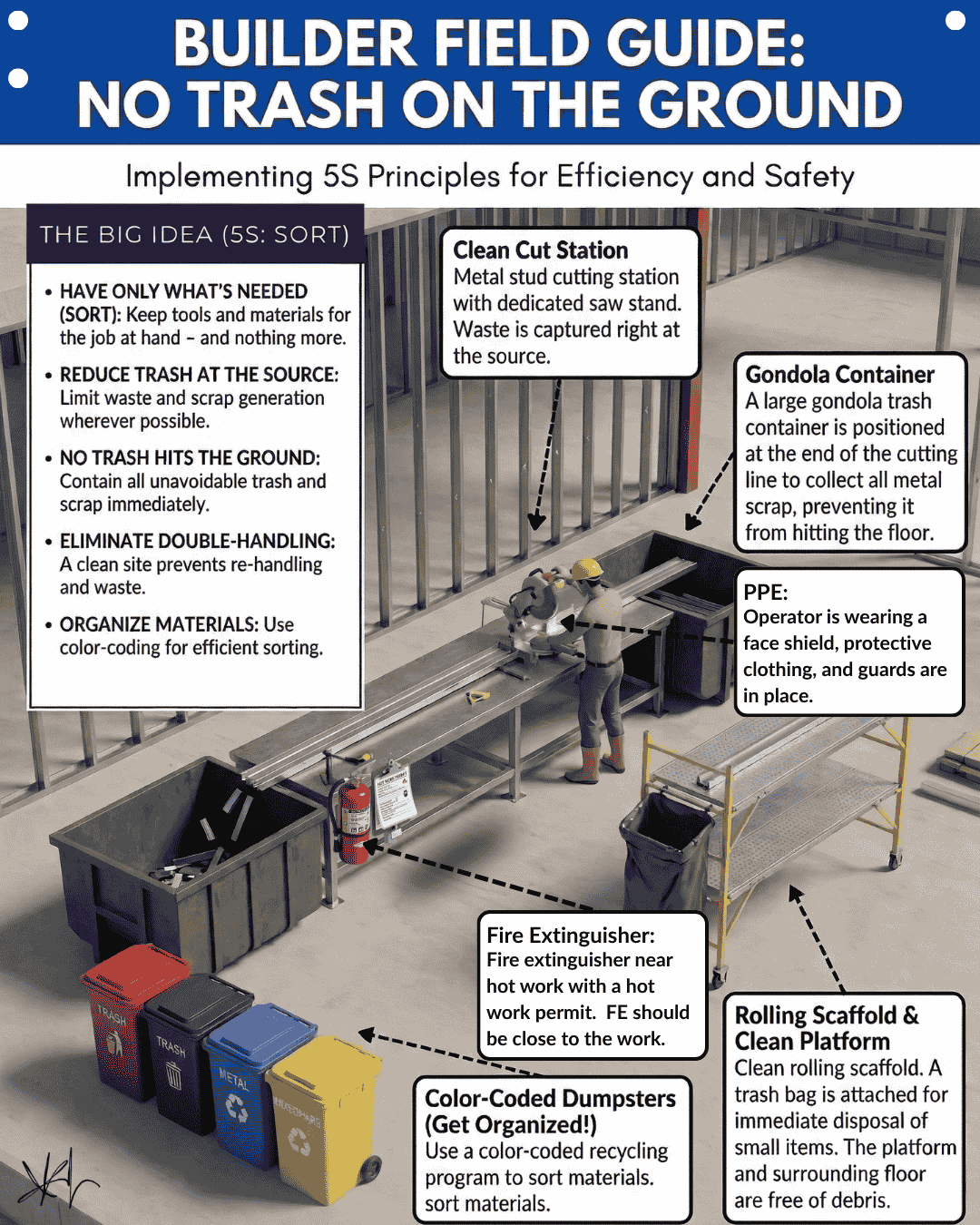
The image in this post shows what source-capture debris management looks like when it’s done intentionally. Every element in that setup has a specific role in making the right behavior the automatic behavior.
The clean cut station a metal stud cutting station with a dedicated saw stand captures waste right at the source. The saw doesn’t live in the middle of the floor. It lives at a designated station that’s designed to contain the output of its operation. Positioned at the end of the cutting line is a gondola container, large enough to catch all metal scrap before it reaches the ground. The worker doesn’t need to think about where to put the scrap. The gondola is there. The geometry of the setup makes it the path of least resistance to put the scrap in the right place. That’s design, not discipline.
A rolling scaffold and clean platform with a trash bag attached handles the small-item debris that every zone generates throughout the day offcuts, packaging scraps, tape, wire ties, the hundred small things that end up on the floor on a typical project. With the bag attached and mobile, it travels with the crew. Debris goes in the bag in real time, not at end of shift when the floor is already covered. Color-coded dumpsters give different waste streams a designated home, making sorting simple and double-handling unnecessary. And the operator working the cut station is in full PPE face shield, protective clothing, guards in place because a clean, organized station is also a safe one.
Notice what’s not in this setup: a reminder sign. There’s no “keep this area clean” poster on the wall. There’s no toolbox talk planned for Friday about debris management. The system communicates the standard through its design. When the gondola is positioned to catch the scrap, the standard is enforced by the environment, not by a supervisor with a checklist.
Watch for these signals that your site’s debris system needs a redesign:
- Cut stations running without a scrap catch container within arm’s reach of the saw
- End-of-shift cleanup taking more than fifteen minutes per zone per day
- Cardboard and packaging accumulating in zones because no removal system was designed
- Trades blaming each other for messy zones when no standard for waste capture was ever established
- Rolling scaffolds without attached bags, creating floor debris wherever small pieces are generated
Teaching the Framework: 5S Sort and Shine as Production Strategy
Jason Schroeder teaches 5S as production support, not housekeeping. The first principle Sort means having only what’s needed for the job at hand and nothing more. It means reducing waste at the source rather than managing it after the fact. It means no trash hits the ground because the system is designed to capture it before it can. When scrap is contained at the cut station, the crew working the zone has one fewer obstacle between themselves and productive installation time. The floor is clear. The access path is clean. The safety hazard that a metal scrap pile creates on a high-traffic floor simply doesn’t exist.
Shine the third S means keeping the work area clean enough that defects, safety hazards, and missing items are immediately visible. A clean zone reveals problems early, when they are still cheap to fix. Jason teaches that cleanliness is a control strategy, not a cosmetic preference. When the floor is covered in debris, you cannot see low morale, you cannot see slower production paces, you cannot see bottlenecks or zone constraints. The mess becomes noise that hides every signal the environment should be sending to leadership. A clean zone is a visible zone. And visibility is how you control production.
The real power of the source-capture approach is that it eliminates double-handling one of the most common and least-tracked wastes on any construction project. When a piece of scrap hits the floor, someone has to pick it up. That’s a task that was created by the absence of a system. The crew member who bends down to pick up that piece of metal stud could have been setting the next piece in the sequence. That’s not a trivial trade-off at scale. Across a whole project, double-handling of debris consumes a meaningful slice of productive labor hours that nobody ever plans for because nobody ever designed the alternative.
The Mission Behind the Method
There is a human story inside the debris conversation that doesn’t get told often enough. When skilled tradespeople work in a cluttered, disorganized, debris-filled environment, it communicates something to them about how the project values their work. It says the people leading this project haven’t thought about what they need to be effective. It says the standard is low. It says nobody here designed this for us. Over time, that feeling erodes pride in the work, reduces buy-in to quality standards, and accelerates the kind of culture where “good enough” becomes the operating norm.
Contrast that with the crew that works at a clean cut station, on a platform with an attached bag, next to a gondola that catches every piece of scrap before it touches the ground. That environment says: we thought about you before you got here. We designed this so you can do your best work without fighting your surroundings. We believe your craft deserves a workspace that respects it. That’s not a soft idea. That’s a production strategy. Respect for people is not soft it is how you build a workforce that cares. If your project needs superintendent coaching, project support, or leadership development, Elevate Construction can help your field teams stabilize, schedule, and flow. Building world-class environments for the craft is where that work begins.
Design It Before the Crew Shows Up
Here is the challenge I want to leave with you. Before your next phase of work mobilizes, design the debris system for that phase the same way you’d design the zone layout or the delivery schedule. Where is the cut station going? What catch container captures the scrap at the source? Which dumpster does each waste stream go to? Is the rolling scaffold equipped with a bag? Is the platform area clear and color-coded by trade? Answer those questions before the first worker steps off the hoist, and you will spend the rest of that phase managing production instead of managing mess.
Clean jobsites are not the result of better people. They are the result of better systems. The craft deserves an environment built to let them win. Design that environment, and the cleanliness takes care of itself. As Taiichi Ohno said: “Something is wrong if workers do not look around each day, find things that are tedious or boring, and then rewrite the procedures. Even last month’s manual should be out of date.” Design the system. Then improve it daily. That’s 5S living in the field.
On we go.
Frequently Asked Questions
Why doesn’t “clean up after yourself” messaging work on construction sites?
Because it’s aimed at behavior rather than system design. Workers don’t create debris intentionally they create it as a byproduct of the work. Without a designed catch system at the source, debris hits the ground by default. Reminders and accountability can’t overcome a system that was designed to produce mess. The fix is designing the environment so the right behavior is automatic.
What is source-capture debris management?
Source-capture means containing waste at the exact point it’s generated before it has the opportunity to reach the floor. A gondola container positioned at the end of a cutting line, a bag attached to a rolling scaffold, a cut station with a built-in scrap trough these are all source-capture solutions. They make the right behavior the path of least resistance for the worker.
How does a clean jobsite connect to production and safety?
A clean zone is a visible zone. When the floor is clear, leaders can see production pace, quality gaps, bottlenecks, and safety hazards. When it’s covered in debris, all of those signals disappear into noise. Cleanliness is a control strategy it makes the problems that slow the project visible while they’re still cheap to fix, and it removes the trip and injury hazards that debris creates in active work areas.
What is double-handling and how does debris create it?
Double-handling is any task performed twice that could have been performed once or eliminated entirely. When scrap hits the floor, someone must pick it up a task created entirely by the absence of a catch system. That pickup is double-handling: work the system generated that didn’t need to exist. Source-capture eliminates it by ensuring the scrap never reaches the floor in the first place.
How does color-coding the dumpsters help?
Color-coding creates a visual standard for waste sorting that workers can follow without instruction or reminders. Each waste stream metal, drywall, wood, cardboard has a designated dumpster that’s identifiable by color. This reduces sorting errors, simplifies recycling compliance, and eliminates the search for where to put different materials. It’s Set in Order applied to waste management: everything has a place that’s obvious and easy to use.
If you want to learn more we have:
-Takt Virtual Training: (Click here)
-Check out our Youtube channel for more info: (Click here)
-Listen to the Elevate Construction podcast: (Click here)
-Check out our training programs and certifications: (Click here)
-The Takt Book: (Click here)
Discover Jason’s Expertise:
Meet Jason Schroeder, the driving force behind Elevate Construction IST. As the company’s owner and principal consultant, he’s dedicated to taking construction to new heights. With a wealth of industry experience, he’s crafted the Field Engineer Boot Camp and Superintendent Boot Camp – intensive training programs engineered to cultivate top-tier leaders capable of steering their teams towards success. Jason’s vision? To expand his training initiatives across the nation, empowering construction firms to soar to unprecedented levels of excellence.
On we go