
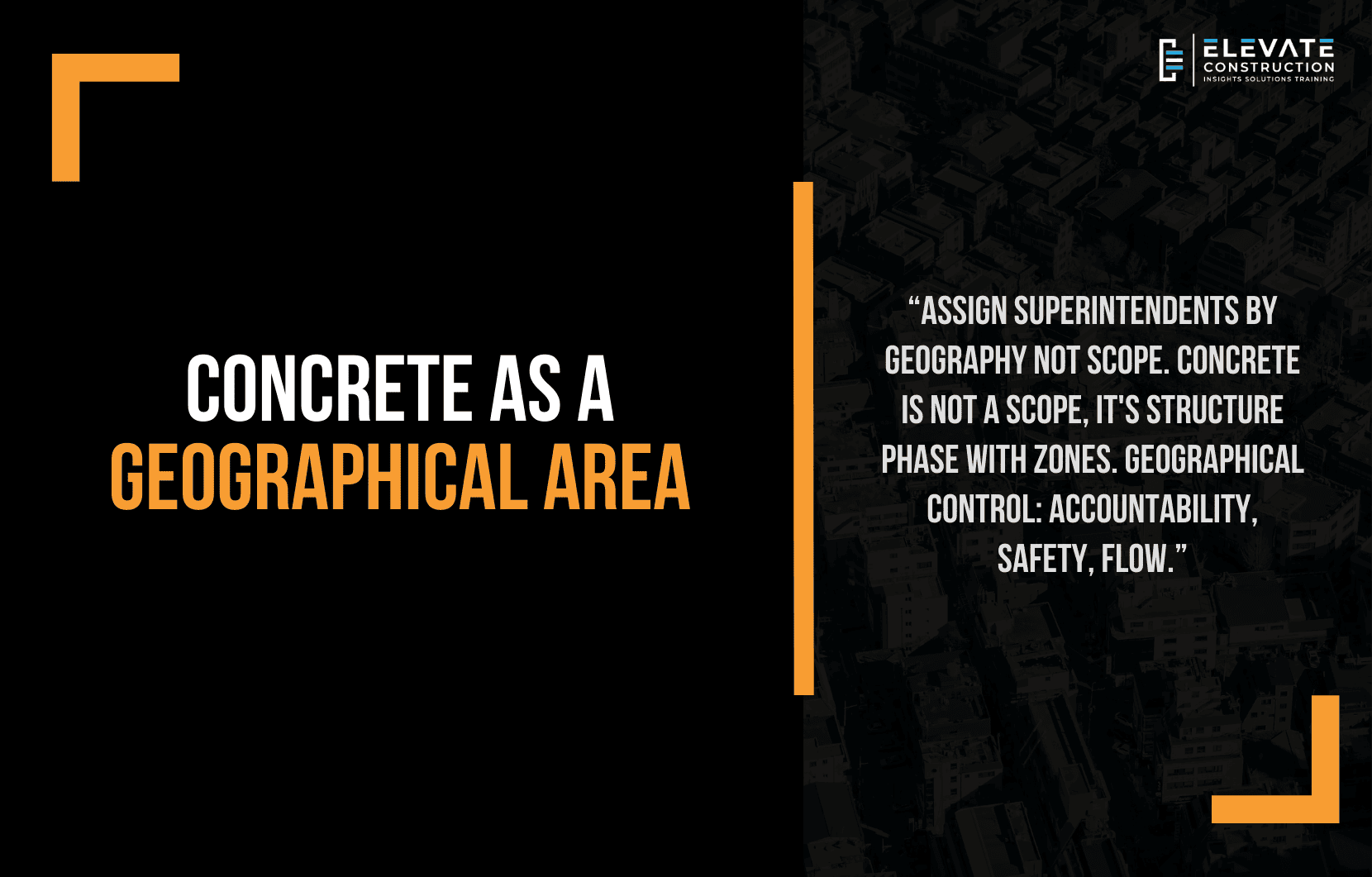
Concrete as a Geographical Area (Why Superintendents Should Own Space, Not Scope)
A really neat general superintendent asked me the other day, “Jay Money, what do you think about me assigning superintendents by scope instead of by geography?” Because he knows that I really like geography. By the way, this person’s brilliant, and it was a great idea, and I’m not being negative about it at all, but I noticed something that was really interesting that tipped me off to why that kind of thinking happens.
And let me just start out by saying why I like geographical control over scope control.
The Problems with Scope Control
A couple of reasons. When you do scope control where like one superintendent does MEP, then another one comes behind and does something else, then another one comes behind and does something else, I don’t like that method. I do want you to know that I was brought up that way. At Hensel Phelps when I was a field engineer, the general superintendent would have me go in and finish things. He would send the other field engineers into buildings to kind of start things, and I would be the finisher.
And one of the things that I noticed was I had to fix a lot of things, and that individual never really got to learn what he was doing or see the entire life cycle through. So that’s one of the things that I don’t like.
Why Geographical Control Works: Ownership and Accountability
The other thing I don’t like is that it was messy. Nobody’s actually in control. Nobody’s actually in control. Because if you’re overseeing scopes, you’re just like running all through the building, and you’re not actually owning an area, and you’re not cleaning that area, and you’re not making sure that area is safe, and you’re not looking at signage for the area.
So geographical control makes sure that you have control of areas, and you’re seeing it from an accountability, a self-accountability standpoint all the way through. And the other thing is all of our production planning systems, all of our Takt planning systems are based on time and location. Time and location, so phases and zones. Everything really does in construction work better by location.
Another Reason: The Buddy-Buddy Problem
Now there’s lots of other reasons why. Let me just give you one more actually. I could probably think of 10 if I was pushed. But another reason why is that when a person on the project delivery team is in charge of a scope, typically the natural human thing there is to get buddy-buddy with those trades. The project delivery team member literally relies on the foreman and kind of disengages.
And if you’re in control of geography, you are doing a great job with, or you can be doing a great job with pre-con meetings, geographical control, and making sure the entire system functions. And if you think about it, when you’re supervising a scope, you’re only supervising a sub-component. You’re not supervising a system.
The Brain Trick: Concrete Is Not a Scope Assignment
So, I would say I’m 99 percent in favor of always assigning people on the project delivery team to locations, space, or geography, and I’m about one percent bought into doing it by scope. And this individual who’s really brilliant was like, “Oh, I had a superintendent over the concrete and it worked really well, so I figured I would entertain the idea.”
And then it hit me that people think that when they have a civil superintendent or a structural superintendent, that they’re assigning it by scope. And so, then they should continue that throughout the rest of the project.
Well, actually, here’s the trick, and your brain is tricking you. The concrete is not a scope assignment. It is a geographical spatial assignment. It just happens that typically when you’re in the concrete phase that you own like all of the area and it’s primarily one scope.
So, you can look at it and be like, “Yeah, that superintendents in charge of concrete.” But really, they’re in charge of structure. Concrete is a scope. Structure is a phase with zones and it’s geography. So, they thought they assigned a superintendent to concrete, but really, they assigned that super to structure, which is a phase with zones, and it’s time by location, and it’s geographical and spatial control. It’s not scope control.
The Same Trick Happens with Civil
The same thing happens with civil. And so, we assign superintendents and we mix up the word. Instead of site work, we say you’re in charge of civil. And instead of saying you’re in charge of structure or foundations or structure, we say you’re in charge of concrete. And then that’s misleading and people think they’re in charge of the trade instead of the geography.
The GC Is in Charge of Environment and Rhythm, Not Bossing Trades
Actually, my brain is starting to get really good at this. The general contractor is in charge of the environment and the rhythm. And those are both spatial or geographical things. We are not in charge of bossing trades around by scope. They already know how to do their job. They just need the path cleared out ahead.
So, every single thing, actually, that takes me back. I’m 100% on the side of assigning project delivery geographically. And I actually changed my mind. I’m 0% bought in to assigning it by scope.
Here’s why geographical assignments work better than scope assignments:
- Geographical control: ownership, accountability, safety, cleanliness – If overseeing scopes, just running all through building, not actually owning an area, not cleaning that area, not making sure area is safe, not looking at signage for area. Geographical control makes sure you have control of areas, seeing it from accountability and self-accountability standpoint all the way through.
- See entire life cycle through, not just finishing – At Hensel Phelps, general superintendent would have me go finish things, send other field engineers to start things. I noticed: had to fix a lot of things, and that individual never really got to learn what he was doing or see entire life cycle through.
- Production planning systems based on time and location (phases and zones) – All production planning systems, all Takt planning systems based on time and location. Time and location, so phases and zones. Everything in construction works better by location.
- Avoid buddy-buddy problem with trades – When person on project delivery team in charge of scope, typically natural human thing: get buddy-buddy with those trades. Project delivery team member literally relies on foreman and kind of disengages. If in control of geography, doing great job with pre-con meetings, geographical control, making sure entire system functions. When supervising scope, only supervising sub-component. Not supervising system.
- Brain trick: concrete is not scope, it’s structure phase with zones – People think when they have civil superintendent or structural superintendent, they’re assigning it by scope. Then should continue throughout rest of project. Here’s the trick: your brain is tricking you. Concrete is not scopae assignment. It is geographical spatial assignment. Just happens that typically when in concrete phase, own all of area and it’s primarily one scope. They’re in charge of structure. Concrete is scope. Structure is phase with zones and it’s geography.
If your project needs superintendent coaching, project support, or leadership development, Elevate Construction can help your field teams stabilize, schedule, and flow.
A Challenge for Construction Leaders
Here’s what I want you to do this week. Stop assigning superintendents by scope. Start assigning them by geography. Stop saying “you’re in charge of concrete” when you mean “you’re in charge of structure phase with zones.” Stop saying “you’re in charge of civil” when you mean “you’re in charge of site work phase with zones.”
The general contractor is in charge of the environment and the rhythm. And those are both spatial or geographical things. We are not in charge of bossing trades around by scope. They already know how to do their job. They just need the path cleared out ahead.
Geographical control makes sure you have control of areas, seeing it from accountability and self-accountability standpoint all the way through. Owning an area. Cleaning that area. Making sure area is safe. Looking at signage for area. Doing pre-con meetings. Making sure entire system functions.
I’ve never seen scope assignment work, even on data centers where there’s heavy electrical or in laboratories or hospitals or where there’s specialty assignments. Spatial or geographical control and assignments is the ultimate.
As we say at Elevate, assign superintendents by geography not scope. Concrete is not a scope, it’s structure phase with zones. Geographical control: accountability, safety, flow.
On we go.
Frequently Asked Questions
Why not assign superintendents by scope?
Because if overseeing scopes, just running all through building, not actually owning an area, not cleaning area, not making sure area safe, not looking at signage. Person in charge of scope gets buddy-buddy with trades, relies on foreman, disengages. Only supervising sub-component, not system.
What’s the brain trick with concrete assignments?
People think when they have structural superintendent, they’re assigning by scope. But concrete is not scope assignment. It’s geographical spatial assignment. Just happens when in concrete phase, own all of area and it’s primarily one scope. They’re in charge of structure (phase with zones). Concrete is scope. Structure is geography.
Why does geographical control work better?
Makes sure you have control of areas, seeing from accountability and self-accountability standpoint all the way through. See entire life cycle. Own area, clean area, make area safe, look at signage. Do pre-con meetings. Make sure entire system functions.
What are production planning systems based on?
Time and location. Phases and zones. All production planning systems, all Takt planning systems based on time and location. Everything in construction works better by location.
What is the GC in charge of?
Environment and rhythm. Both are spatial or geographical things. Not in charge of bossing trades around by scope. They already know how to do their job. They just need path cleared out ahead.
If you want to learn more we have:
-Takt Virtual Training: (Click here)
-Check out our Youtube channel for more info: (Click here)
-Listen to the Elevate Construction podcast: (Click here)
-Check out our training programs and certifications: (Click here)
-The Takt Book: (Click here)
Discover Jason’s Expertise:
Meet Jason Schroeder, the driving force behind Elevate Construction IST. As the company’s owner and principal consultant, he’s dedicated to taking construction to new heights. With a wealth of industry experience, he’s crafted the Field Engineer Boot Camp and Superintendent Boot Camp – intensive training programs engineered to cultivate top-tier leaders capable of steering their teams towards success. Jason’s vision? To expand his training initiatives across the nation, empowering construction firms to soar to unprecedented levels of excellence.
On we go