Why Your Connex Box Is Either Protecting Flow or Killing It
Open the connex box on most construction projects and you’ll find the same thing. Power tools piled on a shelf in no particular order. Hardware in a bucket somewhere near the back or maybe two buckets, it’s hard to tell. Extension cords looped loosely into a corner that somehow turn into a tangle no matter how carefully you left them the night before. Consumables sitting wherever there was room when they arrived. And somewhere in the middle of all that, a journeyman spending the first fifteen minutes of the morning trying to locate a specific bit, a specific blade, or a specific box of anchors that definitely came in last week but nobody is exactly sure where it landed.
That picture is so common it has become invisible. Nobody questions it. Nobody measures it. And because it repeats every single day across every trade on every project, the cumulative cost of that fifteen minutes per worker never shows up in any report. It just quietly consumes the capacity that the crew needed to finish the zone on time.
The Problem Is Not the Box. It’s the Absence of a System.
The connex box was never supposed to be a storage dumpster. It’s supposed to be a mini warehouse and a Lean workstation a hub that feeds the crew everything they need, exactly when they need it, without searching, without improvising, and without a side trip to the supplier because something ran out without warning. When it’s designed that way, it functions that way. When it’s never designed at all, it functions as a holding tank for chaos.
I remember doing a walkthrough early in my career on a large MEP project where we had four different trades sharing a staging area. The connex boxes were packed. Every single one had more tools than it could reasonably hold, hardware mixed in with consumables, extension cords in every drawer, and no labeling anywhere. Each morning, the trades would spend significant time foremen included searching for what they needed or borrowing from each other. What nobody had calculated was how much of that morning time was pure motion waste. No value added. No progress made. Just people fighting a system that was never designed to support them. The system failed them. They didn’t fail the system.
What a Well-Designed Connex Box Actually Does
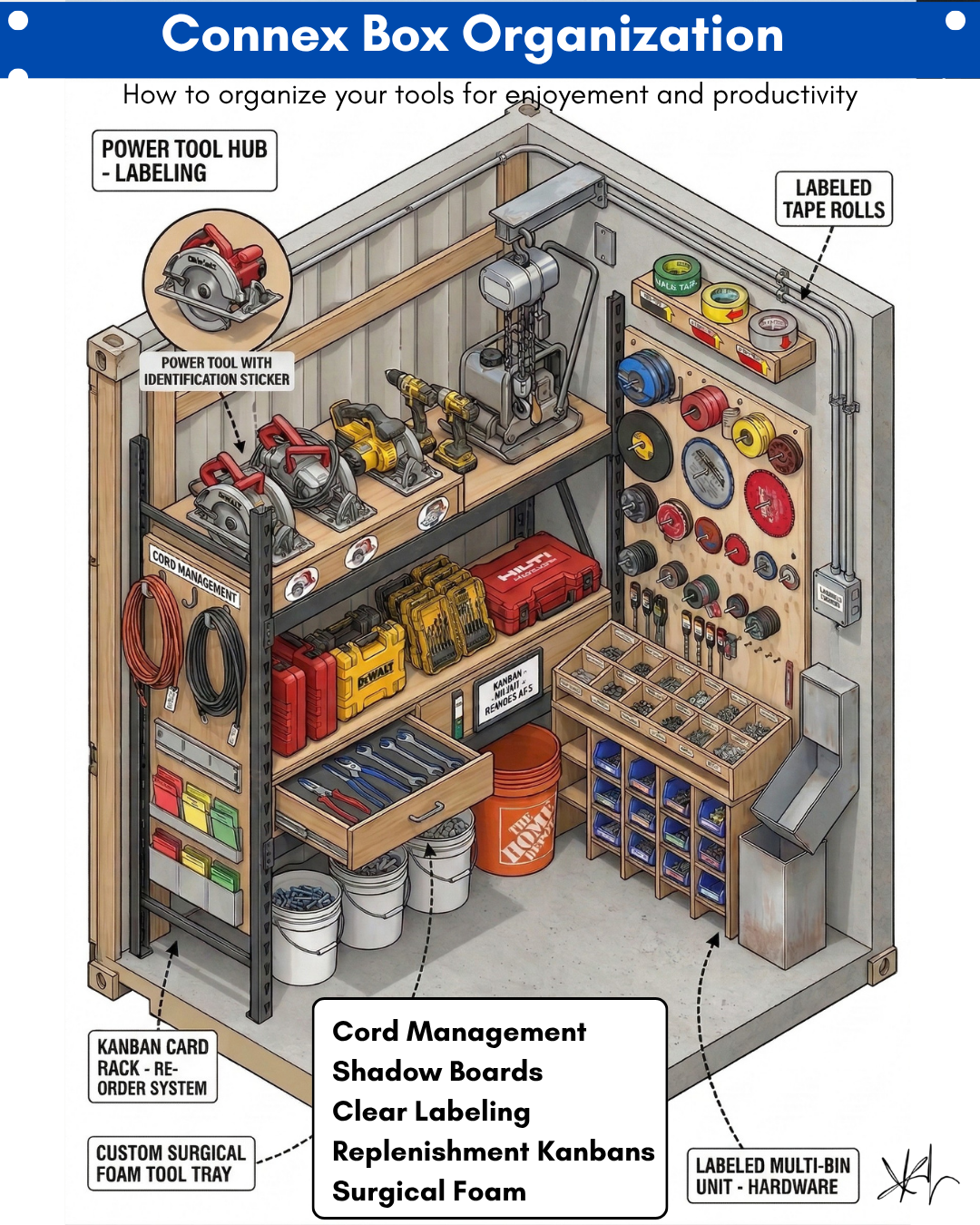
The image in this post shows what intentional connex box organization looks like when it’s built on real Lean principles rather than wishful thinking.
The shadow board and hook system on the back wall handles large power tools circular saws, drills, grinders in a way that makes every absence instantly visible. Each tool has a silhouette. When the tool is there, you see the tool. When it’s gone, you see the shadow. That’s not decoration. That’s a visual management system that tells the team in three seconds whether all the tools that should be at the site are at the site. No count. No question. No digging. The missing tool is visible before the task starts, not twenty minutes after.
The custom surgical foam tool trays in the drawers apply the same principle to hand tools and specialty items. Precision cutouts mean each tool has one home, shaped exactly for it. A tool cannot end up in the wrong place because the wrong place doesn’t have the right shape. That’s Set in Order made physical the principle that everything needed has a defined place, labeled and easy to access at the point of work. When the environment is organized this way, searching is designed out. It cannot happen because the system doesn’t allow it.
Cord management solves one of the most consistent daily friction points on any construction site. Tangled extension cords are not a discipline problem. They are a system problem a predictable outcome of a storage design that doesn’t account for how cords behave. Proper cord management, built into the box, means cords are accessible, untangled, and ready to use without a five-minute wrestling match at the start of every task. It’s a simple fix that returns real time to the crew every single day.
Watch for these signals that a connex box is functioning as a storage dumpster rather than a Lean workstation:
- Workers opening and closing multiple drawers before finding what they need
- Tools from one day’s work ending up in the wrong location by the next morning
- Hardware mixed across containers with no labeling by type or size
- Extension cords requiring untangling before any corded tool can be used
- No visible indicator of when consumables are running low until they run out
The Kanban Replenishment System: Solving the Shortage Problem Before It Happens
One of the most operationally powerful elements in the connex box design is the Kanban card rack and re-order system. This is where 5S and procurement discipline meet at the crew level.
In a traditional connex box, hardware and consumables run out when they run out. Someone notices the anchors are gone. Someone calls the foreman. The foreman calls the office. Materials get ordered. Days pass before the next shipment. In the meantime, the crew adapts substitutes the wrong fastener, borrows from another trade, slows down the task waiting for the right hardware to arrive. That sequence is not a procurement failure in the traditional sense. It’s a system that was never designed to signal demand before the shortage occurred.
The Kanban card solves this at its root. Each hardware bin has a re-order card placed at the level where restocking needs to be triggered not when the bin is empty, but when it reaches the minimum threshold. When the card becomes visible, the signal is already sent. The foreman sees it on the morning check, submits the re-order, and the replacement arrives before the crew ever runs dry. Just-in-time replenishment at the crew level is not complicated. It requires only that someone designed the signal into the system rather than waiting for the absence to force the conversation.
The labeled multi-bin hardware station extends that same logic across the full range of fasteners, anchors, screws, and electrical hardware the crew uses daily. Each bin is labeled by type, size, and count. Every worker including someone new to the project knows immediately where to find the right fastener without asking anyone. The system is self-explaining. That’s what visual management is supposed to create: a work environment where the crew can orient, locate, and act without friction.
Why This Is a Respect-for-People Question, Not an Organization Question
Jason Schroeder teaches 5S not as housekeeping but as production support a way to remove friction so crews can install work without searching. Searching is hidden schedule erosion. When the connex box is organized, the crew’s time goes into installation. When it isn’t, the crew’s time goes into logistics work that the system should have solved before they arrived.
There’s a deeper truth here that gets passed over in most conversations about organization. When skilled tradespeople electricians, pipefitters, carpenters who have spent years mastering their craft are forced to start every day digging through a disorganized box to find what they need, the message that sends is not subtle. It says: we didn’t think about you before you got here. We didn’t design this for your productivity. Your time was not worth the effort of setting this up properly. That’s not intentional. But it’s what an unorganized connex box communicates, every morning, to every worker who opens it.
The flip side is equally true. A connex box with shadow boards, labeled bins, Kanban cards, surgical foam trays, and managed cords communicates something entirely different. It says: we thought about this before you arrived. We built a system that supports you. Your time matters enough to design around. That’s Respect for People made visible, one drawer at a time. If your project needs superintendent coaching, project support, or leadership development, Elevate Construction can help your field teams stabilize, schedule, and flow. Building that culture starts with exactly this kind of intentional environment design.
Start With the Box. Finish With Flow.
Here is the practical challenge. Walk your current project’s connex boxes this week not to inspect people, but to evaluate the system. Open every drawer. Ask: does every tool have a labeled home? Is every piece of hardware sorted and labeled by type? Are cords managed so they’re immediately usable? Is there a system that signals when consumables are getting low? Is a new worker able to find what they need within sixty seconds without asking anyone?
If the answer to most of those questions is no, the crew is absorbing a daily friction tax that the system created. The connex box doesn’t require a major investment to fix. It requires an afternoon of intentional design foam trays cut to fit, shadow boards mounted, bins labeled, Kanban cards placed. Do it once, sustain it daily, and the return in crew time and crew morale will show up immediately. Paul Akers says fix what bugs you every day, make two-second improvements. The disorganized connex box bugs every person who opens it. Fix it. Build a system that lets them win.
On we go.
Frequently Asked Questions
What is a Kanban card in a connex box and how does it work?
A Kanban card is a re-order signal placed at the minimum threshold level in a hardware bin. When the bin drops to that level, the card becomes visible, triggering a restocking request before the bin empties. It prevents mid-task shortages by signaling demand ahead of time rather than reacting after the supply runs out.
How does the shadow board system work for power tools?
Each power tool has a silhouette painted or outlined on the board in its exact shape and storage position. When the tool is stored, the silhouette is hidden. When the tool is missing, the shadow is visible an immediate visual signal that something is out of place or not returned. No counting or inventory check is needed.
Why does cord management matter enough to be part of the connex box design?
Tangled cords create a daily friction tax time spent untangling before any corded tool can be used. Across a full crew for a full project, this adds up to significant lost productive time. Proper cord management built into the storage system means cords are always accessible and ready, removing a predictable daily obstacle from the crew’s morning.
How does the labeled multi-bin hardware station protect production pace?
It ensures every worker can locate the correct fastener, anchor, or fitting by type and size without asking anyone. This eliminates hardware-related search time, reduces substitution errors when the right fastener isn’t easily found, and allows new workers to become self-sufficient immediately. The system communicates the standard without requiring a supervisor to do it.
How does surgical foam in tool drawers reduce waste?
Surgical foam with precision cutouts ensures every tool has one specific home that matches its shape exactly. Tools cannot be stored in the wrong place because the wrong place won’t fit them. This eliminates disorganized drawers, speeds up retrieval, and makes any missing tool visible the moment the drawer is opened protecting both crew time and tool accountability.
If you want to learn more we have:
-Takt Virtual Training: (Click here)
-Check out our Youtube channel for more info: (Click here)
-Listen to the Elevate Construction podcast: (Click here)
-Check out our training programs and certifications: (Click here)
-The Takt Book: (Click here)
Discover Jason’s Expertise:
Meet Jason Schroeder, the driving force behind Elevate Construction IST. As the company’s owner and principal consultant, he’s dedicated to taking construction to new heights. With a wealth of industry experience, he’s crafted the Field Engineer Boot Camp and Superintendent Boot Camp – intensive training programs engineered to cultivate top-tier leaders capable of steering their teams towards success. Jason’s vision? To expand his training initiatives across the nation, empowering construction firms to soar to unprecedented levels of excellence.
On we go