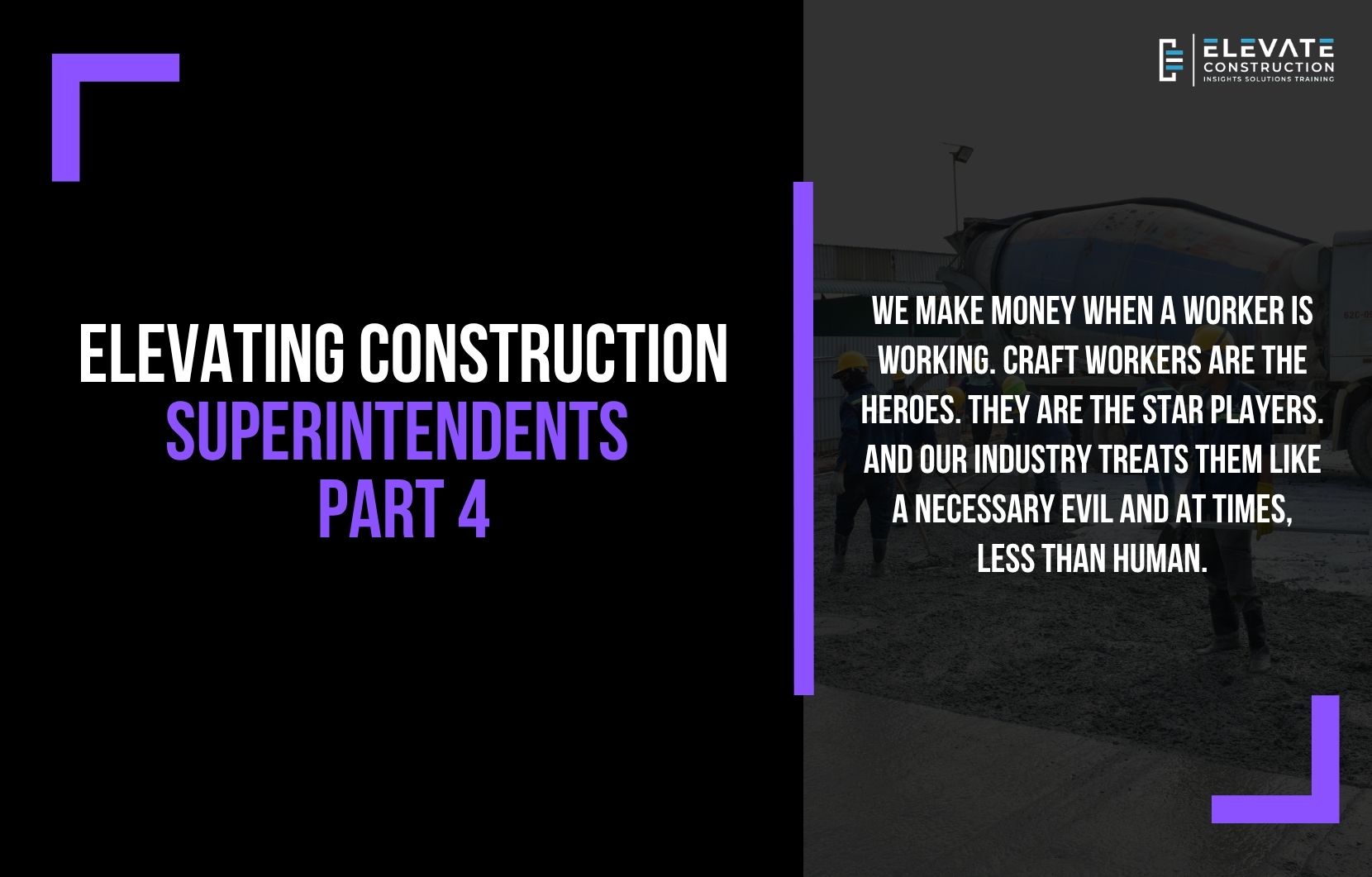
Elevating Construction Superintendents – Part 4

Read 28 min

Are You Treating Craft as Necessary Evil or as Heroes?

You ask yourself how you make money for company. Is it when we send email? Is it when we type letter? Is it when we drive around? Is it during meetings? Answer is simple. We make money when worker is working. Transportation, fabrication, coordination, design, management are all non-value add actions necessary to prepare for moment when worker works. Money is earned when work is being put into place. And who puts that work in place? The craft. Craft workers are heroes. They are star players. They are champions. And our industry treats them like necessary evil and at times, less than human. If you have found yourself operating with that mindset, I urge you to repent and rethink your life. Craft are critical to what we do. They deserve our respect and reverence. Knowing how important craft workers are to our work, our lives, our livelihood, our success, we need to optimize their work and provide them with clear instructions and training, reliable materials and information, and safe places to work. This is one of main duties of field engineer and superintendent: to create stability and flow in life of our skilled craft. Many superintendents in industry treat craft like slaves who need to get job done without any support. We can change that by sharing with them what we’re doing, why we’re doing it, asking their advice along way. We can take interest in their training and development. We can abandon patterns of wrong behavior by providing opportunities and helping craft meet their career goals and reach their potential. We can begin to focus on their work and give all we can to make it more effective, productive, and enjoyable. Because we are not in manufacturing business. We are in construction to build people first who then in turn build great buildings and great things. We are customer service business. We take care of needs of our customer and all customers around us.

Here’s what most superintendents miss. They think construction is about producing product at lowest possible total cost in shortest amount of time with greatest amount of value. So they treat craft as necessary evil. Resources to be deployed. Problems to be managed. People who need to get job done without support. But that’s backwards. We are in construction to build people first who then in turn build great buildings. We are customer service business. Until we recognize that everything we do moves through and is about people, we will not be as successful as we can be. Different from superintendent who leads with care and concern. Who runs safety because wants to keep people safe. Who installs quality work because cares about end users. Who optimizes craft work by providing clear instructions, reliable materials, safe places to work. Who asks: can all skilled craft on site come to work, go where they need to go, huddle with entire project team, then go to work with right materials, instructions, tools, clean work area? Is their work fulfilling yet uneventful? That’s creating stability and flow. That’s treating craft as heroes. That’s building people who build great buildings.

The challenge is most superintendents never learned that craft workers are heroes deserving respect and reverence. Never learned that we make money when worker is working, so everything else is preparing for that moment. Never learned that we are in construction to build people first. Never learned that definition of leadership is influence, and best influence comes from leading with care and concern for people. So they treat craft like necessary evil. Like slaves needing to get job done without support. Never ask their advice. Never take interest in their training. Never help them meet career goals. Wonder why morale is low and production suffers when answer is they’re not building people, they’re just trying to produce product. But givers gain and takers lose. Givers make difference for thousands of people. Takers suck energy out of teams, give industry bad name, make working on projects miserable for everybody.

We Build People Who Build Great Buildings

We are not in manufacturing business. Most people think construction is about producing product at lowest possible total cost in shortest amount of time with greatest amount of value. I would argue that we are in construction to build people first who then in turn build great buildings and great things.

We are customer service business. We take care of needs of our customer and all customers around us. If we do not foresee people who will eventually use our buildings, people who will maintain our buildings, and people currently working on our buildings, then we have gap that we need to close in our own personal leadership.

We need to act, control, and lead out of respect for those people and make them our priority.

Best superintendents in our industry are ones who are approachable, lead with vision of taking care of people, run safety because they want to keep people safe, and install quality work because they care about end users. These superintendents are not only approachable, but also authoritative and respected. They are leaders who can get people to rise up and follow them because of their influence.

At end of day, definition of leadership is influence. Leaders in our industry who make that vital connection will always be more influential.

Support the Craft: They Are the Heroes

Excellent superintendents make supporting craft one of their top priorities. Ask yourself how you make money for company. We make money when worker is working. Money is earned when work is being put into place. And who puts that work in place? The craft.

Craft workers are heroes. They are star players. They are champions. And our industry treats them like necessary evil and at times, less than human. If you have found yourself operating with that mindset, I urge you to repent and rethink your life.

Craft are critical to what we do. They deserve our respect and reverence. Knowing how important craft workers are to our work, our lives, our livelihood, and our success, we need to optimize their work and provide them with clear instructions and training, reliable materials and information, and safe places to work.

This is one of main duties of field engineer and superintendent: to create stability and flow in life of our skilled craft.

Ask yourself if all skilled craft on site can come to work, go to where they need to go, huddle with entire project team, and then go to work with right materials, instructions, tools, and clean work area. Is that situation they have? Is their work fulfilling yet uneventful? If not, we have work to do.

It sounds harsh and dramatic, but many superintendents in industry treat craft like slaves who need to get job done without any support. We can change that by sharing with them what we’re doing, why we’re doing it, and asking their advice along way. We can take interest in their training and development.

We can abandon patterns of wrong behavior by providing opportunities and helping craft meet their career goals and reach their potential. We can begin to focus on their work and give all we can to make it more effective, productive, and enjoyable.

Be Good Neighbor: Treat Them Like Your Grandmother Lives There

Being good neighbor is one of main responsibilities of project superintendent. We must protect our neighbors, people around us, our customers, pedestrians, motorists, and anyone within close proximity of project like we would protect our own family. It is appropriate to advise that we should treat neighbor on corner as if our own grandmother lived there.

One of our main goals is to elevate awareness of team to really care about needs of others. Project team only wins when we can stay on budget within schedule with quality project with team balance in meeting everyone’s individual career goals and when we have delivered remarkable experience for everyone that comes into contact with our project.

Who is your customer on project? Owner of building? End users? Designers? Any of these answers would be correct, but there are additions. Your neighbors are your customers. Your trade partners are your customers. People in adjacent buildings are your customers. Vendors are your customers. Trade partners that go after another sequence of work are customers.

Everybody on your project should be treated in like manner. This is way project can elevate performance and really take it to next level to create flow and good quality work product.

Exhaust Bad Behavior: Worst Behavior You’re Willing to Tolerate

There is nothing that will tear down motivation and morale of good people on your project site more than watching you tolerate bad behavior. As lead superintendent or as assistant superintendent on any part of project, you cannot tolerate bad behavior.

Remember this quote: success of any organization is determined by worst behavior leader is willing to tolerate.

As superintendent, you must have standards. People on project site must know what you expect, and you have to exhaust bad behavior.

Givers Gain and Takers Lose

You can always tell difference between superintendent who is just trying to do his or her job and superintendent who leads with care and concern. Latter will always be one who will have most influence on project.

Now, we are not at work to make friends and close relationships that outweigh need to do business and have respect and appropriate relationships on site. But everything we do within those respectful and professional relationships should be guided by care and concern for people on project.

Find role models who exemplify this behavior, then make resolutions for your own style of leadership. Focus on giving first, and then intentionally practice being leader that you want to be.

Givers gain and takers lose. Givers in this industry will make difference for thousands of people. Takers not only suck energy out of their own teams, but they give industry bad name, and they make working on their projects miserable for everybody.

The System Failed You

Let’s be clear. When superintendents treat craft as necessary evil, it’s not entirely their fault. The system failed by teaching that construction is about producing product at lowest cost in shortest time. Nobody showed that we are in construction to build people first who then in turn build great buildings. Nobody explained that we make money when worker is working, so everything else is preparing for that moment. The system taught produce product when actually build people who build great buildings.

The system also failed by not teaching that craft workers are heroes deserving respect and reverence. If your project needs superintendent coaching, project support, or leadership development, Elevate Construction can help your field teams stabilize, schedule, and flow. Many superintendents treat craft like slaves who need to get job done without support. But craft are critical to what we do. Need to optimize their work by providing clear instructions, reliable materials, safe places to work. Create stability and flow in life of skilled craft. The system taught treat them as necessary evil when actually they are star players, champions, heroes.

The system fails by not teaching that definition of leadership is influence coming from care and concern for people. Best superintendents are approachable, lead with vision of taking care of people, run safety because want to keep people safe, install quality work because care about end users. Leaders who make that vital connection will always be more influential. Givers gain and takers lose. Givers make difference for thousands. Takers suck energy, give industry bad name, make projects miserable. The system taught focus on product when actually focus on people.

The Challenge

Here’s your assignment. Stop treating craft as necessary evil. Start treating them as heroes.

Recognize we make money when worker is working. Transportation, fabrication, coordination, design, management are all non-value add actions preparing for moment when worker works. Money earned when work being put into place. Who puts that work in place? The craft. They are heroes. Star players. Champions. They deserve our respect and reverence.

Optimize their work. Provide clear instructions and training. Reliable materials and information. Safe places to work. Create stability and flow in life of skilled craft. Ask: can all skilled craft come to work, go where they need to go, huddle with team, then go to work with right materials, instructions, tools, clean work area? Is their work fulfilling yet uneventful? If not, we have work to do.

Stop treating craft like slaves who need to get job done without support. Share with them what we’re doing, why we’re doing it. Ask their advice along way. Take interest in their training and development. Provide opportunities helping them meet career goals and reach potential. Focus on their work. Give all you can to make it more effective, productive, and enjoyable.

Remember we build people who build great buildings. We are not in manufacturing business. We are in construction to build people first who then in turn build great things. We are customer service business. Take care of needs of our customer and all customers around us. Until we recognize that everything we do moves through and is about people, we will not be as successful as we can be.

Lead with care and concern. Be approachable. Lead with vision of taking care of people. Run safety because you want to keep people safe. Install quality work because you care about end users. Definition of leadership is influence. Leaders who make that vital connection will always be more influential.

Be good neighbor. Treat neighbor on corner as if your own grandmother lived there. Elevate awareness of team to really care about needs of others. Deliver remarkable experience for everyone that comes into contact with project.

Exhaust bad behavior. Success of any organization is determined by worst behavior leader is willing to tolerate. Have standards. People must know what you expect.

Focus on giving first. Givers gain and takers lose. Givers make difference for thousands. Takers suck energy, give industry bad name, make projects miserable for everybody.

On we go.

FAQ

Why are craft workers the heroes?

We make money when worker is working. Transportation, fabrication, coordination, design, management are all non-value add actions preparing for moment when worker works. Money earned when work being put into place. Who puts that work in place? The craft. They are heroes, star players, champions. They deserve our respect and reverence.

How do you support the craft?

Optimize their work. Provide clear instructions and training, reliable materials and information, safe places to work. Create stability and flow in life of skilled craft. Share with them what we’re doing, why we’re doing it. Ask their advice. Take interest in their training and development. Help them meet career goals and reach potential.

What does it mean to build people who build great buildings?

We are not in manufacturing business. We are in construction to build people first who then in turn build great buildings and great things. We are customer service business. Until we recognize that everything we do moves through and is about people, we will not be as successful as we can be.

What is being a good neighbor?

Treat neighbor on corner as if your own grandmother lived there. Elevate awareness of team to really care about needs of others. Your neighbors are your customers. Trade partners are your customers. People in adjacent buildings are your customers. Everybody should be treated in like manner. Deliver remarkable experience for everyone that comes into contact with project.

Why do givers gain and takers lose?

Givers in this industry will make difference for thousands of people. Takers not only suck energy out of their own teams, but they give industry bad name, and they make working on their projects miserable for everybody. Definition of leadership is influence. Leaders who lead with care and concern for people will always be more influential.


If you want to learn more we have:


-Takt Virtual Training: (Click here)
-Check out our Youtube channel for more info: (Click here) 
-Listen to the Elevate Construction podcast: (Click here) 
-Check out our training programs and certifications: (Click here)
-The Takt Book: (Click here)

Discover Jason’s Expertise:

Meet Jason Schroeder, the driving force behind Elevate Construction IST. As the company’s owner and principal consultant, he’s dedicated to taking construction to new heights. With a wealth of industry experience, he’s crafted the Field Engineer Boot Camp and Superintendent Boot Camp – intensive training programs engineered to cultivate top-tier leaders capable of steering their teams towards success. Jason’s vision? To expand his training initiatives across the nation, empowering construction firms to soar to unprecedented levels of excellence.

Share:

    Share Link


    faq

    General Training Overview

    What construction leadership training programs does LeanTakt offer?
    LeanTakt offers Superintendent/PM Boot Camps, Virtual Takt Production System® Training, Onsite Takt Simulations, and Foreman & Field Engineer Training. Each program is tailored to different leadership levels in construction.
    Who should attend LeanTakt’s training programs?
    Superintendents, Project Managers, Foremen, Field Engineers, and trade partners who want to improve planning, communication, and execution on projects.
    How do these training programs improve project performance?
    They provide proven Lean and Takt systems that reduce chaos, improve reliability, strengthen collaboration, and accelerate project delivery.
    What makes LeanTakt’s training different from other construction courses?
    Our programs are hands-on, field-tested, and focused on practical application—not just classroom theory.
    Do I need prior Lean or takt planning experience to attend?
    No. Our programs cover foundational principles before moving into advanced applications.
    How quickly can I apply what I learn on real projects?
    Most participants begin applying new skills immediately, often the same week they complete the program.
    Are these trainings designed for both office and field leaders?
    Yes. We equip both project managers and superintendents with tools that connect field and office operations.
    What industries benefit most from LeanTakt training?
    Commercial, multifamily, residential, industrial, and infrastructure projects all benefit from flow-based planning.
    Do participants receive certificates after completing training?
    Yes. Every participant receives a LeanTakt Certificate of Completion.
    Is LeanTakt training recognized in the construction industry?
    Yes. Our programs are widely respected among leading GCs, subcontractors, and construction professionals.

    Superintendent / PM Boot Camp

    What is the Superintendent & Project Manager Boot Camp?
    It’s a 5-day immersive training for superintendents and PMs to master Lean leadership, takt planning, and project flow.
    How long does the Superintendent/PM Boot Camp last?
    Five full days of hands-on training.
    What topics are covered in the Boot Camp curriculum?
    Lean leadership, Takt Planning, logistics, daily planning, field-office communication, and team health.
    How does the Boot Camp improve leadership and scheduling skills?
    Yes. You’ll learn how to run day huddles, team meetings, worker huddles, and Lean coordination processes.
    Who is the Boot Camp best suited for?
    Construction leaders responsible for delivering projects, including Superintendents, PMs, and Field Leaders.
    What real-world challenges are simulated during the Boot Camp?
    Schedule breakdowns, trade conflicts, logistics issues, and communication gaps.
    Will I learn Takt Planning at the Boot Camp?
    Yes. Takt Planning is a core focus of the Boot Camp.
    How does this Boot Camp compare to traditional PM certification?
    It’s practical and execution-based rather than exam-based. You learn by doing, not just studying theory.
    Can my entire project team attend the Boot Camp together?
    Yes. Teams attending together often see the greatest results.
    What kind of real-world challenges do we simulate?
    Improved project flow, fewer delays, better team communication, and stronger leadership confidence.

    Takt Production System® Virtual Training

    What is the Virtual Takt Production System® Training?
    It’s an expert-led online program that teaches Lean construction teams how to implement takt planning.
    How does virtual takt training work?
    Delivered online via live sessions, interactive discussions, and digital tools.
    What are the benefits of online takt planning training?
    Convenience, global accessibility, real-time learning, and immediate application.
    Can I access the virtual training from anywhere?
    Yes. It’s fully web-based and accessible worldwide.
    Can I access the virtual training from anywhere?
    Yes. It’s fully web-based and accessible worldwide.
    What skills will I gain from the Virtual TPS® Training?
    Macro and micro Takt planning, weekly updates, flow management, and CPM integration.
    How long does the virtual training program take?
    The program is typically completed in multiple live sessions across several days.
    Can I watch recordings if I miss a session?
    Yes. Recordings are available to all participants.
    Do you offer group access or company licenses for the virtual training?
    Yes. Teams and companies can enroll together at discounted rates.
    How does the Virtual TPS® Training integrate with CPM tools?
    We show how to align Takt with CPM schedules like Primavera P6 or MS Project.

    Onsite Takt Simulation

    What is a Takt Simulation in construction training?
    It’s a live, interactive workshop that demonstrates takt planning on-site.
    How does the Takt Simulation workshop work?
    Teams participate in hands-on exercises to learn the flow and rhythm of a Takt-based project.
    Can I choose between a 1-day or 2-day Takt Simulation?
    Yes. We offer flexible formats to fit your team’s schedule and needs.
    Who should participate in the Takt Simulation workshop?
    Superintendents, PMs, site supervisors, contractors, and engineers.
    How does a Takt Simulation improve project planning?
    It shows teams how to structure zones, manage flow, and coordinate trades in real time.
    What will my team learn from the onsite simulation?
    How to build and maintain takt plans, manage buffers, and align trade partners.
    Is the simulation tailored to my specific project type?
    Yes. Scenarios can be customized to match your project.
    How do Takt Simulations improve trade partner coordination?
    They strengthen collaboration by making handoffs visible and predictable.
    What results can I expect from an onsite Takt Simulation?
    Improved schedule reliability, better trade collaboration, and reduced rework.
    How many people can join a Takt Simulation session?
    Group sizes are flexible, but typically 15–30 participants per session.

    Foreman & Field Engineer Training

    What is Foreman & Field Engineer Training?
    It’s an on-demand, practical program that equips foremen and engineers with leadership and planning skills.
    How does this training prepare emerging leaders?
    By teaching communication, crew management, and execution strategies.
    Is the training on-demand or scheduled?
    On-demand, tailored to your team’s timing and needs.
    What skills do foremen and engineers gain from this training?
    Planning, safety leadership, coordination, and communication.
    How does the training improve communication between field and office?
    It builds shared systems that align superintendents, engineers, and managers.
    Can the training be customized for my team’s needs?
    Yes. Programs are tailored for your project or company.
    What makes this program different from generic leadership courses?
    It’s construction-specific, field-tested, and focused on real project application.
    How do foremen and field engineers apply this training immediately?
    They can use new systems for planning, coordination, and daily crew management right away.
    Is the training suitable for small construction companies?
    Yes. Small and large teams alike benefit from building flow-based leadership skills.

    Testimonials

    Testimonials

    "The bootcamp I was apart of was amazing. Its was great while it was happening but also had a very profound long-term motivation that is still pushing me to do more, be more. It sounds a little strange to say that a construction bootcamp changed my life, but it has. It has opened my eyes to many possibilities on how a project can be successfully run. It’s also provided some very positive ideas on how people can and should be treated in construction.

    I am a hungry person by nature, so it doesn’t take a lot to get to participate. I loved the way it was not just about participating, it was also about doing it with conviction, passion, humility and if it wasn’t portrayed that way you had to do it again."

    "It's great to be a part of a company that has similar values to my own, especially regarding how we treat our trade partners. The idea of "you gotta make them feel worse to make them do better" has been preached at me for years. I struggled with this as you will not find a single psychology textbook stating these beliefs. In fact it is quite the opposite, and causing conflict is a recipe for disaster. I'm still honestly in shock I have found a company that has based its values on scientific facts based on human nature. That along with the Takt scheduling system makes everything even better. I am happy to be a part of a change that has been long overdue in our industry!"

    "Wicked team building, so valuable for the forehumans of the sub trades to know the how and why. Great tools and resources. Even though I am involved and use the tools every day, I feel like everything is fresh and at the forefront to use"

    "Jason and his team did an incredible job passing on the overall theory of what they do. After 3 days of running through the course I cannot see any holes in their concept. It works. it's proven to work and I am on board!"

    "Loved the pull planning, Takt planning, and logistic model planning. Well thought out and professional"

    "The Super/PM Boot Camp was an excellent experience that furthered my understanding of Lean Practices. The collaboration, group involvement, passion about real project site experiences, and POSITIVE ENERGY. There are no dull moments when you head into this training. Jason and Mr. Montero were always on point and available to help in the break outs sessions. Easily approachable to talk too during breaks and YES, it was fun. I recommend this training for any PM or Superintendent that wants to further their career."

    agenda

    Day 1

    Foundations & Macro Planning

    day2

    Norm Planning & Flow Optimization

    day3

    Advanced Tools & Comparisons

    day4

    Buffers, Controls & Finalization

    day5

    Control Systems & Presentations

    faq

    UNDERSTANDING THE TRAINING

    What is the Virtual Takt Production System® Training by LeanTakt?
    It’s an expert-led online program designed to teach construction professionals how to implement Takt Planning to create flow, eliminate chaos, and align teams across the project lifecycle.
    Who should take the LeanTakt virtual training?
    This training is ideal for Superintendents, Project Managers, Engineers, Schedulers, Trade Partners, and Lean Champions looking to improve planning and execution.
    What topics are covered in the online Takt Production System® course?
    The course covers macro and micro Takt planning, zone creation, buffers, weekly updates, flow management, trade coordination, and integration with CPM tools.
    What makes LeanTakt’s virtual training different from other Lean construction courses?
    Unlike theory-based courses, this training is hands-on, practical, field-tested, and includes live coaching tailored to your actual projects.
    Do I get a certificate after completing the online training?
    Yes. Upon successful completion, participants receive a LeanTakt Certificate of Completion, which validates your knowledge and readiness to implement Takt.

    VALUE AND RESULTS

    What are the benefits of Takt Production System® training for my team?
    It helps teams eliminate bottlenecks, improve planning reliability, align trades, and reduce the chaos typically seen in traditional construction schedules.
    How much time and money can I save with Takt Planning?
    Many projects using Takt see 15–30% reductions in time and cost due to better coordination, fewer delays, and increased team accountability.
    What’s the ROI of virtual Takt training for construction teams?
    The ROI comes from faster project delivery, reduced rework, improved communication, and better resource utilization — often 10x the investment.
    Will this training reduce project delays or rework?
    Yes. By visualizing flow and aligning trades, Takt Planning reduces miscommunication and late handoffs — major causes of delay and rework.
    How soon can I expect to see results on my projects?
    Most teams report seeing improvement in coordination and productivity within the first 2–4 weeks of implementation.

    PLANNING AND SCHEDULING TOPICS

    What is Takt Planning and how is it used in construction?
    Takt Planning is a Lean scheduling method that creates flow by aligning work with time and space, using rhythm-based planning to coordinate teams and reduce waste.
    What’s the difference between macro and micro Takt plans?
    Macro Takt plans focus on the overall project flow and phase durations, while micro Takt plans break down detailed weekly tasks by zone and crew.
    Will I learn how to build a complete Takt plan from scratch?
    Yes. The training teaches you how to build both macro and micro Takt plans tailored to your project, including workflows, buffers, and sequencing.
    How do I update and maintain a Takt schedule each week?
    You’ll learn how to conduct weekly updates using lookaheads, trade feedback, zone progress, and digital tools to maintain schedule reliability.
    Can I integrate Takt Planning with CPM or Primavera P6?
    Yes. The training includes guidance on aligning Takt plans with CPM logic, showing how both systems can work together effectively.
    Will I have access to the instructors during the training?
    Yes. You’ll have opportunities to ask questions, share challenges, and get real-time feedback from LeanTakt coaches.
    Can I ask questions specific to my current project?
    Absolutely. In fact, we encourage it — the training is designed to help you apply Takt to your active jobs.
    Is support available after the training ends?
    Yes. You can access follow-up support, coaching, and community forums to help reinforce implementation.
    Can your tools be customized to my project or team?
    Yes. We offer customizable templates and implementation options to fit different project types, teams, and tech stacks.
    When is the best time in a project lifecycle to take this training?
    Ideally before or during preconstruction, but teams have seen success implementing it mid-project as well.

    APPLICATION & TEAM ADOPTION

    What changes does my team need to adopt Takt Planning?
    Teams must shift from reactive scheduling to proactive, flow-based planning with clear commitments, reliable handoffs, and a visual management mindset.
    Do I need any prior Lean or scheduling experience?
    No prior Lean experience is required. The course is structured to take you from foundational principles to advanced application.
    How long does it take for teams to adapt to Takt Planning?
    Most teams adapt within 2–6 weeks, depending on project size and how fully the system is adopted across roles.
    Can this training work for smaller companies or projects?
    Absolutely. Takt is scalable and especially powerful for small teams seeking better structure and predictability.
    What role do trade partners play in using Takt successfully?
    Trade partners are key collaborators. They help shape realistic flow, manage buffers, and provide feedback during weekly updates.

    VIRTUAL FORMAT & ACCESSIBILITY

    Can I access the virtual training from anywhere?
    Yes. The training is fully accessible online, making it ideal for distributed teams across regions or countries.
    Is this training available internationally?
    Yes. LeanTakt trains teams around the world and supports global implementations.
    Can I watch recordings if I miss a session?
    Yes. All sessions are recorded and made available for later viewing through your training portal.
    Do you offer group access or company licenses?
    Yes. Teams can enroll together at discounted rates, and we offer licenses for enterprise rollouts.
    What technology or setup do I need to join the virtual training?
    A reliable internet connection, webcam, Miro, Spreadsheets, and access to Zoom.

    faq

    GENERAL FAQS

    What is the Superintendent / PM Boot Camp?
    It’s a hands-on leadership training for Superintendents and Project Managers in the construction industry focused on Lean systems, planning, and communication.
    Who is this Boot Camp for?
    Construction professionals including Superintendents, Project Managers, Field Engineers, and Foremen looking to improve planning, leadership, and project flow.
    What makes this construction boot camp different?
    Real-world project simulations, expert coaching, Lean principles, team-based learning, and post-camp support — all built for field leaders.
    Is this just a seminar or classroom training?
    No. It’s a hands-on, immersive experience. You’ll plan, simulate, collaborate, and get feedback — not sit through lectures.
    What is the focus of the training?
    Leadership, project planning, communication, Lean systems, and integrating office-field coordination.

    CURRICULUM & OUTCOMES

    What topics are covered in the Boot Camp?
    Takt planning, day planning, logistics, pre-construction, team health, communication systems, and more.
    What is Takt Planning and why is it taught?
    Takt is a Lean planning method that creates flow and removes chaos. It helps teams deliver projects on time with less stress.
    Will I learn how to lead field teams more effectively?
    Yes. This boot camp focuses on real leadership challenges and gives you systems and strategies to lead high-performing teams.
    Do you cover daily huddles and meeting systems?
    Yes. You’ll learn how to run day huddles, team meetings, worker huddles, and Lean coordination processes.
    What kind of real-world challenges do we simulate?
    You’ll work through real project schedules, logistical constraints, leadership decisions, and field-office communication breakdowns.

    LOGISTICS & FORMAT

    Is the training in-person or virtual?
    It’s 100% in-person to maximize learning, feedback, and team-based interaction.
    How long is the Boot Camp?
    It runs for 5 full days.
    Where is the Boot Camp held?
    Locations vary — typically hosted in a professional training center or project setting. Contact us for the next available city/date.
    Do you offer follow-up coaching after the Boot Camp?
    Yes. Post-camp support is included so you can apply what you’ve learned on your projects.
    Can I ask questions about my actual project?
    Absolutely. That’s encouraged — bring your current challenges.

    PRICING & VALUE

    How much does the Boot Camp cost?
    $5,000 per person.
    Are there any group discounts?
    Yes — get 10% off when 4 or more people from the same company attend.
    What’s the ROI for sending my team?
    Better planning = fewer delays, smoother coordination, and higher team morale — all of which boost productivity and reduce costs.
    Will I see results immediately?
    Most participants apply what they’ve learned as soon as they return to the jobsite — especially with follow-up support.
    Can this replace other leadership training?
    In many cases, yes. This Boot Camp is tailored to construction professionals, unlike generic leadership seminars.

    SEO-BASED / HIGH-INTENT SEARCH QUESTIONS

    What is the best leadership training for construction Superintendents?
    Our Boot Camp offers real-world, field-focused leadership training tailored for construction leaders.
    What’s included in a Superintendent Boot Camp?
    Takt planning, day planning, logistics, pre-construction systems, huddles, simulations, and more.
    Where can I find Lean construction training near me?
    Check our upcoming in-person sessions or request a private boot camp in your city.
    How can I improve field and office communication on a project?
    This Boot Camp teaches you tools and systems to connect field and office workflows seamlessly.
    Is there a training to help reduce chaos on construction sites?
    Yes — this program is built specifically to turn project chaos into flow through structured leadership.

    agenda

    Day 1

    Agenda

    Outcomes

    Day 2

    Agenda

    Outcomes

    Day 3

    Agenda

    Outcomes

    Day 4

    Agenda

    Outcomes

    Day 5

    Agenda

    Outcomes