
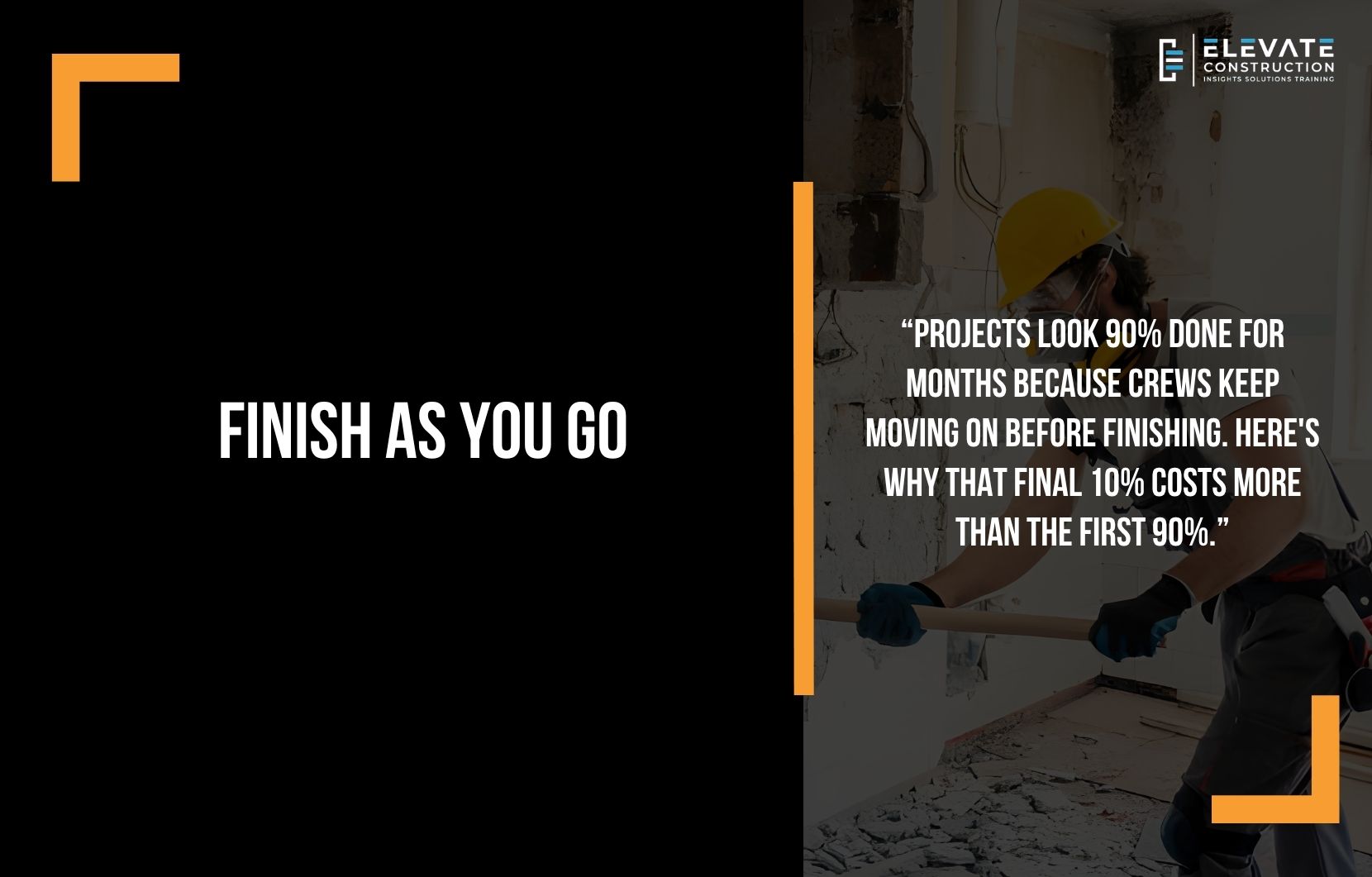
The Finish-As-You-Go Principle: Why the Last 10% of Your Project Takes Longer Than the First 90%
Walk any construction site six weeks from substantial completion and you’ll see the same pattern everywhere. Drywall hung but not taped. Overhead MEP installed but branch lines dangling. Concrete walls stripped but tie holes unpatched. Building pads graded but perimeters trashed. Formwork scattered around the site in pieces. Materials piled in finished areas. Punch lists growing faster than crews can work them down. The project looks ninety percent done. And it stays ninety percent done for months.
Here’s what nobody wants to admit. That final ten percent takes as long as the first ninety percent because crews didn’t finish as they went. They moved from area to area leaving work incomplete, planning to come back later. And later becomes never, or at minimum becomes three times more expensive than doing it right the first time.
The Problem Every Superintendent Faces
You’ve seen this play out. A concrete crew places walls and columns and strips the forms. They move to the next pour. The tie holes sit there unpatched. The cream at the bottom of the forms where concrete leaked out stays there hardened and ugly. They’ll come back to patch it later.
Except later means bringing a patching crew back when other trades are working. Later means boom lifts over finished stairs. Later means coordinating around MEP and drywall and ceiling installers. Later means three times the effort for work that could have been finished in ten minutes when the crew was standing right there. Or watch the MEP trades. They install overhead mains and move to the next area. The branch lines that drop down into walls? They’ll come back for those. The diffuser connections? Later. The tie-ins? Eventually.
So walls go up around incomplete overhead work. Now when MEP comes back, they’re cutting access holes in finished drywall. They’re working around other trades. They’re waiting for areas to clear. They’re creating rework and damage and delay. The system created this problem. The workers are just following the pattern they’ve always seen.
The Failure Pattern That Keeps Projects at 90%
This isn’t about lazy crews or poor craftsmanship. This is about a system that rewards moving fast over finishing completely. Superintendents measure production by square footage installed. Foremen get praised for covering ground quickly. Schedules show progress based on areas started, not areas finished. The entire measurement system creates incentive to move on before work is complete.
So crews do what the system tells them to do. They install as much as possible in as many areas as possible. They leave the finishing touches for later. They plan to come back and clean up and patch and complete. But coming back is always more expensive than staying to finish. Coming back means remobilizing tools. Coming back means context switching for crews who have moved on mentally to other work. Coming back means working around other trades who are now in those areas. Coming back means damage to finished work. Coming back means delays waiting for access. The system failed them. It didn’t fail the workers.
A Story From the Field
I toured a major three-hundred-fifty-million-dollar hospital in California. The general superintendent showed me something I’d never seen before. He said “Jason, we frame most of the walls first. And as MEP does the overhead, they spool those out and put up the overhead, then they bring any of their branch lines down into the walls as they go. They just finish as they go.” I thought about that. People would complain. “The walls are in my way. It’s harder to get here. I have to work around obstacles.”
But the general superintendent knew something most people miss. The waste of coming back and doing it multiple times is greater than the inefficiency of working around walls. If you have walls and you create access zones, crews can still move. But if you wait and come back later, you create massive waste. That project finished on time. Quality was exceptional. Punch lists were minimal. Because crews finished as they went instead of planning to come back later.
Why This Destroys More Than Just Your Schedule
When crews don’t finish as they go, the damage ripples through the entire project. Your punch list becomes unmanageable because incomplete work accumulates faster than you can track it. Your final cleaning takes weeks instead of days because materials and debris pile up everywhere. Your substantial completion gets pushed because that final ten percent takes forever to coordinate.
But it goes deeper than schedule delays. When work sits incomplete, it gets damaged. Someone walks through and kicks that unpatched tie hole making it worse. Rain gets into that unfinished perimeter grading creating erosion. Traffic runs over areas that should have been stabilized. Every day incomplete work sits exposed, it degrades.
And there’s the cost nobody calculates. Coming back to finish work costs three times what finishing it the first time would have cost. The crew has to remobilize. They have to refamiliarize themselves with the area. They have to work around other trades. They have to coordinate access. They have to fix damage that happened while the work sat incomplete. That ten-minute patching job when the crew was standing there becomes a two-hour coordinated effort three weeks later. Your margin evaporates in the coming back. Your schedule slips in the coordination. Your quality suffers in the rework and damage. All because the system didn’t create incentive to finish as you go.
The Framework: What Finish-As-You-Go Actually Means
Finish as you go doesn’t mean lock the doors and never let anyone back in. That doesn’t work on most projects because balancing technicians need access, transportation has to move through areas, final connections have to happen. Locking doors is rarely practical. But there are other creative ways to protect finished work. Make going on finished areas without booties a zero-tolerance item. Have a general contractor carpenter or laborer guarding finished areas. Move out all inventory and excess materials as areas complete. Have a contingency of one or two cleaning people policing the building, picking up anything that might damage finished product, cleaning windows, vacuuming areas.
Some people say that’s waste. Here’s the reality: having people trample back into finished areas wholesale is bigger waste. Having piles grow legs and become bigger messes is bigger waste. Having to remobilize entire crews to come back and finish incomplete work is bigger waste. Finish as you go means crews complete their scope in each area before moving to the next. As they move from area to area, they finish what they’re doing. They don’t leave tie holes for later. They don’t skip perimeter grading. They don’t abandon formwork pieces. They don’t defer branch line connections.
For road work, it means staying just ahead of pipe installation but also finishing and stabilizing areas behind the install so water lines are one hundred percent complete, ready to go, traffic control can be removed, areas can be turned over. For heavy civil, it means when pads are graded and ready, access is in, water lines are installed, utilities are complete, and pads get turned over to home builders finished, not almost finished. For ductwork, it means mains go up, branch lines go in, smaller ducts come down to diffusers, and the scope is ready for sealing and insulation. Not seventy percent ready. Finished.
Examples of Finish-As-You-Go From Different Trades
Here’s what finishing as you go looks like in practice across different scopes:
- Concrete crews place walls and columns, strip forms, and immediately patch tie holes and clean the cream from the bottom where it leaked out, scrape it, rub it down, sweep, and leave that area beautiful before moving to the next pour
- Civil contractors grade building pads and also grade the perimeter and stabilize it for rainwater while they’re there instead of coming back later when pipes and concrete are scattered everywhere
- Underground utility crews camera lines, as-built them, and file all documentation as soon as installation is complete instead of deferring it to closeout when details are forgotten
- Patching crews move through as work happens so they have clear access instead of needing boom lifts over finished stairs and coordinating around five other trades working simultaneously
- Formwork stripping crews remove every piece of formwork, not just the big sections, so two-by-fours and plywood don’t scatter across the site waiting to be picked up later
The Japanese Manufacturing Principle Applied to Construction
There’s a principle from Japanese manufacturing that applies directly to finishing as you go. In the United States, car manufacturing plants produce for economies of scale. If they have tools set up to create Ford F-150s, they’ll make ten thousand of them because the tools are up and running. They overproduce, stage them, transport them, create defects, over-process corrections, and sometimes don’t even sell all the trucks. Massive waste.
In Japan, if they get an order for three hundred seventy-five Toyota Tacomas, they might increase it to four hundred for buffer, but then they switch out the tools on the line, sometimes in five minutes, make those four hundred trucks, then switch tools again and make Camrys. They only produce what the customer ordered. They had to become nimble at switching tools. They focused on reducing switchover time.
How does this apply to construction? We think we need one crew with one tool cart doing one thing, working through all the floors, then another team context-switching back behind them later. That’s batching. That’s creating incomplete work everywhere.
Why not have two tool carts or different tools available and have that single crew finish the work in each area that needs to get done without segmenting everything into waste and handoffs? It’s better to finish while you’re there than to look for individual efficiencies between crews when the handoff creates more waste in the system. Switching tools quickly to complete work in place beats moving on incomplete and coming back later. Every time.
Why This Protects More Than Your Bottom Line
We’re not just building projects. We’re building people who build things. And when we create systems that let crews finish as they go, we’re protecting them from the chaos and frustration of coming back repeatedly to areas they thought were done. Workers take pride in completed work. They feel accomplishment when they finish an area completely and move on. They get demoralized when they have to come back three times to the same area to finish what should have been done the first time. That’s not respect for people. That’s system failure creating rework and frustration.
When crews finish as they go, schedules become predictable. Workers can plan their lives. Families know when dad will be home. The constant crisis of “we need you back on Saturday to finish what we should have finished Tuesday” goes away. That stability protects families. If your project needs superintendent coaching, project support, or leadership development, Elevate Construction can help your field teams stabilize, schedule, and flow. This is respect for people in action. Not the soft version where we’re just nice to everyone. The production version where we design systems that let people finish their work completely and move on with pride instead of leaving trails of incomplete work that create chaos later.
The Practical Path Forward
Start with a simple standard. Display it everywhere. Put it on banners at project entries. Print it on doors. Make it the culture: “Cleanliness, organization, and the right sizing of inventory buffers are a project’s best indicator of health and stability. Plan it first, build it right, and finish as you go.”
That saying is packed with meaning. Clean and organized sites with right-sized inventory show health and stability. Planning with flow, building with quality in the moment, and finishing completely as work progresses creates the conditions for success.
Make finish-as-you-go the standard for every crew. When concrete strips forms, tie holes get patched immediately. When civil grades pads, perimeters get stabilized before moving on. When MEP installs overhead, branch lines come down into walls before leaving the area. When formwork comes down, every piece gets removed and staged properly, not scattered.
Schedule meeting follow-up time. When you attend a meeting, schedule fifteen minutes after to finish paperwork and send out meeting minutes right then. Don’t wait till later. Finish as you go applies to office work too. The doctor who kept an empty desk and took calls immediately instead of batching them stayed mentally healthy because he finished things as they happened instead of letting them pile up.
Reduce your operating footprint as areas finish. When you finish as you go, you reduce work in progress. You reduce the area your team has to manage. You allow focus on smaller and smaller areas, especially critical ones having trouble finishing. You keep teams balanced and healthy. Trades operate in geographical control areas that can actually be controlled. You minimize waste, trade damage, motion, cleanliness issues. The footprint shrinks as completion happens.
The Decision in Front of You
You can keep measuring progress by areas started instead of areas finished. You can keep rewarding crews for moving fast instead of completing work. You can keep planning to come back later for the finishing touches that never quite happen.
Or you can make finish-as-you-go the standard. You can measure completion, not just installation. You can protect finished work with creative controls instead of accepting that incomplete work will pile up. You can recognize that coming back costs three times what finishing the first time costs.
The projects that finish on time aren’t the ones that cover the most ground fastest. They’re the ones where crews complete work in each area before moving to the next, where that final ten percent doesn’t take as long as the first ninety percent because most of it was already finished as they went.
There’s a principle from the book How to Stop Worrying and Start Living. A doctor was interviewed about why he had no stress and an empty desk. During the interview, he paused to take a call, answered the question, provided the information needed, and went back to the interview. When asked why, he said “I finish things as they happen. I don’t let it pile up. I’m not overly busy. I’m able to focus on my patients. This is how I do things.” The interviewer noted the mental health that comes from finishing as you go instead of batching and deferring.
That principle applies to construction. Finish as you go. Complete areas before moving on. Don’t defer patching, cleaning, protecting, documenting. Do it when you’re standing there. Do it while access is clear. Do it before other trades move in and complicate everything. It’s a true principle. It will always be a true principle in construction. And it will make you a ton of money and make you proud of your finished product. On we go.
Frequently Asked Questions
How do you protect finished work if locking doors doesn’t work?
Make booties on finished areas a zero-tolerance item. Station a laborer or carpenter to guard finished zones and manage access. Keep one or two cleaning crew members constantly policing the building to pick up debris, clean windows, and vacuum before damage happens. Move all excess materials and inventory out immediately as areas complete.
What’s the actual cost difference between finishing as you go versus coming back later?
Coming back to finish work costs roughly three times what finishing it the first time costs. The crew has to remobilize tools, refamiliarize with the area, coordinate access around other trades now working there, and fix damage that happened while work sat incomplete. A ten-minute patching job becomes a two-hour coordinated effort.
How do you convince crews to finish completely before moving on when they’re measured on production speed?
Change what you measure. Track areas completed, not just areas started. Praise crews for finishing work completely in each zone. Make punch list length per area a key metric. When the measurement system rewards completion instead of just installation speed, behavior changes.
What does finish-as-you-go look like for MEP trades specifically?
Install overhead mains and immediately bring branch lines down into walls before leaving the area. Complete diffuser connections as walls go up, not weeks later. Finish tie-ins and terminations in each zone before moving to the next. Work around walls instead of waiting for walls to come down later, because the rework costs more than the minor inefficiency.
How do you apply finish-as-you-go to office work and meetings?
Schedule fifteen minutes after every meeting to complete meeting minutes and send them out immediately. Answer emails as they arrive instead of batching them for later. Close out tasks completely before starting new ones. Finish documentation while details are fresh, not days later when you have to recreate context.
If you want to learn more we have:
-Takt Virtual Training: (Click here)
-Check out our Youtube channel for more info: (Click here)
-Listen to the Elevate Construction podcast: (Click here)
-Check out our training programs and certifications: (Click here)
-The Takt Book: (Click here)
Discover Jason’s Expertise:
Meet Jason Schroeder, the driving force behind Elevate Construction IST. As the company’s owner and principal consultant, he’s dedicated to taking construction to new heights. With a wealth of industry experience, he’s crafted the Field Engineer Boot Camp and Superintendent Boot Camp – intensive training programs engineered to cultivate top-tier leaders capable of steering their teams towards success. Jason’s vision? To expand his training initiatives across the nation, empowering construction firms to soar to unprecedented levels of excellence.
On we go