First Who, Then What: Building the Right Project Team in Construction
Every struggling project has a moment that gets misdiagnosed. Leaders look at the schedule, the sequence, the contract language, or the budget and say, “We just need a better plan.” But the truth shows up quietly in the background. The plan isn’t the real problem. The people are.
This isn’t a criticism. It’s a reality of leadership. Construction is executed by people, through people, and for people. If the wrong people are in key roles, even the best plan will fail. If the right people are in the right seats, imperfect plans get fixed fast. That’s why the most important leadership decision you will ever make is not what you do next, but who you do it with.
Why Projects Stall When the “Who” Is Wrong
When the wrong people are in critical roles, projects slow down in ways that are hard to quantify. Decisions take longer. Communication feels heavy. Meetings repeat the same conversations. Problems get worked around instead of solved. Leaders feel exhausted, not because the work is harder, but because they are carrying weight that should be shared.
What makes this painful is that leaders often respond by pushing harder instead of deciding differently. They work longer hours. They tighten controls. They compensate for gaps. And in doing so, they unintentionally protect the problem instead of fixing it.
Construction does not fail because people are bad. It fails because people are misaligned.
The Bus Analogy: Leadership Starts With Who Comes With You
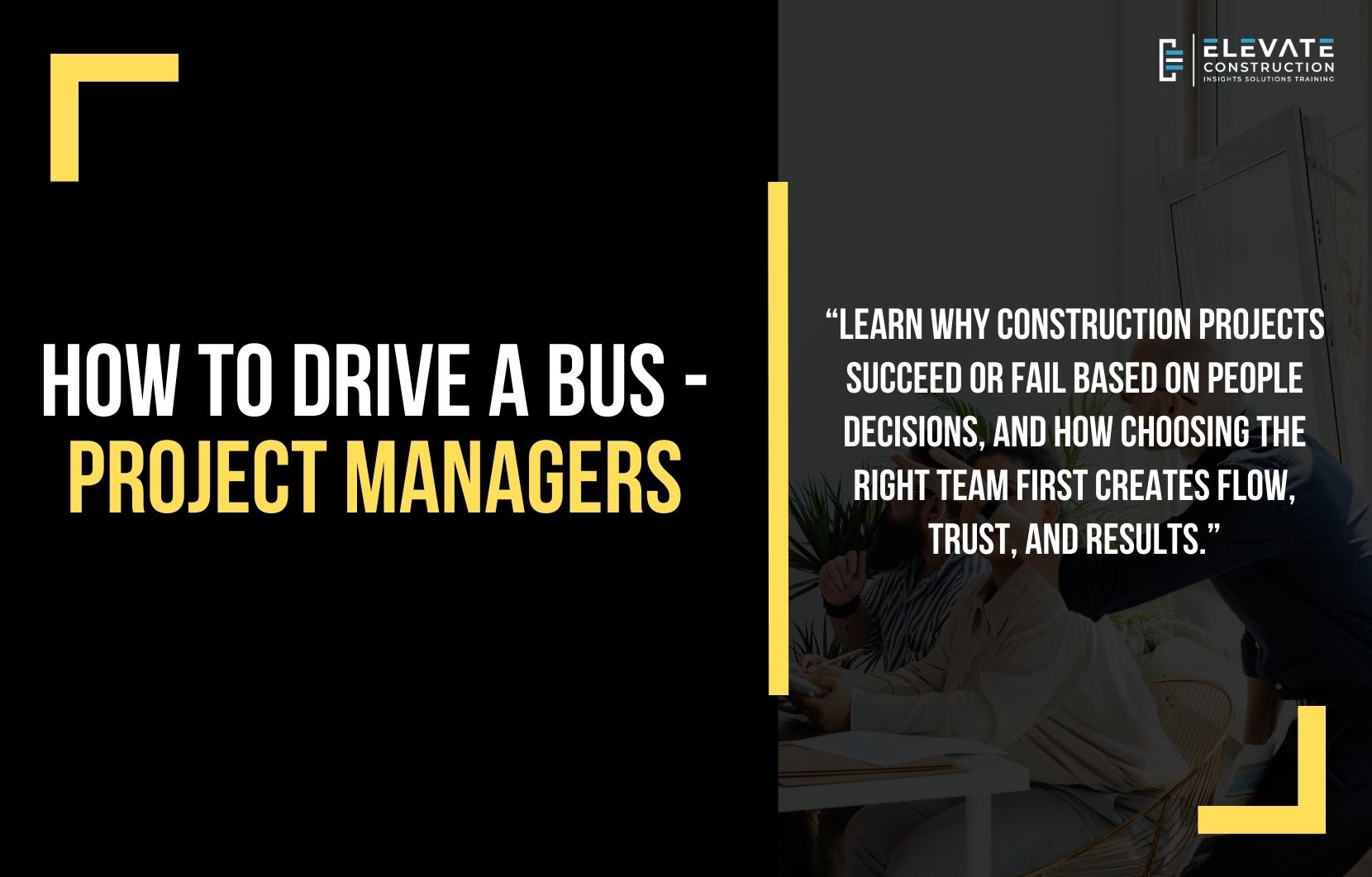
There’s a powerful image that captures this principle perfectly. Leadership is driving a bus. Before you decide where the bus is going, you must decide who is on it. Then you decide who sits in which seat. Only after that does direction matter.
Too many leaders reverse the order. They chase opportunities, set aggressive goals, and launch initiatives before ensuring the team is ready. When results lag, they blame execution. In reality, the bus was never properly assembled.
“First who, then what” is not a slogan. It’s a sequencing rule. And in construction, sequencing always matters.
Getting the Right People on the Bus
The first responsibility of leadership is selection. This includes hiring, promoting, and assigning roles. Rigorous selection does not mean perfection. It means clarity. Leaders must know what the role actually requires and evaluate people honestly against those requirements.
In construction, this is often rushed. Open positions create pressure. Projects need bodies. Leaders convince themselves someone will “figure it out.” Sometimes they do. Often they don’t. And when they don’t, the entire team pays the price.
Taking the time to get the right people on the bus is an investment in speed later.
Right People, Wrong Seats
One of the most misunderstood leadership realities is this: good people can fail in the wrong role. When that happens, leaders often interpret it as a performance issue instead of a placement issue.
A great field leader might struggle in a highly administrative role. A strong technical expert might struggle with people leadership. When leaders leave people in the wrong seats too long, frustration builds on both sides. Confidence erodes. Relationships suffer.
Moving someone to a better seat is not demotion. It’s alignment.
Signals You Have the Wrong Seat Problem
- You spend excessive time checking or correcting one role
- The same issues keep reappearing despite coaching
- Team members avoid going to a specific person
- Energy drops around certain responsibilities
- You feel relief when someone else temporarily covers the role
These are system signals, not character judgments.
Getting the Wrong People Off the Bus With Dignity
This is the hardest part of leadership. And avoiding it causes the most damage. Keeping the wrong person in the wrong role out of kindness feels compassionate, but it isn’t. It wastes their time and drains everyone else.
Removing someone from a role, or from the team, must be done with clarity and dignity. Expectations must be clear. Feedback must be honest. Support must be real. And decisions must be timely.
What hurts teams most is not change. It’s prolonged indecision.
Why “Being Nice” Can Become Disrespect
There is a subtle form of disrespect that hides behind politeness. It’s allowing someone to fail slowly while everyone watches. High performers notice immediately. They lose trust in leadership. They start asking themselves why standards don’t matter.
When leaders avoid people decisions, the best people pay the price. That’s backwards leadership.
Respect means telling the truth, even when it’s uncomfortable.
Putting Who Before What in Daily Leadership
The principle doesn’t stop at hiring and termination. It shows up every day. When a problem arises, leaders often jump straight to solutions. But the better question comes first. Who should be owning this? Who is best positioned to solve it? Who needs support or repositioning?
When leaders fix problems personally instead of fixing roles, they become the bottleneck. When they develop people instead of covering gaps, the system strengthens.
This is how leadership scales.
Coaching Is the Leader’s Job
Leaders don’t succeed by doing the work better than others. They succeed by making others better at the work. Coaching is not an extra task. It is the task.
Coaching clarifies expectations. It builds skill. It reveals whether someone can grow into a role or whether alignment is needed elsewhere. Without coaching, leaders guess. With coaching, they know.
Good leaders don’t work around people problems. They work through them.
What “Rigorous, Not Ruthless” Looks Like
- Clear role definitions and expectations
- Honest, timely feedback
- Documented coaching and support
- Reassignment when appropriate
- Clean, respectful exits when necessary
Rigorous leadership protects people. Ruthless leadership protects ego.
How This Protects Teams and Families
When the right people are in the right seats, work stabilizes. Decisions speed up. Rework drops. Stress decreases. People go home on time more often. Families feel the difference.
This is not theoretical. It’s lived reality on well-led projects. Organizational health shows up as personal well-being.
Respect for people is a production strategy.
How LeanTakt Improves With the Right Team
LeanTakt depends on leadership consistency and team trust. When the right people are in place, zones stabilize. Commitments are reliable. Adjustments happen quickly without drama.
When the wrong people occupy key seats, Takt struggles no matter how good the plan looks on paper. Flow follows leadership alignment.
Support, Coaching, and Elevate Construction
If your project needs superintendent coaching, project support, or leadership development, Elevate Construction can help your field teams stabilize, schedule, and flow. People systems come before planning systems. When leaders learn how to make clear, dignified people decisions, everything else improves faster.
Connecting to the Mission
At Elevate Construction, the mission is to build systems that respect people and create flow. “First who, then what” is one of those systems. It protects teams. It honors top performers. It creates environments where learning and improvement can actually happen.
Healthy teams don’t happen by accident. They are designed.
The Challenge
If your project feels heavy, ask yourself an honest question. Is the problem really the plan, or is it the bus? Leadership means choosing who comes with you, who sits where, and having the courage to act when alignment is off. Remember the principle that never stops being true: “First who, then what.” Make the people decisions you’ve been postponing. Your team is waiting.
FAQ
What does “first who, then what” mean in construction?
It means choosing the right people and placing them in the right roles before setting strategy, goals, or plans.
How do I know if someone is in the wrong seat?
Look for repeated issues, energy loss, constant oversight, and frustration on both sides. These are alignment signals.
Is moving someone out of a role always a failure?
No. Reassignment is often the fastest way to unlock someone’s strengths and protect the team.
Why do leaders delay people decisions?
Because they’re uncomfortable, time-consuming, and emotionally difficult. Unfortunately, delay makes the damage worse.
How does this connect to Lean and Takt planning?
Flow depends on leadership reliability. The right people enable stable planning, faster learning, and predictable execution.
If you want to learn more we have:
-Takt Virtual Training: (Click here)
-Check out our Youtube channel for more info: (Click here)
-Listen to the Elevate Construction podcast: (Click here)
-Check out our training programs and certifications: (Click here)
-The Takt Book: (Click here)
Discover Jason’s Expertise:
Meet Jason Schroeder, the driving force behind Elevate Construction IST. As the company’s owner and principal consultant, he’s dedicated to taking construction to new heights. With a wealth of industry experience, he’s crafted the Field Engineer Boot Camp and Superintendent Boot Camp – intensive training programs engineered to cultivate top-tier leaders capable of steering their teams towards success. Jason’s vision? To expand his training initiatives across the nation, empowering construction firms to soar to unprecedented levels of excellence.
On we go