
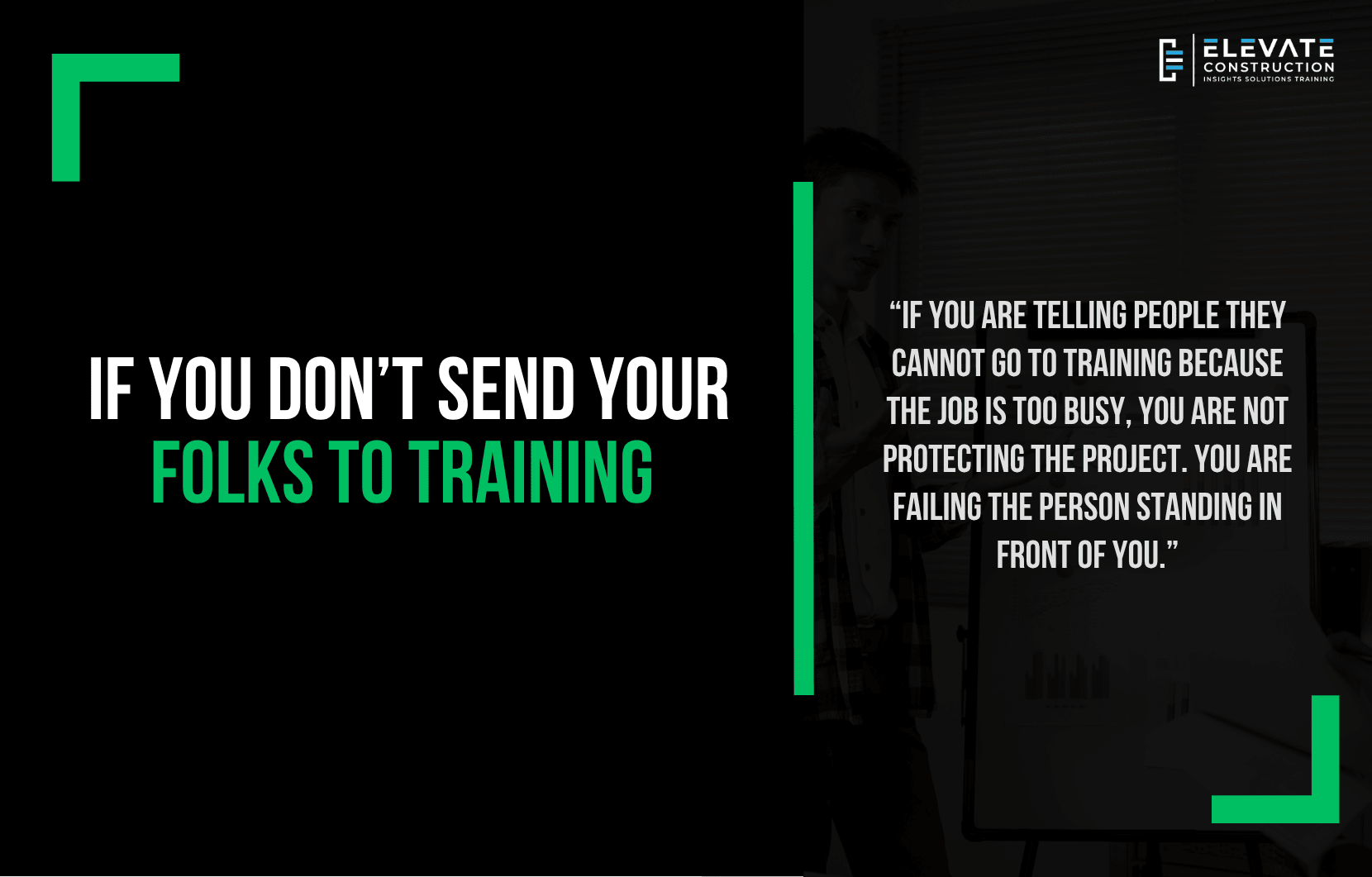
If You Won’t Let Your People Go to Training, You Are Running the Job Wrong
Let me be direct with you because this needs to be said clearly. If you have ever told someone on your project team that they cannot leave for training because you are too busy, you have just told the world three things: you do not know how to run a job, you do not care about the people you are supposed to be developing, and you are comfortable reproducing your own limitations in the next generation of builders. That is not a strong position to be in. And it is time we stop pretending it is acceptable.
The Pain That Plays Out Every Day
There is a field engineer in Flagstaff, Arizona. His company brought Elevate Construction in to run a Field Engineer Boot Camp. His superintendent refused to let him attend. There is a team in Birmingham, Alabama. Someone in that region wanted to bring a boot camp to their people. But when project managers and superintendents found out, they made it clear in tone, in words, in every signal they could send that leaving the job for training was not something they supported. So people did not go. And the opportunity to grow passed by.
These are not isolated stories. This happens all over the industry, constantly, and almost nobody calls it what it is: a failure of leadership.
The Failure Is in the Leader, Not the Schedule
Here is the logic that leaders use to justify blocking training. The job is busy. We cannot afford to lose people right now. We need everyone on site. The schedule is tight. What they are really saying when they run that logic is this: my project is so fragile, my systems are so thin, and my ability to manage the work is so dependent on everyone being present that I literally cannot function with one person missing for a few days. That is not a scheduling problem. That is a leadership problem.
A well-run project, managed by a leader with real systems and real clarity, can absorb a team member being absent for training. A project that cannot absorb that is already in trouble. The training absence did not cause the fragility. The fragility was already there, and the leader in that situation has just revealed it.
The System Failed Them But Now They Are Perpetuating It
I want to say something with empathy, even in the middle of being direct. Many of the leaders who block training were never developed themselves. They were promoted into roles without a real training pathway, placed into complex projects without adequate preparation, and left to figure it out through trial and error. The firefighting, the instinct to keep everyone close, the fear of letting go for even a few days that is what happens when someone was never given the foundation they needed. The system failed them. They did not fail the system. But here is where empathy has a limit: once you are in a position of leadership, you are responsible for what you pass on. Choosing to perpetuate the cycle is a choice.
What Blocking Training Actually Produces
When a leader tells their people they cannot go to training, three things happen. First, they hurt that person’s career directly. A field engineer who misses a boot camp because their superintendent blocked it loses not just the content of that training but the confidence, the connections, and the trajectory change that come with it. That is real professional harm caused by someone who was supposed to be building them.
Second, they model the behavior they claim to hate. The superintendent who complains that the industry does not develop enough strong leaders and then refuses to let their own people attend development training is producing exactly the outcome they are complaining about. You cannot build a better generation by handing them your worst habits.
Third, they demonstrate that they do not actually know how to develop people. The top three qualifications for a construction leader are not technical. They are: you genuinely love people, you know how to train them, and you know how to communicate clearly. A leader who says “I cannot let you go to training right now” has just disqualified themselves from all three. They are not developing anyone. They are extracting from people and calling it leadership.
Here are the signals that a leader is blocking training for the wrong reasons:
- They frame training as a disruption to the project rather than an investment in the team
- They expect people to figure out systems on their own that they themselves never learned
- They have no structured development plan for the people reporting to them
- Their project depends so heavily on individual presence that one absence creates instability
What Construction Leaders Are Actually Supposed to Do
Let me be unambiguous about this. The primary job of a superintendent, a project manager, or any leader in this industry is not to run around executing tasks. It is to build people who can execute at a high level consistently, inside a system that works. That means training people every single day in morning huddles, in one-on-one conversations, in structured development pathways. It means knowing how to transfer knowledge, how to articulate expectations, and how to create the kind of environment where someone can grow. If you are a leader in construction and you do not know how to train people, that is the gap that needs closing not the gap in your schedule caused by someone attending a boot camp.
The best superintendents are continuous learners. They are doing training themselves every year. They are reading, attending conferences, going to boot camps, getting Lean certifications. They hold their people to the same standard because they know what a career built on real development looks like versus one built on survival instincts inherited from an untrained generation. A trained, capable team member does not cost you more than they contribute. They protect your project, raise your standards, and reduce the fragility that makes you think you cannot afford to let anyone leave.
Connecting to the Mission
We build people before we build things. That is not a tagline. That is the sequence. At Elevate Construction, every boot camp, every training program, every book, every podcast is designed around one core belief: the construction industry gets better when its people get better. And people get better when leaders invest in them consistently, deliberately, and without the excuse of busyness. The job is always busy. The schedule is always tight. The leaders who build great teams invest in development anyway, because they understand that a trained team moves faster and safer than an untrained team scrambling from one fire to the next. If your project needs superintendent coaching, project support, or leadership development, Elevate Construction can help your field teams stabilize, schedule, and flow.
Send your people to training. Every time. Without hesitation. Let them develop into leaders who are better than the version of construction they inherited.
A Challenge for Every Leader Reading This
Look at your team right now. When was the last time someone on your project attended structured training outside of a toolbox talk? When was the last time you invested intentionally in the development of a field engineer, a foreman, or a project engineer who reported to you? If you cannot remember, that is the answer. Not the schedule. Not the budget. Not the busyness. The answer is that development is not yet structural on your project, and the people who work for you are absorbing the cost of that gap every single day.
As Paul Akers has said about Japan’s success, “Japan is Japan because of training.” The construction teams and companies that will define this industry twenty years from now are the ones investing in their people right now. Be one of them.
On we go.
Frequently Asked Questions
Is it ever acceptable to delay someone’s training for the project?
In rare cases, a genuine operational emergency might require a brief delay not a block. The standard should be that training gets rescheduled immediately, not shelved. A pattern of delaying training is the same as blocking it.
What if the project really is understaffed and cannot absorb an absence?
Then the staffing problem needs to be addressed, not the training. Using understaffing as a permanent justification for never developing people ensures the team stays understaffed and underprepared indefinitely.
How should a leader who blocked training in the past course-correct?
Acknowledge it, change the behavior immediately, and start investing in the team’s development now. The best time to build people was earlier. The second best time is today.
What makes someone qualified to lead in construction?
The top three qualifications are genuine care for people, the ability to train and develop others, and the ability to communicate clearly. Technical skill matters, but without those three, a leader extracts from their team rather than building it.
What are the best training options for construction leaders?
The Super PM Boot Camp and Foreman Boot Camp at Elevate Construction are purpose-built for field leaders. LeanTakt training develops production planning capability. Reading Elevating Construction Superintendents, The Lean Builder, and Patrick Lencioni’s books builds the leadership and systems thinking foundation that great leaders share.
If you want to learn more we have:
-Takt Virtual Training: (Click here)
-Check out our Youtube channel for more info: (Click here)
-Listen to the Elevate Construction podcast: (Click here)
-Check out our training programs and certifications: (Click here)
-The Takt Book: (Click here)
Discover Jason’s Expertise:
Meet Jason Schroeder, the driving force behind Elevate Construction IST. As the company’s owner and principal consultant, he’s dedicated to taking construction to new heights. With a wealth of industry experience, he’s crafted the Field Engineer Boot Camp and Superintendent Boot Camp – intensive training programs engineered to cultivate top-tier leaders capable of steering their teams towards success. Jason’s vision? To expand his training initiatives across the nation, empowering construction firms to soar to unprecedented levels of excellence.
On we go