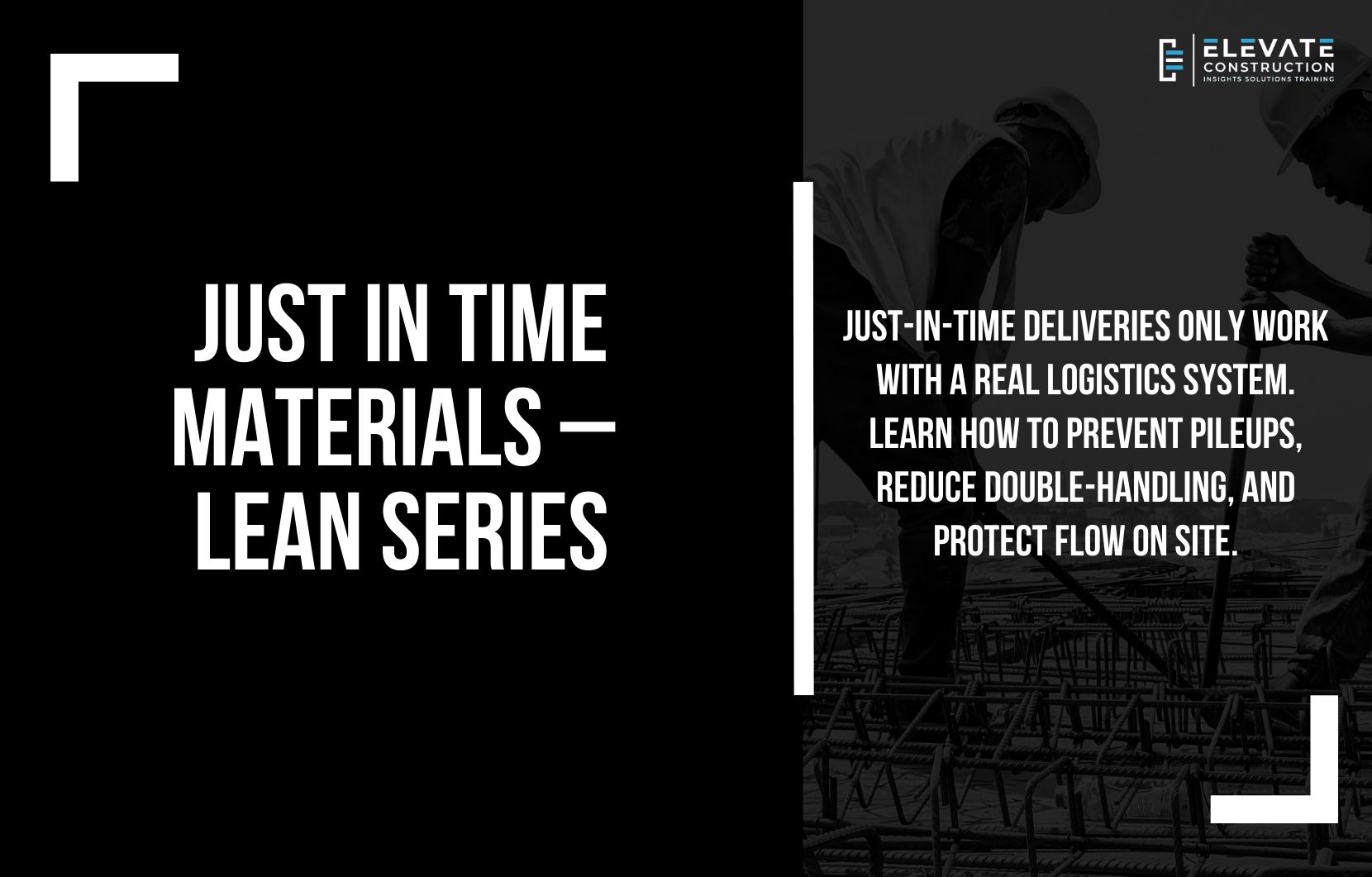
Just-In-Time Deliveries in Construction: How to Stop the Pileups and Protect Flow
Most jobsites don’t have a “materials” problem. They have a delivery system problem.Material shows up early “to be safe,” gets staged wherever it fits, gets moved again when it’s in the way, gets moved a third time when the area opens up, and then everyone wonders why the site feels congested and behind. People work hard all day, but the work doesn’t move. It’s not because crews don’t care. It’s because the system is pushing inventory instead of protecting flow.
Jason Schroeder challenges the buzzword version of “just in time.” If “just in time” means “show up whenever you want and we’ll figure it out,” then it’s not a Lean system it’s chaos with a label. The goal is not to be cute with terminology. The goal is to build a reliable rhythm that keeps the project moving without turning the site into a warehouse.
When “Just in Time” Turns Into “Just a Mess”
You’ve seen it: deliveries arrive early because the vendor had a slot. Or because someone is afraid they’ll be blamed if material isn’t on site. Or because “that’s how we’ve always done it.” The project team accepts it, because early material feels like security.But early material becomes inventory, and inventory creates congestion. Congestion creates blocked access. Blocked access creates waiting. Waiting creates schedule panic. Schedule panic creates even more “deliver it early.” It’s a loop that feels productive because trucks keep showing up, but it’s a loop that quietly kills production.
The system failed them; they didn’t fail the system. When a jobsite has no clear intake rules, no designated staging plan, and no visible delivery rhythm, the environment practically forces people into workarounds. The jobsite becomes a constant game of “move this so we can do that,” and every move is waste.
The Real Definition: What Toyota Meant (And What We Usually Miss)
Jason’s point is that Lean “just in time” was never meant to be wishful thinking. It was meant to be a tightly connected system: the right item, in the right place, at the right time, in the right quantity. That only works when upstream reliability is high and downstream needs are clear.
In construction, we often adopt the phrase but skip the system. We say “just in time” while still running projects with unreliable lookaheads, unclear zones, and constant resequencing. If the plan changes daily, deliveries cannot be truly “just in time.” They will either arrive early and pile up or arrive late and stall crews. That’s why “just in time” isn’t a procurement tactic. It’s a project management strategy. It requires coordination, make-ready, and stable sequencing. In other words, it requires a LeanTakt mindset and a Takt plan that the field can actually follow.
Why “Deliver It Early” Feels Safe but Actually Slows the Job
Early deliveries reduce one fear: “What if we don’t have it?” But they introduce five other problems: where to stage it, who protects it, how many times it gets moved, whether it blocks flow, and whether it causes damage or confusion.
When you deliver early, you’re trading short-term emotional comfort for long-term operational pain. And that pain hits the field first. It hits the foreman trying to find a clean corridor. It hits the crews pushing carts around a pile. It hits the superintendent who spends half the day negotiating space. The real issue is not people being careless. It’s that the project didn’t design logistics like a production system. If you don’t control the flow of materials, materials will control the flow of work.
The Hidden Cost Nobody Budgets: Double-Handling and Stacked Inventory
One of the biggest cost leaks on projects is double-handling. You rarely see it on a cost report because it hides inside “general conditions,” overtime, and lost productivity. Every time a pallet is moved twice, every time a delivery gets re-staged, every time a gang box becomes a junk drawer, you’re paying labor for non-value-added movement. That movement also creates quality risk: damaged material, missing pieces, wrong locations, mixed batches, lost labels. Inventory is not neutral. Inventory creates work. And when inventory creates work, it steals capacity from installation.
Buffers Aren’t Evil: The Difference Between Smart Buffers and Hoarding
Jason is clear that buffers aren’t automatically bad. The problem is unmanaged buffers that turn into hoarding. A smart buffer is intentional, sized, protected, and located based on the plan. It’s tied to a zone release and a sequence. It supports flow without flooding the site. A hoard is uncontrolled “just in case” inventory that spreads everywhere and forces the site to become a storage operation.The goal is to remove uncertainty through reliable planning, not to cover uncertainty with piles of stuff. If your project requires mountains of buffers to feel safe, the planning system needs attention.
The System That Makes JIT Possible: Reliability, Make-Ready, and a Real Plan
Just-in-time deliveries are the result of reliability, not the cause of it. You need a plan the field believes. You need a make-ready system that removes constraints before work starts. You need clear handoffs, stable access, and visible logistics rules. When those pieces are in place, deliveries can align to the rhythm of production.
This is where Takt helps. Takt creates a time-and-space rhythm that makes “when” and “where” clearer. It gives trade partners a predictable beat. When the beat is visible, logistics can be designed around it. When the beat is hidden, logistics become reactive. A project that wants Lean results must stop relying on memory and verbal direction. It must create visual management for deliveries: intake rules, staging maps, delivery windows, and ownership.
Signs Your Delivery System Is Breaking Flow
- Deliveries arrive whenever vendors feel like it, and the site “absorbs” them without intake rules.
- Material is staged in corridors or work areas, then moved multiple times as access changes.
- Crews spend time searching for components because inventory is scattered and unlabeled.
- Work gets delayed because the site is congested, not because the install crew is slow.
- Damage, missing parts, and “wrong location” issues are common because staging isn’t controlled.
How to Build a Delivery Rhythm That Trades Can Actually Follow
A delivery rhythm starts with clarity. What zones are releasing, when, and what material is truly needed for that release? Then you set delivery windows aligned to the work plan. Then you define where material will land, who receives it, and how it gets verified and staged.
This is where projects often skip the hard part: they don’t want to tell vendors “no.” They don’t want to enforce rules. They don’t want to create a controlled intake because it feels like extra work. But the alternative is uncontrolled chaos that creates far more work.
A reliable delivery rhythm also requires real conversations with trade partners. Not blame. Design. What does the crew need at the point of installation? What packaging reduces handling? What labeling reduces searching? What kitting can reduce staging space? What sequence reduces congestion? These are production design questions, not procurement arguments.
What to Do When Deliveries Fail Anyway: Recovery Without Panic
Even with a good system, deliveries will fail sometimes. A truck breaks down. A vendor ships wrong. Weather hits. The question is whether you recover with discipline or panic. A disciplined recovery starts with visibility. What is the real constraint? What is the next-best sequence that preserves flow? What can be prepped while you wait? Who needs to know, and what decision must be made quickly?
Panic recovery looks like this: flood the site with “whatever we can get,” resequence everything on the fly, and accept congestion as normal. That’s how one missed delivery turns into three weeks of instability. Jason’s reminder is simple and sharp: “Wishful thinking is not a strategy.”
If you want stability, build a system that assumes variation will happen and prepares for it.
The Breakfast Story: Why Timing Matters More Than Effort
Jason uses a simple breakfast routine to make the point. If you pour hot chocolate and then try to make pancakes, the timing can be wrong. The hot chocolate sits too long. The pancakes aren’t ready. What felt like a “simple sequence” creates frustration. So you adjust the timing. You change the order. You test. You improve. That’s continuous improvement in real life: small system changes that protect the downstream step.
Material logistics are the same. The question is not “Can we get it delivered?” The question is “Can we deliver it in a way that supports the next step without creating waste?” If the timing is off, you don’t blame the person holding the mug. You fix the sequence.
What “Reasonable Buffers” Actually Look Like
- A small, intentional buffer sized to the next zone release, not the whole building.
- Staging in a designated area mapped to access and installation, not “wherever it fits.”
- Packaging, labeling, and kitting designed to reduce searching and double-handling.
- Delivery windows tied to the lookahead and make-ready plan, not vendor convenience.
- Clear intake rules: who receives, who verifies, who owns staging, and what gets rejected.
A Culture Shift: “See as a Group, Know as a Group, Act as a Group”
When you install a delivery system, you’re not just changing logistics. You’re changing culture. You’re telling the team: we will not accept chaos as normal. We will not warehouse the project. We will design flow. We will make rules visible. We will protect corridors and access. We will coordinate as one system.
This is where visual management becomes essential. People can’t follow rules they can’t see. They can’t hit a delivery rhythm that isn’t posted. They can’t coordinate staging without maps and zones. The jobsite must be designed for interaction, not negotiation.If your project needs superintendent coaching, project support, or leadership development, Elevate Construction can help your field teams stabilize, schedule, and flow.
Bringing It Home: Stability at Work Protects Families at Home
This matters because logistics chaos doesn’t stay on the jobsite. It follows people home. When the day is spent fighting congestion, re-staging material, and managing avoidable confusion, leaders and crews carry that stress into their evenings. Families get the leftovers. Sleep suffers. Patience suffers. Health suffers.
A stable logistics system is not “nice to have.” It’s respect for people. It’s a production strategy that protects humans. LeanTakt, Takt, and visual management aren’t just about schedules. They’re about building a life where construction doesn’t require burnout.
Conclusion
If “just in time” on your project feels like a mess, don’t throw out the concept. Throw out the wishful thinking. Build the system: clear zones, clear sequencing, real make-ready, visible intake rules, and intentional buffers. Then align deliveries to flow instead of fear. The jobsite will get calmer, the work will move faster, and your leaders will spend their time removing roadblocks instead of moving piles.And keep Jason’s reminder in front of you the next time someone says, “It’ll probably be fine”: “Wishful thinking is not a strategy.”Design the rhythm. Protect the flow. Improve one step at a time.
Frequently Asked Questions
What does “just in time” actually mean in construction?
It means delivering the right material, to the right place, at the right time, in the right quantity, aligned with the production plan. It’s not a slogan—it’s the outcome of a reliable planning and logistics system.
Isn’t it safer to deliver material early so we don’t run out?
It feels safer emotionally, but early deliveries create inventory, congestion, double-handling, and damage risk. A safer system is reliable make-ready and a controlled buffer sized to the next release.
What’s the difference between a buffer and hoarding?
A buffer is intentional, sized, protected, and tied to a zone release. Hoarding is uncontrolled inventory that floods the site and forces extra movement, searching, and conflict.
How does Takt help with material deliveries?
Takt provides a clear rhythm in time and space. When zones and handoffs are visible, delivery windows and staging can be designed to match the beat, reducing variation and congestion.
What’s the first step to fixing a broken delivery system?
Make it visual and explicit: define delivery windows, create intake rules, map staging locations, and tie requests to the lookahead and make-ready process. Then enforce the system consistently.
If you want to learn more we have:
-Takt Virtual Training: (Click here)
-Check out our Youtube channel for more info: (Click here)
-Listen to the Elevate Construction podcast: (Click here)
-Check out our training programs and certifications: (Click here)
-The Takt Book: (Click here)
Discover Jason’s Expertise:
Meet Jason Schroeder, the driving force behind Elevate Construction IST. As the company’s owner and principal consultant, he’s dedicated to taking construction to new heights. With a wealth of industry experience, he’s crafted the Field Engineer Boot Camp and Superintendent Boot Camp – intensive training programs engineered to cultivate top-tier leaders capable of steering their teams towards success. Jason’s vision? To expand his training initiatives across the nation, empowering construction firms to soar to unprecedented levels of excellence.