Kaizen Culture Explained: What Continuous Improvement Really Means
In this blog, I want to break down what Kaizen truly looks like in real life, especially in construction and how you can eventually reach the daily improvement rhythm taught in Paul Akers’ 2 Second Lean. But before you get there, there are foundational elements that must be in place so the system doesn’t fall apart. If you’re interested in building a true Kaizen culture that actually works in construction, stay with me.
Seeing Waste for the First Time
If you haven’t read 2 Second Lean, read it twice. You’ll be excited, overwhelmed, and transformed. Paul Akers teaches that we are all blind, blind to waste, blind to overburden, blind to unevenness. These three things destroy flow and create bottlenecks that waste time, effort, and money.
The first step toward Kaizen is learning to see the eight wastes clearly and memorizing them until they become instinctive. Once you see them, they start to bother you, like someone just keyed your truck or left a bathroom with no toilet paper. That irritation is good. It means you’ve opened your eyes.
The Eight Wastes in Real Work
Through Paul’s framework, the wastes follow a natural chain:
- Over processing.
- Excess Inventory.
- Transportation.
- Motion.
- Defects.
- Over processing (again).
- Waiting.
- Not using the genius of the team.
And you can add a ninth: unhealthy conflict or lack of alignment, a massive problem in North America where individual agendas often overshadow teamwork. Without collaboration, no team can win.
Kaizen starts with seeing these wastes and letting them motivate small, daily improvements.
Starting Simple: 3S Every Day
It took me ten years to get to the point where improvement became a natural daily habit. Now I do 3S every day:
- Sort.
- Straighten.
- Sweep or Shine.
When you clean and straighten an area, you see everything clearly and waste becomes obvious. From there, you make fast, practical improvements.
At home, we even share improvements in our family text chat, simple fixes like reorganizing straps in Ziploc bags or backing in the vehicle to make life easier for someone else. Small wins stack fast.
What Kaizen Really Means
Kaizen literally means “change for the better.” People often misunderstand it as a three-day improvement event. That’s not Kaizen.
Kaizen is:
- Daily small improvements.
- System improvements that increase flow.
- Occasional radical improvements when needed.
Paul Akers practices all three. But the daily habit 2 Second Lean only works when the environment supports it.
How We Built Kaizen Into Our Companies
In our companies at Elevate and LeanTakt, it took five years to create a consistent Kaizen culture.
Year 1: Teach the concept.
Year 2: Model improvements.
Year 3: Require daily huddles with improvement sharing.
Year 4: Everyone makes one improvement every two weeks.
Year 5: Everyone makes one improvement every week.
Now with 85 people, that’s roughly 48 improvements per person per year, thousands of improvements annually. And it has transformed us.
We even created a YouTube channel to share before-and-after videos from our team. Gamification helped. Rewards were small but effective. The improvements themselves became the real motivation.
Applying Kaizen in Construction
You absolutely can create a Kaizen culture as a superintendent. I did it every day on site.
Here’s what worked:
- Teaching the eight wastes in orientation.
- Memorizing them with the team.
- Modeling improvements.
- Rewarding workers who submitted before-and-after videos.
- Using the morning worker huddle to share wins.
At one project, I collected over 160 meaningful improvement videos from the team. The jobsite became clean, safe, organized, and stable. It was remarkable.
The Six Prerequisites for Kaizen in Construction
You cannot start Kaizen without these essentials:
- Respect for people and resources
- Stability: a clean, safe, organized site
- One-piece flow
- Takt time: everyone working at the same rhythm
- Visual systems for total participation
- Quality through continuous improvement
If workers can’t see together, they can’t improve together. If bottlenecks aren’t fixed, flow collapses. If flow isn’t aligned, improvement dies. If stability is missing, nothing works. And if respect is missing, forget Kaizen entirely.
The Heart of Kaizen
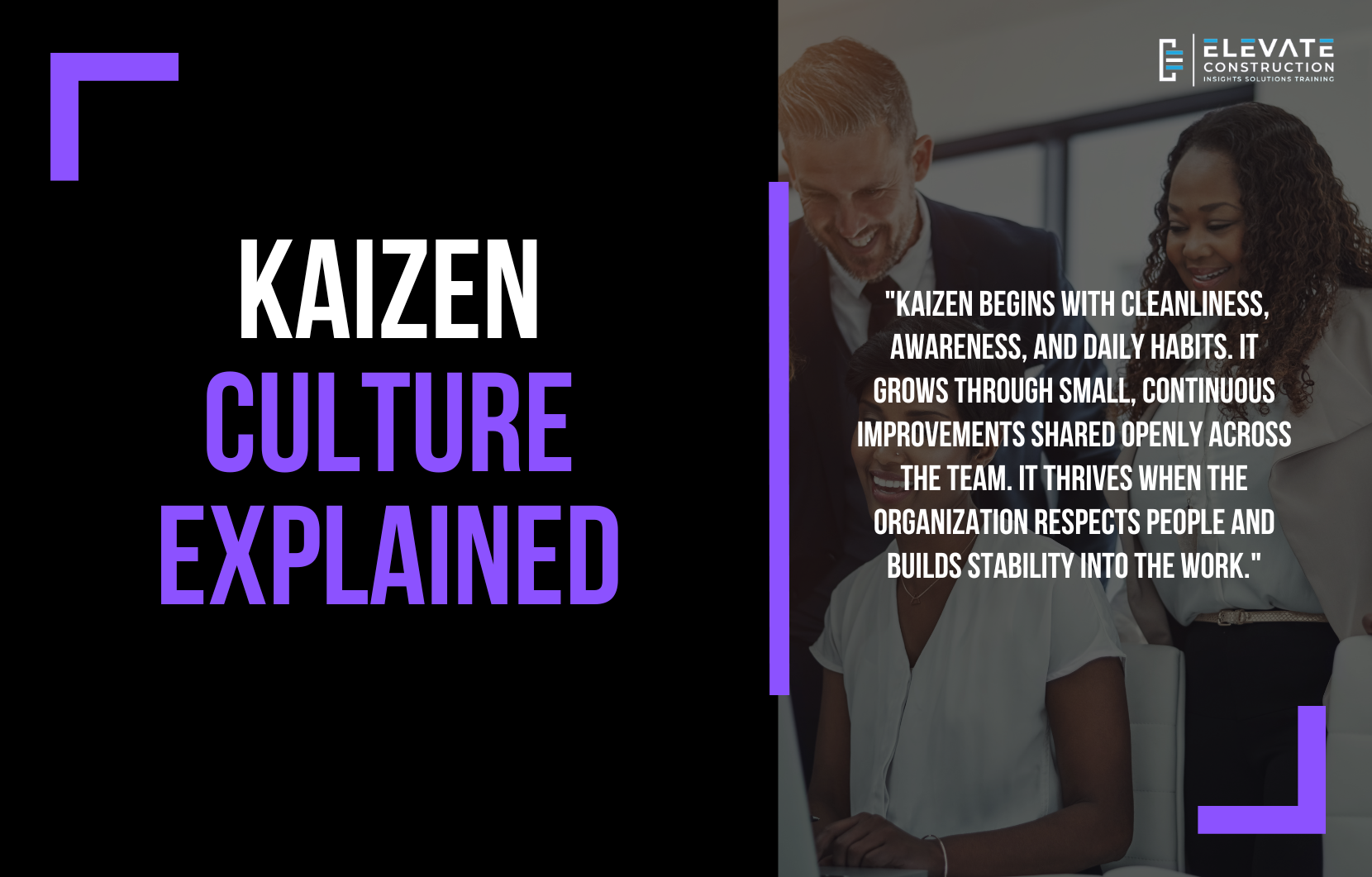
Kaizen begins with cleanliness, awareness, and daily habits. It grows through small, continuous improvements shared openly across the team. It thrives when the organization respects people and builds stability into the work.
I’ve implemented Kaizen both in the field and inside our companies, and it remains one of the most powerful cultural transformations available.
If you want to learn more we have:
-Takt Virtual Training: (Click here)
-Check out our Youtube channel for more info: (Click here)
-Listen to the Elevate Construction podcast: (Click here)
-Check out our training programs and certifications: (Click here)
-The Takt Book: (Click here)
Discover Jason’s Expertise:
Meet Jason Schroeder, the driving force behind Elevate Construction IST. As the company’s owner and principal consultant, he’s dedicated to taking construction to new heights. With a wealth of industry experience, he’s crafted the Field Engineer Boot Camp and Superintendent Boot Camp – intensive training programs engineered to cultivate top-tier leaders capable of steering their teams towards success. Jason’s vision? To expand his training initiatives across the nation, empowering construction firms to soar to unprecedented levels of excellence.
On we go