The Day I Realized “Cognitive Decline” Wasn’t About Age
There are moments on a jobsite that wake you up. Not the dramatic ones with sirens and incident reports, but the quiet ones that hit you in the ribs because they’re true. I was walking a complex building with a field engineer who was doing everything right. He had drive, follow-up, tenacity, and that builder mindset that you can’t fake. He was accountable, he held trade partners to standards, and he was clearly on a trajectory. Then he looked over at me and said, “Jason, I’ve gained a little weight. I don’t feel as well as I usually do. Do you have any recommendations?”
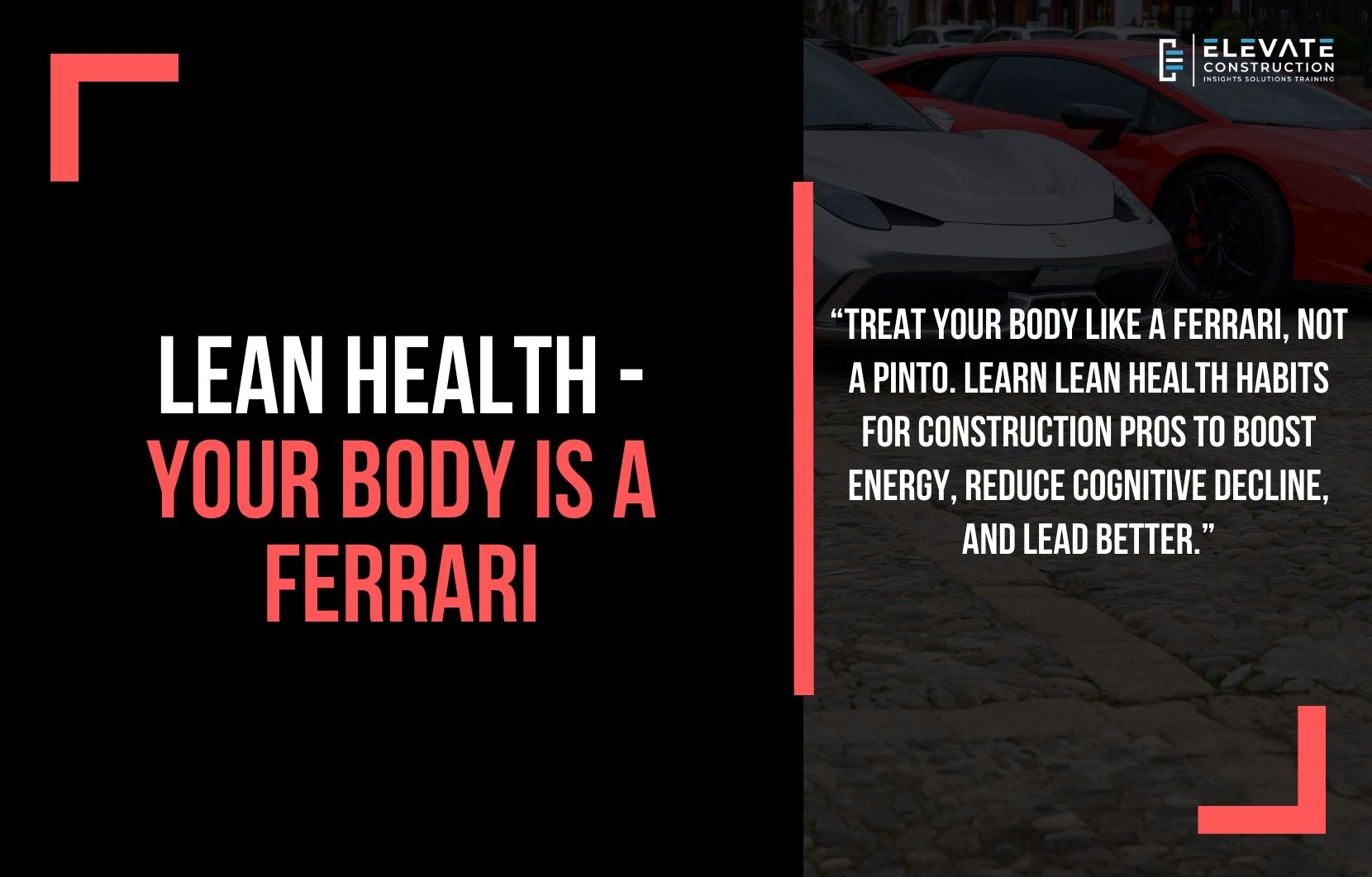
That question landed harder than it should have, because I realized something about myself. I’ve learned a lot about health, I’ve studied a lot of systems, and I’ve lived enough life to see patterns. But I don’t always share what I know until somebody asks, and that’s a blind spot for me. In that moment I thought, I do have something. Something simple enough to actually work for construction people with real lives. Something implementable. I told him about Paul Akers and Lean Health. And when I checked in later, he said the first thing he got from the book was this idea: “Your body is a Ferrari, not a Pinto.” If that’s all he ever took from it, it would still be worth it. Because in construction we keep treating our bodies like disposable equipment, and then we act surprised when our minds slow down, our moods dip, and our energy disappears. We call it stress. We call it getting older. We call it “just the industry.” But a lot of what we’re experiencing is self-inflicted, and it shows up as what I call cognitive decline. Not dementia. Not some clinical diagnosis. I mean that foggy, tired, reactive state where you cannot think clearly, cannot study, cannot lead, cannot be present at home, and cannot bring your best to the field. And for an industry that depends on sharp thinking, quick decisions, and stable leadership, that’s a serious problem.
The Construction Pain We Don’t Admit Out Loud
Construction professionals are some of the toughest people I’ve ever met. That toughness is part of what makes this industry great. It’s also part of what’s hurting us, because we’ve turned toughness into neglect. We skip workouts. We live on gas station food. We run on caffeine and stress. We work too many hours, go home too late, and we pretend our bodies will just keep performing forever. But your body is the vehicle your mind is driving. If the vehicle is breaking down, the driver can’t do the job. When your energy drops, your patience drops. When your patience drops, your leadership suffers. When your leadership suffers, the jobsite becomes reactive. When the jobsite becomes reactive, we create chaos. And then we demand that workers pay for the chaos with their bodies, their time, and their families. That’s not a toughness badge. That’s a system failure.
We want operational excellence, stable flow, and strong teams. We want people respected and families protected. But you cannot build stability when leaders are running on fumes. You cannot coach, train, and develop others when your own mind is dulled by poor fuel and lack of movement. If we’re serious about LeanTakt, flow, and predictable performance, we need to be serious about health. Because health is upstream of everything.
Treating a Ferrari Like a Pinto
Paul Akers frames it in a way that is almost too perfect. If you bought a Ferrari, you would not put junk fuel in it. You would not skip maintenance. You would not drive it into the ground and then act offended when it fails. You’d protect it because it’s valuable. Your body is more valuable than a Ferrari. It carries your mind. It carries your leadership. It carries your ability to love your family well. And yet we treat it like a Pinto. We feed it whatever is fast. We ignore maintenance. We accept “good enough” until it becomes pain, inflammation, fatigue, and brain fog. Then we try to solve it with some extreme plan that isn’t sustainable, we fail, and we conclude nothing works. That’s why I like the Lean Health approach. It’s not built on willpower. It’s built on simplicity, consistency, and a system.
I’m Not Saying This From a High Horse
I’m not sharing this because I’m perfect. I’m sharing it because I’ve been on both sides of it. I’ve had seasons where my energy dropped and my mind didn’t want to read. I’ve had seasons where I felt dull and bored and distracted, and I knew it wasn’t who I really was. I’ve also had seasons where I was on point, reading constantly, learning constantly, showing up with clarity and joy. The difference wasn’t talent. It wasn’t discipline. It was fuel and movement and sleep and the basics. When I came back to those basics, my mind came back. And that matters, because my mission is not just projects. It’s people. It’s workers. It’s families. It’s giving construction professionals a way to live a remarkable life without burning out. That’s why I’m willing to talk about health in the same breath as operational excellence.
Energy Is a Moral Obligation as a Leader
This might sound intense, but I mean it respectfully. If you’re leading people, your energy is not only “your business.” It’s a responsibility. Because your mood and your clarity and your patience create the environment everyone else has to live in. A tired leader is more reactive. A reactive leader causes variation. Variation causes rework. Rework causes overtime. Overtime hurts families. Families break down. People burn out. Workers get injured. Then we all sit around acting confused about why the industry is riddled with stress and dysfunction. If you want to protect people and stabilize flow, start with the basics. Take care of the Ferrari.
Lean Health in Plain, Field-Ready Terms
Lean Health, as shared in the transcript, is built on a handful of principles that are simple enough to implement without turning your life into a science project. It starts with the Ferrari mindset, then moves into food, movement, and habit design. On the food side, the core idea is that most of your intake should be fruits and vegetables, with a smaller portion of protein like fish, chicken, cheese, nuts, and similar foods. It also includes a strong bias away from highly processed foods, sugary drinks, and artificial sweeteners. The key isn’t perfection. The key is building a sustainable pattern where you fuel your body with what it was designed to run on. On the movement side, the method is straightforward. Daily steps, basic bodyweight exercises, and simple substitutions like stairs instead of elevators. This is not about becoming a fitness influencer. It’s about preserving cognitive sharpness, stabilizing mood, and keeping your body capable enough to support the life you want. LeanTakt teaches us to stabilize the system. Health is the same. You’re not chasing a temporary peak. You’re building a stable baseline where your energy is predictable and your mind is clear.
What “Treat It Like a Ferrari” Looks Like on a Real Workweek
These are the kinds of small, natural shifts that fit a construction life without turning it into a checklist identity.
- Choosing water and real food when you’re tired instead of soda, energy drinks, and processed snacks that spike and crash you.
- Building a go-to “default meal” that’s simple and repeatable so you don’t have to negotiate with yourself every day.
- Using the jobsite itself to get steps and movement instead of waiting for the perfect gym routine that never happens.
- Scheduling basic maintenance habits the way you schedule critical work, because you are the critical piece of the system.
Those moves don’t look dramatic, but they compound. In the field, compounding wins.
Make It Implementable, Not Inspirational
Here’s what I want you to take away. Don’t turn this into a motivational poster. Turn it into a system. If your health plan requires a perfect day, it will fail. Construction doesn’t produce perfect days. It produces variability. Weather changes. Deliveries change. Meetings blow up. Problems show up. That’s why your health approach must be stable under pressure. Start by adopting the Ferrari mindset and one or two habits you can sustain. If that’s movement, choose daily steps and a simple bodyweight routine. If that’s food, start by eliminating one major source of junk and replacing it with something you actually enjoy that still fuels you well. Then protect that habit the same way you protect flow on a project. You don’t let random variation destroy your rhythm. You build make-ready. You plan ahead. You set your environment up so the right choice is the easy choice. If your project needs superintendent coaching, project support, or leadership development, Elevate Construction can help your field teams stabilize, schedule, and flow. And I’ll add this with equal conviction: if you want to lead well, you need a body and mind that can carry leadership without collapsing.
Signs You’re Slipping Into Cognitive Decline at Work
This is not a judgment list. It’s a reality check. If you see these patterns, it’s a signal to adjust the system.
- You stop reading, studying, or learning, not because you don’t care, but because you feel mentally tired all the time.
- You feel reactive and impatient in conversations that you normally could handle calmly.
- You rely on caffeine and sugar to “get through the day,” and you crash hard afterward.
- You feel a low-grade fog where details slip and you lose the sharpness you used to have.
If those are happening, don’t shame yourself. Fix the inputs.
Protect Dignity, Protect Flow, Protect Families
I care about this topic because I care about workers and families. When leaders are unhealthy, the whole system pays for it. And usually the people who pay first are the ones with the least power to change the environment. If you stabilize your energy, you stabilize your leadership. If you stabilize leadership, you stabilize planning. If you stabilize planning, you stabilize flow. If you stabilize flow, you stop asking workers to absorb schedule failure with their bodies and their time. That’s respect. This is not vanity. This is stewardship. You have one body. You have one mind. You have one life. Treat it like the remarkable machine it is.
Connecting to Elevate Construction’s Mission
At Elevate Construction, our mission is to pull people up to where they want to be. That includes field performance, leadership, LeanTakt, and operational excellence. It also includes the personal side, because you cannot separate the builder from the human being. We want you sharp. We want you energized. We want you learning. We want you present at home. We want you fulfilled. We want you in a position to coach others, build great teams, and create stable work that protects people. That starts with fuel. That starts with movement. That starts with treating your body like a Ferrari.
The Challenge
Here’s the challenge I want to leave you with. Pick one habit this week that honors the Ferrari. One. Not ten. Not a complete life overhaul. One habit that you can repeat until it becomes normal. Then notice what happens to your mind. Notice what happens to your mood. Notice what happens to your leadership. Notice what happens at home when you have energy left over. That is the whole point. Edwards Deming said, “It is not necessary to change. Survival is not mandatory.” If you want a remarkable life in construction, choose change on purpose.
FAQ
What does Jason Schroeder mean by “cognitive decline” in construction?
In this context, it means the mental fog, low energy, and reduced focus that come from poor fuel, lack of movement, and chronic stress, not necessarily age-related conditions.
How does Lean Health apply to construction professionals?
Construction schedules are variable, so health needs a simple, repeatable system. Lean Health emphasizes practical inputs like better food choices, consistent movement, and habits that hold up under pressure.
Do I need a strict diet to get results?
No. The goal is sustainability. Start with a few changes you can maintain, such as removing sugary drinks, reducing processed foods, and building a default meal routine you enjoy.
How does health connect to LeanTakt and flow?
Leaders with stable energy make better decisions and create more predictable planning. Predictability reduces variation, which protects flow, reduces rework, and prevents burnout.
How can Elevate Construction support teams beyond scheduling?
Through superintendent coaching, project support, and leadership development, Elevate Construction helps teams stabilize their systems so they can plan, execute, and flow without sacrificing people.
If you want to learn more we have:
-Takt Virtual Training: (Click here)
-Check out our Youtube channel for more info: (Click here)
-Listen to the Elevate Construction podcast: (Click here)
-Check out our training programs and certifications: (Click here)
-The Takt Book: (Click here)
Discover Jason’s Expertise:
Meet Jason Schroeder, the driving force behind Elevate Construction IST. As the company’s owner and principal consultant, he’s dedicated to taking construction to new heights. With a wealth of industry experience, he’s crafted the Field Engineer Boot Camp and Superintendent Boot Camp – intensive training programs engineered to cultivate top-tier leaders capable of steering their teams towards success. Jason’s vision? To expand his training initiatives across the nation, empowering construction firms to soar to unprecedented levels of excellence.
On we go