The Levels of Lean Implementation (It Takes Five to Ten Years, Not Instant Pudding)
Here’s something that’s going to disappoint people who want quick fixes: Lean implementation takes five to ten years. Not five to ten months. Not five to ten quarters. Five to ten years. And if you’re not willing to put in that time, you’re not implementing Lean. You’re pretending. You’re selling instant pudding to clients and giving Lean a bad name.
This is about the actual phases of Lean development and why most companies fail before they even start.
The Pain of Instant Pudding Thinking
W.Edwards Deming said that it’s going to take five to ten years to implement Lean in a company. I found that nowadays we can do it much faster. You know, like for instance, Pepper Construction with Coach Schmidt did it in two years. High Street Ventures did it in two years. It’s pretty fast. But in the book Toyota by Toyota, W. Edwards Deming says that all leaders, or not all leaders, but most leaders want instant pudding. Just add water and it’s done. Well, you can’t do that. You can’t do that. You have to put in the time.
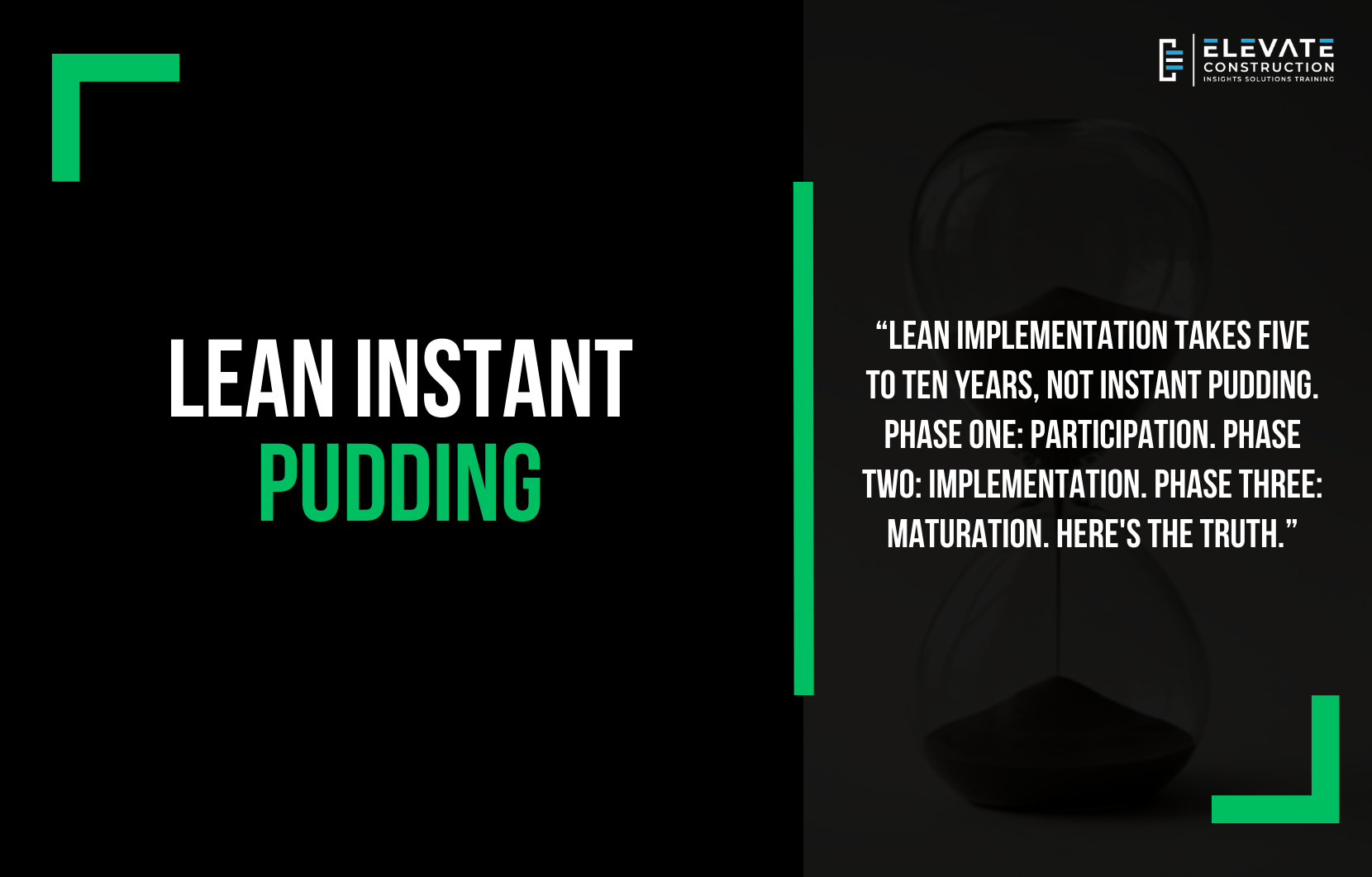
And so, one of the things they said is when you’re introducing and trying to get people to participate, you’re talking about a minimum one to three years. And the first phase is introducing Lean and getting people to participate. And the timeline in here can kind of vary, but the participation phase where you’re getting people to participate can be one to three years.
Phase two, this is a transition where participants go to Lean implementers and developers. Meaning they’re actually helping to develop and implement the system and they’re part of the Lean system. And that can take one to two years.
And then phase three, that’s after that. That’s after two to five years, you have process maturation where the system evolves as a Lean culture grows and matures. And it is self-sustaining.
Here’s the problem. Most companies think they can skip the phases. They want instant pudding. They want to announce they’re Lean on Monday, do a kaizen event on Tuesday, and have a transformed culture by Friday. And when it doesn’t work, they blame Lean. They say, “We tried it. It didn’t stick.” But they didn’t try Lean. They tried instant pudding. And instant pudding isn’t Lean.
The Three Phases of Lean Implementation
Let me break down the three phases clearly so you understand what it actually takes.
Phase One: Introduction and Participation (One to Three Years)
This is where you introduce Lean and get people to participate. Not just comply. Participate. You’re training. You’re modeling. You’re doing gemba walks. You’re holding standards. You’re showing the team that Lean is real, not a flavor of the month. And this takes one to three years because people need to see that leadership is serious. They need to see that the standard won’t slip. They need to see that you’re willing to invest in training, send people to Japan, work shoulder to shoulder, and protect them when pressure comes.
Most companies fail in phase one because leadership delegates it to middle management, the standard slips, and people learn it’s optional. You can’t skip phase one. You can’t rush it. And you can’t fake it.
Phase Two: Implementation and Development (One to Two Years)
This is the transition where participants become implementers and developers. They’re not just following the system. They’re helping to build it, refine it, and improve it. They’re running kaizen events. They’re training others. They’re identifying waste and solving problems. They’re part of the Lean system, not just recipients of it.
This phase takes one to two years because transformation doesn’t happen overnight. People need time to develop the skills, the mindset, and the habits. And leadership needs to support them every step of the way. You can’t rush this phase either. And you can’t skip the development work.
Phase Three: Maturation and Self-Sustaining Culture (Two to Five Years and Beyond)
This is where the system evolves as the Lean culture grows and matures. The system becomes self-sustaining. People improve without being told. Standards hold without constant enforcement. The culture reinforces itself. And Lean becomes the way we work, not a program we run.
But you only get here after two to five years of sustained effort. And most companies never make it because they gave up in phase one or two when they didn’t see instant results.
The Two Non-Negotiables: Caring About People and Being Fanatical About Improvement
So, the only people that I’ve ever known to implement Lean well, they have to have two things. And I’ve checked all of our clients. If they don’t have these two things, it will fail.
Number one is they have a genuine desire to bless the lives of people. Number two, they are interested, highly interested, I would say, or addicted to improvement.
And that seems simple. And you’re like, “Yeah, we have that.” But do you? Do you? Like, this is not bragging, but here are a couple of things:
- We shut down our company and force our people to take six weeks PTO every year
- We shut down two weeks over the holidays even when we were super busy with client work
- When it came time to send multiple people to Japan for training, we spent the money that Kate and I probably could have used to buy a bigger house instead, we sent people to training
- When it comes down to protecting our people or following the crazy whims of a specific client, we take care of our people
Do you really care about people? Are you willing to put in the time? Are you willing to put in the training? Are you willing to work with them shoulder to shoulder?
And then when it comes to improvement, do you just say you want improvement? Do you want to look good? Or do you really care about improving things? Are you doing improvements yourself? Are you, as the CEO, as the leader, as the department head, doing the improvements yourself? Are you utilizing the systems yourself? Are you avoiding email yourself? Are you doing the right things yourself?
The companies that take Lean and run with it care about people and are fanatical about improvement. And they understand that nothing happens fast.
Why Instant Pudding Thinking Destroys Lean
Like if anybody actually thinks about it, how long do you think it took that company to start the company? How long do you think it took them to implement a leadership team? How long do you think it took them to stabilize their marketing and their branding? How long do you think it took them to get through their first couple jobs? You’re talking about five, ten, fifteen, twenty years. And then all of a sudden Lean, a new operating and business system, is supposed to just come in like instant pudding. It’s ridiculous.
When people want to implement Lean as instant pudding, it means they actually aren’t focused currently on improving people and improving things. It means that it’s just something that they can do for show or it’s on the next proposal.
And I do want to say, shame on you, general contractors that are pretending and lying about being Lean and telling clients that you’re Lean and you’re not. That’s so disgusting. In fact, it’s not just dishonest, but you’re taking the industry backwards because now you’re selling something that isn’t real and you’re giving Lean a bad name. Shame on you.
If I go up into Michigan and you say the word Lean, you’ll almost get attacked. It’s like you walking into a bar saying, “God save the king.” You’re going to get attacked. It’s like that scene from The Patriot when Mel Gibson walks into a tavern and does that. People are going to start throwing tomatoes at you. If you say Lean in Michigan to somebody, they’re going to think you’re dumb. Why? Because these car companies tried to steal concepts from Japan and Toyota and implement them for the purpose of improving costs and more productivity without the promise of respect for people.
Respect for People First, Everything Else Second
And I got to be careful because I don’t want to be too critical. There’s a new CEO for a new Lean organization that went on and did a video. And if you listen to him talk, he said that they were going to try and scale Lean for the purpose of cutting costs and being more productive. And if you actually go dig into that organization, they’re one of the most un-Lean organizations in the world. It’s just classical management trying to capitalize on Lean thought. Shame on them.
Lean is about respect for people first. Other things can come in. You can make money later, but it’s respect for people. And it’s a commitment to improvement first.
So, I didn’t mean for this to be a lecture, but it’s definitely a point that has to be made. And it takes time. We’ve got to stop having classical management people in classical management wolves in Lean sheep’s clothing. And we have got to stop thinking that you can get instant pudding. If your project needs superintendent coaching, project support, or leadership development, Elevate Construction can help your field teams stabilize, schedule, and flow.
A Challenge for Leaders
Here’s what I want you to do this week. If you’re thinking about implementing Lean or if you’re in the middle of it, ask yourself these two questions: Do I genuinely care about blessing the lives of people? And am I fanatical about improvement?
If the answer is yes, commit to the five to ten years. Don’t look for instant pudding. Invest in phase one: get people to participate. Then invest in phase two: help them become implementers and developers. Then invest in phase three: let the culture mature and become self-sustaining. Don’t skip phases. Don’t rush. Don’t delegate it to middle management and hope it works.
And if you’re selling Lean to clients when you’re not actually Lean, stop. You’re taking the industry backwards. You’re giving Lean a bad name. And you’re lying. Do the work. Put in the time. Respect people first. Improve fanatically. And understand that nothing worth doing happens fast. As we say at Elevate, Lean takes five to ten years, not instant pudding. Commit to the journey. Protect your people. Improve every day. And let the culture mature.
On we go.
Frequently Asked Questions
How long does it actually take to implement Lean?
Five to ten years for full maturation. Some companies can do it faster Pepper Construction and High Street Ventures did it in two years but you’re still looking at a minimum of one to three years just to get people to participate, another one to two years to develop implementers, and two to five years for the culture to mature and become self-sustaining.
What are the three phases of Lean implementation?
Phase one: Introduction and participation (one to three years). Phase two: Implementation and development (one to two years). Phase three: Maturation and self-sustaining culture (two to five years and beyond). You can’t skip phases or rush the timeline.
What are the two non-negotiables for successful Lean implementation?
One: A genuine desire to bless the lives of people. Two: Being fanatical about improvement. If you don’t have both, Lean will fail. You can’t fake caring about people. And you can’t fake being addicted to improvement.
Why do most companies fail at Lean implementation?
Because they want instant pudding. They delegate it to middle management. They don’t invest in training. They don’t protect people. They don’t model improvement. And they give up when they don’t see instant results. Lean takes time. Most companies aren’t willing to put in the work.
What’s wrong with implementing Lean to cut costs and increase productivity?
Because that’s classical management disguised as Lean. Lean is respect for people first. Other benefits come later. If you implement Lean to cut costs without respecting people, you’re not doing Lean. You’re exploiting people and giving Lean a bad name. Michigan hates Lean because car companies did exactly this.
If you want to learn more we have:
-Takt Virtual Training: (Click here)
-Check out our Youtube channel for more info: (Click here)
-Listen to the Elevate Construction podcast: (Click here)
-Check out our training programs and certifications: (Click here)
-The Takt Book: (Click here)
Discover Jason’s Expertise:
Meet Jason Schroeder, the driving force behind Elevate Construction IST. As the company’s owner and principal consultant, he’s dedicated to taking construction to new heights. With a wealth of industry experience, he’s crafted the Field Engineer Boot Camp and Superintendent Boot Camp – intensive training programs engineered to cultivate top-tier leaders capable of steering their teams towards success. Jason’s vision? To expand his training initiatives across the nation, empowering construction firms to soar to unprecedented levels of excellence.
On we go