
The Cords on Your Floor Are Telling You Something
Here’s the deal: every cord running across a construction floor is a design decision somebody didn’t make. Not a bad crew. Not a careless foreman. A system gap. Nobody designed a better option, so the extension cord went to the floor, the spider box followed it, and within a week the corridor looks like a tangle of orange and yellow that every worker has learned to step over without thinking. The floor clutter becomes invisible until someone trips, or a scaffold can’t pass, or a new worker on their first day nearly goes down in the middle of a pour. That’s when you realize what you normalized.
What Cord Clutter Is Doing to Your Project
Walk any active mid-rise floor during an intensive MEP phase. Count the cords crossing pedestrian paths. Count how many times in a single hour equipment has to pause or reroute because a power distribution point is planted in the middle of a travel lane. Count the seconds workers spend stepping around, lifting over, or re-routing cords that were there yesterday and will be there tomorrow. None of it shows up in the schedule. None of it gets attributed to the power distribution setup. It just gets absorbed as friction and friction accumulates quietly until the pace of work reflects it and nobody can explain why.
Cord management is listed by Jason Schroeder as a core element of 5S in construction precisely because it generates waste across multiple categories at once. Motion waste from navigating around cords. Waiting waste when equipment can’t pass. Safety risk from tripping hazards at the point of work. And a visual environment that signals disorder which means problems hide in the clutter longer before anyone catches them. A clean floor reveals issues early. A floor covered in cords hides everything.
The System Failed Them
I was on a project years ago where a journeyman went down hard stepping over a cord run on a concrete floor. Not a dramatic fall but he tweaked his knee badly enough to be off the job for two weeks. When we did the review, the cord had been in that same position for eleven days. Eleven days of every person on that floor stepping over it. Nobody removed it. Nobody raised it. Not because they were complacent because the system had normalized it. No one had established a standard that cords stay off pedestrian paths. No one had provided a tool to put the spider box somewhere other than the ground.
That worker’s injury was not a behavior failure. It was a system failure. The system allowed a tripping hazard to persist for nearly two weeks on an active floor because nobody had designed the alternative. They didn’t fail the system. The system failed them.
What the Magnetic Spider Box Actually Solves
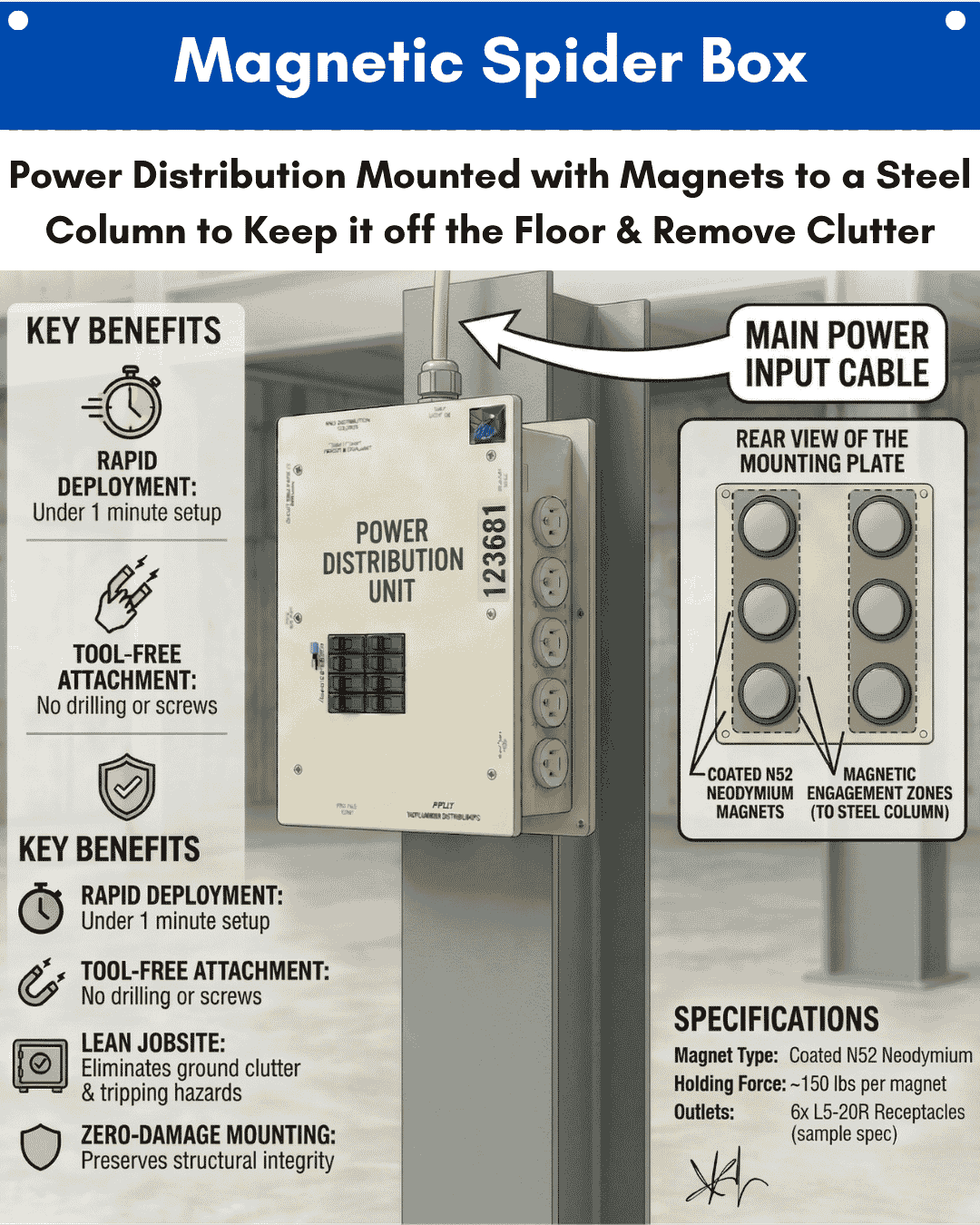
The magnetic spider box shown in this post takes the spider box a piece of equipment that has lived on the floor since construction began using temporary power and removes it from the floor permanently. The mechanism is industrial-strength coated N52 neodymium magnets on the rear mounting plate, each rated at approximately 150 pounds of holding force. The unit mounts directly to a steel column in under a minute with no tools, no drilling, no screws, and no damage to the structure. It comes off just as fast when the scope moves and the power point needs to move with it.
The result is immediate and completely visible. The access path is clear. Cords run vertically from the column to the equipment rather than horizontally across the floor. The tripping hazard ceases to exist because the source has been elevated. The six standard receptacles give the crew full functionality nothing about the power capacity or distribution changes. The only thing that changes is where the unit lives, and that one change resolves the safety problem, the motion waste problem, and the zone cleanliness problem simultaneously.
Watch for these signals that temporary power is generating unnecessary waste on your project:
- Spider boxes sitting on the floor inside active pedestrian or equipment travel paths
- Extension cords crossing corridor paths at floor level in multiple locations
- Scaffolding or rolling equipment requiring cord relocation before it can transit the zone
- Temporary power that hasn’t moved with the work as the scope advanced through the building
Teaching the Framework: Nothing Hits the Floor
Jason Schroeder teaches one of the most practical 5S principles in construction: nothing hits the floor. Materials don’t hit the floor. Tools don’t hit the floor. Packaging doesn’t hit the floor. And power distribution equipment doesn’t hit the floor either. When something occupies the floor that shouldn’t be there, it forces everyone in the zone to adapt their movement around it. That’s motion waste. That’s waiting waste. That’s a safety condition waiting to activate. And it broadcasts a standard whatever is on the floor defines the setpoint for what’s acceptable in that zone.
5S Set in Order says every element of the work environment needs a defined place that is accessible without creating hazards for the people around it. For temporary power, that place has always been the floor not by design, but by default. The magnetic spider box gives it a real place: mounted to the column, off the floor, out of the travel plane. That’s Set in Order applied to a problem the industry has accepted for decades without questioning it.
The rapid deployment time is equally important to how the system supports production. Under one minute from grab to mounted means a crew leader can relocate the power point as the scope moves through the zone without scheduling a task, without waiting for an electrician to be available for a setup move, and without disrupting the production rhythm to manage a logistics detail. The unit moves with the work. That’s point-of-use thinking applied to temporary power the power is where the work is, when the work needs it, without creating problems for everything around it.
Why This Protects the People Doing the Work
There is a human dimension behind the cord clutter conversation that rarely gets acknowledged. The worker who has spent ten years in the field has stepped over thousands of cords. They have compensated for dozens of spider boxes in bad locations. They have rerouted equipment around temporary power setups that nobody thought through. That cumulative adaptation the daily, invisible tax of fighting a work environment that was not designed for them erodes the experience of the craft. It says the people responsible for this project didn’t think about what this floor needs to feel safe and organized. When leaders design the environment intentionally when they eliminate the cord clutter, mount the power off the floor, and build a zone that communicates care workers feel it. That’s not a soft outcome. That’s a production outcome. Crews who are not fighting their environment build better work faster and with more pride in the result.
If your project needs superintendent coaching, project support, or leadership development, Elevate Construction can help your field teams stabilize, schedule, and flow. Designing the work environment from the staging yard to the spider box is where that stability becomes real.
Design the Work. Don’t React to It.
Walk your project this week and look at every spider box on every active floor. Ask one question: is it on the floor? If the answer is yes, ask the follow-up: did we design it that way, or did it just end up there? For the vast majority of projects, it ended up there. Nobody made a decision. Nobody had a better option. The magnetic spider box is that better option simple, strong, fast, and completely reversible as the work moves.
Paul Akers says fix what bugs you. Cords on the floor have bugged every person who has ever worked on a construction project. The tool to fix it exists. Use it.
On we go.
Frequently Asked Questions
What is a magnetic spider box and how does it work?
It’s a power distribution unit with industrial N52 neodymium magnets on the rear plate that mount directly to a steel column no tools, no drilling, in under a minute.
How strong is the magnetic mount and is it safe to use in the field?
Each coated N52 magnet provides approximately 150 pounds of holding force, making the unit stable under normal construction operating conditions and easy to reposition as work moves.
Does the magnetic mounting damage the steel column?
No. The magnets engage the column surface without penetration, preserving structural integrity and eliminating the permission and repair cycle that comes with drilling into building steel.
How does this connect to Lean construction and 5S?
It’s a direct application of 5S Set in Order and the “nothing hits the floor” principle giving temporary power a designated place off the floor so access paths stay clear and tripping hazards are designed out.
When should the unit be moved as the project progresses?
Reposition it at every zone transition so cord runs stay short and power stays at the point of work the same discipline applied to mobile material carts and rolling tool stations.
If you want to learn more we have:
-Takt Virtual Training: (Click here)
-Check out our Youtube channel for more info: (Click here)
-Listen to the Elevate Construction podcast: (Click here)
-Check out our training programs and certifications: (Click here)
-The Takt Book: (Click here)
Discover Jason’s Expertise:
Meet Jason Schroeder, the driving force behind Elevate Construction IST. As the company’s owner and principal consultant, he’s dedicated to taking construction to new heights. With a wealth of industry experience, he’s crafted the Field Engineer Boot Camp and Superintendent Boot Camp – intensive training programs engineered to cultivate top-tier leaders capable of steering their teams towards success. Jason’s vision? To expand his training initiatives across the nation, empowering construction firms to soar to unprecedented levels of excellence.