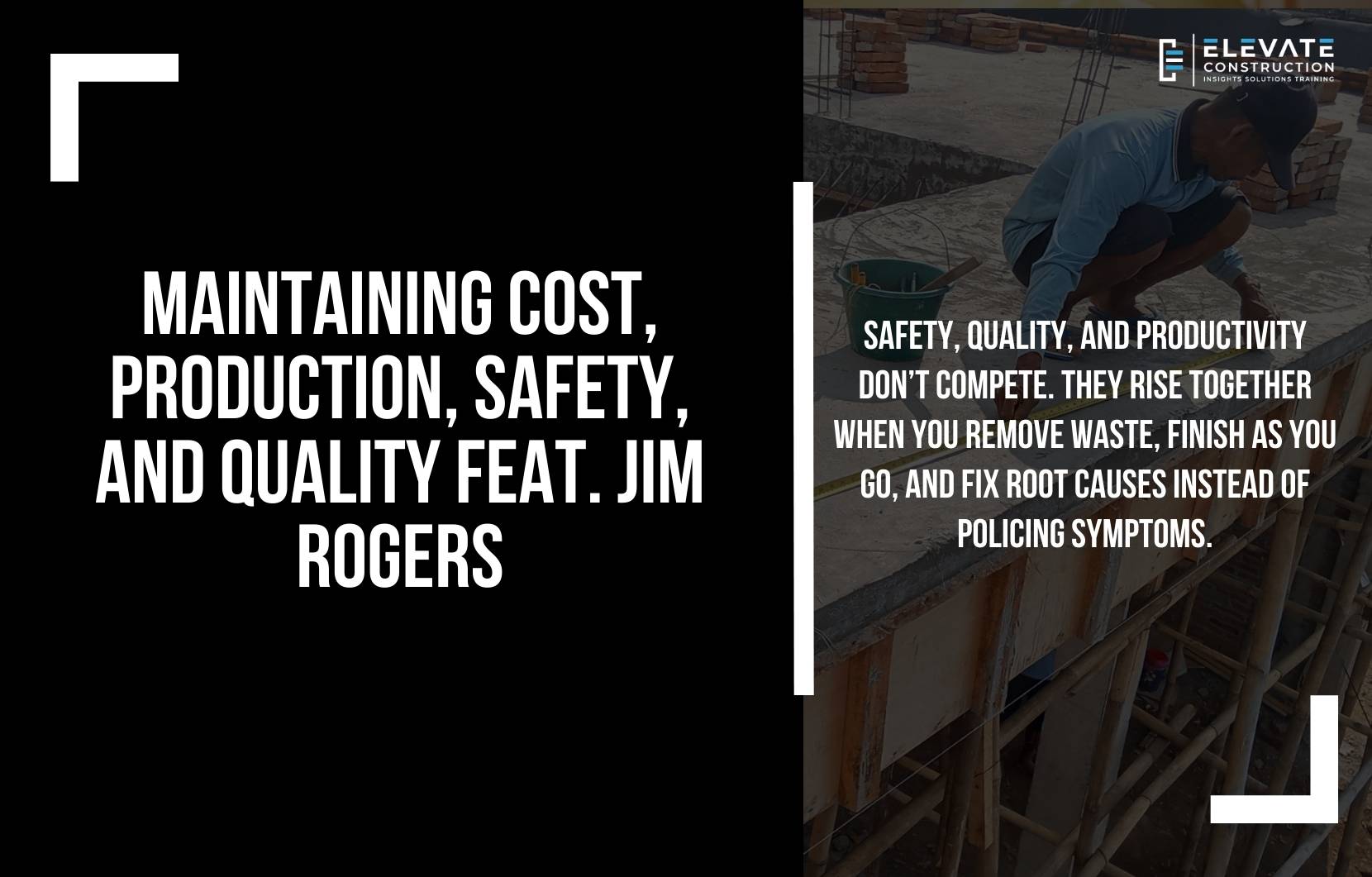
Stop Saying “Pick Two”: Why Safety, Quality, and Productivity Rise Together on a Lean Jobsite
There’s a sentence that has quietly poisoned construction for decades: “Safety, quality, productivity pick two.” It sounds like field wisdom. It sounds gritty and realistic. It’s also wrong. And if you believe it, you will build a jobsite system that forces trade-offs that don’t actually need to exist. Jason Schroeder dismantles that myth in this episode. His point is simple and strong: safety, quality, and productivity are inseparably linked. If you raise one the right way, you raise all three. If you sacrifice one, you usually lose the other two anyway you just don’t see it immediately.
The pain in the field is what you see every day. Crews feel rushed. Work areas are congested. Material is stacked in the wrong places. Access is sketchy. People step over cords, trash, and scrap to “keep moving.” Then the project slows down with injuries, rework, and missed handoffs. We act surprised, but the system produced the result.
The failure pattern is not “people don’t care.” The failure pattern is that we treat safety like a compliance program, quality like inspection, and productivity like a manpower problem three separate tracks. When those tracks compete, the team defaults to the loudest urgency in the moment. Usually that’s “schedule.” And that’s how jobs get dangerous, sloppy, and slow all at once. The system failed them; they didn’t fail the system. If you put crews in cluttered, unplanned workspaces and ask them to go fast, you’re asking them to risk their bodies and their workmanship to compensate for missing planning and logistics. That is not leadership. That is a broken system.
Jason tells stories that make this undeniable. He talks about looking down and seeing an extension cord in the way. If you step over it, you lose balance and slow down. If you stop and move it, you work faster, safer, and with more control. It’s simple, but it reveals the point: unsafe environments create slow work and bad work.
The Lie We Grew Up With: “Safety, Quality, Productivity Pick Two”
This “pick two” mindset becomes a self-fulfilling prophecy. Leaders say it, so teams accept it. Teams accept it, so they stop believing improvement is possible. And when leaders don’t believe improvement is possible, they stop building the systems that make it real.
Jason’s argument is not motivational fluff. It’s operational. Safety, quality, and productivity are not separate departments. They are outcomes of the same production system. If the system is stable, planned, and clean, all three rise. If the system is chaotic, unplanned, and cluttered, all three fall. That’s why this myth is so destructive. It gives leaders permission to accept preventable waste as “just construction.”
What’s Actually True: These Three Are Inextricably Linked
Jason says it directly: safety, quality, and productivity are inextricably linked. When you do one right, you improve the others. Think about it. Quality requires stable conditions. Stable conditions require planning and cleanliness. Cleanliness reduces trip hazards and searching. Less searching and fewer hazards means faster, smoother work. Smooth work reduces stress and mistakes. Reduced mistakes reduces rework. Reduced rework means fewer man-hours and fewer schedule disruptions. That’s the linkage. When the jobsite is designed to support flow, people don’t have to choose between doing it right and doing it fast. Doing it right becomes the fastest path. This is why LeanTakt matters. Flow over busyness. Systems save projects, not heroes. You don’t ask people to compensate for chaos. You remove the chaos.
The Ledge Example: Unsafe Work Creates Slow Work and Bad Work
Jason uses a simple visual: you’re on a ledge, and you have to work while worrying about falling. That fear changes how you move. It slows you down. It degrades quality because your brain is spending bandwidth on survival, not craft.Safety is not a separate add-on. It is a prerequisite for good work. When safety is weak, the work becomes hesitant, inconsistent, and full of stops. And every stop is productivity loss. Every stop is an opportunity for error. Every stop creates stress. That’s why “unsafe speed” is a lie. It’s not speed. It’s borrowed time.
The Root Cause Lens: Don’t Police Symptoms, Fix the System
Jason’s Lean message is consistent: don’t fix symptoms. Fix root causes. If you see unsafe behaviors, ask what the system is forcing. Is access missing? Is material staged wrong? Is the area congested? Is the sequence flawed? Is the plan unrealistic? If you only correct the worker, you might get short-term compliance, but you will not get long-term improvement. The system will keep producing the same risk because nothing changed. Respect for people is a production strategy. Fixing root causes is respect.
Leading Indicators: What to Track Before the Injury and the Rework
Jason emphasizes leading indicators: the things you can observe and correct before the incident happens. Not just lagging measures like recordable injuries or punch lists. Leading indicators include cleanliness, material staging, access, pre-task planning, and whether the work is “ready.”When leaders track leading indicators, they stop being surprised. They start steering the system. This is the same thinking that supports Last Planner, Takt, and flow. If work isn’t made ready, it won’t flow. If it won’t flow, people will start taking shortcuts. Those shortcuts create injuries and rework. You can predict it.
Technology as a Flashlight: Identify, Record, Correct, Walk Away
Jason also talks about using technology like a flashlight: identify problems, record them, correct them, and move on. He’s not talking about gadgets for the sake of gadgets. He’s talking about using tools to make problems visible and reduce the burden on memory and informal communication.Visibility is one of the most powerful safety and quality tools you can create. When issues are visible, they can be corrected quickly. When they’re hidden, they become normalized.
The “Add Manpower” Trap: Why Composite Cleanup Crews Miss the Point
Here’s a trap Jason calls out clearly: when sites get messy, leaders add manpower to clean it—composite cleanup crews, yard guys, extra labor. That might make the site look better temporarily, but it often misses the real issue. It treats cleanup as a separate activity instead of part of production. Lean flips that thinking. Instead of adding people to chase the mess, you redesign the system so mess doesn’t accumulate in the first place. Packaging gets removed at the dock. Materials arrive point-of-use. Trash is dumped immediately. Work is finished as you go. Cleanup becomes built-in. That is how you gain productivity without sacrificing safety and quality.
Lean Changes the Math: Remove Waste and the Work Gets Safer and Faster
Jason’s point is that Lean changes the math. Waste isn’t neutral. Waste creates hazards, creates defects, and slows production. When you remove waste, you reduce hazards, reduce defects, and speed up work. This is why the “pick two” myth collapses under Lean thinking. Lean doesn’t ask you to choose. Lean asks you to design.
Field Story: Chilled Beams, Spotless Floors, and the Crew That Shrunk from 8 to 2
Jason shares a story from a Cancer Center project installing chilled beams. The work area was spotless. Cords were managed. Packaging was removed at the dock. Trash was dumped immediately. Lifts could move cleanly. Yard guys were eliminated. The crew size dropped dramatically from eight to two because the system was designed to support production rather than create obstacles. He describes a major productivity gain tied directly to cleanliness and logistics discipline.
That story isn’t just about cleanliness. It’s about system design. When you remove the friction, you remove the need for extra people. When you remove extra people, you reduce congestion. When you reduce congestion, you reduce hazards. When you reduce hazards, you reduce stops. When you reduce stops, you increase quality. When you increase quality, you increase productivity.This is what flow looks like in real life. This is why LeanTakt works when it’s implemented as a system, not a slogan.
Signals Your Site Is Trading Safety for Speed (and Losing Both)
- Crews are stepping over cords, trash, and scrap “just to keep moving,” and small trip hazards are normalized.
- Work areas are congested and materials are staged wherever there’s space, not where the work happens.
- Rework is increasing, and the schedule is still slipping despite “pushing harder.”
- Leaders respond to mess by adding manpower instead of fixing logistics and point-of-use delivery.
- People feel rushed and start taking shortcuts because the plan didn’t make the work ready.
What This Means for Takt and Flow: Clean Handoffs, Fewer Stops, More Rhythm
Takt requires stable handoffs and predictable rhythm. You cannot run Takt in a chaotic environment where crews are constantly stopping to search for materials, clean up messes, or work around hazards. Those stops destroy rhythm. They destroy morale. They destroy quality.
When safety, quality, and productivity rise together, flow becomes possible. Clean spaces enable clean handoffs. Clean handoffs create predictable rhythm. Predictable rhythm reduces stress. Reduced stress protects families. This is why Jason keeps bringing everything back to systems. The system is what protects people.
Lean Moves That Improve All Three at Once
- Remove packaging and waste at the dock so it never becomes a jobsite hazard or a productivity drag.
- Deliver materials point-of-use and keep access clean so crews can work without stopping to navigate obstacles.
- Finish as you go: clean up immediately, protect the work, and don’t push defects forward.
- Fix root causes instead of policing symptoms—design the environment so the safest path is also the fastest path.
- Use visibility and simple tracking (leading indicators) to steer the system before incidents and rework occur.
At Elevate Construction, this is the heart of the mission: build stable systems where people can do safe work, quality work, and productive work without heroics. LeanTakt and Takt are not about pushing. They’re about designing flow. If your project needs superintendent coaching, project support, or leadership development, Elevate Construction can help your field teams stabilize, schedule, and flow.
The Challenge: Think Differently and Train the Industry Like It Matters
Here’s the challenge Jason leaves you with: stop accepting the “pick two” lie. Start designing environments where the right way is also the fast way. Track leading indicators. Fix root causes. Build logistics that support the field. Finish as you go. And teach your teams that safety, quality, and productivity are not competing priorities they’re one system. Because when you improve the system, all three rise together. And when all three rise, people go home healthier, less stressed, and more present with their families.
FAQ
Do safety, quality, and productivity really rise together?
Yes when you improve the system. Safety reduces stops and fear, quality reduces rework, and productivity rises when waste is removed. Jason’s point is that these outcomes are linked because they come from the same production environment.
Why does an unsafe environment reduce productivity?
Because people work slower and less consistently when they’re navigating hazards or worrying about getting hurt. Even something small like stepping over cords creates imbalance, interruptions, and lost time.
What are leading indicators in safety and quality?
They’re observable conditions you can correct before incidents and defects happen—cleanliness, access, readiness, staging, and pre-task planning. Jason emphasizes focusing on these instead of only tracking lagging results.
Why doesn’t adding cleanup labor solve the problem?
Because it often treats the symptom, not the cause. Lean focuses on designing logistics and “finish as you go” habits so waste doesn’t accumulate and require a separate crew to chase it.
How does this connect to LeanTakt and Takt?
Takt relies on stable rhythm and clean handoffs. Hazards, clutter, and rework create stops that destroy flow. When you design a clean, ready environment, Takt becomes possible and the job runs with less stress.
If you want to learn more we have:
-Takt Virtual Training: (Click here)
-Check out our Youtube channel for more info: (Click here)
-Listen to the Elevate Construction podcast: (Click here)
-Check out our training programs and certifications: (Click here)
-The Takt Book: (Click here)
Discover Jason’s Expertise:
Meet Jason Schroeder, the driving force behind Elevate Construction IST. As the company’s owner and principal consultant, he’s dedicated to taking construction to new heights. With a wealth of industry experience, he’s crafted the Field Engineer Boot Camp and Superintendent Boot Camp – intensive training programs engineered to cultivate top-tier leaders capable of steering their teams towards success. Jason’s vision? To expand his training initiatives across the nation, empowering construction firms to soar to unprecedented levels of excellence.