The POND Meeting: Plan the Next Day to Reduce Variation and Create Flow
Most job sites have a “daily huddle.” Most of them are also wasting that moment.
Not because the intent is bad. The intent is usually good. People want connection, coordination, and a plan. But what Jason Schroeder describes in this episode is what many of us have seen: the daily huddle turns into roll call.
“Hey, I’m in this area with three people.”
“Hey, I’m in this area with five people.”
“Hey, we’re over here with six.”
It sounds organized. It feels like accountability. But it rarely creates flow. And it almost never creates a real plan.
This is why Jason makes a bold statement: the morning huddle is one of the most distracting concepts taught in Lean construction not because the idea of meeting is wrong, but because the industry locked the format in place and never improved it.
The fix is not to cancel huddles. The fix is to shift them into a system that actually plans, communicates, and executes with stability.
Why the Typical Morning Huddle Fails the Field
A same day “plan of the day” meeting often fails for two reasons.
First, it doesn’t plan anything. It reports where people are. That’s status, not production planning. It might help the GC know how much labor is supposedly on site, but it does not reliably coordinate change points, handoffs, constraints, or needs.
Second, when teams try to use the morning of meeting to “plan,” they frequently change the plan right before work begins. That increases variation and destabilizes production. The field gets whiplash. Foremen have no time to properly sequence work. Crews lose confidence in the plan because the plan is always moving.
If the plan changes morning of, you didn’t plan. You improvised.
POD vs POND: The Small Shift That Changes Everything
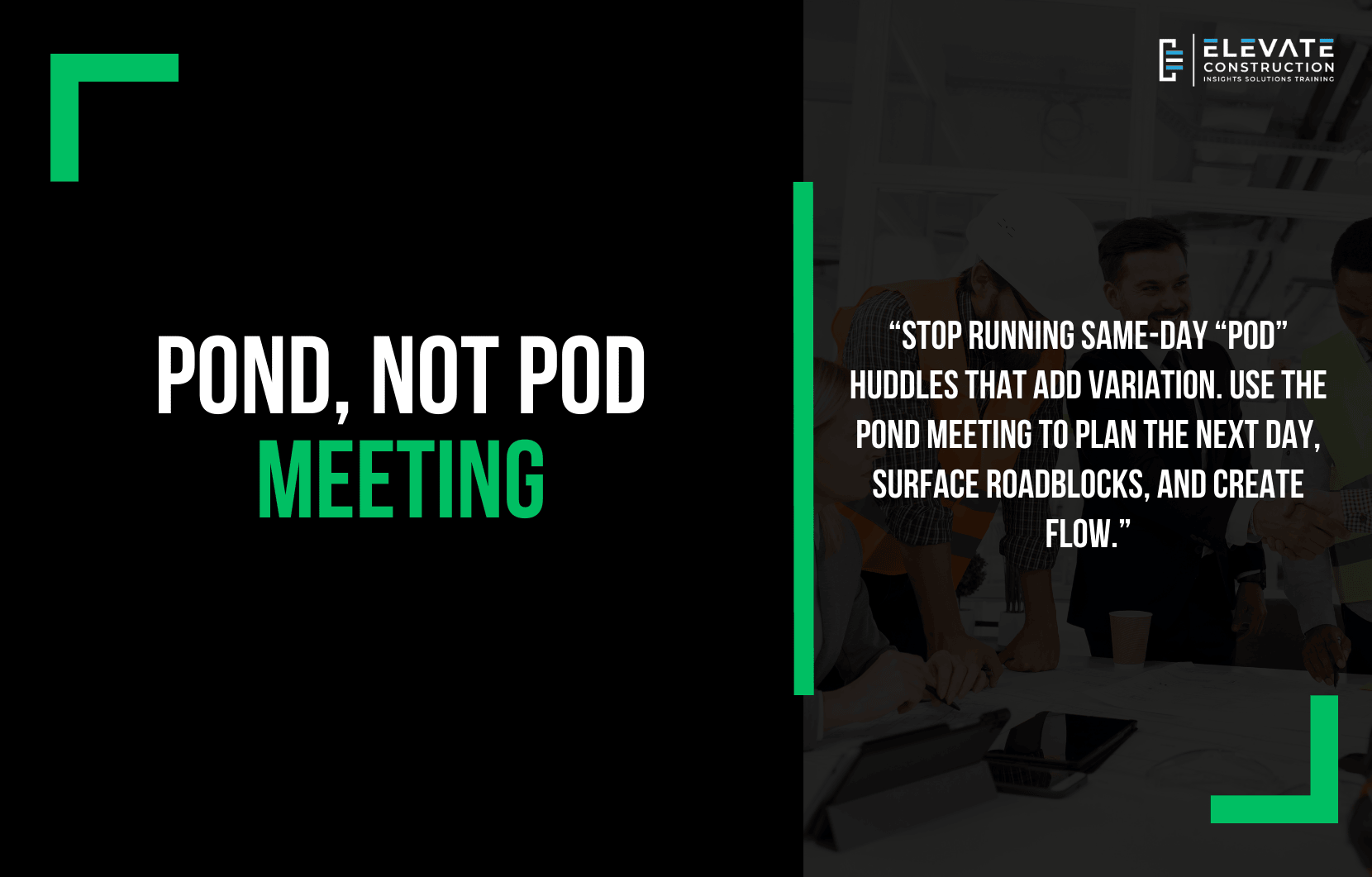
Jason clarifies the language: some people say POD Plan of the Day. But he makes the case for POND Plan of the Next Day.
That shift in timing changes everything.
When you plan the next day in advance, you give foremen time to actually think, coordinate, and make ready. You give trades time to surface roadblocks while there is still time to remove them. You reduce morning chaos. You build stability into the system.
And once the team starts operating this way, the job begins to feel different. Not “busy.” Stable. Predictable. Flowing.
The Real Purpose: Plan, Not Roll Call
The purpose of the POND meeting is not to hear where everyone is standing today.
The purpose is to make tomorrow stable.
A good POND meeting does three things:
- Locks the plan for tomorrow in a “day tight compartment”
- Surfaces roadblocks early enough to remove them
- Coordinates change points and handoffs so trades can flow
That means we stop treating daily planning as a ceremonial meeting and start treating it as a production system.
What a POND Meeting Must Include
If your POND meeting doesn’t include these, it will drift back into roll call:
- A clear focus on tomorrow (not today) and what must be ready
- Visuals that show zones, logistics, and current conditions
- A structured moment for trades to surface roadblocks and ask for help
- A conversation about handoffs and change points, not just manpower counts
- A visible link to the weekly work plan, so daily work stays aligned
- A way to publish the plan to the field so every worker can see it
A POND meeting without visibility and roadblocks is just a meeting.
A Rolling Meeting Cadence That Creates Flow
Jason describes building a rolling cadence of meetings where each meeting supports the next one, creating a seamless system for the field.
Here’s the rhythm he lays out:
- POND meeting (plan of the next day)
- Morning worker huddle with stretch and flex (communicate the plan to the workforce)
- Short team daily huddle/standup (5–15 minutes, often with Kanban, for the project delivery team)
That cadence creates flow because planning happens early, communication happens clearly, and the team’s daily standup is used for real support work not chaos management.
This is what “plan, communicate, execute” looks like as a system, not a slogan.
What Goes on the Screen: Weekly Work Plan + Aerial Zone Map
To improve the POND meeting, Jason describes how the visuals were redesigned.
The team moved the visual logistics and zone maps to one side of the screen and the macro level attack plan to the other. They pulled up the weekly work plan (from Intakt) and showed the most recent aerial photo with logistics and zoning overlaid.
That matters because people plan better when they can see reality.
When the team sees the zones, logistics, access points, and current site conditions, they stop talking in abstractions. They stop guessing. They start coordinating around what is actually possible tomorrow.
Roadblocks First: How Visual Maps Change the Meeting Dynamic
Jason describes a key move that changes the entire meeting.
Before the meeting, trades mark on the visual maps their problems and roadblocks. Then when they come up to speak, they don’t just say where they are. They say what’s blocking them and what they need.
That shift is huge.
Now the meeting becomes a place where constraints are surfaced, the GC and trades can help each other, and reroutes can happen early. Instead of “we’ll deal with it tomorrow,” the team deals with it today so tomorrow can flow.
Roadblock Prompts to Use with Trades
If you want the meeting to stop being status and start being planning, use prompts like these:
- “What is the one thing that could stop you tomorrow, and who can help remove it?”
- “Where is your handoff tomorrow, and what do you need from the trade before you?”
- “What access, layout, inspection, or material constraint is still unresolved?”
- “If you had to reroute your plan, what is your next best option?”
- “What change point tomorrow requires coordination with another crew?”
- “What do you need from the GC today so tomorrow is day tight?”
These questions force real planning without blaming anyone.
From Plan to Workforce: QR Codes, Translation, and Real Connection
The POND meeting only matters if the plan reaches the workforce.
Jason describes a system where the day plan is created in Canva and automatically shows up via QR code in the field. Every worker can see the plan not just the foremen. Then the team creates a social group so communication stays consistent.
He also gives an important shout out: the morning worker huddle was done with genuine appreciation, workers actually leaned in because they cared, and there was English and Spanish translation. The superintendent talked about change points, did two minutes of training, and communicated clearly.
That’s what “respect for people” looks like as a production strategy: clarity, training, and support.
Day Tight Compartments: Why Changing the Plan Morning of Adds Variation
Jason makes a key production point: if you change the plan the morning of, you increase variation.
He calls out the law of the effect of variation: variation extends your project and destabilizes the day. When you change the plan right before executing, you create ripple effects material issues, access conflicts, crews stepping on each other, and unnecessary waiting.
But there’s another trap he calls out.
If you don’t change the plan in a morning of huddle, then you’re often just doing roll call and that’s useless. So the industry gets stuck in a lose lose: change the plan and create chaos, or don’t change it and waste time.
That’s why the plan has to be made the day before.
What to Do the Morning of Instead: A Short Team Standup with Kanban
Jason isn’t saying “no morning meeting.”
He’s saying the morning meeting should be different.
After the POND meeting locks tomorrow’s plan and the worker huddle communicates it to the workforce, the project delivery team can hold a short standup five to fifteen minutes often using Kanban.
The purpose is simple:
- Identify key needs for that day
- Clear key problems and roadblocks
- Support flow based on what was surfaced in the POND meeting
That is the right use of morning time: clearing constraints, not rewriting plans.
Lean Behaviors 1.0 and 2.0: Training the Team Every Day
Jason describes adding two visuals Lean behaviors 1.0 and Lean behaviors 2.0 and using them as daily training topics.
This is one of the most overlooked parts of operational excellence: teams don’t magically improve because they want to. They improve because the system trains and reinforces better behaviors daily.
If the meeting cadence includes micro training and consistent expectations, the project gets better and better because learning becomes built into the work.
How to Implement Fast Without Overwhelming People
Jason notes that some people initially said, “This is a lot of change.”
But the team implemented it in a day.
That’s important: the system does not require months of “change management.” It requires clarity, the right visuals, the right cadence, and a willingness to try.
He also describes a feedback loop: meetings are recorded, uploaded internally, and Jason gives feedback daily. That’s short cycles, frequent iterations, and fast learning exactly how Lean is supposed to work.
Common POD Mistakes That Increase Variation
If you want your POND system to work, avoid these common traps:
- Planning the same day and constantly changing the plan morning of
- Not surfacing roadblocks in the meeting
- Giving foremen no time to actually plan tomorrow
- Using the meeting as a manpower count instead of coordination
- Failing to publish the plan so only a few people “know” it
- Skipping handoffs and change points, then reacting to conflicts later
These mistakes don’t mean people don’t care. They mean the system isn’t designed for flow.
What Operational Excellence Looks Like in the Wild (and Why It Works)
Jason makes a strong claim: this is how operationally excellent projects run.
He references major builders and examples of clean, organized, safe projects where planning happens the day before. He also ties it to Japan and the way Lean systems create stability through advance planning and clear communication.
The point isn’t to name drop. The point is to give you a benchmark: what you’re trying to build is not theoretical. It’s already being done on high performing projects.
And you can do it, too.
If your project needs superintendent coaching, project support, or leadership development, Elevate Construction can help your field teams stabilize, schedule, and flow.
Conclusion
If your daily huddle is rolling call, you’re not planning. You’re just meeting.
If your daily huddle changes the plan morning of, you’re injecting variation into the day and paying for it with waiting, conflict, and stress.
The fix is simple and powerful: plan the day before, publish the plan, surface roadblocks early, and use the morning time to support flow.
FAQ
What is a POND meeting in construction?
A POND meeting is a Plan of the Next Day meeting where foremen and the project team coordinate tomorrow’s work, surface roadblocks, and lock in a stable day plan before crews arrive.
How is a POND meeting different from a POD meeting?
A POD (Plan of the Day) meeting often happens the morning of and becomes either roll call or last-minute replanning. A POND meeting happens the day before, giving the team time to make ready and reducing variation.
Why is changing the plan the morning of a problem?
Changing the plan morning of increases variation, destabilizes production, and creates ripple effects like waiting, access conflicts, and missed handoffs. Planning the day before protects a “day tight compartment.”
What should be discussed in a POND meeting?
Focus on tomorrow’s plan, roadblocks, handoffs, and change points. Use visual logistics and zone maps and tie the conversation to the weekly work plan so the day stays aligned.
What meeting should happen the morning of if POND is done the day before?
Do a short (5–15 minute) team standup often with Kanban to clear roadblocks and support the field based on what was surfaced during POND, then communicate the plan to workers in a structured worker huddle.
If you want to learn more we have:
-Takt Virtual Training: (Click here)
-Check out our Youtube channel for more info: (Click here)
-Listen to the Elevate Construction podcast: (Click here)
-Check out our training programs and certifications: (Click here)
-The Takt Book: (Click here)
Discover Jason’s Expertise:
Meet Jason Schroeder, the driving force behind Elevate Construction IST. As the company’s owner and principal consultant, he’s dedicated to taking construction to new heights. With a wealth of industry experience, he’s crafted the Field Engineer Boot Camp and Superintendent Boot Camp – intensive training programs engineered to cultivate top-tier leaders capable of steering their teams towards success. Jason’s vision? To expand his training initiatives across the nation, empowering construction firms to soar to unprecedented levels of excellence.
On we go