
Stop Masking Ineffectiveness With Wasted Hours
You’re working 65 hours a week. Your spouse tolerates it. Your family adjusts. And you tell yourself it’s what superintendents do. You’re busy from 6 AM to 7 PM, managing fires, babysitting people, fighting through ineffective meetings, and doing reports nobody reads. You collapse at night too tired to think about improvement, too drained to advance your career, too burned out to question whether all those hours were necessary.
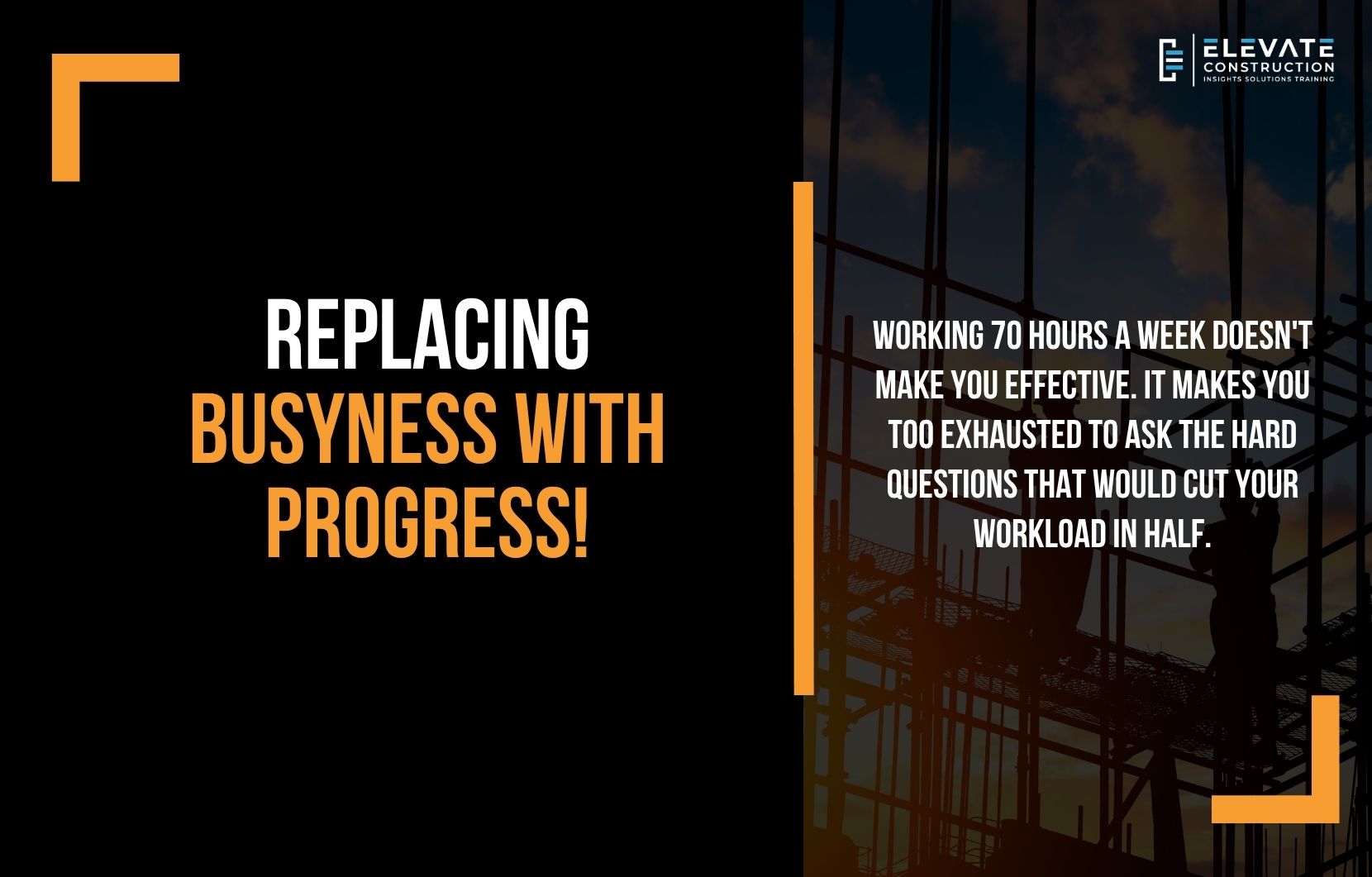
Here’s the truth. Most superintendents have about 30 hours of productive work per week. The other 25 to 40 hours are waste. Context switching. Unnecessary reports. Ineffective meetings. Fighting fires that better systems would prevent. Babysitting people who should be self-sufficient. Transferring information between systems that should talk to each other. If you constrain your time to 50 or 55 hours and force yourself to eliminate waste, you’d discover how much of your day accomplishes nothing. But you won’t ask those hard questions as long as you can mask ineffectiveness with extra hours. Working a lot is not a virtue when most of those hours advance nothing. You need to drive yourself forward, your job forward, and your company forward. And that requires effectiveness, not just effort.
The Real Pain: Long Hours That Don’t Build Anything
Walk any jobsite at 6 PM and you’ll see superintendents still there. They arrived at 5:30 AM. They’ve been moving all day. Meetings. Coordination. RFIs. Layout checks. Trade conversations. Reports. And they’re exhausted. But if you ask what they accomplished that actually moved the project forward, the list is short. Most of the day was scaffolding. Necessary activity that supports the work but doesn’t create it. Or worse, unnecessary activity that supports nothing. Reports nobody reads. Meetings that could have been emails. Fire drills caused by poor planning weeks ago. Context switching between six different tasks that destroys focus and wastes hours recovering mental space.
The pain shows up everywhere. Superintendents who work 70 hours a week but never advance their careers because they have no time for learning. Projects that finish on time but destroy the people running them because effectiveness was never prioritized over effort. Families who adjust to absent parents because construction culture celebrates long hours instead of smart work. And superintendents who burn out at 45 thinking this is what the job requires, never realizing that better systems would have cut their workload in half while producing better results.
The worst part is the missed opportunity. If you had 30 hours of productive work and eliminated the rest of the waste, you’d have 15 to 25 hours per week for continuous improvement. Reading. Learning. Advancing your career. Implementing Lean systems. Building relationships with other superintendents. Touring projects. Teaching. Whatever your passion is. But you’ll never get there as long as you’re allowed to work 70 hours. The constraint forces the question. Without the constraint, you just keep working longer without asking why.
The Failure Pattern: Confusing Hours With Effectiveness
Here’s what teams keep doing wrong. They measure hours instead of outcomes. They celebrate superintendents who arrive first and leave last. They tolerate ineffective meetings because everyone’s busy and nobody has time to fix them. They accept unnecessary reports because that’s how it’s always been done. They let context switching destroy productivity because everyone’s juggling six projects and that’s just construction. And they wonder why people burn out when the culture rewards effort without questioning whether that effort accomplishes anything.
They also treat lone wolves as the ideal. Superintendents work in isolation. They don’t call each other for advice. They don’t tour each other’s projects. They don’t share solutions. They reinvent systems instead of learning from others. And when they struggle, they work longer hours instead of asking someone who’s already solved the problem. This prevents knowledge from scaling. Every superintendent fights the same battles independently. And the company never builds institutional capability because nothing transfers between people.
The failure deepens when companies don’t create the infrastructure for effectiveness. No leader standard work to protect high-value time. No time tracking to reveal waste. No expectation that superintendents will constrain their hours and improve their systems. Just a culture that says work harder when you should be saying work smarter. And people comply because they don’t know any other way. They think 70-hour weeks are proof of commitment instead of evidence of broken systems.
The System Failed You
Let’s be clear. When superintendents work 70 hours a week, it’s not because they’re dedicated. It’s because the system never taught them to question waste. Nobody showed them how to eliminate context switching. Nobody trained them on leader standard work. Nobody constrained their hours and forced them to ask which activities actually matter. The culture rewards busyness, not results. So people optimize for looking busy instead of being effective. And 70-hour weeks become proof of effort instead of a symptom of failure.
The system fails because it treats long hours as inevitable instead of solvable. Construction has always required long hours, so people assume it always will. But that’s wrong. Superintendents work long hours because they’re doing unnecessary work, fighting fires that better planning would prevent, and reinventing solutions others already discovered. Fix those problems and hours drop while results improve. But companies don’t invest in fixing them because the culture celebrates grinding through chaos instead of designing systems that work.
The system also fails because it isolates superintendents instead of connecting them. When you saw a network of superintendents who camp together, share solutions, text and call each other about crew allocation and self-perform coordination, and have the proximity to develop real friendships, you saw something rare. Most companies treat superintendents like competitors instead of collaborators. They don’t create opportunities for connection. They don’t build wolf packs. They celebrate lone wolves grinding alone. And that isolation prevents the knowledge sharing that would cut everyone’s workload while improving everyone’s results.
What Effectiveness Looks Like
Picture this. A superintendent works 50 to 55 hours per week. Not 70. He’s constrained. That constraint forces him to ask hard questions. Which reports actually get read? Which meetings could be emails? Which activities advance the project versus just create the appearance of progress? He eliminates waste ruthlessly. He implements one-piece flow so project visits get documented immediately instead of creating context switching nightmares later. He stops doing elaborate daily reports when a simple app would suffice. He questions why he’s transferring information between systems instead of using one integrated tool.
He also uses leader standard work to protect high-value time. Every week he time blocks the 20 percent of activities that create 80 percent of results. Planning. Constraint removal. Trade coordination. Quality walks. Those get protected time. Everything else fits around them. He tracks his hours weekly and graphs his progress. When hours creep up, he investigates why and eliminates the waste. And the time he saves, 15 to 25 hours per week, goes to continuous improvement. Reading. Learning. Networking with other superintendents. Implementing Lean systems. Advancing his career. The constraint creates effectiveness. Without it, he’d just work longer.
He’s also part of a wolf pack, not a lone wolf. He texts and calls other superintendents. They share solutions. They tour each other’s projects. They have healthy conflict. They hold each other accountable. They camp together. Their kids play sports together. They’ve built proximity and connection over time. And that network makes everyone more effective because nobody’s solving problems alone. Knowledge scales. Questions get answered. Solutions get shared. The whole group advances faster than any individual could alone.
Why Effectiveness Matters
Effectiveness protects health. Peter Kiewit wrote in 1981 that good health is the most essential requirement for individual success. Without it, little else has significant meaning. And working 70-hour weeks destroys health. Excess weight. Lack of exercise. Poor sleep. Stress. All caused by schedules that leave no time for self-care. When you constrain your hours and force effectiveness, you create space for health. Exercise. Sleep. Moderation. The things that extend your useful life and enable long-term performance instead of short-term grinding that destroys you by 45.
Effectiveness also protects families. Chaos at work becomes chaos at home. When you’re working 70 hours and coming home exhausted, you’re absent even when present. Your family adjusts but they shouldn’t have to. When you work 50 to 55 effective hours, you have capacity for family. Evenings. Weekends. Presence. The life you’re supposedly working to provide gets lived instead of sacrificed. If your project needs superintendent coaching, project support, or leadership development, Elevate Construction can help your field teams stabilize, schedule, and flow.
Most importantly, effectiveness enables advancement. You can’t advance your career when you have no time to learn. You can’t implement continuous improvement when you’re too exhausted to think. You can’t build the wolf pack connections that make everyone better when you’re grinding alone. Effectiveness creates the space for growth. And growth is what separates superintendents who plateau at 40 from those who keep advancing into senior roles, general superintendent positions, and leadership. Working 70 hours keeps you stuck. Working 50 effective hours lets you grow.
How to Drive Effectiveness Forward
Start tracking your time honestly. For two weeks, log everything. Meetings. Reports. Coordination. Fire drills. Email. All of it. Then categorize each activity. Productive work that advances the project. Necessary scaffolding that supports the work. Waste that accomplishes nothing. You’ll discover you have about 30 hours of productive work and 25 to 40 hours of everything else. That’s your baseline. Now you know where to improve.
Implement leader standard work and time blocking. Protect the 20 percent of activities that create 80 percent of results. Planning. Constraint removal. Trade coordination. Quality walks. Those get scheduled first every week. Everything else fits around them. If you’re still listening to this podcast and you don’t plan your weeks with leader standard work, shame on you. You’re killing yourself. You’re not protecting the high-value time that creates results. Get it done.
Eliminate context switching. Stop doing project visits and delaying reports. Implement one-piece flow where you schedule enough time to visit and document immediately. Stop juggling six projects without boundaries. Create focus blocks where you work on one thing completely before switching. Context switching wastes hours. One-piece flow saves them. Question unnecessary work. If you’re doing elaborate reports nobody reads, stop. If you’re writing meeting minutes nobody uses, stop. If you’re transferring information between systems, consolidate. Ask the hard question: why am I doing this? If there’s no good answer, eliminate it.
Build your wolf pack. Find other superintendents. Start texting and calling about solutions. Tour each other’s projects. Share what works. Create proximity. Build relationships. Stop being a lone wolf grinding alone. Join or create a network where knowledge scales and everyone advances faster together. Constrain your hours. Set a limit. Fifty to fifty-five max. The constraint forces better questions. Without it, you’ll just keep working longer.
The Challenge
Here’s your assignment. Track your time for two weeks. Log everything. Categorize it. Find your 30 hours of productive work and your 25 to 40 hours of waste. Then pick one category of waste and eliminate it this month. Unnecessary reports. Ineffective meetings. Context switching. Whatever wastes the most time. Cut it. Use the time you save for continuous improvement.
Implement leader standard work if you haven’t already. Time block your weeks. Protect high-value activities. Track your hours. Graph your progress. Drive them down while driving results up. And find your wolf pack. Connect with other superintendents. Share solutions. Build relationships. Stop grinding alone. You’ll work less and accomplish more when knowledge scales through networks instead of isolation.
Working a lot is not a virtue. Effectiveness is. Stop masking ineffectiveness with wasted hours. Constrain your time. Eliminate waste. Build systems. Join wolf packs. And drive yourself forward, your job forward, and your company forward.
Peter Kiewit said good health is the most essential requirement for individual success because without it, little else has significant meaning. Protect your health by protecting your time. Effectiveness enables everything else.
On we go.
FAQ
How do you convince leadership that 50-hour weeks are enough?
Prove it with results. Track your time. Show that 30 hours are productive and 25 are waste. Demonstrate that eliminating waste improves outcomes while reducing hours. Leadership rewards results, not hours. Deliver better results in less time and they’ll support the change.
What if the culture demands long hours as proof of commitment?
Change the culture by being the example. Work 50 to 55 effective hours. Deliver better results than people working 70. Track and share your effectiveness improvements. Culture changes when better methods produce better results. Be the proof.
How do you eliminate context switching when managing multiple projects?
Create focus blocks. Dedicate specific days or half-days to each project. Implement one-piece flow where you complete tasks immediately instead of batching and switching. Use tools that consolidate information instead of forcing transfers between systems. Boundaries reduce switching.
What if there genuinely is 70 hours of necessary work?
Question that assumption. Most 70-hour workloads include unnecessary reports, ineffective meetings, fire drills from poor planning, and waste from broken systems. Fix the systems and the workload drops. If 70 hours are truly necessary, the project is understaffed or poorly planned.
How do you build a wolf pack when superintendents work in isolation?
Start small. Text one other superintendent about a problem you’re facing. Tour their project. Share a solution. Build one relationship. Then another. Proximity helps so look for people in your region. Camping trips and kid sports create natural connection. Don’t wait for company programs. Just start connecting.
If you want to learn more we have:
-Takt Virtual Training: (Click here)
-Check out our Youtube channel for more info: (Click here)
-Listen to the Elevate Construction podcast: (Click here)
-Check out our training programs and certifications: (Click here)
-The Takt Book: (Click here)
Discover Jason’s Expertise:
Meet Jason Schroeder, the driving force behind Elevate Construction IST. As the company’s owner and principal consultant, he’s dedicated to taking construction to new heights. With a wealth of industry experience, he’s crafted the Field Engineer Boot Camp and Superintendent Boot Camp – intensive training programs engineered to cultivate top-tier leaders capable of steering their teams towards success. Jason’s vision? To expand his training initiatives across the nation, empowering construction firms to soar to unprecedented levels of excellence.