Why the Fastest Crews Never Look for Tools
The best crews I’ve ever seen share one quality that you notice within the first hour of watching them work. They don’t stop. Not for tools. Not for hardware. Not for the right blade or the correct bit. They move from task to task with the kind of smooth, uninterrupted rhythm that makes you think they’ve been doing this exact job for years even when the zone is brand new and the scope just changed. And when you look closely at why, the answer is almost always the same. Their environment was designed to let them succeed. Everything they need is exactly where they expect it to be. That’s not luck. That’s a system. And for most crews in construction, that system doesn’t exist which means the alternative does.
What a Disorganized Tool System Actually Costs
Ask any tradesman what they did in the first twenty minutes of their morning and you’ll hear some version of the same story. Opened the gang box, dug through layers of tools from multiple jobs, couldn’t find the right driver, borrowed one from the guy two floors over, walked it back, realized the bit was wrong, went looking again. And then the work started. That whole sequence ten, fifteen, twenty minutes before a single productive task is invisible to the schedule. It’s not tracked. Nobody measures it. And because it happens every day, on every project, for every crew, it has become normalized as “just how things are.”
It’s not how things have to be. And when you add it up twenty minutes per worker, five workers per crew, across a six-month project you are talking about weeks of productive capacity being silently consumed before the first tool even touches the work. That’s not a minor inconvenience. It’s a system failure with a measurable price that most projects never acknowledge because they never designed an alternative.
The system failed the crew. They didn’t fail the system.
A Story That Stuck With Me
Early in my career, I was supervising an interior fit-out where we had two framing crews working adjacent zones. Both crews had the same number of workers. Both were experienced. Both were working off the same drawings. But one of them was consistently finishing faster not by a little, but noticeably. Every afternoon when I walked the zones, one crew was further along. At the end of the week, the difference was half a zone ahead.
I went to watch them work and the thing that jumped out immediately was not how fast they moved. It was how rarely they stopped. The crew that was ahead had organized their cart before the day started. Every tool had a spot. When someone reached for something, it was there. When they finished, it went back in the same place. There was no searching. No borrowing. No walking to the gang box and back. The crew that was behind wasn’t slower in skill they were slower because their environment made them slower. The tools were scattered, the consumables were in a random bin, and every hour contained four or five micro-stops that didn’t seem significant until you tallied the day. The system had been designed that way without anyone realizing they were designing it at all.
Why This Is a 5S and Production Problem Together
Jason Schroeder teaches 5S as production support, not housekeeping. Sort, Set in Order, Shine, Standardize, Sustain these are not aesthetic choices. They are production guardrails. Set in Order specifically exists to eliminate treasure hunts by making tools, materials, and information easy to find, easy to access, and easy to return. Unnecessary walking and reaching is not “normal.” It is waste that leaders must design out. And the standardized tool cart is how that principle gets applied at the most practical, crew-level scale in construction.
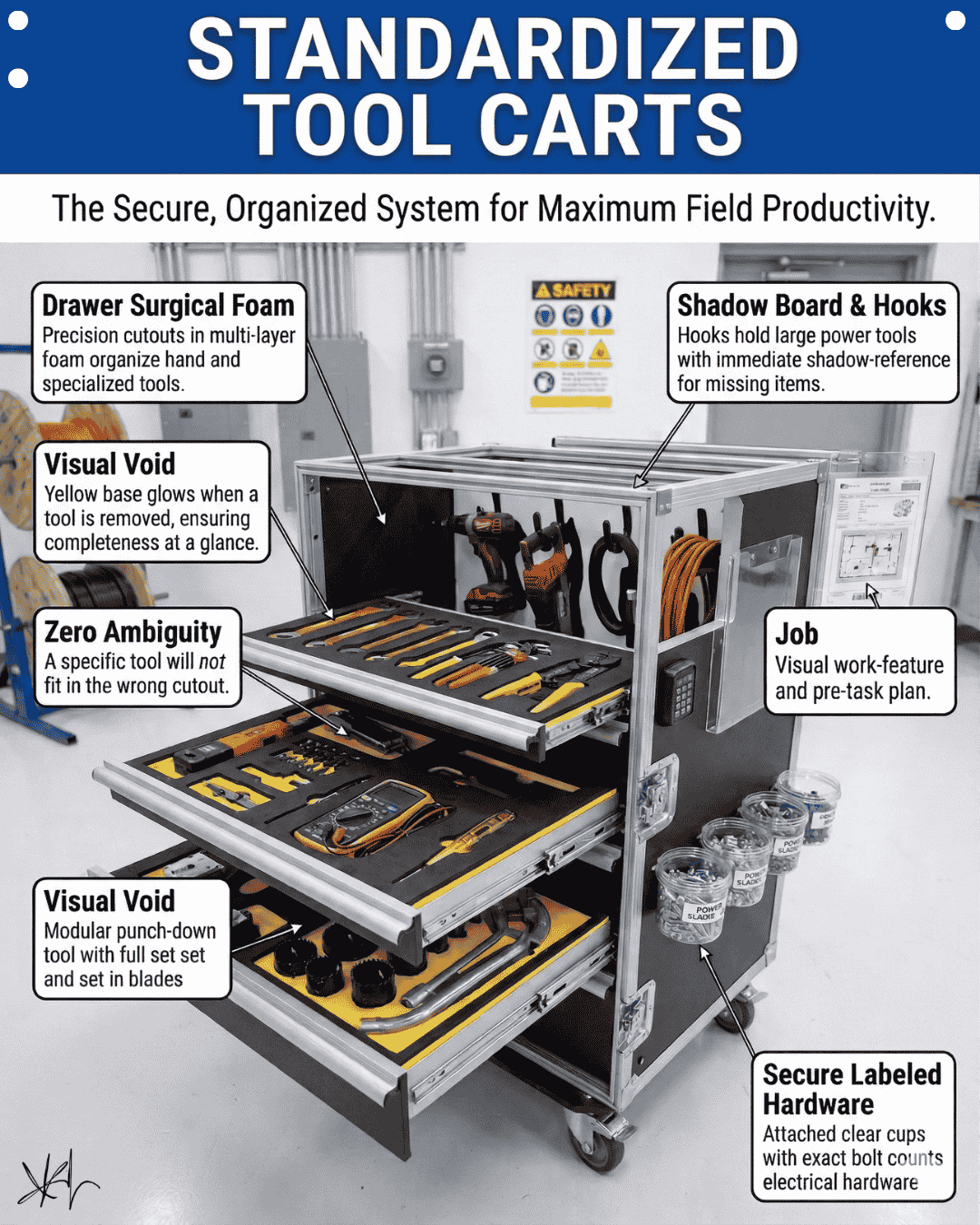
The tool cart shown in the image is an example of 5S made physical. The drawer surgical foam with precision cutouts means every hand tool has a specific home shaped exactly for it. A specific tool will not fit in the wrong cutout there’s zero ambiguity and zero opportunity for items to end up in the wrong place or the wrong drawer by accident. The shadow board and hooks on the outside hold large power tools with immediate visual reference for anything missing. And this is where one of the most important concepts in the whole system comes in: the visual void.
When a yellow base glows through an empty foam cutout, that tells the crew at a glance that something is missing before the work starts, not thirty minutes into a task when the missing tool becomes a crisis. That’s the difference between reactive problem-solving and a system that prevents the problem in the first place. The visual void is not a complicated technology. It’s a piece of foam and a color. But what it does for production making the missing thing immediately obvious without asking, without counting, without a full inventory check is exactly what visual management is supposed to accomplish. You can’t manage what you can’t see. The cart makes the gap visible.
Signs that your crew’s tool system needs a redesign:
- Workers open the gang box and spend more than sixty seconds finding what they need
- Tools from one zone or task end up missing when the next task starts
- Borrowed tools don’t get returned to their cart because there’s no designated place to return them to
- New workers or helpers slow down the whole crew because they don’t know where anything is
- The day ends with tools in the wrong drawer, the wrong zone, or missing entirely
The Details That Make the System Complete
The cart is also more than just tool organization. The job card attached to the front holds the visual work feature and the pre-task plan the quality checklist and task briefing that tells the crew leader exactly what a correct installation looks like and what steps must be followed. Having those documents attached to the cart means the crew doesn’t need to go to the trailer to find them, doesn’t need to ask the foreman to print a new one, and doesn’t start work without the standard in hand. The information travels with the crew, to the place of work, every day. That’s point-of-use storage applied to information, not just tools.
The secure labeled hardware clear cups with exact bolt counts attached to the side of the cart eliminates another common time sink. When a crew is installing and needs specific hardware, they reach for the cup, not a bucket of mixed fasteners, not a trip back to the materials area. The count is visible. The type is labeled. The hardware is exactly what’s needed for that scope. No searching, no guessing, no substituting the wrong fastener because the right one wasn’t organized.
All of it together the foam cutouts, the shadow boards, the visual voids, the hardware cups, the pre-task plan creates an environment that does something that no amount of supervision can replicate: it makes doing the right thing the easiest thing. When the tool goes back to its shadow, that’s not discipline. That’s the path of least resistance, by design.
Respect for People Is Not Soft It’s a Production Strategy
There’s a human dimension to the tool cart conversation that never gets talked about in the typical productivity discussion. When a skilled tradesperson spends part of every day hunting for tools, digging through cluttered gang boxes, or borrowing from a neighboring trade, that’s not just inefficiency. It’s disrespect not intentional, but systemic. It says the system doesn’t value their time. It says their craft matters less than the chaos around them. It erodes the quiet dignity that comes with being good at a skilled trade and having the right tools to show it.
The standardized tool cart is a statement. It says: your time matters. Your craft matters. We are going to design your work environment so that nothing gets between your skill and the work. That’s what Jason Schroeder means when he teaches that respect for people is not soft it’s a production strategy. A crew that isn’t fighting their environment is a crew that brings their full capability to every zone, every day. If your project needs superintendent coaching, project support, or leadership development, Elevate Construction can help your field teams stabilize, schedule, and flow. That work starts at the crew level, with the environment the crew operates in every single day.
Build the Cart. Protect the Crew. Let Them Flow.
Here is the practical challenge. Walk your project this week and open three gang boxes. Look at what you see. Is everything organized with a designated home for each tool? Can a new worker find what they need in thirty seconds? Are consumables counted and labeled? Is the pre-task plan easily accessible, or buried somewhere in a folder in the trailer? What you find tells you exactly how much invisible time your crews are spending every day on problems the system created.
The standardized tool cart is not an expensive or complicated fix. It’s foam, shadow boards, labeled cups, and a commitment to putting everything back where it belongs. But what it unlocks uninterrupted flow, faster crew starts, zero tool searches, visible missing items before the work begins is worth far more than the cost of building it. Paul Akers, one of the leading voices in applied Lean thinking, says fix what bugs you every single day. The cluttered gang box bugs every crew that works off of one. Fix it. Design the system that lets them win.
Flow is not complicated. Sometimes it’s as simple as making sure the right tool is in the right place at the right time. And when that happens, everything else gets easier.
On we go.
Frequently Asked Questions
What is a standardized tool cart and how is it different from a gang box?
A standardized tool cart is a purpose-built, 5S-organized mobile tool station where every tool has a precision foam cutout, shadow board, or labeled container. A traditional gang box stores tools without a designated system, making every retrieval a search. The standardized cart makes missing tools immediately visible and eliminates the time crews spend hunting for what they need.
What is a visual void and why does it matter?
A visual void is the glowing yellow base exposed in a foam cutout when a tool has been removed. It makes the absence of the tool visible at a glance, so a crew leader can verify completeness before the work starts rather than discovering something is missing mid-task. It’s a simple visual signal that prevents the kind of small interruptions that compound into real schedule losses.
How does the standardized tool cart connect to 5S?
The cart is a direct application of the 5S principle Set in Order everything needed has a defined place, labeled and easy to access at the point of work. The shadow board addresses Standardize by making the correct placement visually obvious. The visual void supports Shine and Sustain by making anything out of standard immediately detectable. All five S’s are embedded in the cart’s design.
Why is the pre-task plan attached to the cart?
Attaching the feature of work visual and pre-task plan to the cart brings the quality standard and daily instructions to the point of install. The crew doesn’t need to visit the trailer or wait for the foreman to brief them. The information travels with the tools, ensuring that every worker starts the task with the standard in hand and the expectations clear.
Can this work for smaller crews or does it require a large operation?
It works at any scale. Even a two-person crew benefits from a foam-lined drawer where nothing gets buried and missing tools are immediately visible. The investment in the cart pays back quickly in time saved daily. The principles everything has a place, missing items are visible, information travels with the crew are universal, regardless of crew size or trade.
If you want to learn more we have:
-Takt Virtual Training: (Click here)
-Check out our Youtube channel for more info: (Click here)
-Listen to the Elevate Construction podcast: (Click here)
-Check out our training programs and certifications: (Click here)
-The Takt Book: (Click here)
Discover Jason’s Expertise:
Meet Jason Schroeder, the driving force behind Elevate Construction IST. As the company’s owner and principal consultant, he’s dedicated to taking construction to new heights. With a wealth of industry experience, he’s crafted the Field Engineer Boot Camp and Superintendent Boot Camp – intensive training programs engineered to cultivate top-tier leaders capable of steering their teams towards success. Jason’s vision? To expand his training initiatives across the nation, empowering construction firms to soar to unprecedented levels of excellence.
On we go