
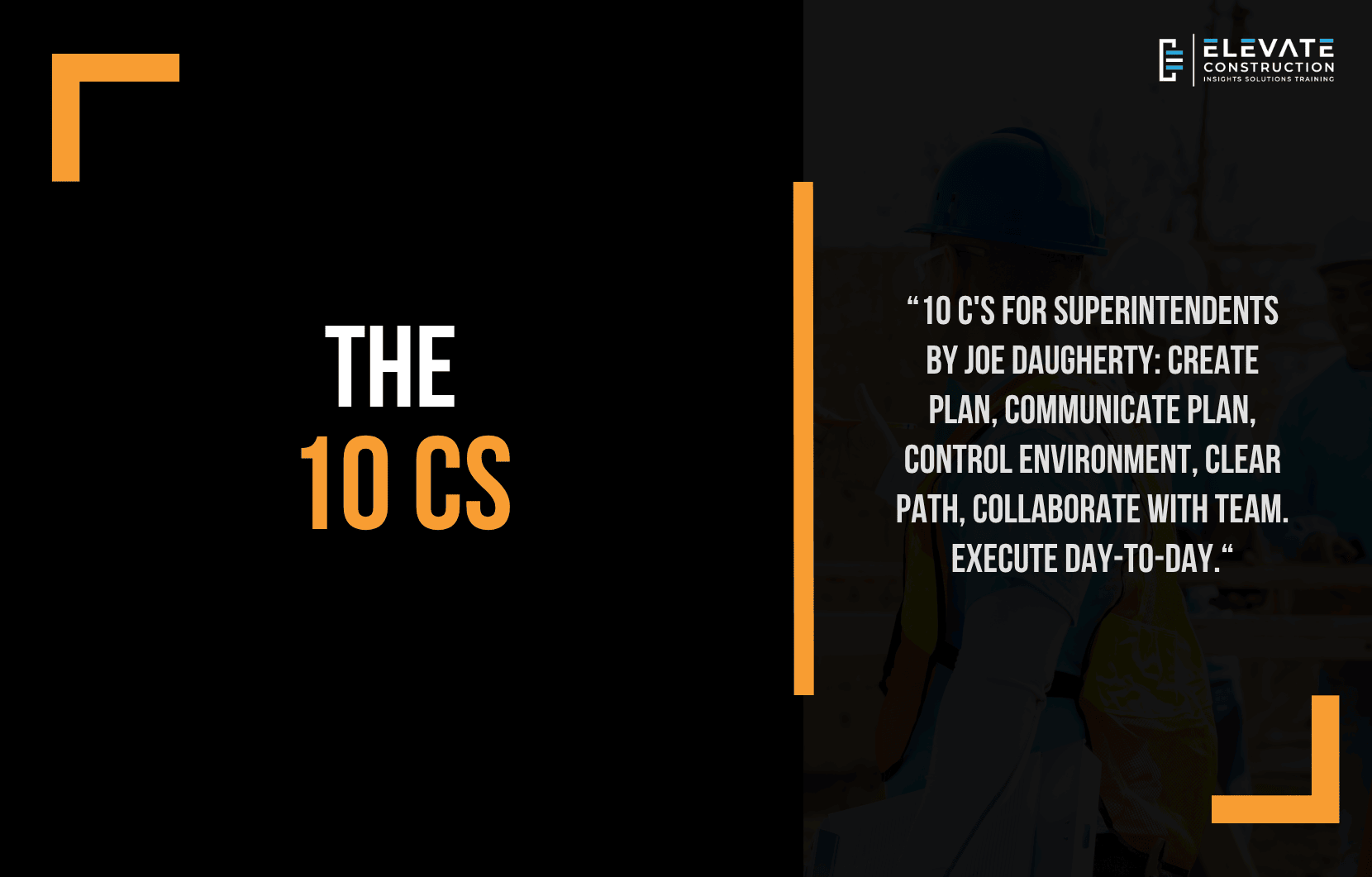
The 10 C’s for Superintendents Part 1 (Create, Communicate, Control, Clear, Collaborate)
In this blog, we have Joe Daugherty, who’s going to share with us the 10 C’s, and this is really what is expected in their company for field leaders, and it really provides a neat pattern. Joe is a general superintendent with a small GC in Spokane, Washington. He runs jobs but is essentially in charge of their field operations, and they do light commercial, convenience store gas stations, and a lot of tenant improvements.
This is a framework that he’s developed for how their superintendents should run their projects.
The Framework: Control, Calm, and Creating the Right Experience
The 10 C’s were designed to be a framework that will give a clear standard to superintendents on how to lead and execute from start to finish, but still allowing them the freedom to use their own style, leverage their own strengths, that type of thing.
But everything boils down to keeping the job from chaos. We want control, and we want calm. And everything is rooted in creating that type of experience for not only us, our self-performed guys, and our customer, but our trades as well. We want the trades to say, “Oh, it’s a Cornerstone project? Oh, yeah, yeah. I want to do that one. I want to be on that one.” That’s what we want.
C #1: Create the Plan
The first one is create the plan. Fundamentally, a superintendent needs to know how he’s going to get from start to finish. A lot of guys out there will just show up, and they’ll set up their trailer, and they’ll just start going without a plan.
And if I was going to get in my car and visit Jason, I wouldn’t just get on the freeway and start driving west and south. I would want to know where I’m going. And so, it’s really important for the superintendent to have a plan, understand how he doesn’t necessarily at the beginning have to have all those details. He doesn’t have to have it down to the micro level.
But he needs to understand that, for instance, if we’re talking about a fuel station, he needs to understand that, “OK, I’m getting my underground storage tanks in early, and I’m moving on to my building. Then I’m understanding when site work is going on, how I’m going to move into finishes, and understand that we’ve got a six-month time frame here to do this. How am I going to do that?”
Creating the plan is essential, because otherwise, if it’s not your plan, then you’re stuck just reacting to someone else’s version of it. So, this is about understanding the job, sequencing it correctly, and thinking ahead before the work actually starts.
C #2: Communicate the Plan
The second one is communicate the plan. We all know that if you could have the greatest plan in the world, but if you keep it in your head, it’s no plan at all. And that might seem basic, but I find myself falling into that pattern sometimes without realizing it. I’ve got a plan for the week, but then I’ll realize, how have I really told everybody what this plan is and what I want to get done?
So, it is a constant reminder that we need to use our voices. We need to talk. I like to call them, I don’t know why I started calling them, I don’t call them daily huddles. I just call them a muster. Just getting everybody together, set the expectations. So, everybody knows, nobody can say that I didn’t know I was supposed to do that.
But also, beyond that, they have to have the big picture. We had a superintendent work for the company who isn’t with us any longer, but he would always say things like, “I don’t like to give the guys the big picture because then they start thinking for themselves.” Like, yes. That’s a good thing.
But anyway, so it’s surprising how many people think like that, but communicate the plan. Because that’s where most of us struggle. We have the plan, but we don’t fully communicate it. And if the team doesn’t know the plan, then there isn’t one.
Clear is kind. Unclear is unkind. We use that at Cornerstone all the time.
The Best Tool for Communicating: Big Screen in the Trailer
What is your biggest trick for communicating the plan? A big screen in my trailer. And you can visualize everything right then and there. Our trailers aren’t real big. We don’t have double wides or anything like that. Our job trailers are generally like eight by 25 or something like that. So there’s not a lot of room for getting guys to assemble.
So, when you’re in the early phases of a project where it might be cold and wet and you’ve got no structure, a lot of times I’ll have to do these things over a Teams call or a Zoom call. But I always have a big screen on my trailer wall. And it’s usually connected to one of my monitors, it’s a mirror of one of my monitors.
And so, I could bring up the Takt plan. I use Intakt pretty much exclusively now, but you remember a point where I was using Bluebeam to kind of map out that plan. So, either or, just getting that thing up on the wall so people can see it in real time is probably the most important thing.
C #3: Control the Environment
Controlling the environment. People can feel when they walk on a job site if the job site’s calm or chaotic. You can just, you’ve been in those situations where you can feel tension in the air. And so, it’s very important for the superintendent—and this is why we talk about keeping a clean site and organized site, safety at the forefront. You want people to know when they step on the site, this job’s under control.
So controlling the environment is the third C. And the thing about these C’s is they’re all, they all dovetail with each other because another way that you can control your environment is by creating a plan and communicating the plan. So, they all kind of work together.
The Concert Analogy: Security Makes the Concert Fun
An analogy came to me. Let’s say you’re going to a concert. If you don’t have control of whether or not people bring in full cans of beer or phones or whatever, and one person in the audience throws their phone at the performer and then they cancel the concert, that’s not respectful to people.
But if those security lines are like, “Nope, you will open your sodas or your beer so that you can’t throw them on stage. No, we are locking up the phones. No, we are making sure there’s no weapons. No, we are making sure that it’s a safe, secure environment. Only people who have bought tickets are in here.” Then you go and you enjoy the concert and people have fun.
So, nobody would say, “Oh my gosh, I didn’t have any fun at the concert because I had to go through security.” No, security and the rules are what make the concert fun. It’s the same thing on our job sites. We have absolute control of the environment, the safety and the cleanliness because that is what allows human beings to have fun, enjoy their work and go home safe every night.
C #4: Clear the Path
Next C: clear the path. And so, this is a big thing for a superintendent. Superintendent is there to make sure that everybody has the tools and opportunity to succeed. If your electrician falls flat and you allowed the plumber to stack, or your civil contractor needs to know some drywall locations, you can’t, you have to make sure you get that done for them. You get it done on time.
One of the big things, when I do my job walks, I’ll just walk up. I’ll say, “Hey, Paul, how’s your world today? What can I do for you? Is there anything I could do?” The proverbial greasing of the wheels so that the machine can keep moving forward.
So, clearing the path. Every day, the superintendent’s looking: “OK. What could slow my team down? What could slow the plan down? What could become a roadblock or an obstacle if I let it? How do I eliminate this before it becomes a problem?”
I remember a long time ago, a superintendent said, “Yeah, I’ve only got two guys here. I really need to hold on to these guys in case any fires pop up. I gotta make sure I got a guy here.” And I’m just thinking, “You’re planning on fires.” We should plan on not having fires.
Leadership Is Clarity, Training, and Support
Before I went to Japan, I couldn’t really explain what leadership is. And in Japan, I learned it’s clarity, training, and support. If you’re a leader, if you are clear about where we’re going, you enable your people through training and capability, and you support them along their path. And that’s what you’re talking about: clear the path.
C #5: Collaborate with the Team
The fifth C is collaborating with the team. You’re not going to build it alone. All of the people on your project are professionals with skills. They should have say-so on what the best way for them to do their job is. But you have to communicate about these things. You have to talk about these things.
So ultimately, you’re not going to do what’s best for one person or self-optimize your schedule, but you’re coming up with a plan together on how you’re going to get this job complete. And you can’t just create your schedule and go out and tell your guys exactly what they’re going to do. Because you need their input. You need their expertise. You need their professional experience on how to get your project done efficiently with the quality the customer deserves.
I’ve heard superintendents who all they do is complain about their subs and how they’re not performing and they make it out that the trades are their enemies, and they’re going to get the job done in spite of them. But that’s just so sad to me when I see that type of attitude from a superintendent, because the first thing I want to do is make sure that guys are able to do the job and go home and feel like they accomplished something. Not stifled. Not put in a box.
When people feel like they’re part of the plan, they execute better.
Here are the first 5 C’s for superintendents:
- Create the plan: understand job, sequence correctly, think ahead before work starts – Fundamentally, superintendent needs to know how going to get from start to finish. Lot of guys just show up, set up trailer, start going without plan. Wouldn’t just get on freeway and start driving. Want to know where going. Important for superintendent to have plan, understand how. Doesn’t necessarily have to have all details down to micro level. But needs to understand: getting underground storage tanks in early, moving on to building, understanding when site work going on, how moving into finishes, got six-month time frame. Creating plan essential, because otherwise, if not your plan, stuck reacting to someone else’s version of it. About understanding job, sequencing correctly, thinking ahead before work actually starts.
- Communicate the plan: big screen in trailer, muster, give big picture – If could have greatest plan in world, but if keep in head, it’s no plan at all. Might seem basic, but find myself falling into that pattern without realizing it. Got plan for week, but realize how have I really told everybody what this plan is. Constant reminder need to use voices. Need to talk. Call them muster. Getting everybody together, set expectations. Everybody knows, nobody can say didn’t know supposed to do that. Also beyond that, have to have big picture. Clear is kind. Unclear is unkind. Use big screen in trailer. Always have big screen on trailer wall connected to monitors. Bring up Takt plan. Use Intakt exclusively now. Getting thing up on wall so people can see in real time most important thing.
- Control the environment: clean site, organized site, safety at forefront – People can feel when walk on job site if job site’s calm or chaotic. Can feel tension in air. Very important for superintendent—this is why talk about keeping clean site and organized site, safety at forefront. Want people to know when step on site, this job’s under control. Controlling environment is third C. These C’s all dovetail with each other because another way control environment is by creating plan and communicating plan. All work together. Like concert: security and rules are what make concert fun. Same thing on job sites. Have absolute control of environment, safety and cleanliness because that is what allows human beings to have fun, enjoy work and go home safe every night.
- Clear the path: grease wheels, eliminate roadblocks before they become problems – Superintendent there to make sure everybody has tools and opportunity to succeed. If electrician falls flat and allowed plumber to stack, or civil contractor needs to know drywall locations, have to make sure get that done for them. Get it done on time. When do job walks, walk up, say, “How’s your world today? What can I do for you?” Proverbial greasing of wheels so machine can keep moving forward. Every day, superintendent looking: “What could slow my team down? What could slow plan down? What could become roadblock or obstacle? How eliminate this before becomes problem?” Leadership is clarity, training, and support. Clear the path.
- Collaborate with the team: need their input, expertise, professional experience – Not going to build it alone. All people on project are professionals with skills. Should have say-so on what best way for them to do their job is. Have to communicate about these things. Talk about these things. Not going to do what’s best for one person or self-optimize schedule. Coming up with plan together on how going to get job complete. Can’t just create schedule and go out and tell guys exactly what going to do. Need their input. Need their expertise. Need their professional experience on how to get project done efficiently with quality customer deserves. When people feel like they’re part of plan, they execute better.
If your project needs superintendent coaching, project support, or leadership development, Elevate Construction can help your field teams stabilize, schedule, and flow.
The Concrete Paving Example: All 5 C’s Wrapped Up
Recent project, we had to do a bunch of concrete paving. So, we ended up changing from asphalt to concrete for the site paving. It was a diesel island addition. And so, because of the time of year in the Northwest, you can’t pave at all times of the year. So, in order to get the project open so the customer could begin their return on investment, they decided to go ahead and pave the site in concrete.
So, we had a week plus to get this done. So, I broke the project into zones, but first thing I have to do is I have to talk to my concrete guy. “What’s a reasonable number of yards you think you could pour?” This was six-inch paving. “What’s the reasonable amount of concrete you can pour in a day with your crew?” I need to ask him that. I can’t just come up with it on my own.
So, in order to create my zone size, I kept it at or below a hundred yards what we decided. And so now I ask him, “OK, how should we break these zones up?” And I started to realize later on, I wouldn’t have even thought of that. He’s thinking about how wide of an area can I finish, what can I send my boat float across? So, he was like, “I need narrow zones.”
So, he tells me, so I come up with this plan, color coded in Bluebeam. And I assign it later so we can pick, this is what we’re going to do Monday, then Tuesday, then Wednesday. And that guy, his crew worked so hard. I bought him lunch twice. They were just working their tails off and they got it done. They got every day done like we planned.
But if it was my plan to begin with and only my plan, it wouldn’t happen. I needed to work with him and come up with that plan. I created a visual so we could communicate that plan. I could print it. Not all the guys spoke English on the concrete crew, but amazing concrete guys. But a picture: “Here’s what we’re pouring today.”
So, it was like all five C’s wrapped up into one scope.
The Theme of the First 5 C’s: Execute Our Day-to-Day
What is the theme of those five? This is how we execute our day-to-day.
A Challenge for Superintendents
Here’s what I want you to do this week. Create the plan. Fundamentally, know how you’re going to get from start to finish. Don’t just show up, set up trailer, start going without plan. Understand job, sequence correctly, think ahead before work starts.
Communicate the plan. If you have greatest plan in world but keep in head, it’s no plan at all. Use your voices. Get everybody together, set expectations. Give big picture. Clear is kind. Unclear is unkind. Use big screen in trailer. Bring up Takt plan. Get thing up on wall so people can see in real time.
Control the environment. People can feel when walk on job site if job site’s calm or chaotic. Keep clean site and organized site, safety at forefront. Want people to know when step on site, this job’s under control. Like concert: security and rules make concert fun. Have absolute control of environment, safety and cleanliness. Clear the path. Make sure everybody has tools and opportunity to succeed. When do job walks, ask, “What can I do for you?” Grease wheels so machine can keep moving forward. Look: “What could slow team down? How eliminate before becomes problem?” Leadership is clarity, training, and support.
Collaborate with the team. Not going to build it alone. All people on project are professionals with skills. Have to communicate. Come up with plan together. Need their input, expertise, professional experience. When people feel like they’re part of plan, they execute better. As we say at Elevate, 10 C’s for superintendents by Joe Daugherty: create plan, communicate plan, control environment, clear path, collaborate with team. Execute day-to-day.
On we go.
Frequently Asked Questions
What is the framework of the 10 C’s?
Framework gives clear standard to superintendents on how to lead and execute from start to finish, but still allowing freedom to use own style, leverage own strengths. Everything boils down to keeping job from chaos. Want control and calm. Everything rooted in creating that type of experience for us, self-performed guys, customer, and trades. Want trades to say, “It’s Cornerstone project? I want to be on that one.”
What does “create the plan” mean?
Fundamentally, superintendent needs to know how going to get from start to finish. Don’t just show up, set up trailer, start going without plan. Important to have plan, understand job. Doesn’t have to have all details down to micro level. But needs to understand: getting underground storage tanks in early, moving on to building, when site work going on, how moving into finishes. Creating plan essential because otherwise stuck reacting to someone else’s version.
How do you communicate the plan?
Big screen in trailer. Always have big screen on trailer wall connected to monitors. Bring up Takt plan. Use Intakt exclusively. Get thing up on wall so people can see in real time. Call them muster. Get everybody together, set expectations. Give big picture. Clear is kind. Unclear is unkind.
What does “control the environment” mean?
People can feel when walk on job site if calm or chaotic. Important for superintendent to keep clean site and organized site, safety at forefront. Want people to know when step on site, this job’s under control. Like concert: security and rules make concert fun. Same on job sites. Have absolute control of environment, safety and cleanliness allows human beings have fun, enjoy work, go home safe.
If you want to learn more we have:
-Takt Virtual Training: (Click here)
-Check out our Youtube channel for more info: (Click here)
-Listen to the Elevate Construction podcast: (Click here)
-Check out our training programs and certifications: (Click here)
-The Takt Book: (Click here)
Discover Jason’s Expertise:
Meet Jason Schroeder, the driving force behind Elevate Construction IST. As the company’s owner and principal consultant, he’s dedicated to taking construction to new heights. With a wealth of industry experience, he’s crafted the Field Engineer Boot Camp and Superintendent Boot Camp – intensive training programs engineered to cultivate top-tier leaders capable of steering their teams towards success. Jason’s vision? To expand his training initiatives across the nation, empowering construction firms to soar to unprecedented levels of excellence.
On we go