How to Find the Real Problems on Your Project Before They Find You
Most project teams manage from information. They look at reports, review schedules, track labor counts, and make decisions based on what the data says. That’s not leadership. That’s distance. And distance is one of the most expensive habits in construction because it guarantees that by the time a problem shows up in the data, it has already cost the project weeks of time and thousands of dollars in rework, delays, and frustrated trades.
The leaders who consistently run better projects do something different. They go to the work. They walk upstream from the finished product, back through the chain of production, looking for what the numbers will never show them. They ask questions instead of issuing directives. They find the slowest trade before the schedule shows the stall. They check the crew board before the foreman reports the problem. They visit the roadblock in person instead of hearing about it third-hand. That discipline has a name in Lean thinking the Gemba walk. And when it’s paired with the Last Planner System and the Takt Production System, it becomes the control mechanism that keeps the entire production system honest.
What Most Leaders Actually Do Instead
I have worked on projects where the superintendent hadn’t been above the third floor in two weeks. The weekly meeting happened. The schedule got updated. The reports went out. And meanwhile, on the upper floors, a critical trade had quietly stalled because a coordination issue hadn’t been resolved. Nobody had walked it. Nobody had talked to that foreman directly. The problem showed up in the data ten days later as a schedule variance, and by then it had already cascaded into a handoff miss, a compressed zone, and overtime for three trades who shouldn’t have needed it.
This is the pattern on most projects. Information travels up and orders travel down, and nobody goes to the place where the real story is. The people closest to the problem see it first and longest, but unless leadership goes to them, the information they hold stays invisible to the plan. It’s not their fault. They’re doing the work. The system failed to go get their wisdom. And the system is always ours to fix.
The Gemba Walk Defined
A Gemba walk, derived from the Japanese term meaning “the real place,” is a structured workplace walkthrough designed to observe people, understand their work, and identify where the production system is failing them. Not where people are failing. Where the system is failing. That distinction is everything.
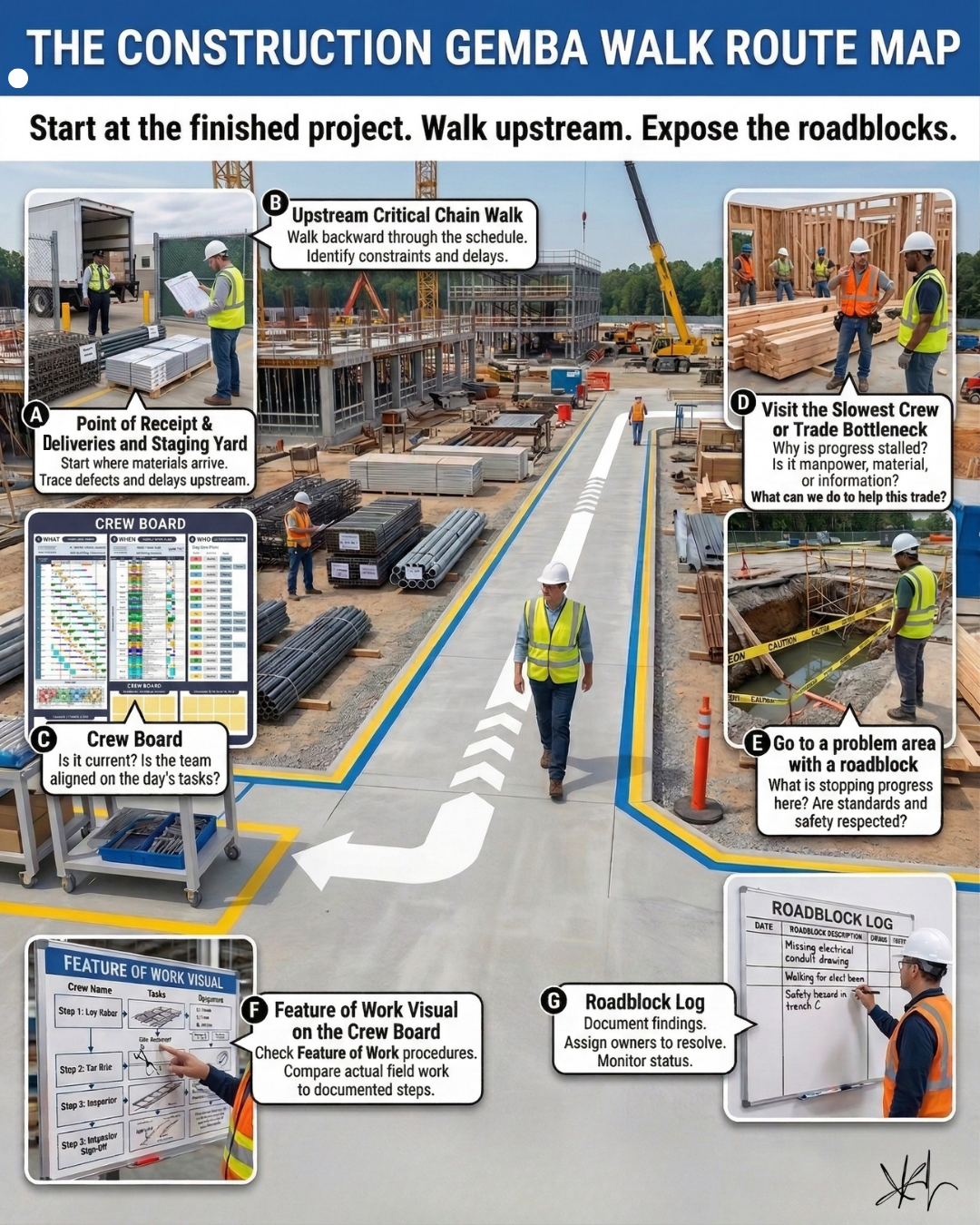
The Construction Gemba Walk Route Map takes this concept and applies it with precision to a construction project. The route starts at the finished product and walks upstream back through the supply chain, back through the production flow, back to where materials enter the project. Each stop on the route has a purpose. Each question is aimed at the system, not at the person. The goal is not to inspect or supervise. It’s to see.
The walk begins at the point of receipt the staging yard and delivery zone where materials arrive, are inspected, and begin their journey into the building. This is the upstream origin point. Any defect or delay born here will travel downstream, compounding as it goes. From there, the route moves to the crew board, checking whether it’s current, whether the team is aligned to the day’s tasks, and whether the visual plan reflects reality or wishful thinking. A crew board that doesn’t match the work happening in the zone is a signal that the information system has broken down.
Walking Upstream and Seeing What the Schedule Can’t
The next stop is the upstream critical chain walk itself walking backward through the schedule, identifying constraints and delays that haven’t yet surfaced in reporting. This is where the Gemba walk earns its value. A constraint that’s visible on the floor today becomes a missed handoff in five days if nobody acts. Walking upstream to find it while there’s still time is how high-performing teams operate. It’s the antidote to reactive firefighting.
From there, the walk takes the leader to the slowest crew or trade bottleneck. This is perhaps the most important stop. The question is not “why are you behind?” It’s “why is progress stalled, and what can we do for you?” That reframe matters enormously. It shifts the conversation from blame to support from accountability-as-punishment to accountability-as-clarity-and-follow-through. When a superintendent approaches the slowest trade with genuine curiosity and a commitment to help, that foreman will tell them things they would never say in a weekly meeting. The Gemba walk is how leaders earn that honesty.
Watch for these signals that your project needs a more structured Gemba walk practice:
- Foremen hesitate or get defensive when leadership walks the floor, suggesting past walks felt like inspections rather than support
- Problems show up in weekly meetings that were visible in the field for several days before anyone reported them
- The slowest trade or zone is identified from reports rather than from direct observation
- The crew board or feature of work visual is rarely checked against actual field conditions
- Roadblock logs exist but ownership and resolution dates are rarely assigned or followed up
The Feature of Work Visual and What It Tells You
One of the stops on the route map is the Feature of Work visual on the crew board. This is a visual quality checklist created in the preconstruction meeting that tells the crew leader exactly what a correct installation looks like and what steps must be followed in sequence. The Gemba walk checks actual field work against those documented steps. This is how quality becomes a daily field behavior rather than an end-of-phase inspection.
This stop also surfaces one of the most important questions a leader can ask on a walk: are the workers doing the work the way we planned it, and if not, is it because the plan was wrong or because something changed that nobody updated? Both answers require action. Neither is the worker’s fault. The system failed to either communicate the right standard or adapt when conditions changed. The walk reveals which it is.
The final stop before closing the loop is the roadblock area a problem zone where the leader arrives in person, verifies that standards and safety are being respected, documents the findings, and assigns an owner with a resolution date. The roadblock log is not a complaint list. It is a commitment system. Every item on it is either owned and being resolved or it is being escalated today.
How the Last Planner System Makes the Walk Matter
Here’s the connection that most teams miss. The Gemba walk without a real production system behind it is just observation. The leader sees problems, documents them, and then returns to a planning system that can’t absorb or respond to what was found. That’s why the Last Planner System and the Takt Production System must work together.
In the transcript from our video on the Last Planner System overview, the point is made clearly: the Last Planner System is a great system, but it fails when it’s attached to CPM. CPM creates large-batch, un-zoned milestones that make the entire downstream system inaccurate. The pull plan gets done for a whole building instead of zone by zone. The look-ahead loses alignment. The weekly work plan gets recreated from scratch because there’s nothing below CPM to filter from. And when a Gemba walk surfaces a real constraint, the team has no structured way to absorb it because the production plan doesn’t have buffers.
Pair the Last Planner System with Takt, and everything changes. Milestones are calculated correctly from real zone-based trade flow. Pull planning happens by zone, gaining buffers in the process. The look-ahead filters directly from the norm-level Takt plan and stays vertically aligned to milestones. The weekly work plan doesn’t need to be rebuilt from whole cloth it’s filtered and adjusted, which frees up the time in coordination meetings to actually find and solve problems. Percent Plan Complete improves. Perfect Handoff Percentage becomes a trackable leading indicator. Roadblock Removal Average tells the team how fast the system is clearing friction ahead of the crews.
Now when the Gemba walk surfaces a constraint in the staging yard, or finds that the slowest trade is stalled because of a coordination miss, or discovers that the crew board hasn’t been updated in three days there is a live production system that can respond. The roadblock gets logged and owned. The constraint gets moved to the team daily huddle. The foreman’s daily plan gets adjusted in real time based on what the walk revealed. The walk feeds the system. The system responds to the walk. That loop is how great projects run.
Why This Protects More Than the Schedule
Behind every production concept is a human being. When leaders don’t walk the work, crews experience that absence as indifference. They feel managed from a distance by people who don’t understand what they’re dealing with. Morale drops quietly. Problems get hidden because raising them never seemed to help before. And the best people the ones with the highest standards are the first to leave a project where leadership doesn’t show up.
When the Gemba walk is done right with curiosity, with questions, with genuine interest in removing friction for the trade it sends an entirely different message. It says: your work matters, your challenges matter, and we are here to serve your ability to install. That’s respect for people made operational. That’s the north star of Lean construction practiced at the daily level. If your project needs superintendent coaching, project support, or leadership development, Elevate Construction can help your field teams stabilize, schedule, and flow. The Gemba walk is where that stability becomes visible.
Start Walking. Start Finding. Start Fixing.
Here is the challenge I want to leave with you. Map your Gemba walk route for your current project this week. Start at the finished product. Walk upstream through the critical chain. Check the crew board. Visit the slowest trade in person and ask what they need. Walk a problem area with fresh eyes. Review the feature of work visual against actual conditions. Then document every finding in the roadblock log with an owner and a date.
Do that twice this week and see what you find that your weekly meeting never would have surfaced. That’s the shift from managing information to leading from the place of work. That’s the difference between projects that grind and projects that flow. Taiichi Ohno, the architect of the Toyota Production System, believed that the answers to your most important production problems are always at the place where the work is happening. He was right. Go there.
On we go.
Frequently Asked Questions
What is a Construction Gemba Walk and how is it different from a regular site walk?
A Gemba walk is a structured route that moves upstream from the finished product through the production chain, with specific stops and questions at each point. It’s not a tour or an inspection it’s a disciplined practice of going to the real place of work to see constraints, support crews, and find problems before they compound. The route and the questions are intentional, not casual.
Why start the walk at the finished product and walk upstream?
Walking upstream reveals the source of problems rather than just their symptoms. A stall at Zone 4 may be caused by a material delay at the staging yard or a coordination miss from two weeks ago. Walking backward through the production chain surfaces those upstream causes while there’s still time to act on them before they show up as schedule variances in the weekly meeting.
How does the Gemba walk connect to the Last Planner System?
The walk produces real field intelligence constraints, roadblocks, crew stalls, quality gaps that must flow back into the planning system to be actionable. In the Last Planner System paired with Takt, that intelligence feeds the daily team huddle, the roadblock tracker, and the weekly work plan adjustments. Without a live production system behind it, the walk produces findings that nobody has a structured way to resolve.
What should a leader do when they find the slowest trade or bottleneck?
Go in person, ask what’s stopping progress, and ask what the team needs. The visit is not a performance review it’s a support call. The information gathered goes directly into the roadblock log with an assigned owner and resolution date. The goal is to remove the constraint before it breaks the handoff rhythm and cascades downstream.
How often should a Gemba walk happen?
On active projects, a structured Gemba walk should happen daily for the superintendent and at least twice weekly for senior leadership. Zone control walks the daily version happen twice a day at minimum. The full upstream route walk, hitting all stops from staging yard to problem zones, should happen at least once daily. The projects that run the cleanest are the ones where leadership is at the place of work consistently, not occasionally.
If you want to learn more we have:
-Takt Virtual Training: (Click here)
-Check out our Youtube channel for more info: (Click here)
-Listen to the Elevate Construction podcast: (Click here)
-Check out our training programs and certifications: (Click here)
-The Takt Book: (Click here)
Discover Jason’s Expertise:
Meet Jason Schroeder, the driving force behind Elevate Construction IST. As the company’s owner and principal consultant, he’s dedicated to taking construction to new heights. With a wealth of industry experience, he’s crafted the Field Engineer Boot Camp and Superintendent Boot Camp – intensive training programs engineered to cultivate top-tier leaders capable of steering their teams towards success. Jason’s vision? To expand his training initiatives across the nation, empowering construction firms to soar to unprecedented levels of excellence.
On we go