What the Crew Preparation Huddle Actually Does And Why It Changes Everything
Here’s the deal: all that planning you did the pull plan, the look-ahead, the weekly work plan, the preconstruction meeting none of it matters if the person actually doing the work cannot see it. That’s the hard truth. And most job sites are built in a way that guarantees the worker never gets there.
Walk any large project and ask a journeyman what the plan is for today. Not what the foreman mentioned in the parking lot the actual plan, the sequence, the quality standard, the coordination handoff with the trade coming behind. Most of the time, the answer is a shrug. Not because the worker doesn’t care. Because the system was never designed to tell him.
The plan lives in someone’s laptop. The schedule is a 76-page PDF that no one in the field can read. The quality standard is in a binder in the trailer. The zone map is on a screen three floors above the work. The information exists. It’s just completely inaccessible to the person who needs it most. And that single failure cascades into rework, stacking trades, safety pressure, and exhausted crews pushing to the finish line every single week.
The Pattern That Created This Problem
Construction has been designed, for decades, as a top-down information system. Leadership creates the plan. Management communicates the plan. Workers execute the plan. And somewhere in that chain, the plan gets filtered, simplified, and eventually reduced to “just start over there and work your way down.”
The people closest to the work have the least access to the information about the work. And then we wonder why quality fails. Why coordination breaks down. Why the same problems repeat zone after zone, floor after floor. The system produced those outcomes, not the workers. A bad system will beat a good person every time. The workers showed up ready. The system wasn’t ready for them.
The System Failed Them
The workers on your projects are skilled professionals electricians, pipefitters, carpenters, ironworkers. People who have spent years mastering their craft. They show up every day ready to produce. The problem is the system keeps them in the dark. It filters, fragments, and delays the information they need, then holds them accountable for outcomes the system made impossible. The system failed them. They didn’t fail the system.
Early in my career, I was a field engineer at a project at Whole Foods world headquarters. Two rod-busting crews, same size, same experience, same tools and materials. One was always ahead. The other was always behind. I asked the foreman of the crew that was consistently ahead what was going on. He said, “Jason, look at that other foreman. What’s he doing?” The other foreman was tying rebar head down, working right alongside his crew. The foreman next to me said, “That’s the problem. He’s working his time bar. When he hits a roadblock, his crew hits a roadblock. I bring materials and information to my crew all day long. I get out ahead of them.” That stuck with me for my entire career. The foreman’s job is not to be the hardest worker in the crew. It’s to be the best preparer. And preparation only works when the information is right there visible, accessible, in the zone, before the work starts.
Why This Matters Beyond Productivity
When workers can’t see the plan, they guess. Guessing in construction leads to rework. Rework leads to schedule compression. Schedule compression leads to stacking trades. Stacking trades leads to safety incidents and exhausted crews. Every one of those outcomes has a human cost. Schedules compress and families lose evenings. Trades stack and workers cut corners under pressure.
This is not just a productivity issue. It’s a respect issue. A family issue. A dignity issue. If we are serious about protecting workers and protecting the families that depend on those workers coming home whole then getting the right information into the field, every single day, is the whole game. Flow over busyness. Clarity over chaos. The plan has to reach the crew.
What the Crew Preparation Huddle Is and How It Works
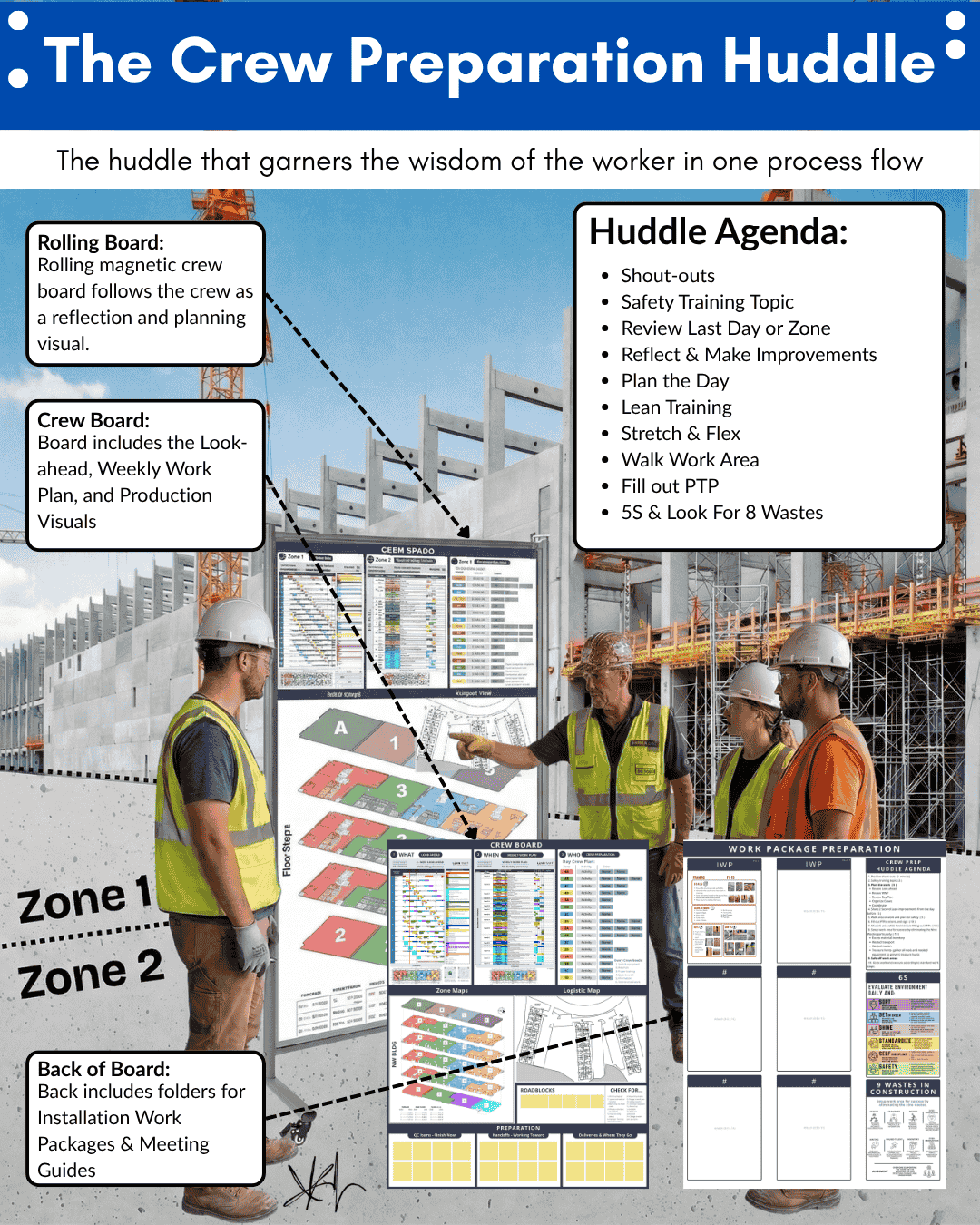
The Crew Preparation Huddle is a short, structured daily meeting where the crew gathers in the zone, around a visual crew board and prepares for the work together. Not a safety toolbox talk in a parking lot. Not a general announcement with no connection to the crew’s specific scope. An actual, practical, plan-the-day session that involves the people doing the work, built around information they can see and act on immediately.
The crew board is the anchor of the entire system. It moves with the crew. On the front sits the look-ahead plan, the weekly work plan, production visuals, and zone maps that crews can mark up with magnets or dry-erase markers. This is not information buried in a schedule it’s in the zone, readable by the workers who are about to do the work. On the back sit Installation Work Packages, crew prep meeting guides, feature-of-work expectations, and visual quality standards for how the work should be done. The quality checklist built in the preconstruction meeting three weeks ago? Right there. The visual standard for a proper installation? On the board that travels with the crew.
Watch for these signals that the Crew Preparation Huddle is missing or broken on your project:
- Workers are unclear on today’s scope and sequence when the day starts
- Quality failures are discovered after the work is complete, not before it begins
- The same coordination breakdowns repeat week after week in different zones
- Foremen are working alongside crews instead of planning ahead of them
- Lean habits like 5S and waste identification feel like GC programs, not crew practices
The huddle agenda is deliberate from start to finish: shout-outs, safety training, a review of the last day or zone, a reflection and improvement session, day planning, a Lean training topic, stretch and flex, a walk of the work area, filling out the pre-task plan, and a 5S check with a look for the eight wastes. Each step serves a purpose. The review of yesterday builds a culture of continuous improvement. The Lean training topic even two minutes builds a crew that understands the system they’re working inside. The walk of the work area creates shared situational awareness before a single tool is picked up. In a Takt production system, this daily crew-level visibility is what keeps zones flowing on rhythm and handoffs clean.
What Total Participation Actually Looks Like
Jason Schroeder teaches that visual systems exist for one reason: total participation. Visual management is a core Lean principle a work environment that is self-explaining and self-improving because the right information is visible to everyone who needs it. The Crew Preparation Huddle is that principle made operational at the crew level. The board doesn’t just display information. It creates a daily ritual where the crew engages with the plan, improves the plan, and owns the plan.
Total participation in practice means leaders come to the board instead of workers going to the trailer. Problems get raised by the crew before they become roadblocks. Zones finish completely because handoff expectations are visible and understood by everyone. The plan gets better every day because the people doing the work are the ones improving it. Lean is impossible without standard work at the crew level and standard work is impossible without visibility. If workers cannot see the plan, reflect on it, and improve it, there is no total participation. There is only managed execution from a distance. As Jason teaches, everything visual so that we have total participation that’s not a nice-to-have. It is one of the six foundational pillars of Lean in construction.
Dignity, Respect, and the Reason All of This Matters
The Crew Preparation Huddle is ultimately about respect respect for the worker’s skill, judgment, and intelligence. Respect for the crew’s ability to improve a process when given the right tools and information. Respect for the families who depend on stable, predictable work.
When we design systems that bring the plan to the worker visually, accessibly, every morning we are not just improving production metrics. We are saying to every person on that crew: you deserve to know what we’re building today, and your opinion on how to build it better matters. If your project needs superintendent coaching, project support, or leadership development, Elevate Construction can help your field teams stabilize, schedule, and flow. That mission is simple: we’re building people who build things.
A Challenge for Builders
Here’s what I want you to do next week. Walk up to a journeyman on your project and ask: “What are you building today, and how does it connect to what the next trade needs from you?” If the answer is confident and clear, your system is working. If the answer is a shrug, you know exactly what to fix. Run the Crew Preparation Huddle consistently. Bring leaders to the board. Train the crew every day even for two minutes. Reflect, improve, and plan again tomorrow. Do that for thirty days and watch what happens to your project, your quality numbers, and the energy of your crews. W. Edwards Deming said it plainly: “A bad system will beat a good person every time.” The Crew Preparation Huddle is how you fix the system one crew, one zone, one day at a time.
On we go.
Frequently Asked Questions
What is the Crew Preparation Huddle, and how is it different from a safety meeting?
The Crew Preparation Huddle is a structured daily meeting where a crew gathers in their work zone to review yesterday, improve the process, plan the day, cover safety, walk the area, and look for waste. It is specific to that crew’s work package and zone not a general announcement. The purpose is preparation, not compliance.
What is on the crew board, and why does it move with the crew?
The front holds the look-ahead, weekly work plan, production visuals, and markable zone maps. The back holds Installation Work Packages, meeting guides, and visual quality standards. The board moves with the crew because the plan needs to be where the work is not in a trailer three floors away.
How does the Crew Preparation Huddle support Lean construction?
Lean requires visual systems for total participation, and the Crew Preparation Huddle makes that real at the crew level. Lean is impossible without standard work and visibility at the crew level. If workers cannot see, reflect on, and improve the plan, total participation doesn’t exist.
What role does the foreman play during and after the huddle?
The foreman facilitates the huddle, then spends the rest of the day planning and preparing work ahead of the crew not working alongside them. A foreman who gets ahead of the crew ensures they never stop. The huddle sets the crew up for a full, uninterrupted day of production.
What are the 8 wastes and why do crews look for them daily?
The 8 wastes in Lean construction are defects, overproduction, waiting, non-utilized talent, transportation, inventory, motion, and extra processing. Looking for them daily builds the habit of continuous improvement at the field level, turning workers into active problem-solvers not passive executors.
If you want to learn more we have:
-Takt Virtual Training: (Click here)
-Check out our Youtube channel for more info: (Click here)
-Listen to the Elevate Construction podcast: (Click here)
-Check out our training programs and certifications: (Click here)
-The Takt Book: (Click here)
Discover Jason’s Expertise:
Meet Jason Schroeder, the driving force behind Elevate Construction IST. As the company’s owner and principal consultant, he’s dedicated to taking construction to new heights. With a wealth of industry experience, he’s crafted the Field Engineer Boot Camp and Superintendent Boot Camp – intensive training programs engineered to cultivate top-tier leaders capable of steering their teams towards success. Jason’s vision? To expand his training initiatives across the nation, empowering construction firms to soar to unprecedented levels of excellence.
On we go