
Graffiti in the Bathroom Is Not a Maintenance Problem. It’s a Leadership Problem.
Here’s the deal: I have been on projects where the project management team had beautiful bathrooms in the trailer clean, stocked, air-conditioned and thirty feet away, the workers who were actually building the project were handed a porta-potty baking in the summer sun with no wash station anywhere nearby. And then the same leadership team would sit in their comfortable trailer and wonder why morale was low, why quality wasn’t where it needed to be, and why they kept seeing disrespect on the floor.
The answer was thirty feet away. It was written on the wall of that porta-potty.
Graffiti in the bathroom is not a maintenance problem. It’s not a cleanup problem. It’s not a vandalism problem. It is a morale problem. It is a signal from the workforce to the leadership that says: you don’t care about us, so we don’t care about this. Workers don’t naturally trash environments they feel invested in. Humans are not naturally destructive of spaces they feel ownership over. Graffiti appears when there is contention between the workforce and the delivery team when workers have absorbed enough disrespect, enough discomfort, enough signal that they don’t matter, that a bathroom wall becomes the place they express it. Leadership created the conditions. The graffiti is just the visible symptom.
What Most Projects Accept That They Shouldn’t
Most construction projects don’t think of the bathroom as a leadership statement. It shows up on the mobilization checklist as a compliance item number of portable units per worker ratio, placement from the work area, distance from water sources. And once those boxes are checked, nobody thinks about it again until there’s a problem.
But the bathroom is experienced twice or more every single day by every worker on the project. It is one of the most consistent human experiences on the entire site. And the condition of that space whether it is clean or dirty, stocked or empty, comfortable or miserable communicates something to every worker who enters it, every single time.
Jason Schroeder teaches that bathroom quality is the first indicator of whether a project is truly Lean. If the bathroom is not good enough for the project management team’s grandmother, it is not good enough for workers and foremen. That is not a soft standard. It is a precise one. It takes the ambiguity out of the conversation. Apply it to your site today and you will know immediately whether the standard has been met.
A Story That Made This Personal
I was on a hospital project years ago that had about 200 workers at peak. The bathrooms were the standard construction fare functional, minimally maintained, no supplies in the stalls, barely cleaned. I started paying attention to the morale patterns across the project. The zones that performed best had the most engaged crews. And when I looked at what was different about those zones, one consistent thread was that the foremen in those zones had taken it upon themselves to advocate for their crews’ basic needs including bathrooms. They had made it a point to ensure supplies were available, to report cleanliness issues immediately, and to communicate to their crew that someone was paying attention.
The zones with the most turnover, the most quality issues, and the most coordination failures had the worst bathroom situations. Not as a coincidence. As a signal. When leadership took ownership of the bathrooms all of them, across the full site the tone of the project changed. Not because a clean toilet improved productivity directly. Because what it communicated about who mattered on this project changed how people showed up.
What the Lean Bathroom Standard Actually Is
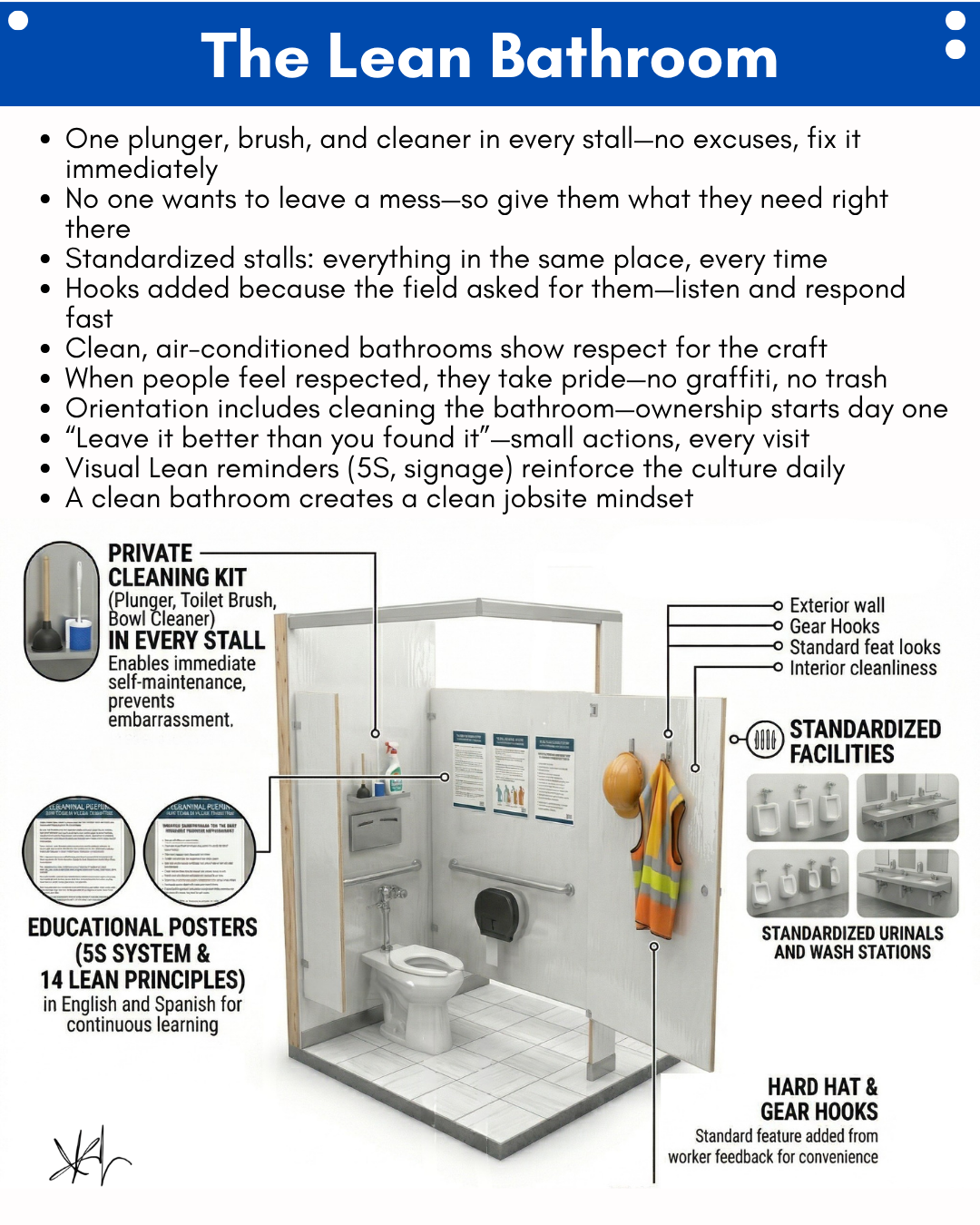
The image in this post shows what a bathroom designed to the Lean standard looks like. Every element has a purpose. Together they communicate one message: we thought about you before you walked in here.
A private cleaning kit plunger, toilet brush, and bowl cleaner in every stall. Not stored in a central supply room that requires finding someone to access. Right there. This enables immediate self-maintenance, prevents embarrassment, and removes the excuse. Nobody has to tolerate a condition they couldn’t fix because the tools weren’t available. The kit is there. The standard is there. The expectation is that every worker who uses the stall leaves it the way they found it or better.
Standardized facilities mean the layout and supplies are the same in every stall. Gear hooks at consistent height because the field asked for them and leadership listened fast. This is the 5S principle of Standardize made real in the most basic human environment on the project. When everything is in the same place every time, the space becomes familiar and trustworthy. Workers stop noticing the bathroom negatively because there is nothing negative to notice.
Watch for these signals that bathroom standards on your project are producing a morale problem:
- Graffiti in any stall on any unit this is a morale signal, not a vandalism problem
- Missing or depleted supplies with no restocking system or schedule
- No cleaning tools available inside the stall
- Units without adequate ventilation, lighting, or shade in summer months
- Workers reporting discomfort or embarrassment when using site facilities
Educational Posters and the Culture Loop
The Lean Bathroom has educational posters the 5S system and 14 Lean principles in English and Spanish posted visibly inside the stall. This is not decoration. This is continuous learning at the point where workers have a moment of uninterrupted attention. A worker who reads the 5S principles twice a day for six months has read them over 300 times. That repetition is how culture gets built. Not through a one-time orientation. Through daily, ambient reinforcement at the place where people are paying attention.
This also extends the Lean culture conversation into a space that most projects have abandoned as a lost cause. The bathroom is not a write-off. It is an opportunity. When the space is clean, the posters are maintained, the supplies are stocked, and the language includes both English and Spanish the bathroom becomes part of the cultural fabric of the project rather than a symptom of its dysfunction.
Why Cleanliness Is the Beginning of All Lean Thinking
Jason Schroeder teaches clearly: cleanliness is the beginning of all Lean thinking. You cannot see problems in a dirty environment. You cannot see low morale, slower paces, bottlenecks, quality deficiencies, or safety conditions in a space that is filthy and disorganized. A clean site including clean bathrooms creates a clear, calm stream where what’s going wrong becomes visible and fixable. A dirty site hides everything until it’s already a crisis.
When workers walk into a clean, well-stocked, air-conditioned bathroom with hooks for their hard hats and educational signage on the wall, something shifts. Not the bathroom. Their relationship to the project. They take pride. They stop trashing it. They leave it better than they found it. And that behavior leaving things better carries from the bathroom to the floor, to the zone, to the handoff, to the quality of the work they turn over. It is not linear, but it is real. The culture of the bathroom becomes the culture of the project.
If your project needs superintendent coaching, project support, or leadership development, Elevate Construction can help your field teams stabilize, schedule, and flow. That stability starts with the most basic signal of whether workers are respected and the bathroom is where that signal is most visceral.
Go Look at the Bathrooms Today
Here is the challenge. Not next week. Not at the next site walk. Today. Go look at the bathrooms your crew is using not the ones in your trailer, theirs and ask one question: are these remarkable? Not passing. Not acceptable. Remarkable.
If the answer is no, you have identified one of the cheapest, fastest, highest-return improvements available to your project. Private cleaning kits in every stall. Gear hooks for hard hats. Standardized layout. Educational posters in English and Spanish. Air conditioning or adequate ventilation. A cleaning schedule with accountability. Orientation that includes bathroom ownership from day one.
The more respect you show the crew, the more respect the crew shows the project. That is not a management theory. It is the lived reality of every well-run construction project in existence.
As Jason Schroeder teaches: “If workers understood that bathrooms are resources that enable their productivity, they would leave them better than they found them, and the project would flow.”
Leave it better than you found it. Every visit. Every day.
On we go.
Frequently Asked Questions
Why does Jason Schroeder say bathrooms are a Lean indicator?
Because the condition of the bathroom reveals whether leadership respects workers at the most basic level. Clean, well-maintained facilities with proper supplies signal that the project team thought about the whole worker. Everything else in the Lean system flows better when that foundation is right.
What does graffiti in the bathroom actually tell you?
It tells you the workforce is disgruntled. Graffiti is not natural it appears when workers feel enough contention with the delivery team that the bathroom wall becomes the place they express it. It is a leadership and morale problem that happens to show up on a porta-potty.
Why put a cleaning kit in every stall rather than at a central supply point?
Because removing the friction between seeing a problem and being able to fix it immediately is the whole point. If the plunger is somewhere else, workers will tolerate a condition they didn’t create. When the kit is in the stall, the standard becomes self-enforcing.
How do educational posters in the bathroom support Lean culture?
They create daily, ambient reinforcement of Lean principles in the one space where workers have a guaranteed moment of uninterrupted attention. Consistency over time seeing the same principles twice a day for months builds the kind of familiarity that turns concepts into habits.
Why should bathroom orientation be included in project onboarding?
Because ownership starts on day one. When workers are taught from the beginning that the bathroom is their space and their responsibility leave it better than you found it they internalize that standard before any behavior pattern forms in the opposite direction.
If you want to learn more we have:
-Takt Virtual Training: (Click here)
-Check out our Youtube channel for more info: (Click here)
-Listen to the Elevate Construction podcast: (Click here)
-Check out our training programs and certifications: (Click here)
-The Takt Book: (Click here)
Discover Jason’s Expertise:
Meet Jason Schroeder, the driving force behind Elevate Construction IST. As the company’s owner and principal consultant, he’s dedicated to taking construction to new heights. With a wealth of industry experience, he’s crafted the Field Engineer Boot Camp and Superintendent Boot Camp – intensive training programs engineered to cultivate top-tier leaders capable of steering their teams towards success. Jason’s vision? To expand his training initiatives across the nation, empowering construction firms to soar to unprecedented levels of excellence.