
Most Projects Treat Commissioning Like a Destination. The Best Projects Treat It Like a Direction.
Here’s a truth that every project team eventually learns the hard way: you cannot protect your finishes in a building that isn’t conditioned. You cannot commission a system that isn’t complete through the vertical spine of the structure. And you cannot finish strong if you haven’t been building toward commissioning from day one. The teams who discover this during closeout spend the last six weeks of the project in crisis mode reworking ductwork to accommodate finishes, troubleshooting controls because systems were never properly sequenced, scrambling to balance airflow in a building that was enclosed too late to flush properly. They didn’t cause those problems in closeout. They caused them in preconstruction when nobody asked the question: what is our path to commissioning, and are we building toward it from the moment we break ground?
What Most Projects Actually Do
Most project schedules treat commissioning as a phase something that happens after construction. It shows up near the end of the baseline schedule, compressed between substantial completion and TCO, and it gets squeezed harder than any other phase when the project runs behind. The MEP team is asked to complete their point-to-point in half the time they need. The controls contractor can’t finish programming because the systems weren’t ready when they were supposed to be. The test and balance firm shows up to find that the air handlers can’t run continuously because parts of the building are still under construction. And the building flush which requires the HVAC system to run at full capacity for an extended period never happens properly because nobody protected the time for it.
None of that is a commissioning failure. It’s a sequencing failure that started months earlier. Commissioning doesn’t fail at the end. It fails in the production plan that was never designed around it.
A Story That Changed How I Think About This
I remember being an MEP superintendent on a complex laboratory project early in my career. We had a commissioning agent on the project who was sharp and had seen more troubled closeouts than most teams encounter in a decade. In one of our early coordination meetings, he asked the project team a simple question: when does power reach the roof? Not the full electrical package. Just power to the roof. Nobody could answer specifically. The power distribution sequence hadn’t been mapped against the commissioning sequence they existed in separate parts of the schedule and nobody had connected them.
That question unlocked six weeks of replanning. Because the answer revealed that based on the current sequence, power would reach the roof in time to fly in the air handlers, but not in time to run them before the interior finishes were going in. The building was going to be enclosed with no conditioning capability. Paint going in without controlled humidity. Casework being installed in a building with temperatures swinging thirty degrees between morning and afternoon. That rework potential from cracking casework, failing paint, and humidity damage to specialty systems would have cost more than the replanning effort ten times over. We moved commissioning up by six weeks. It was the right call, and I’ve never forgotten it.
The Four-Step Path of Commissioning
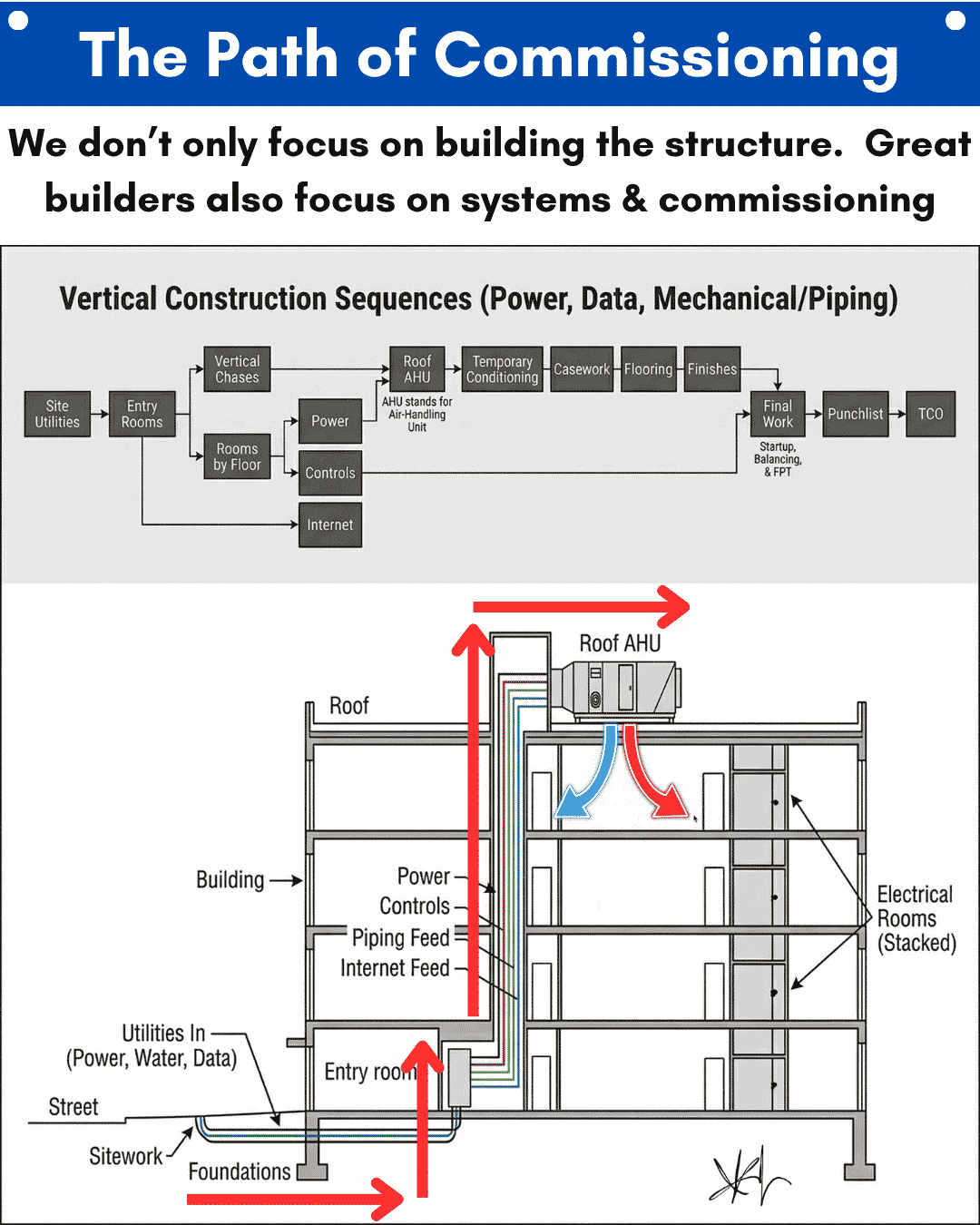
The sequence shown in the image in this post is how great builders think about commissioning from day one. It moves in four deliberate steps each one enabling the next and it is non-negotiable. Skipping or compressing a step doesn’t save time. It transfers the cost to a later phase where it multiplies.
Step one is utilities to the building. Power, water, data, gas, sewer, storm drain all of it stubbed in from the street and brought into the entry rooms at grade level. The service entry section handles power. The main distribution frame handles communications. The mechanical room receives water. Nothing vertical in the building can be powered, tested, or commissioned before this step is complete and verified. This is the foundation of the entire commissioning sequence, and it must be tracked as a system milestone, not buried in the horizontal construction schedule.
Step two is bringing services into the entry rooms. This is where utilities transition from off-site infrastructure to building systems. Fire pump room, mechanical room, MDF, service entry section each system has a specific home at grade, and getting them into those homes completely and inspected unlocks the vertical run up the building. This step requires close coordination between the electrical, mechanical, and low-voltage trades and it is the first place commissioning sequences commonly stall because the coordination didn’t happen in preconstruction.
Step three is running systems vertically through the building. Power up through the electrical rooms stacked floor by floor. Communications and controls cabling through the independent distribution frames and chase spaces. Hydraulic piping hot water, chilled water, domestic rising through the building to feed equipment. Ductwork rising through vertical shafts to the roof. This is the spine of the commissioning sequence. When the vertical infrastructure is complete power, piping, data, duct everything above can be connected. Until it is, the air handlers on the roof are expensive equipment waiting to do their job.
Watch for these signals that the commissioning path is not being built into the production plan:
- Electrical room sequences are scheduled as part of the interior phases rather than as standalone vertical milestones tracked separately
- The air handler delivery date is on the schedule but the power and piping hookup sequence leading to startup is not
- Point-to-point is scheduled as a single block at the end of the project rather than built floor by floor as interior work completes
- Test and balance appears only in the closeout phase with no protection for the time required to run the system at full load
Step Four: Getting Air Moving
Step four is the air handler flying it in, connecting power, piping, and controls, performing the mechanical startup, completing the point-to-point through the entire vertical system, and then running the system. This is the moment the building starts to breathe. Exhaust pulls stale air. Supply delivers conditioned air. The building environment stabilizes. And then everything downstream of this moment becomes possible in the right conditions: full test and balance, functional performance testing, building flush, and eventually the TCO walk.
Jason Schroeder’s framework for commissioning is clear: you track by system, not by location. Print the one-line diagram. Print the HVAC flow diagram. Put them on the wall. Highlight segments as they’re complete. Build the commissioning sequence into the production plan as a parallel track alongside the interior Takt zones not as a separate, disconnected schedule that nobody references until the team is scrambling. The individual commissioning activities happen floor by floor as each zone completes its dry-side and wet-side connections, pre-functional checklist, and point-to-point. When every floor is done, the building-level point-to-point can begin. That sequencing is not optional. It is the only path that works.
Why Sequencing and Takt Are the Answer
The Takt Production System naturally supports the commissioning path because it creates zone completion discipline. In a Takt environment, trades don’t leave zones partially done they complete each zone before moving to the next. That means the mechanical and electrical work in Zone 1 is fully installed, inspected, and ready for the commissioning sequence before the zone is handed off. The pre-functional checklist can run floor by floor because the work is actually done floor by floor. The point-to-point can progress because the controls cabling was completed in sequence, not scattered across the building wherever trades happened to be working.
Without Takt, without zone completion discipline, commissioning becomes an archaeological dig crawling through a partially complete building trying to trace systems that were installed in fragments across months of work. That dig takes weeks. It produces the compressed, chaotic closeouts that the industry has normalized and should not accept. If your project needs superintendent coaching, project support, or leadership development, Elevate Construction can help your field teams stabilize, schedule, and flow. That flow runs all the way to the TCO walk and it starts with a commissioning sequence built into the production plan from day one.
Build It on Paper First. Then Build It in the Field.
Here is the challenge. On your next project, before construction begins, sit down with your MEP trade partners and build the commissioning path visually. Map it in four steps: utilities in, entry rooms complete, vertical spine complete, air handlers online. Put dates against each step. Check those dates against the interior Takt plan to confirm the vertical milestones are achievable in the production sequence you’ve designed. Then move commissioning up by at least six weeks from wherever your first instinct put it. Protect those six weeks. Build the plan that makes the path achievable, and then build to the path.
The best projects don’t ask when commissioning starts. They build so that commissioning is already happening floor by floor, system by system, from the first week of interior work to the last.
As Jason Schroeder teaches: “Plan it first, build it right, finish as you go.” That’s the path of commissioning. Start it now.
On we go.
Frequently Asked Questions
What is the path of commissioning and why does sequencing matter?
It’s the four-step vertical sequence utilities in, entry rooms, vertical infrastructure, air handlers online that must happen in order. Skipping or compressing a step transfers the cost forward as rework, compressed testing, and failed closeouts.
Why should commissioning be moved up earlier in the schedule?
Because every downstream activity test and balance, building flush, functional performance testing, TCO requires stable, running systems. Moving commissioning up by six weeks creates the buffer needed to run those activities properly instead of compressing them into crisis mode.
How does Takt support the commissioning sequence?
Takt requires zone completion before handoff, which means MEP work is done floor by floor in sequence enabling pre-functional checklists and point-to-point to happen progressively rather than as a chaotic end-of-project scramble.
What is point-to-point and when should it happen?
It’s the controls verification process where the controls team confirms every piece of equipment is properly connected and communicating. It should happen floor by floor as each zone’s systems complete not as a single block at the end of the project.
What is building flush and why is it important?
Building flush requires the HVAC system to run at full capacity for an extended period to purge construction contaminants before occupancy. It can only happen when the system is fully operational which is why getting air handlers online early is critical to TCO readiness.
If you want to learn more we have:
-Takt Virtual Training: (Click here)
-Check out our Youtube channel for more info: (Click here)
-Listen to the Elevate Construction podcast: (Click here)
-Check out our training programs and certifications: (Click here)
-The Takt Book: (Click here)
Discover Jason’s Expertise:
Meet Jason Schroeder, the driving force behind Elevate Construction IST. As the company’s owner and principal consultant, he’s dedicated to taking construction to new heights. With a wealth of industry experience, he’s crafted the Field Engineer Boot Camp and Superintendent Boot Camp – intensive training programs engineered to cultivate top-tier leaders capable of steering their teams towards success. Jason’s vision? To expand his training initiatives across the nation, empowering construction firms to soar to unprecedented levels of excellence.