Lean Construction Starts at the Gate
Most project teams spend months building a production plan, designing zone sequences, setting up crew boards, and engineering the morning huddle into a tight, disciplined routine. Then day one comes and half the crew walks onto the floor before the huddle starts, three workers show up who haven’t been oriented, and somebody from a sub-tier sub is wandering a zone they have no business being in. The production system that was so carefully designed begins its first day already compromised not by a planning failure or a scheduling error, but by an uncontrolled gate.
This is the problem that most Lean conversations never reach. We talk about Takt, Last Planner, visual management, and crew preparation huddles. We build meeting systems and zone maps and roadblock logs. But if the gate is open to anyone, at any time, with no verification of who they are or whether they’re prepared to be there every system built downstream of that gate is exposed to instability from the moment the first boot hits the ground.
The Site Entry Problem Nobody Measures
Walk the entry of a typical commercial project during mobilization week. People arrive in waves, some before the huddle, some after. Some are oriented, some are waiting for their turn but went ahead to find their foreman first. Some have their PPE, some are borrowing a hardhat from a coworker by the gate. Nobody knows exactly how many workers are on the site at any given moment. If something happens and you need to account for every person on the project, you’re cross-referencing sign-in sheets, calling foremen, and hoping the picture is accurate.
That’s not a workforce problem. That’s a system problem. And the system was not designed to produce a different result.
I remember a project early in my career where we had a serious near-miss in the first week of heavy MEP installation. When we did the post-incident review, one of the first questions asked was: who was in that area? It took three hours to reconstruct an accurate picture of who had been where and when. The paperwork didn’t match what the foremen recalled. The sign-in sheet had gaps. One worker who had not yet attended orientation had entered the site through a secondary gate that was occasionally left open for delivery access. Nobody intended for that to happen. The system allowed it to happen because nobody had designed the entry to prevent it.
What Controlled Site Access Actually Creates
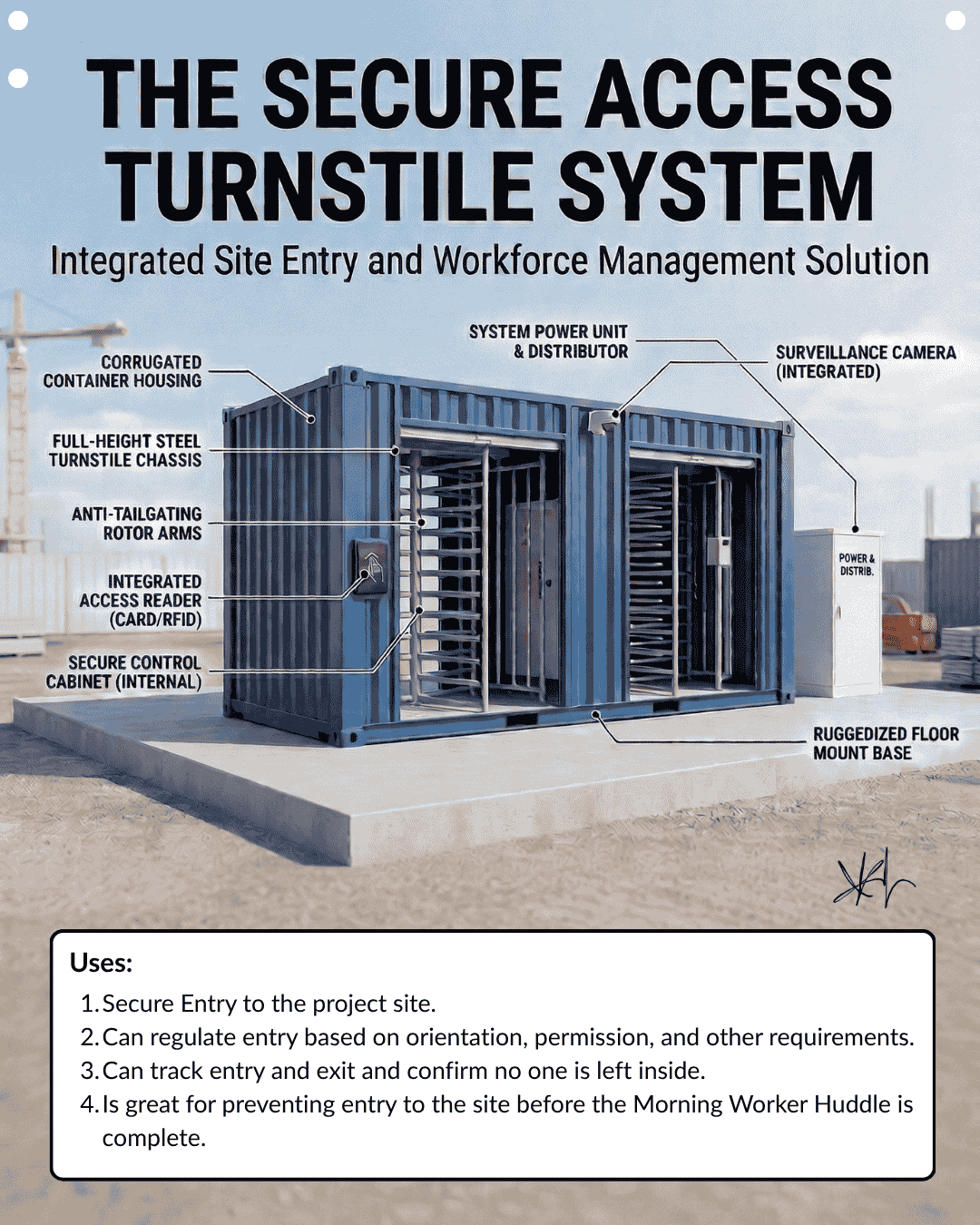
The Secure Access Turnstile System shown in this post is not about surveillance. It’s about stability. The full-height steel turnstile chassis with integrated card and RFID access reader does something elegantly simple: it makes entry conditional. You enter when you have been verified. You enter when your orientation is on record. You enter when the system confirms you have permission to be on this project today. Not before.
The anti-tailgating rotor arms mean the system can’t be defeated by two people walking through on one badge. The integrated surveillance camera provides a real-time record of every entry and exit, creating an accurate headcount that the project team can access instantly rather than reconstructing from paper records during an emergency. The secure control cabinet manages all of it from a single, ruggedized system that operates in the outdoor construction environment without degrading over a long project.
The use case that matters most is the one at the bottom of the image: preventing entry to the site before the morning worker huddle is complete. That single function is worth examining carefully because its implications run deeper than most people initially recognize.
Watch for these signals that site entry is producing instability on your project:
- Workers appearing on floors before the huddle has completed, with no knowledge of the day’s safety focus or plan
- Difficulty producing an accurate headcount within ten minutes of an emergency or incident
- Unoriented workers found in active work zones who entered through unsecured access points
- Foremen starting crew prep huddles with incomplete crews because some members arrived late after the main huddle
- Unauthorized sub-tier workers on site who were not registered through the general contractor’s verification system
Why the Morning Worker Huddle Cannot Be Optional
Jason Schroeder teaches that the morning worker huddle is the most important meeting in construction. Its purpose is to create one social group, win over the workforce, and communicate the plan for the day safety focus, permits, active deliveries, weather conditions, and daily training. When workers feel listened to and respected in that huddle, something shifts. The project becomes a team instead of a collection of separate subcultures competing for space and resources. People see as a group, know as a group, and act as a group.
But that result depends entirely on one condition: everyone is in the huddle. Not most people. Everyone. When workers arrive after the huddle starts and slip into the work area, they carry fragmented information into a system that was designed around shared knowledge. They don’t know the safety focus for the day. They haven’t heard the delivery windows. They weren’t part of the training topic that the whole crew just aligned on. And when something goes wrong in that zone later a near-miss, a coordination failure, a quality issue the thread often traces back to a worker who was present on the project but absent from the alignment that the whole day depended on.
The turnstile makes the huddle non-optional without a single additional reminder or enforcement conversation. The gate doesn’t open until the huddle is complete. There’s nothing more to enforce. The system does it.
Orientation, Verification, and Respect for Every Worker
Beyond the daily flow, the access control system addresses one of the most overlooked risks on active construction projects: unverified entry. The card and RFID reader means only workers who have been properly onboarded and received their site credential can enter. This isn’t bureaucratic it’s protective. A worker who hasn’t attended orientation doesn’t know the site-specific safety standards. They don’t know the emergency egress plan, the active hazard zones, the PPE requirements for specific areas, or the behavior expectations that the project team has worked to establish. Sending them into a live construction environment without that knowledge is not respectful. It’s a risk to them and to everyone working around them.
The best onboarding programs including the approach Elevate Construction recommends deliver a series of trainings through the daily morning huddle specifically because crews fluctuate and workers join at different times. A trade joining mid-project deserves the same quality of information as trades that mobilized in week one. The turnstile reinforces this standard by making entry conditional on completed orientation, regardless of when in the project lifecycle a worker arrives. It protects new arrivals by ensuring they’re never sent into an active site without the context they need to be safe and effective.
Control Is Not the Opposite of Respect It’s an Expression of It
The word “control” makes some leaders uncomfortable. They hear “turnstile” and think surveillance, restriction, distrust. But there’s a different frame that’s more accurate: controlled entry is how you protect every person who walks through that gate. It’s how you guarantee that the craft worker arriving at 6:45 AM will hear the safety briefing that was designed to protect them. It’s how you confirm they’ve been told about the active lift zone on level three, the wet concrete in the southwest corner, and the revised delivery sequence that changes traffic flow this morning. It’s how you know, without paper or guesswork, who is on the project and where.
That’s not control for control’s sake. That’s Respect for People made operational. If your project needs superintendent coaching, project support, or leadership development, Elevate Construction can help your field teams stabilize, schedule, and flow. Stability at the production level is impossible without stability at the site entry level. The gate is where the system begins. Design it accordingly.
Build the Foundation That Every Other System Depends On
Here is the challenge I want to leave with you. Think about the project you are running right now and ask: at any moment during the workday, can I tell you exactly how many verified, oriented workers are on this site? Can I confirm that every one of them attended this morning’s huddle before they entered the work area? Can I produce that information in under five minutes without calling four foremen and cross-referencing two different sign-in sheets?
If the answer is no, the foundation of the production system is not as stable as the planning system you’ve built above it. The Takt plan, the visual area boards, the crew prep huddle, the zone control walks all of it performs better when the team that executes it is complete, aligned, and verified at the point of entry. Design the gate the way you design the schedule: with intention, with systems, and with the people doing the work firmly in mind. Lean construction starts at the gate. Build the gate right.
On we go.
Frequently Asked Questions
What is a secure access turnstile system and how is it different from a sign-in sheet?
A secure access turnstile system uses card or RFID credentials tied to verified orientation records to control physical entry. A sign-in sheet captures who reported being there it cannot prevent entry, verify credentials, track exits, or produce a real-time headcount. The turnstile makes entry conditional and the headcount automatic.
How does the turnstile enforce morning huddle attendance without added supervision?
The system can be configured to lock entry until the huddle is complete. Workers arriving before that time wait at the gate. No supervisor needs to manage it, enforce it, or track exceptions. The gate is the enforcement mechanism, which removes the need for daily reminders and confrontational accountability conversations.
Why does unverified site access create a safety problem?
Workers who haven’t attended orientation don’t know site-specific safety standards, hazard zones, emergency egress routes, or PPE requirements for specific areas. Sending them into an active construction environment without that knowledge exposes them and everyone working near them to preventable risks. Controlled entry ensures every person on the project has the information they need to be safe.
What does the anti-tailgating feature do?
Anti-tailgating rotor arms prevent two people from entering on a single credential scan. Without this feature, someone who isn’t verified can enter by following closely behind someone who is. The anti-tailgating mechanism ensures every entry is individually verified, maintaining the integrity of the access control system throughout the day.
How does real-time entry and exit tracking support emergency response?
In an incident or emergency requiring site evacuation, knowing exactly who is on the project and being able to verify it in real time is critical to an accurate muster count. Paper sign-in sheets require manual cross-referencing under pressure. The integrated tracking system produces an accurate headcount instantly, giving the safety team the information they need to confirm everyone has evacuated.
If you want to learn more we have:
-Takt Virtual Training: (Click here)
-Check out our Youtube channel for more info: (Click here)
-Listen to the Elevate Construction podcast: (Click here)
-Check out our training programs and certifications: (Click here)
-The Takt Book: (Click here)
Discover Jason’s Expertise:
Meet Jason Schroeder, the driving force behind Elevate Construction IST. As the company’s owner and principal consultant, he’s dedicated to taking construction to new heights. With a wealth of industry experience, he’s crafted the Field Engineer Boot Camp and Superintendent Boot Camp – intensive training programs engineered to cultivate top-tier leaders capable of steering their teams towards success. Jason’s vision? To expand his training initiatives across the nation, empowering construction firms to soar to unprecedented levels of excellence.
On we go