
Building a Learning Organization: What O’Shea Builders Got Right About Team Development
There is a version of team development that exists in construction as a scheduled event. A workshop gets planned. A trainer comes in. The team completes the exercises. The trainer leaves. Six months later, the behaviors look the same as they did before the workshop, and the next budget cycle sees training deprioritized because the previous round did not produce measurable results. That version of development is common, and it does not work. It does not work because it treats development as a program rather than a culture. Tess Fialka and Josh Fry, Director and Assistant Director of Employee Development and Engagement at O’Shea Builders, came on this episode to describe what the alternative looks like, and the results speak for themselves: increased gross revenue, improved team satisfaction scores, and a regional award for excellence in training and development.
What Makes O’Shea Different
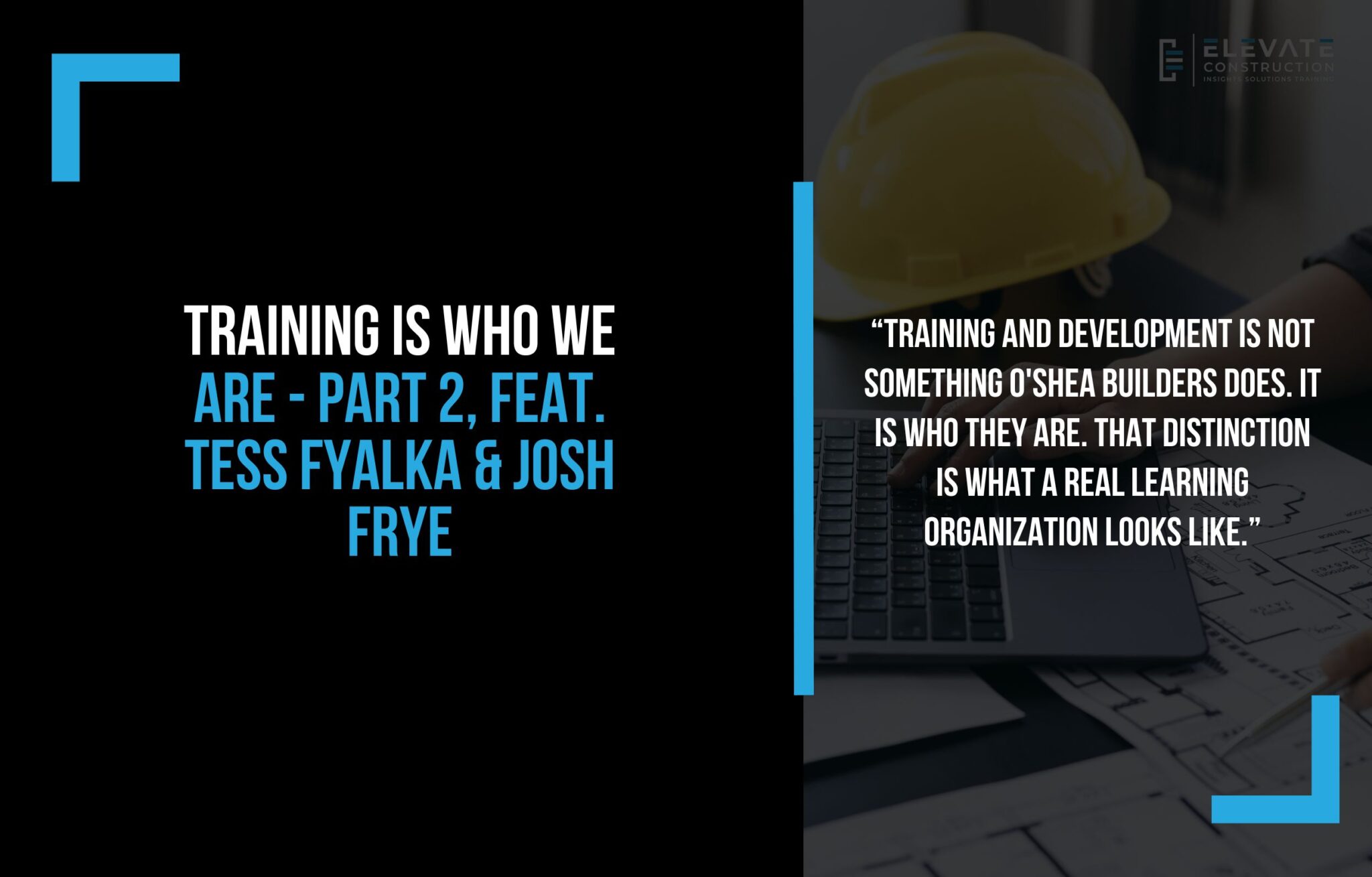
Harry Schmidt and Tyler Cormany, O’Shea’s director of business strategies and vice president, have said consistently that the company’s performance comes from its investment in leadership and team development. Not as a department or a program, but as an organizational identity. As Tess Fialka frames it: training and development at O’Shea is not something the company does. It is who the company is.
That framing matters because it changes what development is resourced for. When development is a program, it competes for budget against other line items and often loses when the schedule gets tight. When development is an identity, it is inseparable from the organization’s strategy and its understanding of how results are produced. O’Shea is an overnight success fifteen years in the making, as they say internally. That timeline reflects an organization that has consistently invested in people, iterated on what works, abandoned what does not, and built a culture capable of implementing lean production systems, Last Planner, Takt planning, and operational excellence precisely because the people were developed to lead those systems before the systems were introduced.
Getting the Right People on the Bus
The development journey at O’Shea begins before anyone joins the company. The recruitment and selection process is deliberate and intentional in a way that most construction companies are not. The goal is not to fill a position quickly. The goal is to identify whether the candidate has the knowledge, skills, and abilities the role requires and whether they are a genuine cultural complement to the organization. Not a cultural fit in the sense of sameness, but a complement in the sense that they add something to what is already there while sharing the organization’s values.
The interview process reflects that intention. Candidates do not meet only with the hiring manager. They meet with the team they would be joining, because the team’s perspective on who belongs in their group is as relevant as the hiring manager’s assessment of technical qualifications. When the right person joins O’Shea, the whole team has already had a voice in that decision, which means the belonging starts earlier and the integration goes faster.
Onboarding as Culture Integration, Not Compliance
Once someone joins O’Shea, the onboarding is not a checklist of policies and procedures. It is a tailored program that can run anywhere from three weeks to twelve months depending on the role, designed to do two things: introduce the new team member to O’Shea’s systems and processes, and genuinely integrate them into the culture. The relationship-building piece is explicit and deliberate. Tess Fialka describes it as trying to ensure that people feel like they are part of the O’Shea family very early, because those relationships are being built from the first day, not left to form on their own over time.
That investment in early relationship-building produces the kind of belonging that makes everything else work. A new team member who has been welcomed into the community, introduced to the people they will work alongside, and oriented to the culture’s values around learning and respect is a team member who is already contributing from the right foundation. The technical skills can be developed. The cultural foundation has to be built early or it does not form at all.
The Learning Disciplines That Develop Leaders
O’Shea has identified a set of leadership development disciplines that produce the leaders its field and office operations need. These are not one-time training events. They are ongoing areas of focus that are woven into the leadership development journey.
The key areas that Tess and Josh describe:
- Behavior and personality development using DISC, helping team members understand how different personalities show up and how to communicate effectively across those differences
- Conversations and collaboration training, specifically Conversations Worth Having by Jackie Stavros and Sheri Torres, and Humble Inquiry by Edgar Schein, which develop the quality of workplace dialogue
- Emotional intelligence, drawing on Susan David’s work, which builds the self-awareness and interpersonal skill that leaders need to navigate high-stakes situations
- Leading through change, drawing on John Kotter’s work and other change management frameworks, which helps both leaders and their teams understand their natural orientation toward change and develop the patience and persistence the process requires
- Psychological safety, grounded in Amy Edmondson’s The Fearless Organization, which creates the conditions under which people contribute fully and challenge what is not working
- Leadership Circle 360 as a development tool, which gives leaders a baseline on twelve core leadership competencies and a coaching pathway to improve their Achilles heels
Each of those disciplines builds capability that shows up in how O’Shea’s teams collaborate, how they manage their projects, and how they treat the people in their care. They are not independent training events. They are interconnected investments in the kind of leaders who can implement lean systems, maintain psychological safety, and build crews that perform at the highest level.
Respecting the Nature of People
One of the most important phrases in this conversation comes from Tess Fialka’s description of the philosophy behind O’Shea’s approach: respect for the nature of people. This is different from respect for people in the generic sense. Respecting the nature of people means recognizing that every individual brings a different perspective, a different communication style, a different relationship to change, and a different set of strengths to the organization. It means not expecting people to fit into a predetermined mold, but instead asking: what is this person’s nature, what are they capable of, and how can we create the conditions for that to emerge fully?
Jason Schroeder connects this directly to the field. The soft-spoken foreman in a room full of louder personalities is not a problem to manage. They are a person to understand. The crusty foreman who gets emotional when challenged is not someone to fight back against. They are someone whose passion and communication style can be met where it is. The ability to do that, to be curious instead of reactive, to connect rather than resist, is a leadership skill that gets developed. It does not arrive automatically with a promotion.
Leaders as Learners and Teachers
The multiplication effect at O’Shea comes from what Josh Fry describes as leaders who are learners and teachers simultaneously. Harry Schmidt and Tyler Cormany do not just mandate development for their team. They participate in it. They send articles and books to their colleagues. They engage with new ideas. They model the growth mindset that Carol Dweck’s work describes and that O’Shea has embraced as a foundational principle.
When the leader at the top of an organization is visibly, genuinely committed to learning, it changes what learning means throughout the organization. It is no longer a performance expectation. It is a cultural norm. The superintendent who sees their vice president reading a book and sharing an article about lean production does not need to be told that reading and learning are part of the job. The behavior of the leaders is the communication. As Jason puts it: if you want a clean project, pick up the trash yourself. The same principle applies to learning. If you want a learning organization, be a fanatical learner from the top.
Built for Organizations That Want to Last
The results at O’Shea are not accidental. They are the compounded outcome of fifteen years of consistent investment in people, iterative improvement of development programs, a hiring process that selects for cultural complement as well as technical skill, and a leadership team that models what it asks of others. No single intervention produced those results. The culture produced them, and the culture was built one deliberate decision at a time. If your project needs superintendent coaching, project support, or leadership development, Elevate Construction can help your field teams stabilize, schedule, and flow.
Persistence and Patience: The Two P’s
Josh Fry closes with what he calls the two P’s: persistence and patience. Continuous improvement is continuous. It does not arrive at a destination. There is no moment at which the organization is finished developing its people. There are only iterations, small victories, honest assessments of what is not working, and the commitment to keep going. When a new tool or program is introduced and the initial results are modest, persistence means continuing rather than abandoning. When the change is slower than expected, patience means trusting the process rather than declaring failure. Together, those two qualities are what allow an organization to become something worth becoming over time. Not in a sprint. Not through a single program. Through the compounding effect of showing up, learning, adjusting, and going again.
On we go.
FAQ
What is the difference between a company that does training and a learning organization?
A company that does training schedules events, sends people to workshops, and considers the investment made when the event concludes. A learning organization treats development as an ongoing cultural identity rather than a periodic program. At O’Shea Builders, training and development is not a department that runs programs. It is the expression of who the organization is and how it operates. Leaders are learners and teachers simultaneously. Development is built into onboarding, into daily interactions, and into how leadership behaves at every level. The result is that learning compounds over time rather than fading after each event.
How does the onboarding process at O’Shea build culture rather than just compliance?
The onboarding program is explicitly designed to do two things: introduce new team members to systems and processes, and genuinely integrate them into the O’Shea culture through relationship-building. The program runs anywhere from three weeks to twelve months depending on the role, and it includes interactions not just with the hiring manager but with the entire team the new person will be working alongside. The subject matter experts who participate in onboarding are themselves learning and teaching, which reinforces the culture’s commitment to development across the organization. By the end of onboarding, new team members know their colleagues, understand the values, and feel genuine belonging rather than provisional membership.
What does respecting the nature of people mean in a field leadership context?
It means recognizing that every individual brings a different communication style, a different relationship to change, a different set of strengths, and a different way of engaging with work and with leadership. Respecting the nature of people means not forcing everyone into the same mold but learning how to connect with each person where they are. In the field, this looks like a superintendent who responds to a quiet foreman with curiosity rather than frustration, who engages a passionate and emotional communicator with patience rather than resistance, and who makes space for different approaches to the work rather than insisting on a single style. It is a leadership skill that gets developed, not assumed.
What book recommendations did Tess Fialka and Josh Fry share for leaders who want to grow in these areas?
For psychological safety: The Fearless Organization by Amy Edmondson. For leadership: Multipliers by Liz Wiseman and anything by Patrick Lencioni, especially The Ideal Team Player. For conversations and collaboration: Conversations Worth Having by Jackie Stavros and Sheri Torres, and Humble Inquiry by Edgar Schein. For emotional intelligence: Susan David’s work on the subject. For change management: John Kotter’s publications and Who Moved My Cheese. For mindset: Mindset by Carol Dweck. For foundational leadership concepts: John Maxwell’s The 21 Irrefutable Laws of Leadership. None of these are silver bullets. They are pieces of a larger development puzzle that work best when applied iteratively alongside real organizational experience.
What are the two P’s that Josh Fry says are essential for sustained organizational improvement?
Persistence and patience. Continuous improvement is not a project with a completion date. It is an ongoing commitment that requires the organization to keep showing up even when progress is slow, to keep adjusting even when results are modest, and to keep believing in the direction even when the distance to the destination is hard to see. Persistence means continuing to implement and refine rather than abandoning when the first iteration is imperfect. Patience means trusting that the compounding effect of consistent investment in people will produce results over time that a short sprint cannot. Together, those two qualities are what allow an organization to become, over fifteen years, the overnight success that O’Shea Builders has become.
If you want to learn more we have:
-Takt Virtual Training: (Click here)
-Check out our Youtube channel for more info: (Click here)
-Listen to the Elevate Construction podcast: (Click here)
-Check out our training programs and certifications: (Click here)
-The Takt Book: (Click here)
Discover Jason’s Expertise:
Meet Jason Schroeder, the driving force behind Elevate Construction IST. As the company’s owner and principal consultant, he’s dedicated to taking construction to new heights. With a wealth of industry experience, he’s crafted the Field Engineer Boot Camp and Superintendent Boot Camp – intensive training programs engineered to cultivate top-tier leaders capable of steering their teams towards success. Jason’s vision? To expand his training initiatives across the nation, empowering construction firms to soar to unprecedented levels of excellence.