
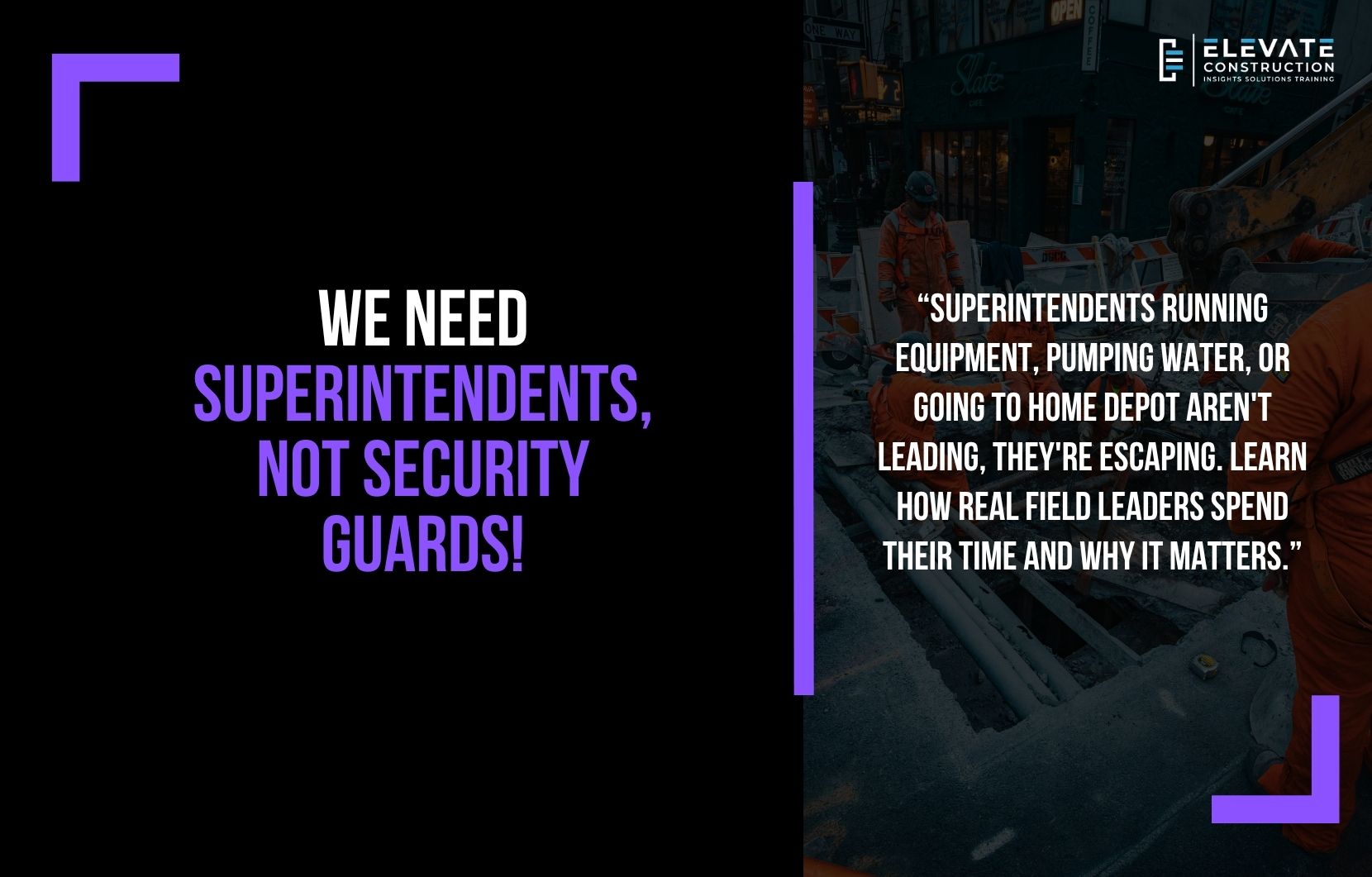
Stop Being a Security Guard: What Real Superintendents Actually Do
Here’s the deal: if your superintendent spends half the day in a forklift, running to Home Depot, or pumping water out of a trench, you don’t have a superintendent. You have an expensive security guard pointing people in different directions. And that’s costing you production, safety, and the respect of every trade partner on your site.
I’ve seen it everywhere. The super who jumps in equipment “just this one time.” The foreman who answers every question instead of teaching people to find their own answers. The field leader who stays buried in doing instead of leading. They’re working hard, running constantly, and wondering why the project never gets ahead of schedule.
The problem isn’t effort. The problem is they’re in the wrong role doing the wrong work.
The Real Problem: Addiction to Chaos and Certainty
Let’s name what’s actually happening. Superintendents and foremen can get addicted to the adrenaline of chaos. Someone once posted that online and got pushback, “That’s childish. That’s not real.” But it’s absolutely true. We get addicted to those chemicals that rush, that feeling of being needed in the moment.
Think about the foreman who came up through the trades. They know how to unload that delivery. They know how to operate the equipment. They know how to pump out water. They’re getting certainty from doing things they already know how to do. They’re getting significance from being the hero who saves the day. But they don’t know how to plan a schedule. They don’t know how to lead a huddle. They don’t know how to create stability. They don’t know how to manage trade flow.
So where do they go? Back to what gives them certainty and significance. Back to doing instead of leading. And every time they do, they’re abandoning their actual role.
This ties directly to the six basic human needs: certainty, significance, variety, love and connection, growth, and contribution. When someone focuses too much on certainty and significance, they’ll spend all day on equipment and at Home Depot instead of properly delegating, planning, and executing the work. The system failed them by promoting them without training. But now they’re failing everyone else by refusing to step into the role they were given.
The Construction Industry Created This Problem
Here’s what happened: construction has spent decades saying “Hey worker, go be a foreman. Hey foreman, go be a superintendent” without any training. It’s ridiculous. We take great workers and throw them into leadership positions with zero preparation, then blame them when they don’t know what to do.
I’ve worked with companies that trained like crazy when they were $1.5 billion in annual revenue. As they grew larger, training decreased. That makes no sense. You need more capability and more capacity to expand, not less. You cannot scale without developing your people.
And let me be clear about something: we don’t have a worker problem or a foreman problem in this industry. We have a construction culture problem. We have a process problem. Companies are not providing the right training, the right support, the right environments. They’re not taking care of workers. Then they blame people instead of fixing the broken system.
If your company doesn’t train, if you don’t create stability, if you don’t respect trade partners and workers, you’re part of the problem. The United States has entered an economy of scarcity. There are contractors out there using and abusing trade partners, asking for more manpower and materials because they’re not obeying production laws, slowing everything down because they won’t do any training. These are the folks hurting the industry right now.
What Real Superintendents Actually Do
A superintendent is a military commander. A superintendent is a general. Not a security guard. Not someone pointing people in directions. Not someone doing the work of others.
Your job as a superintendent is this: study your drawings every day, be in your schedule planning and executing work every day, lead huddles and communicate every day, and take reflection walks every day. If you’re not doing those things every day, you’re not a builder you’re a broker. And anybody can be a broker. You could take an Amazon delivery driver and put them in a superintendent role as a broker and they’d be just as successful as you are.
Think about that. If all you’re doing is pointing and saying go here, go there, go here, go there—if you’re always running around like a chicken with your head cut off you’re not adding value. You’re not being a superintendent. You’re being an expensive traffic director.
The three builder habits define how you should spend your time: studying your drawings even if you don’t like to, being in your schedule even if you don’t like to, and doing reflection walks and leading people even if you don’t like to. Everything else interspersed throughout your day should be meetings, fanatical communication, directing and coaching and mentoring other people, having hard conversations, solving problems, and building your team.
That’s it. That’s your job. You are paid to watch. You are paid to see. You are paid to think. You are paid to plan. You are paid to execute. You are not paid to work. You want to work? Go be a worker. They’re great people. I respect workers. They make us money. But your job is in a support role.
Flip that organizational triangle in your mind. Workers are at the top putting in the work. Foremen are a layer below supporting them. Superintendents are a layer below supporting foremen. Every other position is a layer below, a layer below, a layer below. If you get out of your support role, you’re letting everyone fall.
Signs You’re Operating as a Security Guard, Not a Superintendent
Watch for these warning signals that tell you you’ve slipped out of your leadership role and into escapism mode:
- You’re the first person people call when equipment needs to be moved or deliveries need to be unloaded
- You spend more time in a truck going to Home Depot than you do in your schedule
- You get interrupted eight or more times per hour with questions that workers should be able to answer themselves
- You feel a rush of significance when someone says “can you just help me with this one thing”
- Your phone rings constantly because people have learned you’ll drop everything to solve their problems
- You haven’t studied the drawings in three days because you’ve been “too busy putting out fires”
- Trade partners come to you before researching drawings or asking their own office
- You’re physically exhausted at the end of every day but can’t point to any planning or leadership work you completed
These are symptoms of the same disease: you’re getting your certainty and significance from doing instead of leading. You’re running away from the hard work of building teams, holding hard conversations, and creating systems. Every time you jump in that forklift, you’re telling yourself “at least I know how to do this” instead of learning how to do what you were actually hired to do.
When “Helping” Is Actually Escapism
Getting in a forklift is escapism. Getting in a piece of equipment is escapism. Pumping out water is escapism. Going to Home Depot is escapism. It’s a way for you to run away from doing your job.
When I see a superintendent get up and walk out eight times in an hour to answer questions, I automatically know they don’t have any idea what they’re doing. There’s no reason that kind of instability should be on your project site. They’re selfishly playing savior to get the significance and certainty from being needed.
The antidote is to actually learn how to be a foreman or superintendent. Once you learn that, you tell your trade partner: “Have you researched the drawings? Have you asked your office? Okay, I have time at 3:00 to help you, but right now I’m focused on leader standard work.” You hold them accountable.
And here’s the truth: if you don’t have trade partners grade you on your performance, and if you don’t grade the performance of trade partners, you’re not doing your job. Winners like to win and they need to know how to win. When you refuse to measure performance, what you’re saying is “I’ve got a bunch of losers on my site that I’m trying to play savior with, and I don’t dare put the hoop up because I know they’re not going to make the shots.”
I believe in people. People are smart. People are incredible. People can rise to the occasion. Winners like to win. Winners like to know how to win. So grade your contractors on site. Make expectations clear. Your winners will start to learn how to win, and the people choosing to lose will realize they’re not going to survive in your culture.
Boundaries and Leader Standard Work
Successful superintendents set boundaries. My boundaries are: I’m not going to let you waste my time. I’m not going to do your work for you. You are going to perform and here are the expectations. You’re going to be safe. You’re going to be clean. You’re going to be organized. You will have scheduled deliveries according to material inventory buffers.
A superintendent has to protect their leader standard work. When somebody from the bottom of the ship tells the captain to come down and sweep the deck, the captain has to have the guts to say “Nope, actually I’m going to steer the ship away from icebergs.”
The superintendent who doesn’t expect foremen to do their own job doesn’t respect people. If you think that foreman is too stupid or unable to go do their own job, you don’t respect people. Every worker on site can wear their safety glasses. Every foreman can do their reports and plan their work. Everybody can research their own answers before wasting your time. They’re smart human beings. Everyone can follow the rules. Everyone can fit into the system. Everyone can earn an A.
When you see a superintendent playing savior with people, they’re pushing other people down to lower levels of existence and disrespecting them, elevating themselves into a false sense of importance. They don’t believe in their people.
What Superintendent Boundaries Actually Look Like
Here’s what it means to protect your role and stay in your lane as a field leader:
- When a foreman asks a question they should know, you respond: “Have you checked the drawings? Have you called your office? Come back at 3:00 if you still need help.”
- When a delivery shows up and the foreman asks you to unload it, you say: “That’s your crew’s responsibility. Get your operator or call for one.”
- When someone interrupts your planning time with a non-emergency, you redirect: “I’m in leader standard work right now. Let’s talk at the huddle or schedule time this afternoon.”
- When a trade partner hasn’t done their homework, you hold them accountable: “This is the third time this week. We’re tracking this in your performance grade.”
- When your project manager asks you to run to the supply house, you delegate: “I’ll have the assistant superintendent handle that. I’m working on next week’s schedule.”
- When equipment needs moving and you’re the only one who can operate it, you stop and ask: “Why haven’t we cross-trained anyone else? This is a training failure.”
These boundaries aren’t about being difficult or unhelpful. They’re about respecting your role, respecting the capabilities of your team, and protecting the planning and leadership work that only you can do. Every time you say yes to do someone else’s job, you’re saying no to do your own.
The Dichotomy of Leadership
Here’s the balance: you have to speak up, you have to lead, you have to build a team, you have to hold people accountable, you have to coach and mentor, you have to lead meetings, and you have to communicate—but you have to do it in a non-asshole way.
You cannot go around yelling at people and blaming people and thinking you’re being a superintendent. That’s not how it works. We have a no-asshole rule. You are not allowed to be an asshole and be a leader.
You have to create stability. You have to create order. You have to create connection. You need to take care of the bathrooms. You need to have a nice lunchroom. You need to have huddles. You need to listen to your trade partners. You need to make sure you have collaborative planning cycles in your weekly work plan. You need to create trade flow. You need to listen. You need to apologize. You need to forgive. You need to be that person who supports and respects people.
When you do that, when you say “I am here for our team, I am here for them, I am a support system, I love them, I care for them, I take care of them, I am their number one support, I am bought into them, I want them to succeed, I respect them, I honor them”, then you will get out of the Home Depot truck, you will get out of the loader, you will get out of the forklift, and you will start connecting and leading people in a dynamic and professional way.
What This Means for Companies and Individuals
For companies: stop blaming people. Fix the process. Fix the culture. Provide training. We have to get professional development to our people and not allow security guard behavior. When you start doing this, some of your security guards will quit. Your future superintendents will elevate and rise to the occasion. That’s the goal.
For individuals: stop being a victim. If you don’t have training, you owe yourself an explanation. If you’re not getting that promotion, you need to put yourself on punishment. The higher you get into leadership positions, the more you get to do the gut-wrenchingly hard things. That’s what leadership means.
A superintendent is a professional project management role. You cannot not learn what you need to learn to succeed. You need to switch your focus to growth and contribution. Stop taking and start giving. Learn your role. Study the drawings. Master scheduling and production laws. Learn building information modeling. Learn survey. Learn lift drawings. Learn fundamental superintendent duties. Keep a to-do list. Fill out daily reports properly.
Your friends are the people who tell you hard things. You have got to stop security guard behavior. You need to become a superintendent. And for those of you who want to be real field leaders, who want to create stability, protect trade flow, and build teams that succeed, that is why I do this podcast. That is why I’m in business. You are my why. I am here for you, and I am going to do everything in my power to elevate you. If your project needs superintendent coaching, project support, or leadership development, Elevate Construction can help your field teams stabilize, schedule, and flow.
FAQ
Q: How do I know if I’m doing “security guard work” versus real superintendent work?
Ask yourself: am I doing things anyone could do, or am I doing things only a trained leader can do? If you’re unloading deliveries, running equipment, or pumping water, that’s security guard work, pointing people in directions without planning or strategy. Real superintendent work is studying drawings, managing the schedule, leading huddles, coaching your team, creating stability, and protecting trade flow. If you’re physically doing the work instead of planning and leading the work, you’re in the wrong mode.
Q: What if I’m the only one on site who knows how to operate the equipment?
Then you’ve failed to train your team. Part of your job as a leader is building capability in others. If you’re the only one who can do something critical, you’ve created a single point of failure. Your job is to develop redundancy, cross-train your people, and ensure the work can happen whether you’re there or not. Jumping in “just this one time” reinforces the pattern and prevents your team from learning. Set boundaries, delegate, and invest in training.
Q: How do I transition from doing to leading if I’ve been promoted from the trades?
Start with the three builder habits: study your drawings every day, work in your schedule planning and executing work every day, and lead huddles and take reflection walks every day. Read leadership books. Listen to podcasts. Attend training like fundamental builder boot camps. Switch your focus from certainty and significance (doing what you already know) to growth and contribution (learning new skills and giving to your team). It requires a mindset shift from fixed to growth, and it won’t happen overnight, but it’s the only way to succeed in the role you’ve been given.
Q: What should I do when a foreman or trade partner asks me a question they should be able to answer themselves?
Set boundaries and hold them accountable. Ask: “Have you researched the drawings? Have you asked your office?” If not, schedule time later to help them, don’t drop everything immediately. Teach them how to find answers instead of being their answer machine. If this is a recurring problem, grade their performance and make self-sufficiency a clear expectation. You’re not helping them by doing their job for them, you’re disrespecting them by assuming they can’t do it themselves.
Q: How can companies fix this culture of superintendents doing the wrong work?
Provide training. Create clear role definitions. Implement leader standard work. Grade superintendent performance on the right metrics—not how many fires they put out, but how well they plan, communicate, create stability, and develop their teams. Stop rewarding heroics and start rewarding systems. Hold people accountable to staying in their role. And if someone refuses to stop doing security guard work after coaching and support, invite them to leave the role and find one that fits their skillset better.
On we go.
If you want to learn more we have:
-Takt Virtual Training: (Click here)
-Check out our Youtube channel for more info: (Click here)
-Listen to the Elevate Construction podcast: (Click here)
-Check out our training programs and certifications: (Click here)
-The Takt Book: (Click here)
Discover Jason’s Expertise:
Meet Jason Schroeder, the driving force behind Elevate Construction IST. As the company’s owner and principal consultant, he’s dedicated to taking construction to new heights. With a wealth of industry experience, he’s crafted the Field Engineer Boot Camp and Superintendent Boot Camp – intensive training programs engineered to cultivate top-tier leaders capable of steering their teams towards success. Jason’s vision? To expand his training initiatives across the nation, empowering construction firms to soar to unprecedented levels of excellence.
On we go