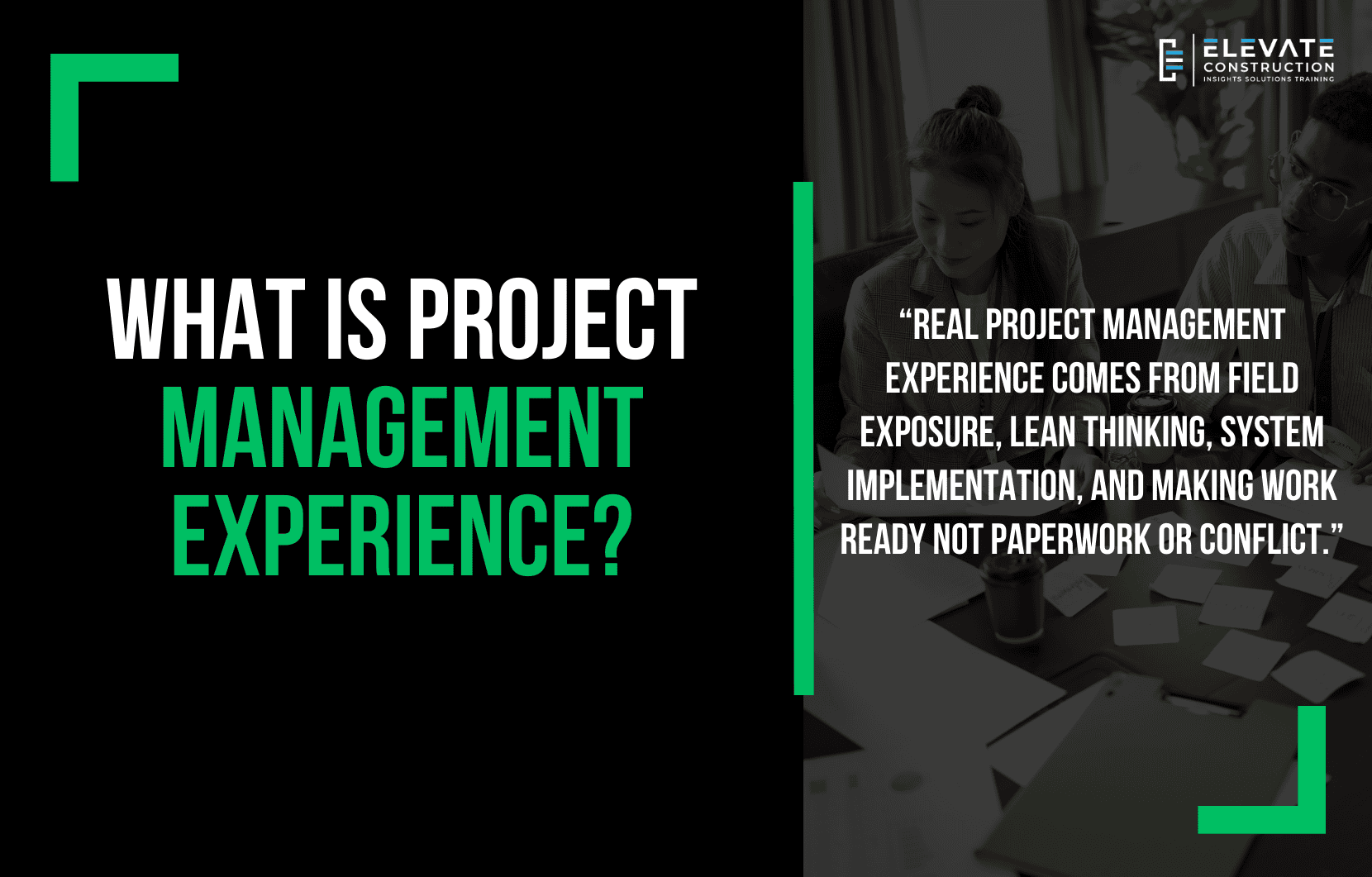
Project Management Experience: What Actually Builds Capability (and What Doesn’t)
A lot of people think they’re getting project management experience when they’re really just staying busy. They manage emails. They track logs. They survive bad projects. And over time, they assume that the pain equals progress.
It doesn’t.
Project management experience is not something you should shortchange yourself on. You deserve real experience the kind that wires your brain for effectiveness, builds judgment, and sets you up for a career where you actually help people succeed.
The difference between shallow experience and meaningful experience shows up later. And by then, it’s expensive to fix.
Why “Project Management Experience” Is Often Misunderstood
In construction, experience is often confused with exposure. If someone has been around long enough, handled enough RFIs, or lived through enough conflict, we assume they’re seasoned.
That assumption is dangerous.
Experience is not what you’ve been near. It’s what you’ve implemented. It’s what you’ve done repeatedly, correctly, and intentionally. Bad systems produce bad habits, and repeating those habits does not make you better it makes them permanent.
The system failed a lot of people by calling survival “experience.”
Personal Organization Systems Are Foundational Experience
Before you can lead work, you must lead yourself. Personal organization is not optional it is foundational.
To do lists, leader standard work, time blocking, and flow-based planning are not productivity hacks. They are how professionals create stability in their own work so they can support others.
If your days are reactive, your impact will be reactive. Learning to organize your time and commitments is one of the first real experiences every project manager needs.
Learning to Work with People Is Not Optional
Project management is a people profession. If you cannot communicate clearly, build trust, and collaborate respectfully, no system will save you.
Learning how to work with people how to listen, influence, and support is real experience. It is earned through practice, reflection, and humility.
You can know every technical system and still fail if you cannot connect with humans.
Why Time by Location Scheduling Changes How You Think
Learning to schedule in a time by location format fundamentally rewires how you see work. It teaches one piece flow. It exposes batching. It helps you understand rhythm.
Once your brain sees work this way, Lean concepts make sense. Flow becomes visible. Problems surface earlier.
This is not just a scheduling skill. It is a thinking skill and it is one of the most valuable experiences you can gain.
Lean Construction Experience Separates Good from Great
Lean is not theory. It is practice.
The more experience you gain with Lean construction, the less wasteful your project management becomes. You stop pushing. You start preparing. You design systems instead of reacting to chaos.
Learning Lean through books, mentors, training, and direct application is not optional if you want effective experience. It accelerates everything else.
Field Engineer Experience Shapes Your Entire Career
If you can get field engineer experience early in your career, do it. It will shape how you see construction forever.
Field experience teaches respect for the craft. It teaches cause and effect. It teaches what decisions actually land like in the field.
Project managers who start close to the work make better decisions for the rest of their careers. That perspective is priceless.
Why You Must Get Experience on Good Projects
This is critical. You must get experience on good projects.
One bad project can teach you a lot. Two should raise concern. Three in a row can permanently damage how you see work.
Experience wires your brain. Practicing in broken systems wires broken thinking. The saying is not “practice makes perfect.” Practice makes permanent. Only perfect practice moves you toward excellence.
Seek out good projects, good mentors, and good systems. That experience is more valuable than gold.
Implementation Experience Beats Knowledge Every Time
Knowledge is not power. Knowledge plus action is power.
You can attend every class, read every book, and earn every credential and still have no real experience if nothing is implemented. Real experience is measured by what changed because you were there.
Did systems improve? Did people succeed? Did work flow better?
That is experience.
Making Work Ready Is the Experience That Matters Most
The most valuable experience you can gain is making work ready for crews.
Crews need labor, equipment, materials, information, space, and permissions before work starts. Preparing all of that is project management.
Experience with trade partner preparation, pre mobilization, pre con meetings, first in place inspections, follow ups, and final inspections is what separates real professionals from administrators.
That is where value is created.
Implementing Systems, Not Just Managing People
People can often figure things out despite bad systems. That does not make the system good.
Real project management experience includes implementing systems: pre planning, Takt Production System, Last Planner System, visual standards, training, and follow through.
The question is not “Did you work with people?” The question is “Did you implement systems that helped people succeed?”
Experiences That Do Not Build Real Project Managers
- Paperwork only roles with no field impact
- Repeated exposure to broken projects
- Conflict heavy environments without learning
- Administration without implementation
- Survival mistaken for growth
Experiences That Compound Value Over an Entire Career
- Field engineering and craft exposure
- Lean construction application
- Time by location scheduling
- System implementation and follow through
- Making work ready consistently
If your project needs superintendent coaching, project support, or leadership development, Elevate Construction can help your field teams stabilize, schedule, and flow.
The challenge is simple. Design your experience intentionally. Seek good systems. Implement what you learn. Wire your brain for excellence. As a reminder: “Practice doesn’t make perfect. Practice makes permanent.”
FAQ
What counts as real project management experience?
Experience where you implement systems, support crews, and improve outcomes not just manage paperwork.
Is field experience really that important?
Yes. It shapes judgment, builds respect for the craft, and improves decision making long term.
Can bad projects still be valuable experience?
One can be. Repeated bad projects wire bad habits and should be avoided.
What experience do hiring leaders value most?
Implementation, making work ready, Lean application, and system execution.
How can I improve my experience quickly?
Get close to the field, learn Lean, practice time by location planning, and implement what you learn.
If you want to learn more we have:
-Takt Virtual Training: (Click here)
-Check out our Youtube channel for more info: (Click here)
-Listen to the Elevate Construction podcast: (Click here)
-Check out our training programs and certifications: (Click here)
-The Takt Book: (Click here)
Discover Jason’s Expertise:
Meet Jason Schroeder, the driving force behind Elevate Construction IST. As the company’s owner and principal consultant, he’s dedicated to taking construction to new heights. With a wealth of industry experience, he’s crafted the Field Engineer Boot Camp and Superintendent Boot Camp – intensive training programs engineered to cultivate top-tier leaders capable of steering their teams towards success. Jason’s vision? To expand his training initiatives across the nation, empowering construction firms to soar to unprecedented levels of excellence.
On we go