
Why “Watch for Traffic” Is Not a Safety System
Every construction project has workers crossing paths with equipment every single day. Forklifts moving materials. Telehandlers delivering to zones. Delivery trucks pulling in and out. Site equipment sweeping across access roads. And somewhere in that mix, workers are walking to the hoist, to the staging yard, to their next zone, back to the gang box. In most projects, the safety plan for that interaction is a verbal reminder at the morning huddle and a hope that everyone is paying attention.
That’s not a system. That’s a wish. And wishes are not an acceptable substitute for engineering when a worker’s life is on the line.
The construction industry loses workers to struck-by incidents at a rate that should be unacceptable to every leader in the field. These are not mysterious accidents. They follow patterns. They happen in predictable locations site entries, crosswalk zones, hoist staging areas, delivery routes where equipment and pedestrians interact without adequate separation, visibility, or dynamic alerting. They happen because the site was designed for production and safety was addressed in the toolbox talk, not in the site plan. The system failed them. They didn’t fail the system.
The Way Most Sites Handle Pedestrian and Traffic Conflict
Walk the site entry of a typical mid-size commercial project and you’ll see the version of traffic management that most teams consider standard. A cone line along the fence. A paper sign on the gate reminding drivers to watch for workers. An orange vest that workers are supposed to wear. And the assumption that skilled tradespeople who have navigated construction sites their whole careers will intuitively know when it’s safe to cross.
That assumption has been wrong too many times. The operator in a telehandler has a limited field of view. A delivery driver unfamiliar with the site is focused on navigation, not pedestrian watching. A worker walking back from the hoist at the end of a shift is focused on the day, not the approaching forklift. None of those people is negligent. All of them are operating inside a system that didn’t give them enough engineered protection. A cone line and a reminder are not engineering. They are documented hope.
A Story About What Engineered Safety Changes
I was on a project where we had a near-miss at a site entry that shook the whole team. A delivery truck pulled through the gate while a crew was walking back from the morning huddle. Nobody was hurt barely. The driver saw them at the last second. But the conditions were exactly right for a struck-by fatality: no dedicated pedestrian path, no alerting system for the driver, no physical separation between the crosswalk and the equipment route. After that near-miss, we redesigned the entry completely. Reflective crosswalk markings. Safety bollards. A stop sign at the gate. A convex mirror on the gate pole for the blind spot. Exterior lighting. The changes took less than a week to install. In the remaining twelve months of that project, we had zero entry-zone incidents. Not because workers got more careful. Because the system got better.
What a Fully Engineered Worker Crosswalk System Looks Like
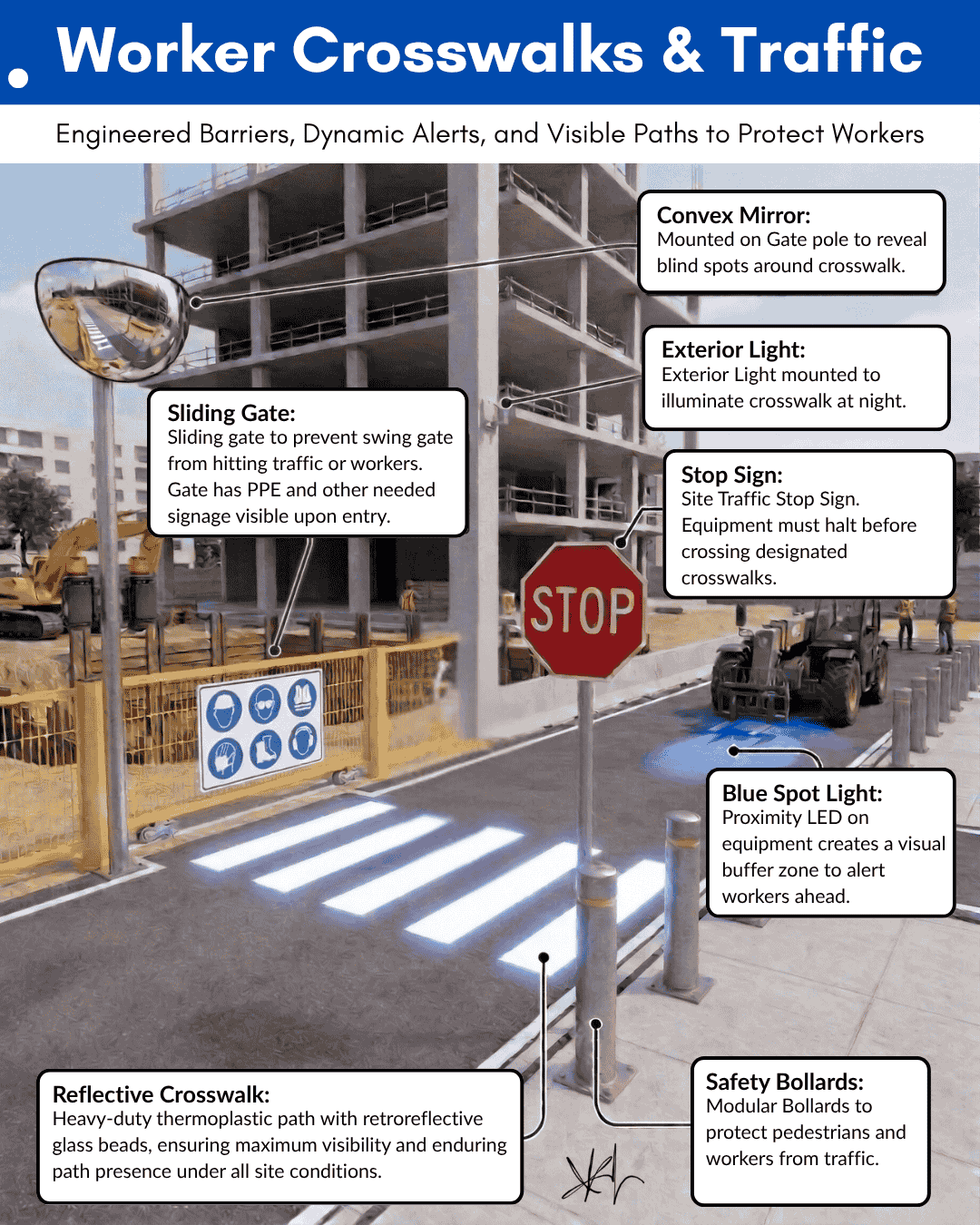
The image in this post shows what deliberate, layered protection looks like when it’s designed into the site rather than bolted on as an afterthought. Each component has a specific function in the system, and together they create a level of protection that no combination of reminders and training can replicate.
The reflective crosswalk itself heavy-duty thermoplastic with retroreflective glass beads ensures maximum visibility in all light conditions and enduring path presence through weather and traffic wear. The worker always knows exactly where to walk. The driver always knows exactly where to look. That clarity alone removes significant ambiguity from an interaction that happens dozens of times a day.
The blue spot light is one of the most powerful elements in the entire system. This proximity LED, mounted on approaching equipment, projects a visible blue buffer zone ahead of the machine that alerts any pedestrian in the path before the equipment arrives. The worker doesn’t need to hear the equipment. They don’t need to be looking in the right direction. The light reaches them first, creating a dynamic warning that reacts to the actual presence of moving equipment rather than a static reminder on the wall.
The stop sign is a site traffic stop sign not a suggestion. Equipment must halt before crossing designated crosswalks. Full stop. This is not advisory. Combined with the sliding gate, which prevents swing-gate contact with traffic or workers, the system creates a physical checkpoint at entry where all equipment submits to the same rule, every time, without exception.
The convex mirror mounted on the gate pole solves the blind spot problem that no amount of operator training can fully overcome. Geometry creates blind spots. The mirror eliminates them. A driver approaching the entry can see pedestrians in zones that would otherwise be invisible from the cab before the crossing, before the conflict, before any reaction would be required at all.
Watch for these conditions on your project that signal the pedestrian-equipment interface is relying on behavior rather than engineering:
- No reflective or thermoplastic markings designating worker crossing paths at entry and hoist zones
- Equipment moving through pedestrian areas with no proximity alerting system
- Site entry without a convex mirror to cover blind spots in the approach path
- Lighting that does not illuminate crosswalks during early morning mobilization or late afternoon shifts
- Safety bollards missing from areas where equipment regularly approaches pedestrian paths
The Framework: Engineered Safety Means the System Protects Before Humans React
Jason Schroeder teaches that a safe site is one where standards are common to the group, consequences are established, orientation and training are provided, visual reminders are present, and accountability is maintained at all levels. But there’s a deeper principle underneath all of that: the environment itself should be designed so that doing the right thing is the easiest thing. The engineered worker crosswalk system is that principle applied to the most dangerous daily interaction on any active construction site.
The layered approach in the image reflects exactly how Lean safety thinking works. One layer of protection can fail. A driver doesn’t see the sign. A worker steps into the path before the blue light reaches them. The reflective markings are worn from traffic. But when every layer is present reflective path, proximity alert, stop requirement, blind spot mirror, physical bollards, exterior illumination, sliding gate the probability of all layers failing simultaneously approaches zero. This is not redundancy for its own sake. It is the recognition that a system protecting human life deserves to be over-engineered, not minimally compliant.
Exterior lighting on the crosswalk is one of the most overlooked elements. Most construction incidents near site entries happen during low-light conditions early mobilization, late shifts, winter months when darkness falls mid-afternoon. A crosswalk that is perfectly visible at noon is invisible at 6:00 AM if it hasn’t been designed for lighting. Mounting an exterior light to illuminate the crossing zone is a simple, low-cost installation that extends protection to every hour of the working day.
The safety bollards complete the physical layer of the system. Modular bollards positioned to protect pedestrians from traffic create a physical barrier that doesn’t depend on a driver’s attention or a worker’s situational awareness. They are there, always, regardless of who is tired or distracted or moving faster than the site plan intended.
Why This Is About Dignity, Not Compliance
There is a truth underneath every safety conversation that doesn’t get said often enough: every worker who steps onto a construction site is someone’s spouse, parent, sibling, or child. They have families who expect them home at the end of the day. And they are trusting that the leaders who designed the site they work on thought carefully about keeping them safe. That trust is a responsibility. A serious one.
Engineering the worker crosswalk system is not a compliance exercise. It’s a statement. It says: we thought about you before you arrived. We designed this so the system protects you, not just your own caution. We believe your life is worth the cost of a reflective crosswalk, a blue spot light, a convex mirror, and a stop sign. When leaders build sites that way, workers feel it. They take more care with the standards because the standards are taken seriously. They raise safety concerns because the culture has already demonstrated that safety is real, not performative. If your project needs superintendent coaching, project support, or leadership development, Elevate Construction can help your field teams stabilize, schedule, and flow. Building that culture starts with building the environment to match it.
Design It In Before the First Boot Hits the Ground
Here is the challenge for every project leader reading this. Pull up the site logistics plan for your current or next project and look specifically at the places where workers and equipment share space. The site entry. The hoist staging area. The delivery route through the staging yard. The path from the parking zone to the site gate. At each intersection, ask: what happens if a worker and a piece of equipment arrive at the same moment and neither is looking? If the answer is “we’re relying on both of them being alert,” the system needs redesign.
Install the reflective crosswalk before mobilization, not after the first near-miss. Specify the blue spot light as a requirement for any equipment operating in pedestrian-shared zones. Mount the convex mirror at every entry where blind spots exist. Put up the bollards before deliveries begin. Light the crosswalk before winter shifts start. Do all of it before the workers arrive, and the site will be safer every day of the project without a single additional reminder.
The best safety programs don’t rely on better behavior. They engineer out the conditions where the wrong behavior is fatal. Build those systems first.
On we go.
Frequently Asked Questions
What makes an engineered crosswalk different from painted lines and a cone?
An engineered crosswalk layers multiple systems retroreflective thermoplastic markings, proximity equipment alerts, physical bollards, blind-spot mirrors, dedicated lighting, and enforceable stop requirements so protection doesn’t depend on any single element or any single person paying attention. Painted lines and cones create a visual suggestion. Engineered systems create conditions where the conflict is structurally prevented.
What is the blue spot light and how does it protect workers?
The blue spot light is a proximity LED mounted on site equipment that projects a visible buffer zone on the ground ahead of the machine. It alerts pedestrians in the path before the equipment arrives, creating a dynamic warning that reacts to the actual presence of moving equipment. Workers don’t need to hear it or be looking in the right direction the light reaches them first.
Why is a convex mirror critical at site entries?
Equipment cabs have limited field of view, and site entry geometry creates blind spots where approaching workers are invisible to operators regardless of how careful they are. A convex mirror mounted on the gate pole reveals those blind spots before the equipment enters the pedestrian crossing zone, giving drivers visibility they cannot get from the cab alone. It’s a low-cost solution to a predictable geometric problem.
How does exterior lighting improve crosswalk safety?
Most construction incidents at site entries happen during low-light conditions early mobilization hours, late shifts, and winter months. A crosswalk that’s visible at noon may be completely dark at 6:00 AM. Exterior lighting extends full protection to every hour of the working day without adding any behavioral requirement to workers or operators.
Are safety bollards necessary if equipment is following the stop sign rule?
Yes. Rules depend on behavior, and behavior is imperfect under conditions of fatigue, distraction, and unfamiliarity with the site. Bollards are a physical layer that protects workers regardless of whether a driver follows the stop sign. When all layers rule, light, sign, mirror, and bollard are present simultaneously, the probability of a simultaneous failure drops to near zero. Worker safety deserves that level of redundancy.
If you want to learn more we have:
-Takt Virtual Training: (Click here)
-Check out our Youtube channel for more info: (Click here)
-Listen to the Elevate Construction podcast: (Click here)
-Check out our training programs and certifications: (Click here)
-The Takt Book: (Click here)
Discover Jason’s Expertise:
Meet Jason Schroeder, the driving force behind Elevate Construction IST. As the company’s owner and principal consultant, he’s dedicated to taking construction to new heights. With a wealth of industry experience, he’s crafted the Field Engineer Boot Camp and Superintendent Boot Camp – intensive training programs engineered to cultivate top-tier leaders capable of steering their teams towards success. Jason’s vision? To expand his training initiatives across the nation, empowering construction firms to soar to unprecedented levels of excellence.
On we go