
The Most Important Meeting in Construction Happens Before Anyone Touches a Tool
Here’s the deal: the moment workers step through the gate without alignment, the project is already behind. Not because of a scheduling failure or a material shortage or a coordination gap because fifty or a hundred or two hundred people just entered a shared space with separate agendas, separate priorities, and no shared understanding of what success looks like today. That’s not a workforce problem. That’s a system problem. And the morning worker huddle is the system that solves it.
I have never seen a Lean, operationally excellent project without a Morning Worker Huddle. Not once. Because Lean requires total participation everyone working as a group toward a shared plan and you cannot build total participation if people scatter to their zones the moment they arrive without ever becoming one team first.
What Happens When There Is No Huddle
Most projects start the day the same way. Workers arrive, badge in or sign a sheet, and head to their area. Some stop to talk to a foreman. Some get instructions from a trade supervisor. Some arrive and simply continue what they were doing yesterday. By 7:15, fifty people are spread across eight floors doing what they individually believe should happen not what the project needs to happen as a coordinated, sequenced team.
The mechanical trade is working in a zone the drywall crew expected to enter today. The electrician doesn’t know there’s a concrete pour in the adjacent corridor that will restrict access until noon. The new worker who showed up this morning was never told about the permit required before the hot work can begin. A foreman makes a decision about sequencing without knowing that the adjacent trade made the opposite decision yesterday. Within two hours, the invisible chaos that started at the gate has become visible conflict on the floor.
None of these people did anything wrong individually. They filled information gaps the system left open. The system failed them. They didn’t fail the system.
Why the Huddle Is the Foundation of Everything Else
Jason Schroeder teaches that the Morning Worker Huddle is the most important meeting in construction. Its purpose is to create one social group, win over the workforce, and communicate the plan for the day safety focus, permits, active deliveries, weather, and training. When workers feel listened to and respected in that huddle, something shifts. The project becomes a team rather than a collection of separate subcultures competing for space and resources.
This is not a soft outcome. It is a production outcome. People like people they’re near. People like people they understand. People coordinate with people they know and trust. All of those conditions that make production flow coordination, handoff discipline, willingness to raise a problem before it becomes a crisis they develop through daily connection. The huddle is the mechanism that creates that connection at scale, across all trades, every single morning before a single tool is picked up.
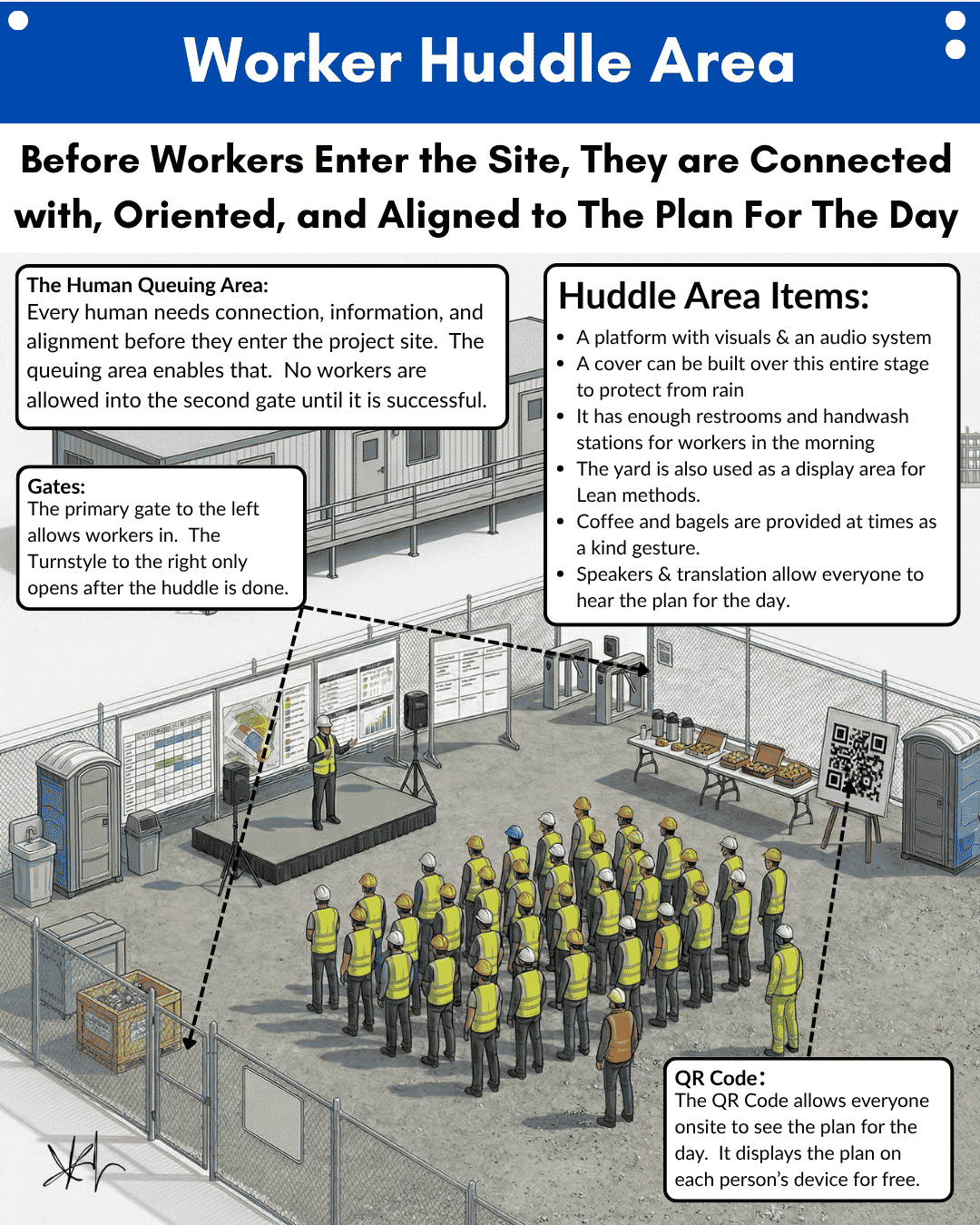
The image in this post shows what a properly designed huddle area looks like. It is not a parking lot gathering. It is a designed space covered to protect from rain, equipped with audio and a platform so every worker can hear the plan regardless of where they’re standing, with enough restrooms and handwash stations for the full workforce, a QR code that displays the day plan on every worker’s personal device, speakers and translation so language is never a barrier to alignment, and coffee and breakfast available as a small but meaningful gesture that says the project team values this time and values the people spending it here. Every element of the setup communicates the same message: this meeting matters, and so do you.
The Human Queuing System
One of the most powerful operational concepts in the morning huddle setup is intentional queuing. Every human being needs connection, information, and alignment before they enter a high-stakes environment. The huddle area enables that no workers are allowed through the second gate until the huddle is complete.
This is not a control mechanism. It is a care mechanism. A worker who enters the project site unoriented to today’s safety focus is exposed to risk they weren’t prepared for. A worker who enters without knowing the daily delivery windows is going to cross paths with equipment they didn’t anticipate. A worker who enters without knowing what the person working adjacent to them is planning to do today will inevitably create conflict that could have been prevented in five minutes. Intentional queuing says: before we ask anything of you, we are going to give you everything you need to be safe, effective, and connected to the team around you.
The primary gate to the left allows workers in. The turnstile to the right opens only after the huddle is complete. Both gates working together create a designed entry one that guarantees alignment before anyone reaches the floor.
Watch for these signals that your project needs a structured morning huddle:
- Workers arriving and dispersing to zones without any shared briefing
- Coordination conflicts recurring floor by floor that trace back to separate trade agendas
- Safety incidents involving information that was available but never communicated to the affected worker
- New trade mobilizations where workers enter the project without knowing project-specific safety standards
- Foremen making sequencing decisions in isolation that conflict with adjacent trade plans
What the Huddle Actually Covers
The morning worker huddle is structured, not improvised. It runs through a deliberate agenda: shout-outs that recognize individuals by name, the safety focus for the day, active permits and hot work requirements, delivery windows and logistics impacts, weather conditions and their effect on the work plan, any phase transitions or zone handoffs happening today, and a training topic even two minutes that builds the crew’s Lean knowledge over time.
The training component is worth emphasizing because it is the element most often skipped on projects that run a version of the huddle. Jason Schroeder’s podcast began as miniature training topics he delivered in this very huddle. Two minutes on the eight wastes. Two minutes on the purpose of zone maps. Two minutes on what a perfect handoff looks like. Over the course of a six-month project, that’s more than forty training sessions delivered to the full workforce building a crew that understands the system they’re working inside, not just the task they’re assigned to today.
The QR code on the huddle board allows every worker to pull the day plan onto their own device without printing, without dependence on someone else to interpret it for them. The translation speaker ensures that a worker whose primary language is Spanish, Vietnamese, or any other language receives the same complete information as every other worker in the huddle. Alignment is only alignment if it reaches everyone. Partial communication is partial alignment, and partial alignment still produces chaos just less of it.
Connection Before Production
Jason Schroeder teaches that workers and foremen are the only people who actually add value in construction they are the ones who put work in place. Every other role in the system exists to support them. Until their environment is clean, safe, organized, and stable, the system hasn’t arrived where it needs to be. The morning worker huddle is how that support system shows up at the start of every day. It says: we are going to connect with you before we ask anything of you. We are going to give you the information you need. We are going to treat this thirty minutes as the most valuable thirty minutes of the day because it is.
The trades who experience that quality of morning consistently report something that doesn’t show up in productivity metrics but shows up everywhere else: they care more. They show up earlier. They raise problems. They protect handoffs. They look out for the trade coming behind them. They become one team instead of competing subcultures. That transformation is not manufactured through incentives. It is built, daily, through a meeting that treats people like the professionals they are.
If your project needs superintendent coaching, project support, or leadership development, Elevate Construction can help your field teams stabilize, schedule, and flow. The morning worker huddle is where that stability is born.
Start Tomorrow With One Team
Here is the challenge. This week, walk your project gate and watch what happens in the first twenty minutes of the workday. Count how many workers enter without anyone speaking to them. Count how many workers go directly to their zone without any shared briefing. Count how many decisions get made in that first hour that conflict with what another trade is planning. That count is the gap between where your project is today and what the Morning Worker Huddle makes possible.
Set up the space. Build the agenda. Protect the time. Bring every trade together before the first gate opens. Do it for thirty days and watch what happens to your safety record, your coordination quality, and the way your trades talk about this project compared to every other one they’ve worked on.
Training builds people. Structure builds systems. Do both, every morning, before anyone enters the work.
As Jason Schroeder teaches: “We’re building people who build things.” Start there at the gate, with the huddle, with one team.
On we go.
Frequently Asked Questions
What is the Morning Worker Huddle and how long does it take?
It’s a structured daily meeting held before workers enter the site that covers safety, the day plan, permits, deliveries, training, and shout-outs. It typically runs fifteen to thirty minutes.
Why must the huddle happen before workers enter the site?
A worker who enters unoriented creates their own plan, which conflicts with others. Alignment before the gate is what converts a group of separate trades into one coordinated team.
What should the huddle agenda include?
Shout-outs, safety focus, active permits, delivery windows, weather impacts, zone or phase updates, and a brief Lean training topic every element serves a specific purpose in creating daily alignment.
How does the QR code on the huddle board help workers?
It puts the day plan on every worker’s personal device instantly no printing, no relying on someone else to relay information, and no language barrier when paired with translation speakers.
What happens after the Morning Worker Huddle?
Workers move to their gang box or work area for the Crew Preparation Huddle a smaller, crew-level meeting that covers the specific task, quality checklist, pre-task plan, and daily tool and material shakeout.
If you want to learn more we have:
-Takt Virtual Training: (Click here)
-Check out our Youtube channel for more info: (Click here)
-Listen to the Elevate Construction podcast: (Click here)
-Check out our training programs and certifications: (Click here)
-The Takt Book: (Click here)
Discover Jason’s Expertise:
Meet Jason Schroeder, the driving force behind Elevate Construction IST. As the company’s owner and principal consultant, he’s dedicated to taking construction to new heights. With a wealth of industry experience, he’s crafted the Field Engineer Boot Camp and Superintendent Boot Camp – intensive training programs engineered to cultivate top-tier leaders capable of steering their teams towards success. Jason’s vision? To expand his training initiatives across the nation, empowering construction firms to soar to unprecedented levels of excellence.