
If Your Workers Are Eating on a Bucket, Your Project Is Telling Them Something
Here’s the deal: the lunch area on your jobsite is a message. Not a policy. Not a line item. A message. And right now, on most projects in this industry, that message reads something like this you are here to produce, and where you rest is not our concern. Workers figure it out. They find a piece of open floor, a cooler they brought from home, a spot near the hoist base that’s out of the wind. They make do. And they notice, every single day, that nobody designed this part of the project for them.
That’s not neutral. It accumulates. And it shapes how those workers feel about the company, the project, and the leadership team managing it in ways no compensation package can fully undo.
What the Industry Has Normalized
For decades, the construction industry has treated worker rest areas as an afterthought. Order the porta-potties. Check. Set up a trailer for the project team. Check. Design a real lunch space where fifty workers can eat a meal in dignity and comfort? That question never makes the mobilization checklist on most projects. By the time someone raises it, the project is underway and there’s no obvious place to put it, no budget was set aside for it, and the answer becomes “workers can use the break area near the hoist if they want.”
The break area near the hoist is where deliveries queue. It’s not shaded. The ground is uneven. There’s nowhere to store food. And in the middle of the Phoenix summer, it is a place where a person can genuinely suffer during a thirty-minute break that is supposed to restore them for the second half of the workday.
Jason Schroeder teaches that bathrooms are Lean indicators the first signal of whether a project is truly Lean. Clean, well-maintained facilities signal that leadership respects the workers who use them. If the bathrooms aren’t good enough for the project management team’s grandmother, they’re not good enough for the workers. The same principle applies to the lunch area, and the standard is just as clear: if it isn’t good enough for you to eat in, it isn’t good enough for your crew.
A Story About What It Communicates
I was on a project years ago where the superintendent one of the best I’ve worked alongside made a decision early in the project that surprised everyone on the team. Before the first trade mobilized, he had a conditioned tent set up with tables, chairs, refrigerators, microwaves, and a freezer stocked with popsicles. The trades came in and saw it on day one. I watched the reaction. These were experienced crews who had worked on dozens of projects. Most of them had never seen anything like it.
By the end of the first week, that lunch area was the most talked-about thing on the project among the trades. Not the schedule, not the production system, not the Takt plan the lunch area. Because it told them something none of those other things could. It said: we thought about you before you arrived. We knew you’d need a place to rest, and we built it before you even asked. That shift in the relationship between the general contractor and the trade workforce didn’t stay at lunchtime. It showed up in how quickly trades raised roadblocks, how readily they participated in huddles, how much discretionary effort they brought to the zones. You cannot buy that with a dollar-per-hour increase. You earn it by caring about the whole person, not just the hours they’re producing.
What a Proper Worker Lunch Area Includes
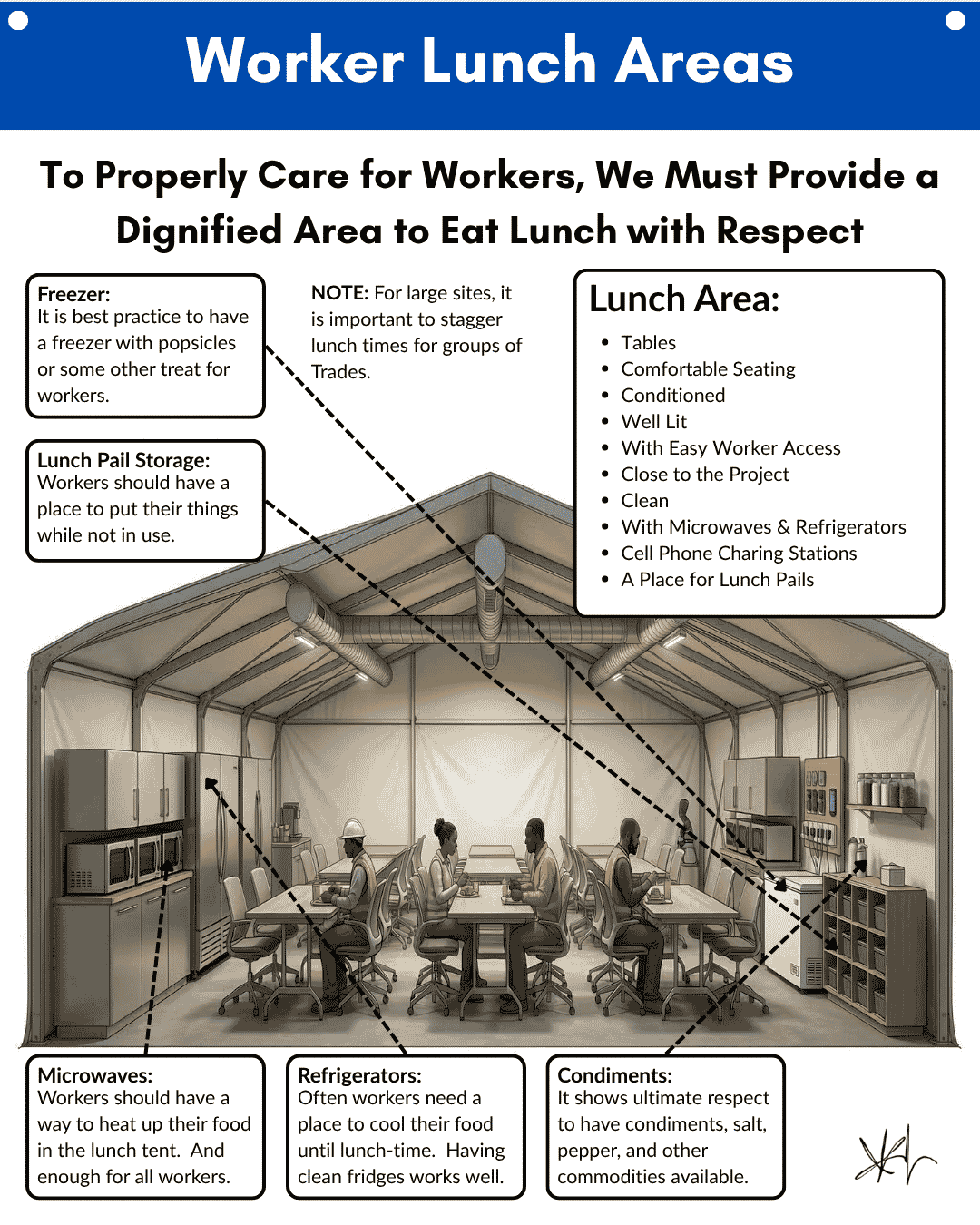
The image in this post shows what a dignified worker lunch area looks like when it’s designed with intentionality. It is not expensive. It is not complicated. But it communicates an entirely different standard than the alternative.
Tables and comfortable seating are the non-negotiable foundation. Workers need a flat surface to eat at and a chair that supports their body after a physically demanding morning. The area needs to be conditioned cooled in summer, heated in winter because the purpose of the break is recovery, and a worker who spends their lunch sweating in an uncooled tent is not recovered when they return to work. Lighting matters. A well-lit space is a welcoming space. A dark or dim tent signals that this area wasn’t thought through.
Microwaves and refrigerators in quantities that actually serve the crew solve the fundamental problem of workers having to eat whatever survived in a warm bag until noon. Many workers bring food from home because eating out is expensive, and that food needs to be stored cold and heated when the break arrives. A single microwave for fifty workers creates a line. Two or three changes the experience. A clean refrigerator, stocked or available for workers to use, shows that the project team thought through the logistics of feeding people over an eight-to-ten-hour day.
Cell phone charging stations respect the reality of how workers stay connected to their families during the workday. It’s a small addition that costs almost nothing and communicates that the project understands workers are full human beings with relationships outside the fence line. Designated lunch pail storage a shelf, a rack, a labeled area keeps personal belongings organized and off the floor, which is its own dignity signal. And condiments: salt, pepper, hot sauce, napkins. These are small. But they are the detail that says someone thought about the experience of eating here, not just the fact of providing a space to do it.
On large sites, staggering lunch times by trade prevents overcrowding and gives every crew a real break rather than a rushed scramble for table space. The freezer stocked with popsicles on a hundred-degree afternoon is a small gesture but ask any worker who has ever pulled one out at the end of a scorching summer day how it felt, and the answer will not be small.
Watch for these signals that your project’s rest facilities are falling short of the standard:
- Workers eating at the hoist base, on material pallets, or in their vehicles rather than in a designated lunch area
- A lunch tent that is unconditioned during summer or winter mobilization
- One microwave or no microwave for crews of thirty or more
- No refrigeration available, requiring workers to eat food that has been warming since 6 AM
- No charging stations, forcing workers to leave work areas during the day to check in with family
Why This Is a Production Decision, Not Just a Welfare Decision
Workers and foremen are the only people who actually add value in construction they are the ones who put work in place. Everyone else in the system, from project executives to designers to superintendents, is necessary but exists to support the people doing the installing. Until the environment those workers operate inside is clean, safe, organized, and dignified, the system has not arrived where it needs to be.
The lunch area is part of that environment. A worker who returns from a thirty-minute break in a cool, comfortable space with a warm meal is not the same worker who returns from thirty minutes on a bucket in the sun. Their physical recovery is different. Their emotional state is different. Their relationship to the project and to the company is different. That difference shows up in the afternoon production numbers, in the care taken with handoffs, in the willingness to raise a problem rather than work around it.
Jason Schroeder teaches that when workers feel listened to and respected, magic happens the project becomes a team rather than a collection of separate subcultures. The lunch area is one of the most tangible, visible ways to begin earning that trust before a single production meeting happens. If your project needs superintendent coaching, project support, or leadership development, Elevate Construction can help your field teams stabilize, schedule, and flow. That work begins with the conditions workers experience every day including the thirty minutes they get to step away and be human.
Take Care of Your People Everything Else Gets Easier
Here is the challenge. Before your next project mobilizes, put the worker lunch area on the preconstruction checklist not as an afterthought, but as a deliberate design decision. Where will it go? What size does it need to be to seat the peak crew count? Is it conditioned? How many microwaves and refrigerators does the crew size require? Is it close enough to the work that a thirty-minute break doesn’t become a fifteen-minute break by the time workers walk to it and back?
Answer those questions before mobilization day, and then build what the answers require. Not the minimum compliant version. The version that says: we see you, we care about you, and we built this for you.
The best crews in this industry don’t stay on projects only because the pay is right. They stay because they feel respected. They go the extra distance because the project went the extra distance for them first.
As Jason Schroeder teaches: “Respect for people is not soft it’s a production strategy.” Build a lunch area that proves it.
On we go.
Frequently Asked Questions
Why does a worker lunch area matter for project performance?
A worker who recovers properly during a break returns to the afternoon with more physical and mental capacity. Comfort during rest is directly linked to sustained production quality throughout the day.
What is the minimum a proper lunch area should include?
Tables, comfortable seating, air conditioning or heat, microwaves and refrigerators sufficient for the crew size, and a designated area for lunch pail storage sized to serve the peak workforce without overcrowding.
Why stagger lunch times on large projects?
Staggering by trade prevents overcrowding, ensures every worker gets a real break with table space and equipment access, and keeps the lunch area calm and functional rather than rushed.
How do small gestures like condiments and popsicles matter?
They signal that someone thought about the experience of being there not just the fact of having a space. That level of care communicates respect in a way workers remember and respond to.
How does the lunch area connect to winning over the workforce?
Workers who experience genuine care in the physical environment extend more trust to the leadership team. That trust shows up in huddle participation, roadblock reporting, quality care, and discretionary effort across the entire project.
If you want to learn more we have:
-Takt Virtual Training: (Click here)
-Check out our Youtube channel for more info: (Click here)
-Listen to the Elevate Construction podcast: (Click here)
-Check out our training programs and certifications: (Click here)
-The Takt Book: (Click here)
Discover Jason’s Expertise:
Meet Jason Schroeder, the driving force behind Elevate Construction IST. As the company’s owner and principal consultant, he’s dedicated to taking construction to new heights. With a wealth of industry experience, he’s crafted the Field Engineer Boot Camp and Superintendent Boot Camp – intensive training programs engineered to cultivate top-tier leaders capable of steering their teams towards success. Jason’s vision? To expand his training initiatives across the nation, empowering construction firms to soar to unprecedented levels of excellence.