
Your Project Doesn’t Have a Labor Problem. It Has a Flow Problem.
Watch a crew that looks slow and unproductive and you will almost always find the same thing underneath it. They’re not lazy. They’re not incompetent. They’re fighting their environment. They’re walking to get materials that should have been at the work area before they arrived. They’re hunting through a gang box for a tool that was used two floors up and not returned. They’re waiting for a pre-task plan that lives in the trailer instead of on the cart they’re standing at. They’re doing logistics work that the system was supposed to solve before the workday started.
That’s not a people failure. That’s a system failure. And it repeats, quietly, across every trade, every floor, every zone accumulating into a schedule loss nobody ever measures because it looks like ordinary construction friction instead of what it actually is: designed-in waste.
What Most Projects Never Question
Here’s the thing about motion waste, waiting waste, and transportation waste: they have become so normal on most jobsites that nobody questions them anymore. A pipefitter walking four hundred feet to retrieve a fitting is just doing their job. A carpenter waiting while someone tracks down the right fastener is just part of the day. A worker who can’t find the eye wash station because it was moved two zones over is just dealing with construction.
None of that is normal. All of it is designed. And by “designed,” what I mean is that nobody made an intentional design decision to prevent it. In the absence of a designed system, motion and waiting fill the gap. They always do. The question is not whether waste will exist on a project without deliberate design it will. The question is whether the team is willing to design it out.
I remember early in my career watching two mechanical crews working identical scopes on adjacent floors of the same building. The crew on one floor seemed to move faster than the other by a noticeable margin. When I finally looked closely at the difference, it wasn’t skill or experience. One crew had their materials pre-staged on a rolling cart that moved with them as they worked. The other crew had their materials at the end of the corridor, and every time they needed something, someone walked. Over eight hours, that walking added up to more than an hour of productive capacity per person gone to motion waste. The system designed the outcome. The people just lived inside it.
What Systems on Wheels Actually Solve
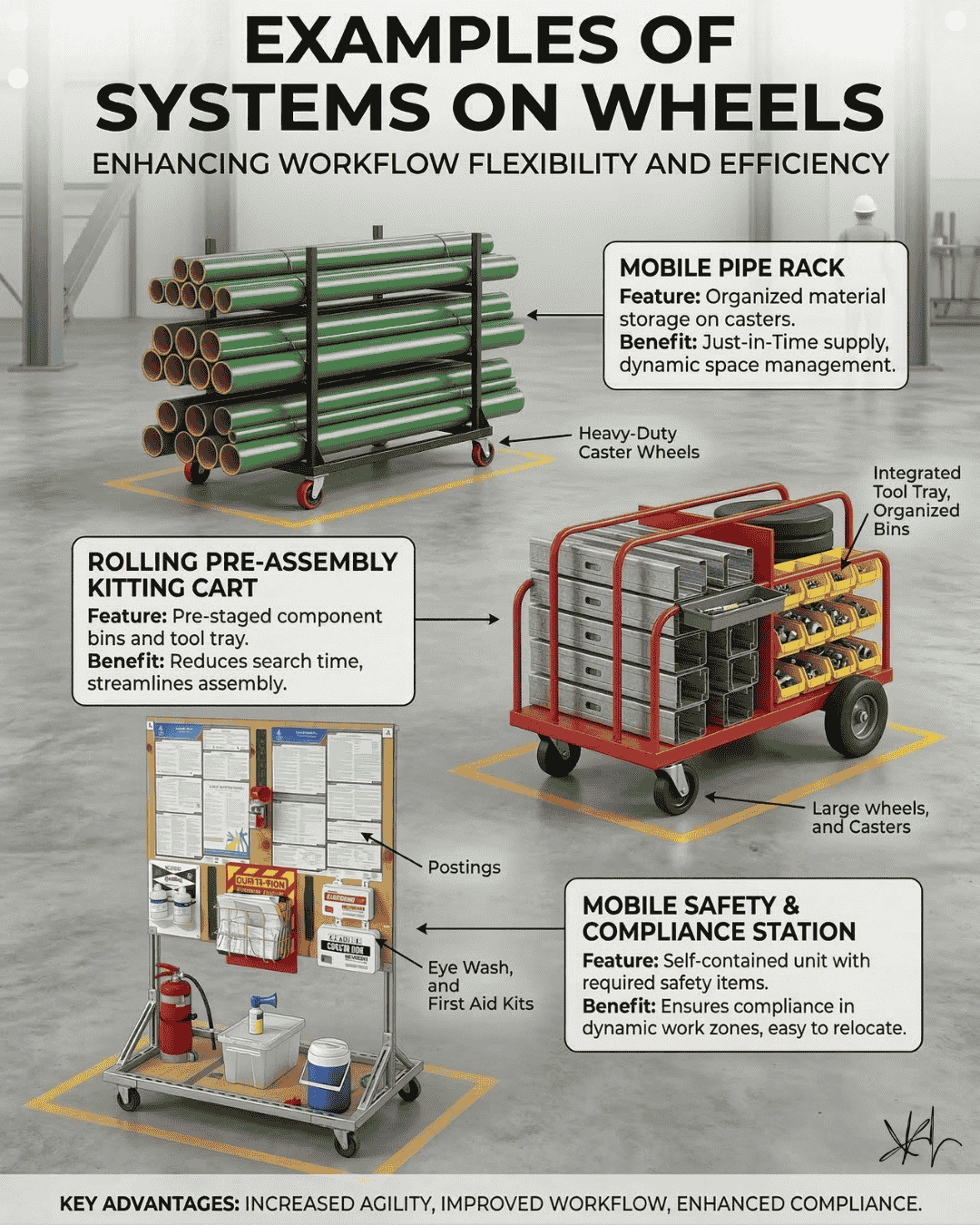
The image in this post shows three systems a mobile pipe rack, a rolling pre-assembly kitting cart, and a mobile safety and compliance station and each one represents a deliberate answer to a specific category of waste that most construction teams are absorbing every day without tracking it.
The mobile pipe rack solves the just-in-time supply problem at the crew level. Instead of pipe being staged in a fixed location away from the work where it has to be transported in multiple trips, where it accumulates before it’s needed, where it occupies floor space that active work needs the rack moves with the crew on heavy-duty caster wheels. The pipe is where the work is. Organized by size and configuration, it supports dynamic space management so the zone stays clear and materials don’t pile up ahead of demand. This is just-in-time at its most practical: not a sophisticated scheduling algorithm, but a cart with wheels positioned at the point of install.
The rolling pre-assembly kitting cart takes the same thinking one step further into the assembly sequence itself. Pre-staged component bins and an integrated tool tray mean the crew begins the work with everything they need already organized and within reach. The cart doesn’t just move materials it reduces search time and streamlines the assembly process by bringing the workstation to the worker instead of sending the worker to the workstation. When you eliminate the trips back to the gang box, the trips to the staging area, the borrowed tool that’s now one floor up the crew’s productive rhythm becomes unbroken. That’s what flow feels like at the crew level.
Watch for these signals that motion and waiting waste are consuming productive capacity on your project:
- Workers making multiple trips between the work area and material staging before completing a single task
- Pre-task plans, quality checklists, or compliance postings stored in the trailer rather than at the point of work
- Safety stations located at fixed points that don’t move when the work does
- Materials arriving at a zone before they’re needed, cluttering active work areas and requiring re-handling
The Mobile Safety Station: Embedding Compliance Into the Flow
The third system the mobile safety and compliance station addresses one of the most consistent failures in construction safety management. Eye wash stations, first aid kits, fire extinguishers, required postings, and compliance documents are typically fixed. They live where they were installed during site setup, and as the work moves zone to zone and floor to floor, the compliance infrastructure stays behind. The worker who needs the eye wash is now forty feet from it. The fire extinguisher required near hot work is in the corridor, not near the torch. The posting that verifies permit status is back at the trailer.
None of that is intentional. It’s what happens when safety is treated as a fixed-location requirement rather than a mobile production system. The self-contained mobile station solves this by design: required safety items travel with the work, ensuring compliance in dynamic work zones without requiring anyone to walk back to the fixed setup to use them. This is not just a logistics improvement. It is a safety improvement. The station at the point of work is a station someone will actually use when something happens. The station forty feet away in a fixed location is one they may not reach in time.
Why the 5S Principle “Everything on Wheels” Changes the Whole Jobsite
Jason Schroeder teaches this as one of the six key implementation ideas for 5S in construction: what if everything was on wheels, on carts, or on pallets so it could be easily moved and color-coded by trade? That question deceptively simple unlocks a completely different way of thinking about jobsite organization. It reframes the question from “where should we store things?” to “how do we keep the right things at the right place as the work moves?”
Fixed storage made sense when work was fixed. But construction work moves. Takt time moves crews from zone to zone on a defined rhythm. A production system designed around mobility matches the reality of how construction actually works work moving forward through the building instead of requiring crews to adapt their workflow to a static storage design that was laid out before anyone knew exactly how the work would flow.
Point-of-use storage and kitting is a core Lean principle Jason applies to eliminate walking, searching, and re-handling. The crew should not spend its day doing logistics work that the system could have solved. When materials are scattered, the crew becomes the supply chain. Systems on wheels design the crew out of the supply chain role and back into the installing role which is the only role they should be filling, and the only one the project is paying them to fill.
What Flow Produces That Pushing Never Can
When systems are designed to bring work to the crew materials at the point of install, tools pre-staged, safety within reach, compliance embedded rather than chased something shifts in the energy of the project. Crews are no longer fighting friction to do their jobs. They’re just doing their jobs. The rhythm becomes smooth. The zone stays clean because nothing is being dragged from one end to the other. Handoffs are cleaner because the work area was organized for completion, not for starting. Quality improves because workers aren’t rushing to compensate for time lost to logistics. Safety improves because the systems designed to protect people actually follow them to where the work is.
That’s not a theory. It’s what LeanTakt and Elevate Construction see on every project where mobility is designed into the work environment instead of left to chance. If your project needs superintendent coaching, project support, or leadership development, Elevate Construction can help your field teams stabilize, schedule, and flow. That work almost always includes looking at whether the project’s physical systems are designed to support the crew or designed to make them work around limitations that were never questioned.
Design the System That Does the Work of Eliminating Waste
Here is the practical challenge. Before your next phase begins, walk the proposed work area and ask: how will materials get to the crew as the work moves through the zone? Where will tools be when they’re needed at the point of install? Where will safety compliance items be as the zone changes? If the answer to any of those questions is “back at the fixed staging area” or “in the gang box at the end of the corridor” you have already designed in the waste, whether you intended to or not.
Put things on wheels. Stage materials at the point of install in just-in-time quantities. Pre-kit the components that get assembled together. Move the safety station with the work. These are not expensive changes. They are design decisions that take a few hours of preconstruction thinking and return that investment every hour of every workday for the duration of the phase.
The goal is not to work harder. The goal is to make the work flow.
On we go.
Frequently Asked Questions
What is the core principle behind systems on wheels in construction?
It’s point-of-use storage applied to a mobile workforce. Since construction work moves through zones, the systems that support it materials, tools, safety stations should move with it rather than stay fixed. This eliminates the motion, transportation, and waiting waste created when crews have to travel away from their work area to get what they need.
How does a rolling pre-assembly kitting cart reduce waste?
It stages components and tools in pre-organized bins at the work area before the task starts, eliminating the multiple trips to the gang box, staging area, or another floor that otherwise fragment the crew’s productive rhythm. Fewer trips means more installation time per hour and a cleaner work area throughout the zone.
Why should the safety and compliance station be mobile?
Because the work moves and fixed safety stations don’t. An eye wash station, first aid kit, or required compliance posting located far from the active work zone is one that may not get used when an incident occurs. Mobile stations ensure compliance items are at the point of work, which is the only location where they actually protect the people using them.
How does this connect to the Takt Production System?
Takt moves crews through zones on a defined rhythm. If the physical systems supporting those crews materials, tools, safety infrastructure are fixed and can’t follow the rhythm, the crew breaks flow to chase supplies instead of flowing with the plan. Mobile systems keep the logistics layer aligned with the production layer so the Takt rhythm is protected in execution, not just in the plan.
What is the simplest way to start implementing this approach?
Pick the single biggest motion waste on your current project the thing crews walk to most often and put it on wheels. That one change will produce immediate, visible results and build the case for expanding the approach to every zone. Start with what bugs the crew most. Fix that first. Then keep going.
If you want to learn more we have:
-Takt Virtual Training: (Click here)
-Check out our Youtube channel for more info: (Click here)
-Listen to the Elevate Construction podcast: (Click here)
-Check out our training programs and certifications: (Click here)
-The Takt Book: (Click here)
Discover Jason’s Expertise:
Meet Jason Schroeder, the driving force behind Elevate Construction IST. As the company’s owner and principal consultant, he’s dedicated to taking construction to new heights. With a wealth of industry experience, he’s crafted the Field Engineer Boot Camp and Superintendent Boot Camp – intensive training programs engineered to cultivate top-tier leaders capable of steering their teams towards success. Jason’s vision? To expand his training initiatives across the nation, empowering construction firms to soar to unprecedented levels of excellence.
On we go