
Your Staging Yard Is Telling the Trades Exactly What to Expect
Walk the staging yard of a project during the first week of heavy mobilization and you will learn everything you need to know about how that project is going to run. Not from the schedule. Not from the project meeting. From the yard. If materials are piled without organization, if trade zones are undefined, if forklifts are navigating around obstacles to find what they’re looking for, if the ground is soft and uneven and there’s no clear traffic flow that yard is broadcasting a message to every trade that shows up: this project doesn’t have a system. And the trades will respond accordingly. Their discipline, their care, their investment in the project’s success all of it adjusts to match the environment they’re working inside.
The flip side is equally true. A staging yard that is gridded, labeled, stabilized, trade-zoned, and worker-ready before the first delivery arrives sends the opposite message. It says: we thought about this before you got here. We designed this for you. Bring your best work this project is ready for it.
What Most Staging Yards Actually Are
The honest description of the typical construction staging yard is that it starts as a plan and becomes a dumping ground within two weeks. Deliveries arrive faster than anyone anticipated. Someone stacks pipe in the area that was supposed to be steel. A trade partner drops their materials in the first open spot they can find. The base gets chewed up by forklift traffic in wet weather and nobody filled it back in. By the fourth week, the yard is a maze that nobody fully understands, deliveries are being received in the wrong locations, and the forklift operator is spending more time navigating than moving materials.
None of that is the result of careless people. It’s the result of no design. The yard was laid out informally and allowed to fill organically, and organic fill in a construction yard always produces chaos. The system or absence of one produced the outcome.
I remember on a large MEP project walking the staging yard with the general superintendent about three weeks in. He was frustrated. Materials from three different trades had ended up mixed together in what was supposed to be a clear access lane. A delivery of mechanical equipment had nowhere to go because the designated area was already occupied by electrical gear that hadn’t been moved as planned. The foreman of the mechanical trade told him the yard was the reason their install pace was off they were spending an hour each morning just locating and organizing what they needed before work could start. The yard was not a logistics support system. It was a logistics obstacle. The project team designed it in the office. Nobody thought about how it would actually work.
What a Lean Staging Yard Is Built Around
Jason Schroeder teaches that the supply chain must be zoned to match the production plan. Material staging, delivery routes, laydown, and point-of-use storage must match the zone plan inside the building. If the production plan is zoned but the materials are not, crews will waste hours every day. Zoned supply is a prerequisite for zoned flow. The Lean staging yard takes that principle and applies it at the site level before a single pallet enters the building.
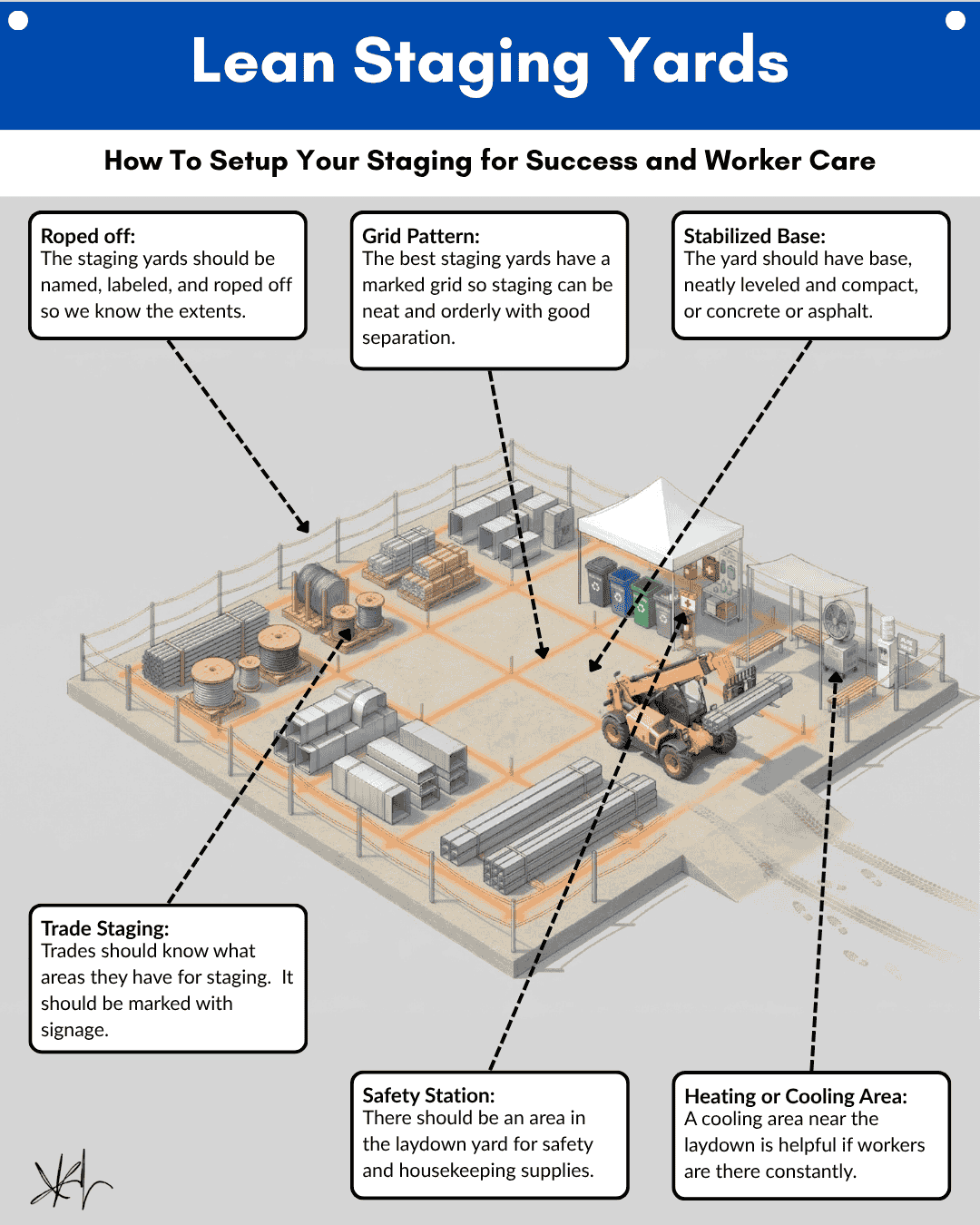
The foundation of the system is the stabilized base. It should be compacted base, concrete, or asphalt level, drivable in all weather conditions, and maintained throughout the project. This is not an upgrade or a luxury. It is a basic production requirement. A soft, uneven yard slows forklift travel, creates hazards, degrades equipment, and discourages trades from maintaining any organization because the environment itself doesn’t support it. The setpoint of the yard the standard the environment communicates governs what people do inside it.
The grid pattern is what transforms the stabilized base into an organized system. A marked grid allows materials to be staged with precision rather than guesswork. Each trade knows exactly where their staging area is. Deliveries go to the right grid section. Forklifts have clear travel lanes. The difference between a marked grid and an unmarked yard is the difference between an organized warehouse and a warehouse where everything is just stacked wherever there was room. The grid is visual management applied to the outdoor supply chain.
Watch for these signals that a staging yard is functioning as a liability rather than a production system:
- Deliveries landing in the wrong location because trade zone boundaries were never marked
- Forklifts navigating around obstacles rather than traveling clear, defined routes
- Materials from different trades mixed together in ways that require sorting before use
- The base deteriorating from forklift traffic without a maintenance plan to restore it
- Workers spending significant time each morning in the yard locating materials before the workday begins
Trade Zones, Safety Stations, and Worker Care
The trade-specific staging zones are where the Lean yard design pays the biggest dividend in daily operations. Each trade knows what area they have for staging it’s marked with signage, roped off to define the extents, and large enough to hold the materials that trade needs for their current production phase without spilling into adjacent zones or travel lanes. When a delivery arrives for the electrician, it goes to the electrical zone. When the mechanical crew needs to locate their ductwork, it’s in the mechanical zone not mixed in with the steel or the drywall. No overlap. No confusion. No foreman from one trade moving another trade’s materials out of the way to get to their own.
The safety and housekeeping station in the yard completes the discipline loop. Tools for cleanliness and compliance aren’t stored somewhere distant they’re right there in the yard, accessible, maintained, and restocked. This is the same principle applied elsewhere in the project: safety infrastructure at the point of work rather than far from it. When the cleanup tools are visible and accessible, cleanup happens. When they’re an afterthought, the yard deteriorates.
The worker care area shade structure, cooling, or heating depending on climate and season reflects something that most staging yard designs never include but should. The trades who work this yard are people with families who depend on them. A worker who is overheated, understaffed on shade, or spending their break in direct sun in the Phoenix summer is not a worker who is being respected. Worker amenities at the laydown yard signal that the project takes care of the people doing the work at every location, not just inside the building. That signal builds loyalty and commitment that no productivity incentive can replicate.
The Yard as the Extension of the Production System
The Takt Production System works by creating a train of trades flowing through zones at a defined rhythm. That rhythm depends on materials arriving in the right quantities at the right time in the right location. The yard is where that supply chain begins its final leg. If the yard is chaotic, materials get delivered late, in the wrong place, or in a configuration that requires re-handling before they can be loaded. Every one of those breakdowns upstream of the zone creates a delay downstream inside the building that shows up in the schedule as a missed handoff, a Takt rhythm disruption, or a trade crew standing idle while someone sorts out the materials that should have been ready.
Conversely, a yard organized to support the Takt plan trade zones aligned to production sequence, delivery windows coordinated with the weekly work plan, materials staged just-in-time in right-sized quantities for each zone’s current demand becomes an invisible part of the production system. It feeds the train without interruption. Trades arrive at the zone with what they need. Handoffs happen on rhythm. The schedule holds not because the field team pushed harder, but because the system was designed to support them.
If your project needs superintendent coaching, project support, or leadership development, Elevate Construction can help your field teams stabilize, schedule, and flow. Building that system starts in the yard, before the first crew enters the building.
Design the Yard Before the First Delivery Arrives
Here is the challenge for every superintendent and project team reading this. Pull up the logistics plan for your next project and look specifically at the staging yard layout. Ask: does every trade know exactly where their staging area is? Are the extents roped off and marked with signage? Is the base stabilized and maintained? Is the grid marked? Are the trade zones aligned to the production sequence so materials can be pulled in the order the work demands them? Are clear forklift travel lanes defined? Is there a safety station in the yard? Is there shade or shelter for workers spending extended time there?
If any of those questions reveal gaps, the yard is not yet a production system it’s a plan waiting to become a dumping ground. Design it before mobilization, enforce the standard from day one, and maintain it through every phase transition. When you fix the yard, you fix the first link in the chain that feeds everything else.
On we go.
Frequently Asked Questions
Why does the staging yard design matter so much for project flow?
The yard is where the supply chain transitions to the production system. If materials arrive in the wrong location, in the wrong order, or in a chaotic environment that requires sorting, every downstream zone is affected. A designed yard feeds the train of trades smoothly. An undesigned yard creates daily friction that the schedule absorbs as delay.
What is the purpose of a grid pattern in the staging yard?
The grid creates a precise, visual organization system so materials are staged in known locations rather than wherever there was space. Trades know where their materials are. Deliveries go to the right zone. Forklifts have clear travel lanes. The grid eliminates the searching and rerouting that a flat, unmarked yard produces every day.
Why should trade staging zones be separated and signed?
When zones are clearly marked and assigned, each trade knows their boundaries and deliveries land in the right area without supervision. Without signed zones, materials mix, trades fight for space, and forklifts spend time sorting rather than moving. Separation by trade is zoned supply matching the zoned production plan inside the building.
What is the stabilized base requirement and why does it matter?
A stabilized base compacted gravel, concrete, or asphalt ensures the yard is drivable in all weather conditions, protects forklift equipment, and supports the organizational standard the grid requires. A soft or uneven yard deteriorates quickly under traffic, makes precision staging impossible, and communicates to every trade that the standard in this yard is low.
How does worker care in the staging yard connect to project performance?
Workers who have access to shade, cooling, or heating at the laydown area are being respected as people whose wellbeing matters. That respect builds commitment, reduces fatigue-related errors, and signals that the project culture extends to every location not just inside the building. A project that cares for its people in the yard will have trades who care for that project in return.
If you want to learn more we have:
-Takt Virtual Training: (Click here)
-Check out our Youtube channel for more info: (Click here)
-Listen to the Elevate Construction podcast: (Click here)
-Check out our training programs and certifications: (Click here)
-The Takt Book: (Click here)
Discover Jason’s Expertise:
Meet Jason Schroeder, the driving force behind Elevate Construction IST. As the company’s owner and principal consultant, he’s dedicated to taking construction to new heights. With a wealth of industry experience, he’s crafted the Field Engineer Boot Camp and Superintendent Boot Camp – intensive training programs engineered to cultivate top-tier leaders capable of steering their teams towards success. Jason’s vision? To expand his training initiatives across the nation, empowering construction firms to soar to unprecedented levels of excellence.
On we go