
You Can’t Ask for Lean Without Supplying It
Here’s a question worth sitting with: how many times have we asked a crew to improve their work environment, reduce waste, and make things better and then given them nothing to actually do it with? No labeling supplies. No foam for tool organization. No marking tape for shadow boards. No time carved into the day to make the improvement, document it, and share it with the team. Just an instruction. Just an expectation. And then confusion when nothing changes.
That’s not a people failure. That’s a leadership failure. And it repeats itself constantly in construction because Lean gets introduced as a mindset which it is without being set up as a system which it also must be. You cannot build a culture of continuous improvement on good intentions alone. The people doing the work need the space, the training, the resources, and the time to actually improve. Without those four things, the improvement culture doesn’t exist yet. It’s just a goal.
What the Table in This Image Represents
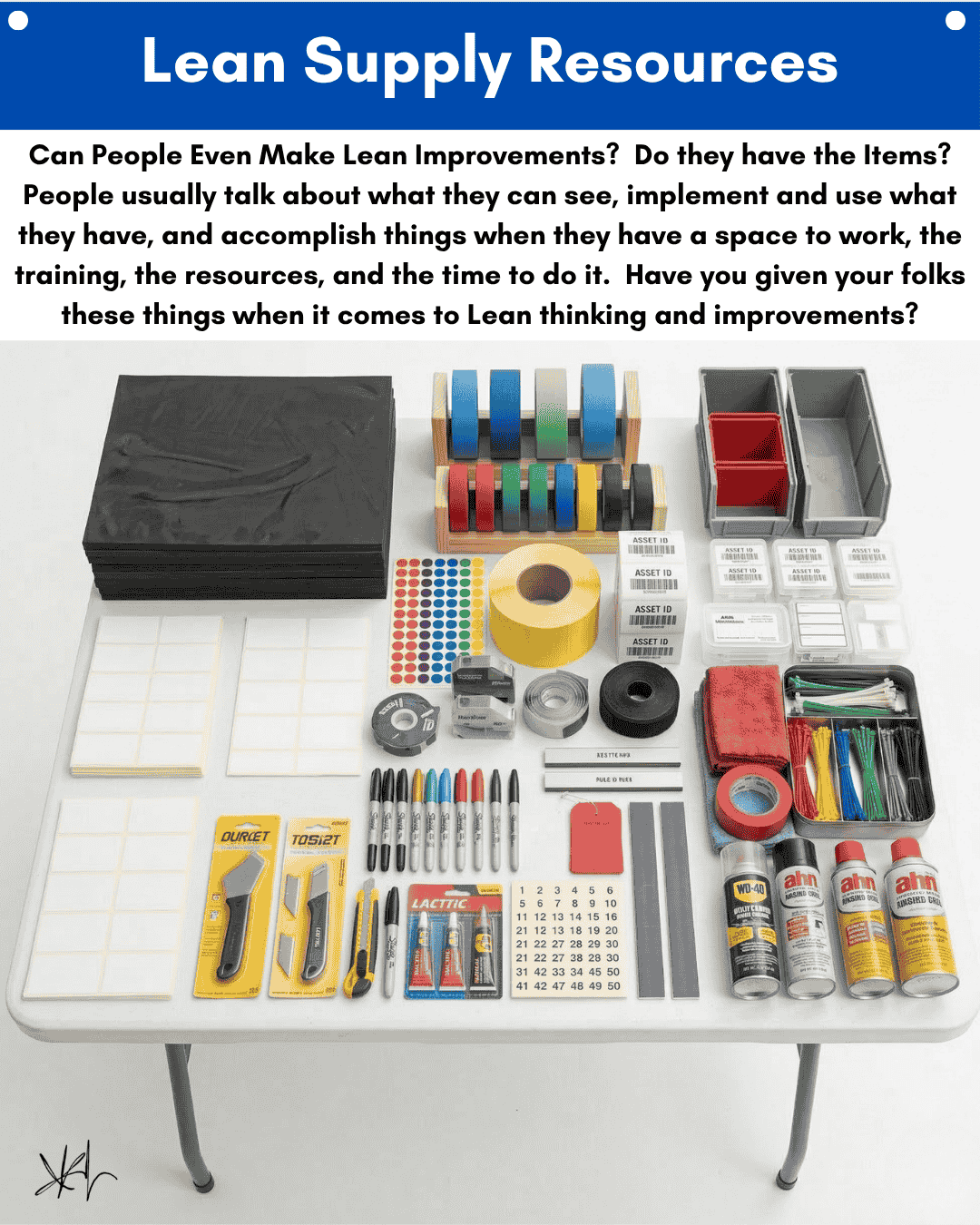
Look at the image carefully. Foam padding. Magnetic labeling tape. Color-coded dot stickers. Marker sets. Utility knives. Dry-erase boards. Whiteboards. WD-40. Label holders. Calendar sheets. Organization bins. These aren’t glamorous. They’re not expensive. They’re the raw materials of a Lean improvement culture the tools that make a two-second improvement possible every day. When these items are available, accessible, and restocked, the message to every worker is clear: we want you to fix what you see. We believe you have the wisdom to improve things. Here’s what you need to act on that belief.
When these items aren’t available when someone has a good idea for organizing their work area and has to go find their own supplies, make a case to get them approved, wait two weeks for delivery, and then repeat that process every time the culture dies before it starts. Not because the person didn’t care. Because the system didn’t support them. The system failed them. They didn’t fail the system.
The Gap Most Companies Don’t Acknowledge
I was on a project years ago where the leadership team was genuinely excited about Lean. They had been to training. They talked about Kaizen in the weekly meeting. They put up posters. And then they wondered why nobody on the field team was making improvements. When I walked the job and asked a few foremen directly, the answers were painfully consistent. One said, “I’d love to organize our staging area properly but I can’t get labeling tape approved through purchasing without a three-day lead time.” Another said, “We did an improvement once and nobody noticed. So we stopped.” A third said, “We don’t have time built in for it the schedule doesn’t have improvement in it anywhere.”
The enthusiasm at the leadership level was real. The gap between that enthusiasm and what was actually available to the crew was enormous. Nobody had asked: have we given our people what they need to improve? The answer, clearly, was no. And until that question gets asked and answered with action, the improvement culture will stay in the conference room and never reach the zone.
What It Actually Takes to Build an Improvement Culture
Jason Schroeder teaches that you can’t get into a Kaizen culture in construction unless you do specific things first. Respect for people and resources has to come before improvement. The site has to be clean, safe, and organized beautifully before the team can even see the waste they would otherwise fix. One-piece flow has to be happening before improvements to the flow are meaningful. And then everything has to be visual so that total participation becomes possible. You cannot improve a system you cannot see, and you cannot see a system that isn’t made visible.
The Lean supply kit shown in the image supports every one of those preconditions. Foam and labeling materials support Set in Order giving everything a visible, designated place. Color-coded tape and bins support Standardize creating a consistent visual system across the crew that anyone can follow without asking. Whiteboards and dry-erase markers support visual management making the plan, the standard, and the improvement visible to the whole team. The supplies are not the culture. But they are the enablers of the culture. Without them, culture stays aspirational.
The time component matters just as much as the physical supplies. Paul Akers whose Two-Second Lean system Jason has taught and implemented on projects teaches a daily practice: 3S your area, see the waste, make a small improvement, shoot a before-and-after video, share it with the team. This takes five to ten minutes. But it has to be built into the day. It has to be protected. If the schedule has no room for improvement, the schedule is saying improvement doesn’t matter regardless of what the morning meeting is communicating. At LeanTakt, Jason and the team practice one improvement per person per week. At scale with eighty-five people, that’s over four thousand improvements per year. The compounding effect of that on a construction project is staggering. But it only works when time is protected for it.
Watch for these signals that your team wants to improve but can’t:
- Workers making suggestions in huddles that never result in any visible change
- Improvement ideas requiring supply requests that take days or weeks to fulfill
- No before-and-after documentation of any improvement ever being shared with the broader team
- The improvement culture living in leadership conversations but absent from the daily crew routine
- People stopping themselves from starting an improvement because they don’t have the right material on hand
The Genius of the Team Is the Most Wasted Resource in Construction
Not using the genius of the team is one of the eight wastes Jason Schroeder teaches. It is arguably the most devastating one, because it compounds across every other category. The person who knows exactly why the staging area keeps getting cluttered, who understands the motion waste in the morning tool retrieval routine, who has seen the same quality issue repeat three zones in a row that person has knowledge the project desperately needs. If the system gives them no channel to act on it, the knowledge stays locked inside them and the waste continues.
The Lean supply kit is one of the most visible and tangible ways to open that channel. When a foreman or journeyman walks past a supply table stocked with exactly what they need to make an improvement and knows they’re allowed and encouraged to use it that moment changes the relationship between the worker and the project. It says: your ideas are welcome here. Your observations matter. We made it easy for you to act. That’s not a soft cultural gesture. That’s a production strategy. When the genius of the team is activated, the project gets smarter every day. When it stays locked inside people who weren’t given a way to contribute, the project stays as smart as it was on day one.
If your project needs superintendent coaching, project support, or leadership development, Elevate Construction can help your field teams stabilize, schedule, and flow. Part of that work is making sure the improvement culture has the physical, temporal, and relational conditions it needs to actually take root.
Give Your People What They Need Then Watch What Happens
Here is the challenge. Before your next phase of work starts, set up a Lean supply station on the project. Stock it with labeling materials, foam, color tape, markers, dry-erase surfaces, organization bins, and whatever else your crews need to 3S their areas and document their improvements. Build ten minutes of daily improvement time into the crew leader’s routine. Ask for before-and-after videos. Share them in the morning huddle. Celebrate the first one loudly so the culture knows this is real.
Do that for thirty days and watch what happens to the engagement of your crew, the cleanliness of your zones, the quality of your handoffs, and the pride people bring to work. The supplies cost almost nothing. The time investment is small. The return in morale, in waste reduction, in the daily compounding of small improvements is transformational.
Lean is a system. Systems require support. Give your people what they need to improve.
On we go.
Frequently Asked Questions
Why does providing physical supplies matter so much for Lean culture?
Because improvement culture can’t live in intentions alone. When someone has a good idea but has to wait days for supplies to act on it, the energy dies and the habit never forms. Having materials immediately accessible removes the friction between “I see a problem” and “I fixed the problem” which is the entire mechanism of daily continuous improvement.
What does Two-Second Lean look like on a construction project?
It means starting each day with a brief 3S of your area, seeing waste through the lens of the eight wastes, making one small improvement, and documenting it with a before-and-after video. Shared in the morning huddle, these improvements compound across the entire crew.
How do you protect time for improvement in a production schedule?
Build it in explicitly ten minutes per crew leader per day, or one improvement per person per week. If improvement time isn’t in the plan, it will always get consumed by production pressure. Protecting the time is the leadership action that signals improvement is real, not just a talking point.
What is the eighth waste and why is it the most important?
Not using the genius of the team is the eighth waste the failure to capture and act on the knowledge of the people closest to the work. It compounds every other waste because the solutions to most field problems are already known by the crew.
What should be in a Lean supply station on a construction project?
Foam padding for tool organization, color-coded labeling tape, markers and dry-erase supplies, label holders and bin labels, color-coded dot stickers, whiteboard surfaces, small organization bins, and basic maintenance supplies like WD-40.
If you want to learn more we have:
-Takt Virtual Training: (Click here)
-Check out our Youtube channel for more info: (Click here)
-Listen to the Elevate Construction podcast: (Click here)
-Check out our training programs and certifications: (Click here)
-The Takt Book: (Click here)
Discover Jason’s Expertise:
Meet Jason Schroeder, the driving force behind Elevate Construction IST. As the company’s owner and principal consultant, he’s dedicated to taking construction to new heights. With a wealth of industry experience, he’s crafted the Field Engineer Boot Camp and Superintendent Boot Camp – intensive training programs engineered to cultivate top-tier leaders capable of steering their teams towards success. Jason’s vision? To expand his training initiatives across the nation, empowering construction firms to soar to unprecedented levels of excellence.
On we go