
A Bin and a Sign Is Not a Smoking Area
Here’s the deal: most construction sites handle the smoking area the same way they handle every other worker comfort question minimally, reactively, and as late as possible. A trash can near the perimeter fence. A hand-painted sign. Sometimes a small overhang if the project team is feeling generous. And then everybody moves on to the real planning work, which apparently does not include the daily experience of the workers who will spend ten months on that site.
That standard communicates something. Not intentionally, but clearly. It says: we know you have needs, and we chose the cheapest possible response to them. That message does not build the kind of workforce trust and project pride that high-performing teams run on. And on the air quality side, it produces a secondary problem nobody planned for smoke migrating into work areas, across pedestrian paths, and toward nonsmoking workers going about their day.
Both problems are solvable. Neither requires significant investment. They just require someone to decide that the worker experience was worth designing for rather than accommodating at minimum compliance.
What the Industry Normalizes That It Shouldn’t
Walk the perimeter of most active construction sites and the smoking situation is immediately visible. Workers congregating at an unmarked area. No shelter. No seating. Smoke drifting back toward the building or across the access path. On cold or rainy days, breaks get cut short because there’s no protection from the weather. In summer heat, the area has no shade. Nobody thought about it as a designed space it emerged as whatever the leftover corner of the site allowed.
Jason Schroeder teaches that bathrooms are a Lean indicator the first signal of whether a project is truly Lean and truly respects the people building it. If facilities aren’t good enough for the project management team’s grandmother, they aren’t good enough for the workers. The same principle applies to every other amenity on the site. The standard you set for the break area, the lunch tent, the smoking station all of it tells the workforce how seriously you take the claim that people matter here.
The workers who smoke on your project are skilled professionals. They spend eight to ten hours a day doing physically demanding, technically complex work in conditions that most people would find exhausting. A designed break space with real shelter and clean air is not a reward. It is a baseline standard of care. The system failed them when it was never designed to meet that standard.
A Story About What a Designed Space Communicates
Early in my career I was on a project where a subcontractor foreman approached me about the smoking area. He wasn’t complaining. He was asking, almost apologetically, whether anything better was possible because his crew had nowhere to go during breaks that wasn’t either in the sun or near the building entrance where the smoke was causing complaints from other trades. His crew was one of the most productive on the project. They showed up early, stayed late, and hit every milestone in their phase plan. And for ten months, their break experience was a trash can next to a fence.
We moved the area, added a simple shelter, and put in proper seating. The reaction from that crew was completely disproportionate to the effort because the gesture wasn’t really about the bench. It was about being seen. When people feel cared for, they perform differently. Not because of the bench because of what the bench means about the people running the project.
What the Enclosed Smoking Station System Actually Provides
The enclosed smoking station in this post is a different approach from the ground up. It treats the smoking area as a designed system with specific functional requirements rather than an afterthought requiring minimal compliance.
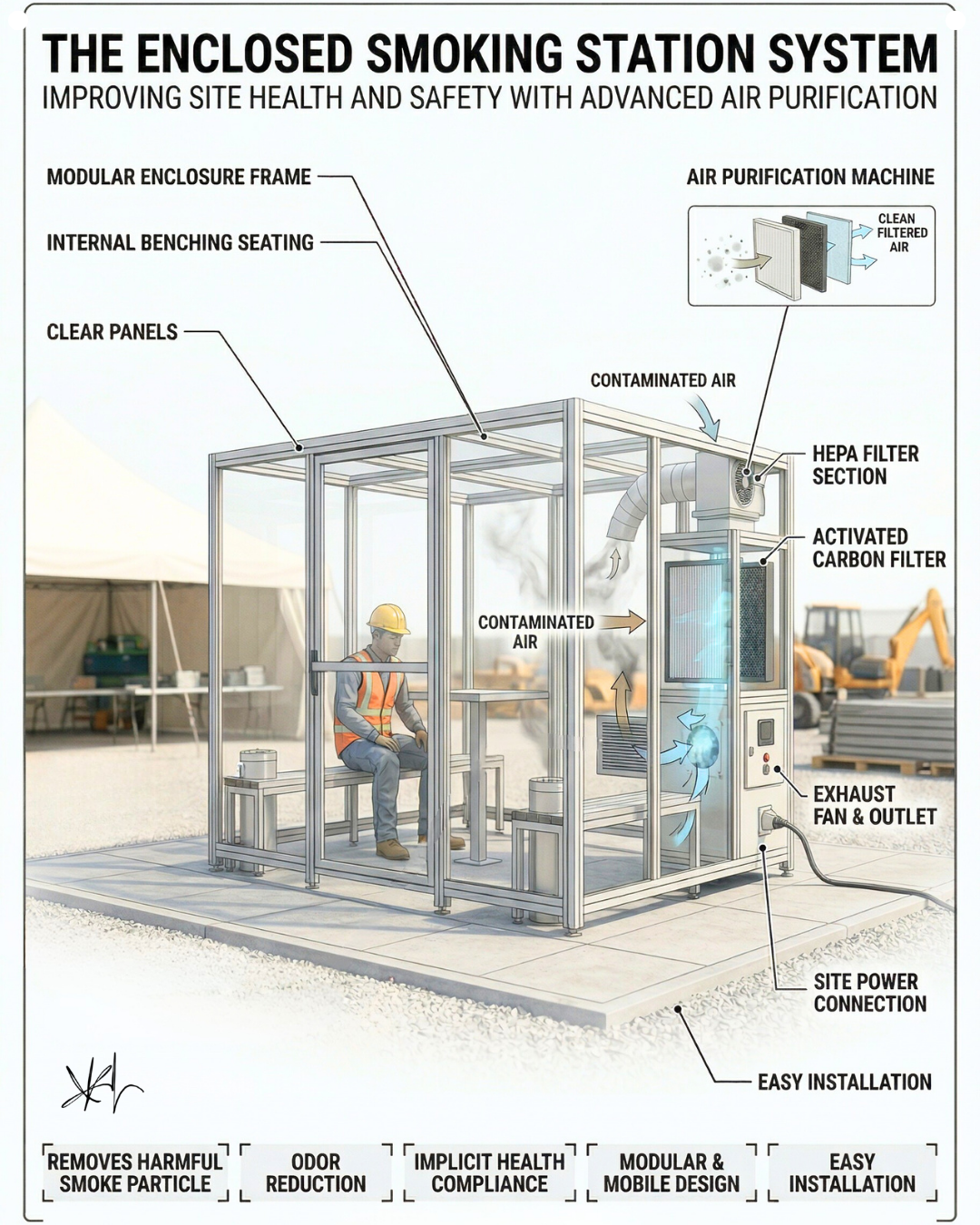
The modular enclosure frame with clear panels creates a fully enclosed, visible, and weather-protected space. Workers can use it in rain, wind, or summer heat without the break being compromised by conditions. The clear panels maintain visibility and transparency the station is not a hidden corner, it is a professional, self-contained unit that communicates organizational standards at a glance. Internal benching seating gives workers a comfortable place to actually rest during the break rather than standing in an exposed area that discourages proper use.
The air purification system is where the technology makes the most meaningful contribution. A HEPA filter section captures harmful smoke particles at the source inside the enclosure. An activated carbon filter layer addresses odor. An exhaust fan draws contaminated air through both filter stages before releasing clean, filtered air outside. The result is that workers inside the station are not exposed to the full concentration of unfiltered smoke, and workers outside the station are not exposed to smoke migrating from an open area. Both populations are protected by design, not by hope.
Watch for these signals that your site’s smoking area is producing avoidable problems:
- Smoke from the designated area migrating toward building entrances, active work zones, or break areas used by nonsmokers
- Workers congregating in non-designated areas because the official area has no shelter or seating
- Cold or wet weather causing breaks to be shortened or skipped because the area provides no protection
- Air quality complaints from nonsmoking workers about proximity to unfiltered smoke drift
Why This Connects to the Total Worker Care Standard
Jason Schroeder’s framework for the general contractor’s responsibility is clear: the GC owes workers a safe, clean, stable, and human environment. That responsibility does not have exceptions for areas of the site that are uncomfortable to think about. Smoking is a legal activity. Workers who smoke have chosen a personal behavior that the project has no authority to prohibit on break time. What the project does have authority and responsibility over is the conditions in which that behavior occurs and whether those conditions are safe, organized, and respectful of the whole workforce.
The site power connection on the enclosed unit means setup requires no complex electrical work. Easy installation and mobile design means it can be repositioned as the project evolves and the active work areas shift the same principle applied to mobile material racks, safety compliance stations, and spider boxes. The amenity moves with the project rather than being fixed in a location that made sense on day one but is inconvenient by week eight.
All of this adds up to something that cannot be measured in a single line item but shows up across the entire project: the signal that leadership thinks about every worker’s experience. The signal that the environment was designed by people who asked, “what do workers actually need here?” before arriving at the minimum. That signal builds trust. And trust, as Jason Schroeder teaches, is the foundation of a workforce that sees as a group, knows as a group, and acts as a group instead of fifty separate subcultures coexisting on the same site.
If your project needs superintendent coaching, project support, or leadership development, Elevate Construction can help your field teams stabilize, schedule, and flow. That work includes the full picture of what the worker experience looks like from the gate to the lunch area to the smoking station to the zone.
Design Every Corner of the Worker Experience
Here is the challenge. Walk your current project during break time and look at where workers who smoke are going. Is there shelter? Is there seating? Is the area designed, or did it emerge by default into whatever corner was available? Is the smoke staying contained, or is it migrating toward other workers and work areas?
If what you find is a bin and a sign fix it before the next phase begins. The enclosed smoking station is a modular, mobile, simple-to-install solution that solves the problem completely. It is not the biggest investment a project will make. But the message it sends to every worker who uses it and every worker who walks past it is larger than its footprint suggests.
As Jason Schroeder teaches: “Respect for people is not soft it’s a production strategy.” Design every part of the worker environment to prove it.
On we go.
Frequently Asked Questions
What makes the enclosed smoking station different from an open smoking area?
It contains smoke within a filtered enclosure protecting users from full concentration exposure and preventing smoke from drifting toward nonsmoking workers, building entrances, or active work zones. It also provides weather-protected shelter and seating that an open area never does.
How does the air purification system work?
Contaminated air is drawn through a HEPA filter that captures smoke particles, then through an activated carbon filter that reduces odor, before being exhausted as filtered air by an internal fan. Both worker populations inside and outside the station are protected.
Why does the modular, mobile design matter on a construction site?
Construction work moves through phases and zones. A fixed smoking area that was convenient at mobilization may be inaccessible or near active work by month four. Mobile design means the station repositions with the project rather than creating a compliance problem as conditions change.
How does providing a proper smoking area connect to site health compliance?
An enclosed, filtered station provides implicit health compliance by containing smoke and preventing exposure to nonsmoking workers reducing air quality complaints, informal gathering in unauthorized areas, and the regulatory risk that comes from unmanaged smoke drift near occupied spaces.
Does this require special electrical installation?
No. The unit connects directly to standard site power with no complex installation required, making it immediately deployable as part of the initial site setup rather than a later addition that gets deferred indefinitely.
If you want to learn more we have:
-Takt Virtual Training: (Click here)
-Check out our Youtube channel for more info: (Click here)
-Listen to the Elevate Construction podcast: (Click here)
-Check out our training programs and certifications: (Click here)
-The Takt Book: (Click here)
Discover Jason’s Expertise:
Meet Jason Schroeder, the driving force behind Elevate Construction IST. As the company’s owner and principal consultant, he’s dedicated to taking construction to new heights. With a wealth of industry experience, he’s crafted the Field Engineer Boot Camp and Superintendent Boot Camp – intensive training programs engineered to cultivate top-tier leaders capable of steering their teams towards success. Jason’s vision? To expand his training initiatives across the nation, empowering construction firms to soar to unprecedented levels of excellence.