
Your Work Truck Is Either Creating Flow or Killing It
Here’s the deal: when I walk a jobsite, I always look at the trucks. Not because I’m checking on people because the trucks tell me everything I need to know about how a crew was set up to work that day. Some trucks are chaos. Tools piled in the bed with no organization. Fasteners mixed across three different containers. A ladder tossed on top of everything else. And within the first ten minutes of the morning, someone is already digging through it all looking for a specific bit while the rest of the crew stands around. That’s not a lazy crew. That’s a system that was never designed to support them.
Other trucks are completely different. Everything has a place. Tools are visible on shadow boards. Bins are labeled and color-coded. The flat staging surface is clear and ready. You can find anything in thirty seconds or less. Those trucks don’t just look better they produce better, from the first moment of the day to the last.
What the Truck Actually Reflects
The state of a work truck is a direct output of how seriously the company takes the idea of setting their people up to succeed. A disorganized truck is not the result of disorganized people. It’s the result of no one ever sitting down and asking: what does this crew need to access quickly, what should be where, and how do we design this vehicle so the work starts immediately instead of after a ten-minute search?
That question is never asked on most projects. The truck gets loaded, accumulates things over time, and eventually becomes a mobile storage problem that everyone works around without questioning. And because the waste it creates searching, waiting, rework from using the wrong tool because the right one couldn’t be found is distributed in small increments across every workday, it never gets measured or attributed to the system that caused it. It just becomes the cost of doing business. It shouldn’t be.
I remember on one service project watching two technicians of equal skill starting their morning routines at adjacent trucks. One had an organized truck with shadow boards, labeled drawers, and a clear flat surface for staging. The other had a standard utility bed where everything had migrated over weeks into one general pile. The organized technician was on the roof and working within eight minutes of arriving at the vehicle. The other spent fourteen minutes locating tools and loading a bag before he could even walk to the ladder. That difference six minutes per morning adds up to over twenty hours across a single year for one worker. That’s not a minor inefficiency. That’s a system problem that never had to exist.
What a Lean Work Truck Is Actually Built Around
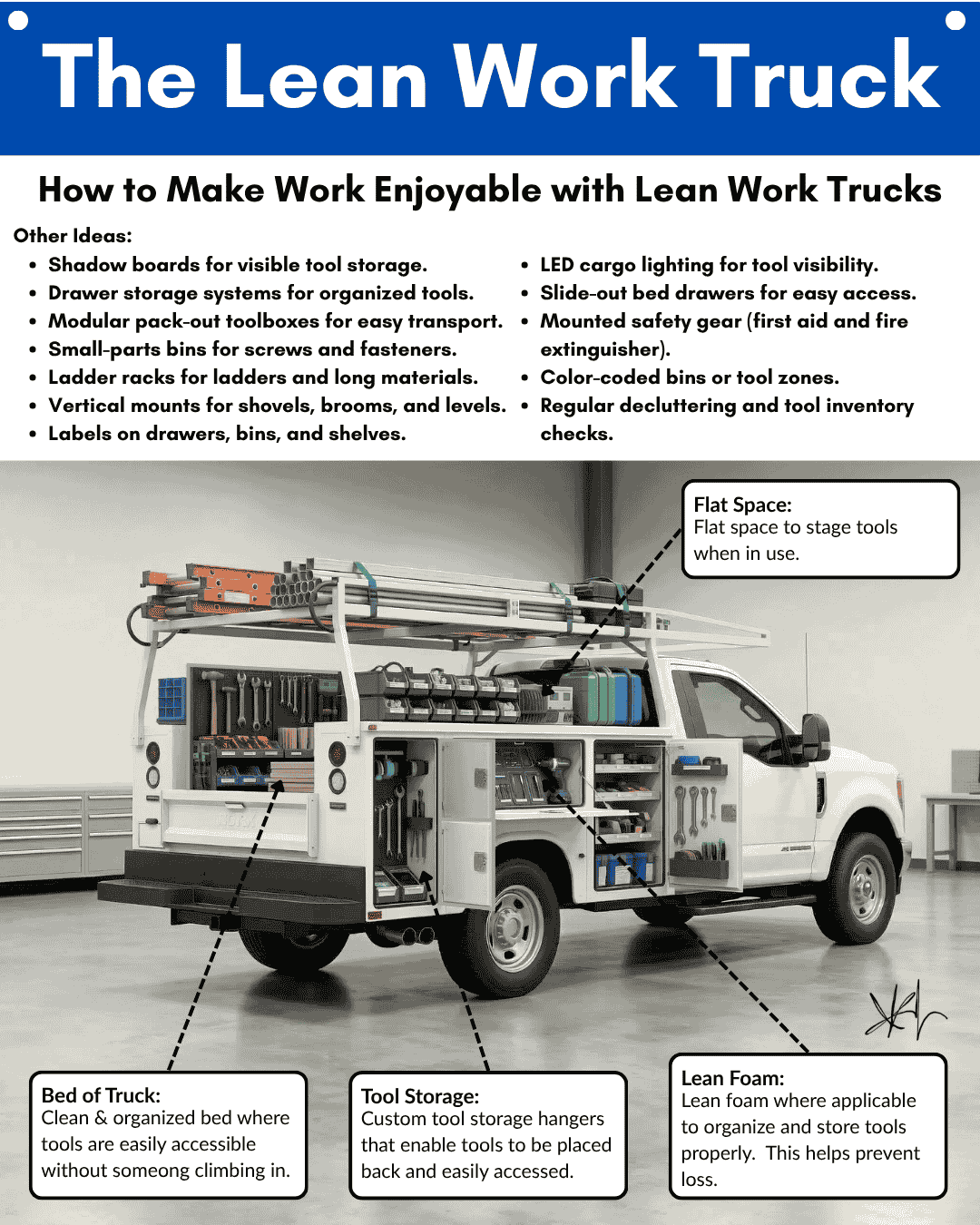
The image in this post shows what happens when someone applies 5S thinking to the work truck from the ground up. Every element has a purpose, and the purpose is always the same: put what the crew needs at the place of work, in a configuration that makes searching impossible and access immediate.
The bed of the truck is clean and organized so tools are easily accessible without anyone having to climb in and rummage. This is one of the most common waste-generators on a disorganized truck the five minutes spent climbing into a bed, moving things around, and climbing back out before the work actually starts. A clean, organized bed with a designated flat staging surface for tools in use eliminates that entirely. The tool is either in its labeled home or staged on the flat surface while it’s being used. There’s no third option.
Custom tool storage hangers hold individual tools so they can be placed back and accessed without searching. This is the field equivalent of the shadow board on the connex box each tool has a silhouette, each absence is visible, and putting things back becomes the path of least resistance rather than a discipline requirement. The lean foam inserts in drawers where applicable prevent tool loss by creating a physical home for every item so nothing can get buried under something else or lost in transit.
Watch for these signals that a work truck is functioning as a liability rather than an asset:
- Tools regularly left at job sites because they weren’t returned to a designated home on the truck
- Duplicate purchases of tools that “disappeared” but were actually buried in the disorganized bed
- Morning setup taking more than five minutes because the crew has to locate and organize before they can work
- Borrowed tools from other trucks because the correct one can’t be found in the chaos
- No labeling on any bin, drawer, or compartment meaning every retrieval is a memory test
The 5S Principles That Make It Work
Jason Schroeder teaches 5S not as housekeeping but as production support the discipline of removing friction so the crew can install work without searching. The work truck is one of the most practical and highest-leverage places to apply this discipline in all of construction, precisely because it travels to every job and sets the tone for every workday before a single tool touches the work.
Sort means only what is needed for this scope is on this truck. Not everything that has ever been used. Not the spare parts from three jobs ago that nobody wanted to deal with. Every drawer, shelf, and bin contains only what belongs there for current work. What isn’t needed is removed. When a truck is over-full, it becomes impossible to find anything, impossible to put things back in their place, and impossible to know what’s actually there at a glance.
Set in Order means every tool and every item has a labeled, designated home it returns to after use. Shadow boards make the location visual you can see where the drill goes, where the level goes, where the conduit bender goes, without remembering or asking. LED cargo lighting means that visibility is maintained in early morning and evening conditions so the organization can actually be used in the full range of hours a crew works.
Standardize means every truck in the fleet is organized the same way. When a helper moves from one truck to another, they can find what they need immediately because the layout is consistent. When a new crew member joins, they don’t have to learn a different system the standard is the same everywhere. This is how companies scale quality and reduce variation without micromanaging every individual.
Making Work Enjoyable Is Not a Soft Goal It Is a Production Strategy
Jason Schroeder teaches that work should be enjoyable because stable systems reduce stress and conflict. When the plan is clear and support is real, teams can focus and perform. Enjoyable does not mean easy it means controlled, respected, and predictable. A Lean work truck is exactly that kind of system. It says to the craft professional who opens it every morning: we thought about your day before you did. We designed this so you can go straight to the work without fighting your own tools to get there. That’s not a luxury. That’s respect for the person whose skill is the entire value of the company’s service.
When a worker can walk to the truck, grab exactly what they need, and get right to work without searching, without asking, without improvising the tone of the day is set immediately. The crew is productive from minute one. Morale is higher because nobody started the morning frustrated. Tools last longer because they’re stored properly and returned consistently. And the company’s reputation is built every time a client sees an organized, professional truck pull up to their building.
If your project needs superintendent coaching, project support, or leadership development, Elevate Construction can help your field teams stabilize, schedule, and flow. The Lean work truck is where that discipline starts one of the most visible and most personal expressions of whether a company truly believes that the people doing the work deserve an environment designed for their success.
Design the Truck That Sets the Day Up Right
Here is the challenge for every field leader and company owner reading this. Look at your fleet this week not from a distance, but up close. Open the drawers. Look at the beds. Ask: can anyone on the crew find any tool in under thirty seconds? Is there a labeled home for every item? Does every truck in the fleet use the same layout so it’s consistent? Are the LED lights working so the organization is usable at 6 AM? If the answers reveal a gap between where you are and where the standard should be, don’t blame the crews. Design the truck.
Shadow boards, labeled bins, lean foam inserts, slide-out drawers, ladder racks, cargo lighting, a clean flat staging surface none of these are expensive or complicated. They are design decisions that take an afternoon to implement and return their investment every day for years. Paul Akers says fix what bugs you every single day, two-second improvements. A disorganized truck bugs every crew member who opens it. Fix it. Build the system that lets them win from the moment they arrive.
A messy truck creates friction. A Lean truck creates flow. And flow is what makes construction feel great.
On we go.
Frequently Asked Questions
What makes a work truck “Lean” and how is it different from just being organized?
A Lean truck is organized around eliminating specific wastes motion, searching, waiting, and re-handling through deliberate design choices like shadow boards, labeled bins, lean foam inserts, and consistent layout standards. It’s not just tidy; it’s a system that makes the right behavior the easiest behavior every time the truck is opened.
Why do tools go missing more often from disorganized trucks?
Without a designated labeled home for each tool, there’s no visual signal when something is missing. Tools get used, set down, buried under other items, and eventually lost or left on a job. Shadow boards and labeled storage make absences immediately visible so tools are returned before they disappear.
How does truck organization connect to crew morale?
Starting the day by fighting a disorganized truck sets a frustrated tone before the work even begins. When a crew can access what they need immediately, the morning flows smoothly, the work starts faster, and the entire day carries less friction and frustration. Morale and productivity are connected directly to how the system sets the crew up.
What is the most important first step to organizing a work truck?
Sort first remove everything that doesn’t belong for the current scope. Most trucks are disorganized partly because they carry things from past jobs that were never cleared out. A clean start with only what’s needed makes every subsequent organizational step far easier.
How does standardizing truck layouts across a fleet add value?
When every truck uses the same layout, any crew member can work off any truck without relearning where things are. New workers orient immediately. Helpers can be sent to the truck by any team member. And the company can audit and maintain the standard consistently instead of managing individual variations across dozens of vehicles.
If you want to learn more we have:
-Takt Virtual Training: (Click here)
-Check out our Youtube channel for more info: (Click here)
-Listen to the Elevate Construction podcast: (Click here)
-Check out our training programs and certifications: (Click here)
-The Takt Book: (Click here)
Discover Jason’s Expertise:
Meet Jason Schroeder, the driving force behind Elevate Construction IST. As the company’s owner and principal consultant, he’s dedicated to taking construction to new heights. With a wealth of industry experience, he’s crafted the Field Engineer Boot Camp and Superintendent Boot Camp – intensive training programs engineered to cultivate top-tier leaders capable of steering their teams towards success. Jason’s vision? To expand his training initiatives across the nation, empowering construction firms to soar to unprecedented levels of excellence.
On we go