
The Neighbors Your Project Forgot to Respect
Every construction project has a client. Most teams could tell you exactly what that client wants, what their expectations are, and what success looks like in their eyes. There are meetings, submittals, RFI responses, and quality walk-throughs all dedicated to making sure that relationship is healthy. Now ask a different question: who is taking care of the family that lives in the apartment building forty feet from the site hoarding? Who is protecting the business owner whose storefront is buried behind a fence and a jersey barrier for eighteen months? Who is managing the experience of the pedestrian who used to walk that sidewalk and now has to navigate an unmarked detour through a construction zone every morning?
On most projects, the honest answer is nobody. Not because the team doesn’t care about people most builders care deeply. But the community adjacent to the project was never designed into the project management system. They were treated as a consequence of the work, not as stakeholders in it. And they feel that absence every single day.
What the Construction Industry Normalizes That It Shouldn’t
Construction impacts are real. Noise, vibration, dust, traffic disruption, blocked sightlines, closed sidewalks, early-morning deliveries, weekend work these are not trivial inconveniences. For a business owner, a blocked entrance during peak hours can mean lost revenue for months. For a family in a nearby residence, six months of early-morning demolition work while young children try to sleep is a genuine quality-of-life issue. For an elderly neighbor who depends on a specific pedestrian route, an unmarked closure creates real hardship and real risk.
The industry has normalized treating these impacts as unavoidable. “That’s construction.” “They knew it was coming.” “We have the permits.” All of that may be legally accurate and still be a failure of leadership. Having a permit to make noise does not mean you cannot communicate when the noise will happen. Having the right to close a sidewalk does not mean you cannot design a safe, clearly marked alternative. The permission to build does not relieve the team of the responsibility to care.
A Story About What Happens When You Don’t Win the Neighborhood
Early in my career I was on a project in a dense urban area where we had underestimated the community relations dimension of the job. We had done everything right from a permitting standpoint. Traffic control was approved. Noise variances were in order. The schedule was posted in the trailer. Within the first month, we had a business owner showing up at the site office daily, a city council member calling our project executive, and a noise complaint that triggered an unannounced inspection during a critical pour. None of those problems came from doing bad work. They came from a community that felt invisible and uninformed.
When we finally sat down with the neighboring business owners, the number-one complaint was not the noise level or the truck traffic. It was the lack of communication. Nobody had told them what was coming. Nobody had given them a way to ask questions or flag concerns. Nobody had treated them like people who mattered to the project’s success. Once we established a community hotline, sent weekly impact notices, and posted the weekly work schedule publicly, the tension dropped almost immediately. The work hadn’t changed. The relationship had.
What a Well-Designed Community Care System Looks Like
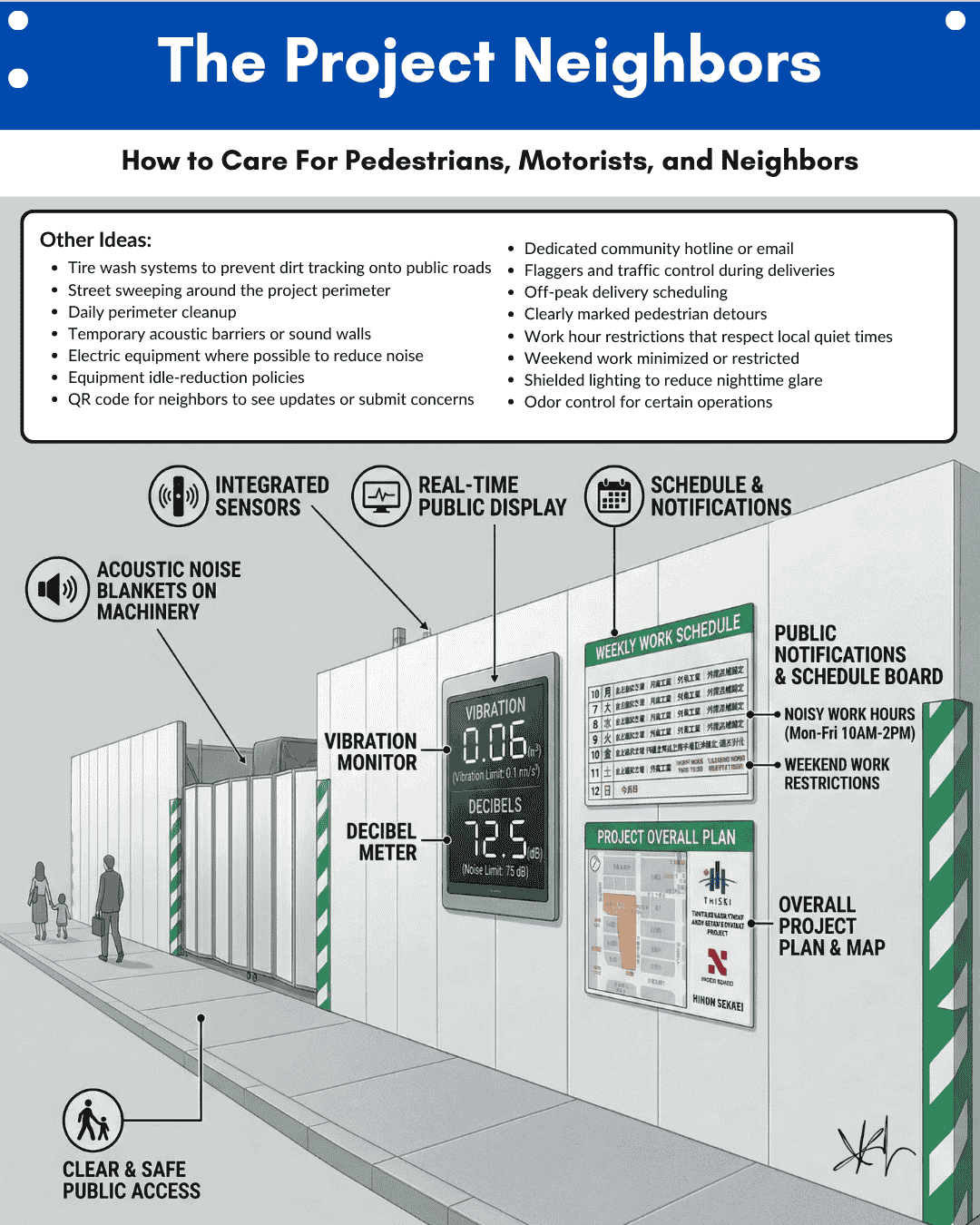
The image in this post shows what it looks like when a project team designs the community experience the same way they design the production system: intentionally, visually, and with the people affected firmly in mind.
The real-time public display on the fence showing current vibration readings and decibel levels is one of the most powerful elements in the system. It does something no amount of community meetings can fully replicate: it puts accurate information in front of neighbors at the moment they’re experiencing the impact, without requiring them to ask anyone or submit a complaint. A parent walking by with a child who is bothered by noise can look at the display and see exactly what the reading is, whether it’s within permitted limits, and what the project’s committed noise window is. The transparency removes the adversarial dynamic. When people can see that the project is operating within standards, even if those standards are uncomfortable, trust builds. When they can’t see anything and just experience the impact, they assume the worst.
The vibration monitor serves the same function for the ground-transmitted impacts that demolition and heavy equipment create. Sensors feed real-time data to the public display so that a business owner who feels a vibration through their floor doesn’t have to wonder whether it’s normal or whether something has gone wrong. The data is right there, public, honest, and continuous.
Watch for these signs that a project’s community care approach needs redesign:
- Neighbors showing up at the site office to complain rather than reaching a dedicated hotline
- City council or elected officials becoming involved because community members had no other escalation path
- Sidewalk closures with unclear or unmarked detour routing
- Weekend work or early-morning deliveries occurring without advance notice to the surrounding area
- Adjacent businesses experiencing predictable impacts that nobody addressed in the communication plan
Transparency as a Production Strategy
Jason Schroeder teaches that transparency is not a personality trait it is a production strategy. Hidden problems become expensive problems. This principle applies not just inside the project team, but to everyone the project affects. A neighbor who doesn’t know what’s coming is a neighbor who escalates when it arrives. A business owner who has no way to communicate concerns becomes a city council agenda item. An uninformed community becomes a project delay when permits get challenged, inspections get triggered, and political pressure creates schedule risk that no production plan accounted for.
The weekly work schedule on the public-facing board flips the dynamic entirely. Instead of neighbors experiencing the project as a black box of unpredictable disruption, they can see what’s planned for the coming week when the noisy work is happening, when deliveries will be arriving, what areas will be affected, and when quiet periods are protected. That predictability respects people’s ability to plan their own lives around the project’s impacts. It treats the neighbor as an intelligent adult who deserves information, not as a bystander to be managed after the fact.
The acoustic noise blankets on machinery, the equipment idle-reduction policies, the off-peak delivery scheduling, the tire wash systems that prevent dirt tracking onto public roads each of these is a design decision that says: we thought about the people who live and work around us before we started. We made choices to reduce our impact even when we weren’t legally required to. That posture builds goodwill that no marketing effort can replicate, and it protects the project from community friction that no schedule buffer can fully absorb.
Why This Is About Respect for People, Not Just Public Relations
The Elevate Construction mission is to build remarkable people and systems that build the world. That vision doesn’t stop at the fence line. The world being built includes the community the project sits inside. The families being protected are not just the families of the workers on the site they include the families who live next door, whose sleep matters, whose businesses matter, whose sidewalks matter.
Jason Schroeder’s core teaching on respect for people is straightforward: answer every decision by asking, what would respect people? Applied to community care, the question becomes: does this decision treat the neighbors of this project as people who matter, or as obstacles to be minimized? A real-time noise display respects people. A community hotline respects people. A clearly marked pedestrian detour that is safe, maintained, and actually functional respects people. Sending mobilization and impact notices before work begins, so no one is surprised, respects people. If your project needs superintendent coaching, project support, or leadership development, Elevate Construction can help your field teams stabilize, schedule, and flow. Building that culture extends beyond the site boundary to everyone who shares the neighborhood with the work.
Build the Reputation That Outlasts the Project
Here is the challenge I want to leave with you. Think about the most recent project your team completed and ask: what did the neighbors experience? Did they know your hotline number? Did they receive impact notices before significant work phases? Did they have a way to see the weekly schedule without coming to the site office? Were their pedestrian routes safe, maintained, and clearly signed? Were quiet hours protected with enforcement, not just intention?
The answers to those questions define the reputation your company built in that community and in the minds of every business owner, city official, and resident who watched the project happen. That reputation travels. It shows up in the next permit application, the next community meeting, the next project in that neighborhood or that city. Great builders don’t just build buildings. They build goodwill. And goodwill, like a good production system, is designed not assumed.
On we go.
Frequently Asked Questions
Why should construction teams actively manage the community experience?
Because community friction is a real project risk. Unmanaged neighbor concerns escalate to permit challenges, unannounced inspections, and political pressure that can delay the schedule none of which any production plan can fully absorb.
What does a real-time public noise and vibration display accomplish?
It puts accurate live data in front of neighbors at the exact moment they’re experiencing an impact, removing the need to call or complain. When people can see the project is within standards, trust builds instead of resentment.
How does the public weekly work schedule benefit the surrounding community?
It transforms the project from an unpredictable source of disruption into something neighbors can plan around. A business owner who knows loud work is scheduled Tuesday morning can prepare accordingly predictability is its own form of respect.
What is the value of a community hotline for construction projects?
A hotline gives neighbors a designed channel to raise concerns before they escalate to the city or elected officials. A complaint that gets answered and resolved is a relationship one that doesn’t show up as a project risk.
When should impact notices be sent to neighbors?
Before any major phase change, noisy work period, or weekend work schedule not after the impact has already started. Sending them in advance is what separates a real communication system from an apology.
If you want to learn more we have:
-Takt Virtual Training: (Click here)
-Check out our Youtube channel for more info: (Click here)
-Listen to the Elevate Construction podcast: (Click here)
-Check out our training programs and certifications: (Click here)
-The Takt Book: (Click here)
Discover Jason’s Expertise:
Meet Jason Schroeder, the driving force behind Elevate Construction IST. As the company’s owner and principal consultant, he’s dedicated to taking construction to new heights. With a wealth of industry experience, he’s crafted the Field Engineer Boot Camp and Superintendent Boot Camp – intensive training programs engineered to cultivate top-tier leaders capable of steering their teams towards success. Jason’s vision? To expand his training initiatives across the nation, empowering construction firms to soar to unprecedented levels of excellence.
On we go