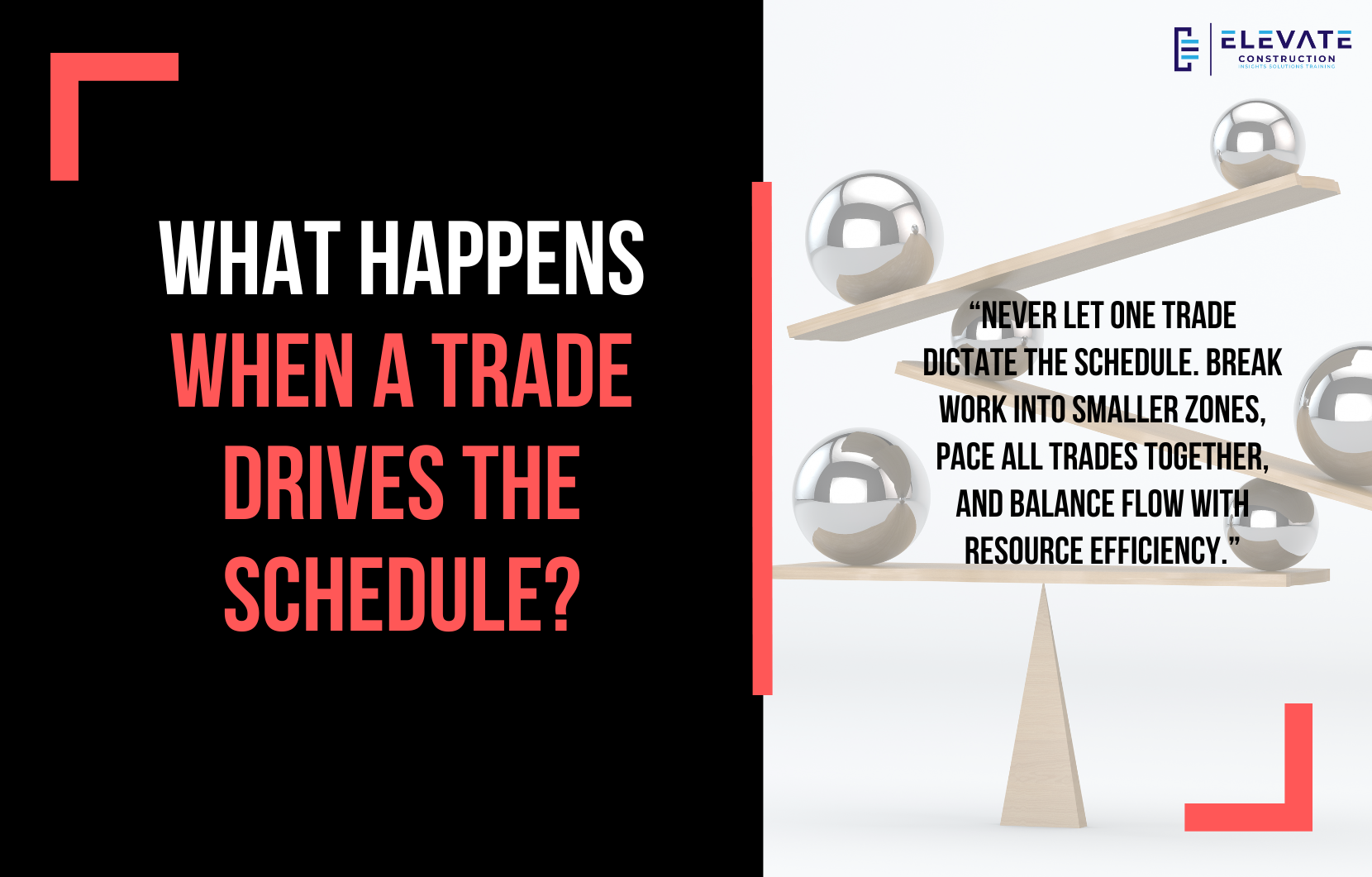
What Happens When a Trade Drives the Schedule?

Read 3 min

Don’t Let Trades Drive the Schedule

A question came in recently about how to handle trades who want to batch large areas on a project and, essentially, drive the schedule. This is an issue I’ve seen many times, and it’s worth addressing head-on.

Trade partners will often say: “Clear out a big space and let us go full speed. We’ll knock it out.” On the surface, it sounds efficient but in reality, it slows down the entire project.

Here’s why:

  • Large batch areas extend timelines. For example, one trade might take 10 days in a massive zone. If the work is split into two smaller zones, each taking 5 days, the overall phase shortens dramatically. Smaller zones mean faster project throughput.
  • Mismatched pacing disrupts flow. If most trades are running on a 5-day takt time, but one insists on a 10-day pace, the whole system suffers. Weeks and sometimes months are lost.
  • The orchestra analogy matters. Just like an orchestra needs a conductor, a project needs superintendents to set the rhythm. Every trade must move together, at the same pace, in balanced zones. If one trade tries to play solo at their own speed, the whole performance falls apart.

This is where the balance between flow efficiency and resource efficiency comes in. Lean thinking often emphasizes flow, but ignoring resources leads to burnout and chaos. On the other hand, focusing only on resource efficiency sub-optimizes the project. The key is combining both: pacing supply and demand so the entire system is optimized, not just one trade.

When a trade partner insists on doing whatever they want, it’s like a human body where only the lungs are healthy while the heart and liver are failing. The system dies, and the “winning” trade loses with it.

A superintendent’s job is to protect the whole ensuring every trade works together in sync. That’s the only way to deliver a profitable, healthy, optimized project.

Key Takeaway

Never let one trade dictate the schedule. Break work into smaller zones, pace all trades together, and balance flow with resource efficiency. The project only succeeds when the entire system is optimized.

If you want to learn more we have:

-Takt Virtual Training: (Click here)
-Check out our Youtube channel for more info: (Click here) 
-Listen to the Elevate Construction podcast: (Click here) 
-Check out our training programs and certifications: (Click here)
-The Takt Book: (Click here)

Discover Jason’s Expertise:

Meet Jason Schroeder, the driving force behind Elevate Construction IST. As the company’s owner and principal consultant, he’s dedicated to taking construction to new heights. With a wealth of industry experience, he’s crafted the Field Engineer Boot Camp and Superintendent Boot Camp – intensive training programs engineered to cultivate top-tier leaders capable of steering their teams towards success. Jason’s vision? To expand his training initiatives across the nation, empowering construction firms to soar to unprecedented levels of excellence.

On we go
Posted in All

We Are All Needed, Feat. Jason Sturgeon

Read 3 min

Building Better Leaders and a Healthier Construction Industry

In this blog, we sat down with Jason Sturgeon of Arcade Way finding to talk about his mission, the work he’s doing, and why leadership training in construction is about so much more than just building projects it’s about building people.

Jason has been in construction for nearly 30 years, working his way through roofing, siding, carpentry, and residential, commercial, and even owner’s rep roles. A decade ago, he founded Arcade Way finding, a company built on a simple but powerful idea, construction is a people business, and leadership should start with genuinely caring about crews.

The Heart of Leadership

Arcade Way finding’s programs, including Foreman Basic Training and PM Basic Training, focus on three pillars:

  1. Leadership: Teaching communication, conflict management, and how to build a real safety culture where crews look out for each other.
  2. Construction Management Principles: From daily reports and scheduling to RFIs and change orders, the fundamentals that field leaders need to navigate the role.
  3. Technology: Not about making foremen experts in every new tool, but teaching them a process to approach tech with curiosity and confidence.

At the center of all of this is one question, Are you leading from fear or from love? Jason points out that in construction, many leaders are afraid of being “found out” for what they don’t know. His approach normalizes asking questions, admitting gaps, and replacing fear-driven leadership with care driven leadership.

Beyond Work

Changing Lives

While better leadership creates smoother projects and more profitability, Jason cares most about the human results. Graduates of Arcade’s programs often share stories like:

  • Improved relationships with their crews and bosses.
  • Better connections with their kids and spouses.
  • One participant even credited the program with saving their marriage.

Addressing Industry Challenges

Jason is also leading the Build the Circle Initiative, which sponsors underrepresented groups in construction women, minorities, ESL speakers, LGBTQ workers into leadership roles. With the “silver tsunami” of retiring baby boomers, construction cannot afford to ignore untapped talent. Build the Circle ensures those voices have a path to leadership, with coaching and support for the long haul.

How You Can Support

Jason’s challenge to all of us is simple: when you see someone upset on the job, don’t just fight fire with fire. Slow down, listen, and ask: “Is this coming from fear or love?” That small shift can change relationships, projects, and lives.

And if you want to support Arcade’s mission, sponsoring a student for $2,500 can truly change someone’s career and life forever.

Key Takeaway

Construction is not just about building structures, it’s about building people. By leading with care instead of fear, investing in diverse leaders, and supporting programs like Build the Circle, we can create a healthier, more inclusive, and more sustainable industry for the future.

If you want to learn more we have:

-Takt Virtual Training: (Click here)
-Check out our Youtube channel for more info: (Click here) 
-Listen to the Elevate Construction podcast: (Click here) 
-Check out our training programs and certifications: (Click here)
-The Takt Book: (Click here)

Discover Jason’s Expertise:

Meet Jason Schroeder, the driving force behind Elevate Construction IST. As the company’s owner and principal consultant, he’s dedicated to taking construction to new heights. With a wealth of industry experience, he’s crafted the Field Engineer Boot Camp and Superintendent Boot Camp – intensive training programs engineered to cultivate top-tier leaders capable of steering their teams towards success. Jason’s vision? To expand his training initiatives across the nation, empowering construction firms to soar to unprecedented levels of excellence.

On we go

Posted in All

What Is Retainage On A Construction Project

Read 3 min

What is Retainage on a Construction Project?

In this blog, I’m going to give you the exact definition of retainage, explain how it’s typically handled, and share some of my opinions on where the industry should go. If you want a quick and clear definition, you’re in the right place.

The Definition of Retainage

Retainage, also called retention, is a portion of the subcontractor’s contract amount that is withheld from progress payments. The purpose is to give the general contractor leverage to ensure the trade partner finishes their work in a quality manner and demobilizes properly.

It’s intended to provide security for both the general contractor and the owner. Retainage encourages subcontractors to complete their punch list items, prevents defects, and supports proper project closeout.

How Retainage Works

During the project, subcontractors bill monthly for completed work. The general contractor withholds a certain percentage typically around 10%. Retainage is released only after all change orders are reconciled, punch lists are complete, and closeout inspections are finished.

While this system protects project delivery, it creates a serious issue: subcontractors and even general contractors effectively become banks. They loan money sometimes millions for months without receiving interest. This practice strains cash flow, and as anyone in business knows, cash flow is king.

The Problem with Retainage

You can have a great product, the best team, solid profits on paper but if cash isn’t flowing into your bank on time, the business is at risk. Delayed payments and withheld retainage are some of the biggest threats to subcontractors’ survival.

A Better Way Forward

So, what’s the alternative? At Lean Built, we don’t hold retainage. Instead, we rely on strong preparation upfront, takt production systems, and zone control.

With zone control, you don’t wait for one massive punch list at the end, you finish your work as you go, zone by zone. Eventually, with blockchain technology, payments will be tied to these smaller gates. Imagine this: once a work package is inspected and signed off in a zone, payment is made immediately 100%.

This approach would:

  • Improve subcontractors’ cash flow.
  • Eliminate the need for retainage as leverage.
  • Ensure quality and completeness throughout the project.

We’re not there yet, but the future of construction payments lies in collaborative trust, lean systems, and real-time verification.

Final Thoughts

I’m not saying you should ignore your current contracts or stop using retainage tomorrow. But I am inviting the industry to shift toward a more collaborative and financially sustainable model.

As technology advances and more companies embrace takt planning and takt steering, we’ll move closer to a system that eliminates retainage and supports healthier cash flow for everyone.

That’s retainage in a nutshell and a glimpse at where we could go as an industry.

If you want to learn more we have:

-Takt Virtual Training: (Click here)
-Check out our Youtube channel for more info: (Click here) 
-Listen to the Elevate Construction podcast: (Click here) 
-Check out our training programs and certifications: (Click here)
-The Takt Book: (Click here)

Discover Jason’s Expertise:

Meet Jason Schroeder, the driving force behind Elevate Construction IST. As the company’s owner and principal consultant, he’s dedicated to taking construction to new heights. With a wealth of industry experience, he’s crafted the Field Engineer Boot Camp and Superintendent Boot Camp – intensive training programs engineered to cultivate top-tier leaders capable of steering their teams towards success. Jason’s vision? To expand his training initiatives across the nation, empowering construction firms to soar to unprecedented levels of excellence.


On we go


Posted in All

Manage Your Timelines

Read 3 min

A Brilliant Approach to Critical Project Sequences

This week, I want to share a powerful concept that Kevin Rice brought up during our Foreman Boot camp training.

Managing Timelines.

The boot camp itself was an amazing experience designed by Kevin, filled out with my contributions, and supported by Kate’s incredible manual (which is practically a full book). The energy and feedback from participants were phenomenal. Beyond the training, though, Kevin left us with an idea that deserves to be a permanent part of our planning approach.

The Idea: Managing Timelines

In construction, we’re used to master schedules, phase planning, and pull plans. But Kevin pointed out something different: certain critical efforts on a project don’t fit neatly into the normal production planning system. They’re not repetitive, they don’t involve multiple zones, and they don’t always align with traditional milestones.

He called these efforts timelines.

Examples include:

  • Securing permanent power with the utility company
  • Installing elevators
  • Getting gas or internet set up
  • Ordering long-lead switchgear and electrical equipment
  • Coordinating solar systems and net zero building components

These are major, one off sequences that can make or break the project if they fall behind.

Why Timelines Matter

As Kevin explained, a timeline is a single sequence from start to finish that requires its own milestones and inch stones (the small, step by step actions that drive progress).

Fred Strosser, a field director I admire, once told me: “Don’t go to sleep on these issues.” Reframed: Don’t go to sleep on these timelines.

Take permanent power as an example. Between design approvals, utility coordination, long-lead equipment, and on-site installation, the lead time can stretch from 14 to 24 months. That means you must start driving this process from day one. Waiting is not an option.

The same goes for elevators, solar installations, or exterior envelope systems on complex projects. If you treat them as just another milestone inside a bigger plan, you risk missing critical deadlines. If you treat them as their own timeline with constant “what’s next?” action steps, you set your project up for success.

The Role of the Project Manager

For project managers, this means:

  • Identifying which efforts qualify as independent timelines.
  • Mapping out not only milestones but also inch stones.
  • Driving the ball forward consistently never waiting, never falling asleep.

Superintendents and PMs must manage these timelines together with urgency and clarity.

Final Thoughts

I love this concept because it clarifies something I’ve practiced but hadn’t named before. From now on, I’ll be integrating it into future editions of the First Planner System book and into our training sessions.

When it comes to project success, don’t just manage the big plan manage the critical timelines inside it.

Key Takeaway:

Every project contains critical, one-off sequences like permanent power or elevator installs that don’t fit into the normal schedule. Treat them as independent timelines, break them down into milestones and inch stones, and never “go to sleep” on them. Managing timelines effectively can determine whether your project succeeds or stalls.

If you want to learn more we have:

-Takt Virtual Training: (Click here)
-Check out our Youtube channel for more info: (Click here) 
-Listen to the Elevate Construction podcast: (Click here) 
-Check out our training programs and certifications: (Click here)
-The Takt Book: (Click here)

Discover Jason’s Expertise:

Meet Jason Schroeder, the driving force behind Elevate Construction IST. As the company’s owner and principal consultant, he’s dedicated to taking construction to new heights. With a wealth of industry experience, he’s crafted the Field Engineer Boot Camp and Superintendent Boot Camp – intensive training programs engineered to cultivate top-tier leaders capable of steering their teams towards success. Jason’s vision? To expand his training initiatives across the nation, empowering construction firms to soar to unprecedented levels of excellence.

On we go

Posted in All

A Response to Negative Feedback

Read 3 min

Responding to Negative Reviews

I recently received a review that, at first glance, had me fuming. My initial instinct was to fire back sarcastically and dismissively. But instead of letting ego drive the response, I decided to step back and use it as an opportunity to connect, clarify, and stand firm in what I believe.

The review read: “Good perspective on construction. Stop the political comments.”

That struck a nerve. Why? Because what some call “political comments” aren’t politics at all they’re about human dignity.

You cannot elevate construction while being racist, sexist, or discriminatory toward anyone. You can’t treat women, minorities, or the queer community as less than human and claim to stand for progress. These aren’t political issues; they are moral and human ones. And if you think they don’t belong in construction, you’ve missed the point.

The reviewer also criticized my admiration for Taylor Swift. Here’s why I respect her: she stands for empowerment, creativity, feminism, LGBTQ+ rights, philanthropy, and authenticity. She even risked her career to call out political leaders who supported horrific policies against women. That’s courage and those are values worth promoting, whether you like her music or not.

On the flip side, I openly call out destructive influences like Andrew Tate, who glorifies misogyny and toxicity. If that makes someone uncomfortable, so be it. I will never allow voices like his to poison the culture of construction.

Here’s the truth, I welcome criticism when it’s intelligent, accurate, and helpful. But vague, snarky comments that misrepresent who I am or what I stand for don’t help anyone. If you truly want change, step forward with constructive feedback or a willingness to engage in open dialogue. Hiding behind a username and throwing stones doesn’t move the industry forward.

At the end of the day, I’m not here for money or fame. I’m here to bless lives and make construction better. That means speaking the truth even when it’s uncomfortable, even when it costs me.

Key Takeaway

Real progress in construction requires us to confront racism, sexism, and toxic influences head on. These aren’t political “side notes” they’re central to building an industry where every person is valued. Criticism is welcome, but it must be intelligent, accurate, and constructive if it’s truly meant to help.

If you want to learn more we have:

-Takt Virtual Training: (Click here)
-Check out our Youtube channel for more info: (Click here) 
-Listen to the Elevate Construction podcast: (Click here) 
-Check out our training programs and certifications: (Click here)
-The Takt Book: (Click here)

Discover Jason’s Expertise:

Meet Jason Schroeder, the driving force behind Elevate Construction IST. As the company’s owner and principal consultant, he’s dedicated to taking construction to new heights. With a wealth of industry experience, he’s crafted the Field Engineer Boot Camp and Superintendent Boot Camp – intensive training programs engineered to cultivate top-tier leaders capable of steering their teams towards success. Jason’s vision? To expand his training initiatives across the nation, empowering construction firms to soar to unprecedented levels of excellence.

On we go
Posted in All

Prepared Details

Read 5 min

Preparation is one of the most underrated skills in construction and in life. We often talk about systems, planning, or innovation, but those things only matter when the details are handled ahead of time. I had a powerful reminder of this while driving to Dallas, Texas for the Super PM Bootcamp with my son Levi.

Before the trip, we took time to ensure everything was in order. The truck had its oil changed, the trailer was inspected, the roadside kit and toolkits were stocked, and every lock, chain, and safety measure was ready. Even small things were taken care of, like having a new charger and a stand for my phone. We made sure that everything we could anticipate was handled so we could hit the road without stress.

As we drove, I realized how much peace of mind comes from this level of preparation. When we arrived at the hotel in El Paso, I faced a common problem: where do you park a truck with a trailer downtown? I called ahead, the valet gave me a solution, and because everything was locked and ready, I could confidently leave the vehicle and walk away. Levi and I were free to enjoy the evening without stress because we had everything secured and handled.

This feeling of being absolutely prepared is more than just comfort. It creates the conditions for success. When a dust cap came off one of the trailer axles, I did not panic. I had the grease, tools, and replacements ready, so the issue was solved quickly. I have seen firsthand what happens when those details are ignored. Years ago, I had multiple experiences with boat trailers where the bearings overheated, caught fire, and forced me to limp home pouring water on them just to make it back. Those were lessons learned the hard way. This time, because I had prepared, even unexpected problems were minor adjustments instead of disasters.

Another element of preparation was timing. Instead of waiting until the last possible moment to leave, we left with buffers built in. That gave us room to absorb delays like road closures, unexpected stops, or important phone calls without jeopardizing our arrival time. Because of the extra space, we still made it to our destination smoothly.

That morning, while talking with Kate, I had what I called a Paul Akers moment. Paul is famous for his approach to lean and simplicity, and as I looked at the truck, trailer, and gear all organized, I felt the power of having everything in its place. The systems were clean, the tools were ready, and the environment was set up to support the journey. With all the details handled, I could focus on enjoying the trip, spending time with Levi, and thinking about the bigger picture of the bootcamp.

Kate said something that struck me. She reminded me that when the details are taken care of, you free yourself to focus on innovation, creativity, and the work that truly matters. Without preparation, you are constantly wasting time fixing, searching, or reacting to problems. With preparation, you are free to spend your time on progress.

This lesson extends beyond a road trip or a trailer. It is how I want my life, home, office, and projects to be. Imagine a backpack or a suitcase where everything has a place, where nothing is missing, and where you can grab what you need instantly. Imagine a home or office that is organized so completely that you never waste energy on clutter or broken systems. That is the essence of lean.

Of course, not everyone has the resources of someone like Paul Akers to buy the best tools, foam inserts, or storage systems. When you are young, raising a family, or working with limited means, it can be harder to build that environment. But the principle remains the same: start where you are, prepare what you can, and keep striving for a system where everything is ready before the work begins.

In my own life, with a house full of family and limited space, I know how challenging this can be. But the vision is clear. A larger, well designed home and workspace would allow us to fully implement these systems, and I am committed to making that happen. Lean is not just about construction projects. It is about how we live, how we prepare, and how we free ourselves to spend time on what matters most.

The trip to Dallas reminded me that preparation is not just about avoiding problems. It is about creating space for joy, for family, and for innovation. When you take care of the details in advance, you create the conditions for remarkable experiences and meaningful work.

Key Takeaway
When the details are handled ahead of time, you free yourself to focus on innovation, creativity, and the work that matters most.

If you want to learn more we have:

-Takt Virtual Training: (Click here)
-Check out our YouTube channel for more info: (Click here) 
-Listen to the Elevate Construction podcast: (Click here) 
-Check out our training programs and certifications: (Click here)
-The Takt Book: (Click here)

Discover Jason’s Expertise:

Meet Jason Schroeder, the driving force behind Elevate Construction IST. As the company’s owner and principal consultant, he’s dedicated to taking construction to new heights. With a wealth of industry experience, he’s crafted the Field Engineer Boot Camp and Superintendent Boot Camp – intensive training programs engineered to cultivate top-tier leaders capable of steering their teams towards success. Jason’s vision? To expand his training initiatives across the nation, empowering construction firms to soar to unprecedented levels of excellence.


On we go

Posted in All

The Base of Construction

Read 5 min

In construction, training is not just important, it is the lifeblood of our industry. Without training, skills fade, knowledge disappears, and the craft of building slowly erodes. Recently, while talking with Kate about lessons from Japanese culture and preparing for my upcoming lean trip to Japan, I had a powerful realization about how training connects directly to our ability to keep essential skills alive in construction.

Kate shared a story from her reading about Japanese traditions. Many of their sacred buildings are intentionally constructed with materials that will age and wear down so they must be rebuilt every twenty years. They could preserve them with modern methods, but instead they choose to let them deteriorate naturally. Why? Because it ensures that each generation maintains the skill and craftsmanship required to rebuild them. The practice keeps their culture of building alive.

The contrast struck me. In the United States military, there was once a need to produce a specialized type of munitions. The chemical process required had not been used for decades, and all the experts who once knew how to make it had retired or passed away. Rebuilding that knowledge cost tens of millions of dollars and years of retraining. The skill had been lost because it was no longer being taught or practiced.

This is exactly what is happening in construction. As technology advances, as companies scale, and as older builders retire, we are losing critical skills. It might seem harmless to rely on robotic total stations, VDC teams, and automation, but the truth is that these tools cannot replace the builder’s mind. Skills like turning angles, doing coordinate geometry, drafting lift drawings, or building physical project models may feel outdated, yet they shape the way a builder thinks and learns to solve problems.

Today, many in the field struggle to write RFIs, process submittals, or create effective production plans. Even CPM scheduling, once a staple of construction management, is no longer taught with the same rigor. These gaps are not because our people lack intelligence or ability. They are the natural result of an industry that stopped training.

I see three key reasons why training has fallen behind. First is technology. Instead of using technology to enhance human capability, many companies expect it to replace human skills altogether. It is like stepping onto a moving walkway and standing still instead of walking forward. Technology should accelerate our abilities, not become an excuse to stop learning.

The second reason is cultural. For years, older builders trained the next generation through direct, sometimes harsh, teaching. When workplace culture changed and human resources clamped down on yelling or aggressive instruction, many of those seasoned builders chose silence over adaptation. They simply stopped teaching, and with them, decades of knowledge began to vanish.

The third reason is scaling. Companies that were once mid-sized ballooned into multi-billion-dollar enterprises almost overnight. Their training programs did not scale with them. Projects became larger and more complex, especially with advanced technology like data centers and microchip plants, yet the systems to develop builders at the same pace were missing.

The result is an industry filled with smart, hardworking people who lack the foundational training they need to thrive. The issue is not intelligence, it is education. We must return to the fundamentals. Training must be relentless, structured, and designed to preserve the skills that shape real builders.

At Elevate Construction, we have committed ourselves to capturing and sharing the wisdom of great builders before it is lost. Through books, guides, visuals, and structured programs, we are working to fill the training gap and mass-produce builders who are ready for the future. In our own company, with a young team of over seventy people, we are already seeing the results. Visitors tell me our builders know how to plan, schedule, and execute better than many industry veterans, not because they are naturally gifted, but because they have been trained from day one.

If I could wave a wand, I would love to see the federal government invest in a national program to mass-produce builders the way we once mobilized for wartime industries. Give us the resources, land, and support, and we could create tens of thousands of skilled builders in a matter of years. That may be a dream, but it points to the urgency of the situation. The future of our industry depends on whether or not we choose to prioritize training.

The Japanese preserve their culture by rebuilding their temples every generation. In construction, our temples are the skills of field engineering, project planning, and the art of building itself. If we stop training, we lose them. If we commit to training, we ensure that generations of builders will carry the craft forward.

Key Takeaway
When we stop training, we lose the skills that shape real builders. To protect the future of construction, we must relentlessly invest in education and preserve the fundamentals.

If you want to learn more we have:

-Takt Virtual Training: (Click here)
-Check out our YouTube channel for more info: (Click here) 
-Listen to the Elevate Construction podcast: (Click here) 
-Check out our training programs and certifications: (Click here)
-The Takt Book: (Click here)

Discover Jason’s Expertise:

Meet Jason Schroeder, the driving force behind Elevate Construction IST. As the company’s owner and principal consultant, he’s dedicated to taking construction to new heights. With a wealth of industry experience, he’s crafted the Field Engineer Boot Camp and Superintendent Boot Camp – intensive training programs engineered to cultivate top-tier leaders capable of steering their teams towards success. Jason’s vision? To expand his training initiatives across the nation, empowering construction firms to soar to unprecedented levels of excellence.


On we go

Posted in All

Are You Ready to Receive The Value?

Read 4 min

Today I want to talk about something that has been on my mind quite a bit: how we actually implement systems on projects. Over the years, through Elevate Construction and Lean Takt, we’ve refined incredible processes, books, and systems that truly add value. But I’ve realized something critical. Having great systems is only half the equation. To actually make them work, project teams need the ability and mindset to receive the value.

Think of it like the human body. Glucose in the bloodstream provides the energy we need, but it’s insulin that enables our cells to absorb and use it. Without insulin, all that potential energy in the blood just causes problems. In construction, our systems are glucose. The project team and their ability to implement the insulin. Without both, you can’t get the value.

We’ve worked with some fantastic clients where they embraced this reality. They were clear on their operating systems, they trained their people, they walked projects regularly, and their teams knew what was expected of them. Those companies not only received the value but multiplied it, finishing projects faster, doubling productivity, and becoming recognized examples of operational excellence.

On the other hand, we’ve also seen clients struggle. They’ll ask for help, but they don’t implement a first planner, they don’t build consensus, they avoid training, and they fail to create clarity for their people. It’s like installing a world-class Japanese toilet but never showing anyone how to use it. The tool is incredible, but without training, buy-in, and clear conditions, it becomes wasted potential.

So how do we ensure projects actually receive the value? I’ve found a helpful framework I call the three of three.

First, the operational excellence layer. Projects must be planned with rhythm and trade partner involvement. That means using the first planner, takt planning, and last planner together. If even one of these is missing, the whole system falters.

Second, scaling excellence. Organizations need to clearly define their operating system, train everyone in it, and then perform regular field walks for at least 18 months. This ensures consistency, accountability, and lasting adoption.

Third, the implementation switch. People must know what they are supposed to do, they must want to do it, and they must have the right circumstances and support systems. Miss any one of those and real implementation will stall.

When all three layers of three are present, remarkable things happen. Projects finish ahead of schedule, trade partners are engaged, builders develop mastery, and the culture of training and improvement thrives. When even one is missing, companies struggle, conflict increases, and the benefits of lean systems remain out of reach.

The real heart of this conversation comes back to respect for people. True respect isn’t just installing systems and expecting compliance. It means giving teams the clarity, training, tools, and support they need to succeed. It means building consensus so they actually want to implement. And it means ensuring master builders are in place to carry the craft forward and anchor the culture.

At the end of the day, the systems we teach are powerful, but they only bring transformation if leaders commit to being the insulin that helps projects receive the value. That’s when lean systems stop being theory and start being the fuel that makes projects remarkable.

Key Takeaway

Great systems alone are not enough. Projects only succeed when leaders create clarity, build buy-in, and provide the support that allows teams to receive and apply the value.

If you want to learn more we have:

-Takt Virtual Training: (Click here)
-Check out our YouTube channel for more info: (Click here) 
-Listen to the Elevate Construction podcast: (Click here) 
-Check out our training programs and certifications: (Click here)
-The Takt Book: (Click here)

Discover Jason’s Expertise:

Meet Jason Schroeder, the driving force behind Elevate Construction IST. As the company’s owner and principal consultant, he’s dedicated to taking construction to new heights. With a wealth of industry experience, he’s crafted the Field Engineer Boot Camp and Superintendent Boot Camp – intensive training programs engineered to cultivate top-tier leaders capable of steering their teams towards success. Jason’s vision? To expand his training initiatives across the nation, empowering construction firms to soar to unprecedented levels of excellence.


On we go
Posted in All

How to Fail a System

Read 4 min

When we talk about project delivery systems like IPD, design build, or CM at risk, the danger is not in the concepts themselves but in how people misuse them. These frameworks are powerful, but they can easily be undermined by practices that hurt both contractors and owners.

One of the worst examples I see is the competitive design proposal process. On paper, it sounds like a good way for clients to get the best deal. In reality, it forces multiple contractors and design teams to spend millions of dollars producing detailed proposals, only for one team to be selected. The stipend offered never comes close to covering the cost. Worse, the client often takes the best elements from all submissions, leaving two contractors out millions of dollars and months of wasted effort. That is not fair, and it damages trust in the system.

True design builds work differently. The RFQ focuses on qualifications, team history, and capability. One contractor is selected with their design partner, and only then does design move forward. This avoids wasted time and resources while ensuring the owner still gets a qualified team and a strong design.

Another harmful practice is poorly executed phased design. Done well, phased design can accelerate delivery by overlapping certain design packages with early construction. But too often, teams rush ahead without a complete kit. Structural packages are issued without coordination for MEP systems, embeds, or critical supports. The result is constant rework, wasted money, and frustration in the field. Phased design only works when packages are fully coordinated with the systems that depend on them.

All of these examples point back to a bigger issue: a lack of systems thinking. As Deming warned, organizations often fail because of their best efforts. People try to optimize parts of a process without understanding how the whole system works. They take a framework like Last Planner or takt and adapt it incorrectly, skipping crucial steps or layering it onto CPM, which directly violates the principles that make it effective. The intention is good, but the outcome is chaos.

We have to stop approaching construction as if every system is optional or customizable at will. There are fundamental principles, Goldratt’s Rules of Flow, the 14 principles of the Toyota Way, the 3M framework of waste, unevenness, and overburden, that do not change. Ignoring them leads to failure. Systems like takt, Last Planner, and IPD have correct ways to be applied. The idea that “one size fits none” is a myth. Some principles really do fit all.

The deeper problem in our industry and in our culture is arrogance. We resist learning from history. We resist cooperation. We put up paywalls, compete unnecessarily, and treat knowledge as something to hoard instead of something to share. Meanwhile, other countries are outpacing us because they cooperate, they train, and they build systems that everyone participates in.

Lean construction is not about individuals showing off ideas or monetizing every new framework. It is about continuous improvement, total participation, and respect for people. That means bringing in trade partners, training teams, and making sure the systems are implemented as designed. It means being willing to update and improve, not clinging to outdated methods because “that’s the way we’ve always done it.”

If we want construction in the United States to thrive, we need humility and collaboration. We need to stop failing in spite of our best efforts and start succeeding because we are willing to work together in systems. The truth is simple: no contractor, no consultant, no country can solve this alone. Cooperation is the only path forward.

Key Takeaway

Delivery systems like IPD, design build, and CM at risk succeed only when applied with systems thinking, cooperation, and respect for people. Misuse, arrogance, and competition turn powerful frameworks into wasted effort.

If you want to learn more we have:

-Takt Virtual Training: (Click here)
-Check out our YouTube channel for more info: (Click here) 
-Listen to the Elevate Construction podcast: (Click here) 
-Check out our training programs and certifications: (Click here)
-The Takt Book: (Click here)

Discover Jason’s Expertise:

Meet Jason Schroeder, the driving force behind Elevate Construction IST. As the company’s owner and principal consultant, he’s dedicated to taking construction to new heights. With a wealth of industry experience, he’s crafted the Field Engineer Boot Camp and Superintendent Boot Camp – intensive training programs engineered to cultivate top-tier leaders capable of steering their teams towards success. Jason’s vision? To expand his training initiatives across the nation, empowering construction firms to soar to unprecedented levels of excellence.


On we go

Posted in All