Safe, Psychologically Safe

Read 17 min

Psychologically Safe: Why Real Safety Includes Protecting the Culture Too

Here’s the deal. Psychological safety is one of the best concepts I have come across in years of doing this work, and I am still not great at it myself. I try hard in this area, and I want to talk about a piece of it that gets misunderstood constantly, because getting it wrong in either direction actually costs your team the very safety you are trying to protect.

What Psychological Safety Actually Means

Psychological safety is the shared belief that people can speak up, ask questions, admit mistakes, offer ideas, or challenge the status quo without fear of embarrassment, punishment, or negative consequences. The concept was popularized by researcher Amy Edmondson, who studied how teams actually learn and perform.

In a psychologically safe crew or team, people feel comfortable saying things like I do not understand, can you explain this. I made a mistake. I disagree with this approach. I have an idea that might sound unconventional. Can we talk through a risk I am seeing? Those sentences, said out loud without fear, are what real psychological safety sounds like in practice.

Here is what it is not. It does not mean everyone agrees with each other. It does not mean there are no performance standards or accountability. It does not mean feedback stays positive no matter what. It does not mean difficult conversations get avoided. Psychologically safe teams can have rigorous debate and genuinely high expectations. They just handle that debate respectfully and constructively instead of through fear.

Why This Actually Matters on a Jobsite

Research consistently ties psychological safety to better teamwork, more innovation, faster learning from mistakes, higher engagement, and a much greater willingness to surface real concerns and risks before they become real problems.

Picture the same team meeting under two different conditions. In low psychological safety, someone notices a flaw in the project plan and says nothing, because they are worried about looking incompetent or upsetting a superior. In high psychological safety, that same person raises the concern, the team discusses it openly, and the issue gets addressed before it grows into something expensive. The simplest way to think about the whole concept is that psychological safety means feeling safe enough to take an interpersonal risk. That single idea, applied consistently, changes how many problems get caught early instead of late.

The Part Almost Nobody Talks About

Here is where I want to add something important, because psychological safety, done wrong, can quietly become an excuse to tolerate real damage to a culture.

I believe people are fundamentally good at their core. But behavior is a different thing than a person’s true self, and some people, whether through genetics, motivation, or patterns shaped somewhere entirely outside your company, end up behaving in ways that genuinely tear down a culture. Not disagreeing constructively. Not raising hard questions. Actively working, through behavior, to undermine the shared habits, trust, and beliefs that make a team function well together.

Psychological safety was never meant to build a protective bubble around that kind of behavior. Confusing the two is the mistake, and it happens more often than people realize.

What Doing This Wrong Actually Looks Like

Here is the failure mode in practice. Psychological safety gets set up correctly at first. Everyone can speak up, take interpersonal risks, and challenge the status quo. Then a specific person, who may genuinely be a good human being underneath it all, starts behaving in a way that consistently damages the culture. They quietly work against shared trust. They roadblock efforts. They chip away at the habits that made the team strong.

Done wrong, the organization tells itself that because it values psychological safety, it has to keep tolerating that behavior indefinitely, coaching it forever without ever addressing the actual pattern directly. That is not psychological safety. That is a misapplication of a genuinely good concept, and it slowly damages the very safety it was supposed to protect for everyone else on the team.

Watch for these signs psychological safety is being applied the wrong way:

  • A pattern of culture damaging behavior being repeatedly excused as just part of being open and inclusive
  • Coaching conversations happening over and over with no real change and no real consequence
  • Other team members starting to disengage because the same disruptive behavior keeps going unaddressed

What Doing It Right Actually Looks Like

The right approach keeps psychological safety fully intact while still protecting the culture. You create real safety. People can take interpersonal risks, speak up, and challenge the status quo without fear. And if a specific pattern of behavior continues to tear down the culture, does not improve even after direct, honest conversation, and keeps functioning as a genuine roadblock to the team, you address it directly and respectfully.

That might mean naming clearly that the behavior has to stop for the person to continue working there. In some cases, it might mean the honest conclusion that this is not the right fit, and that person needs to go find a place where they can express themselves the way they choose, while your team continues doing its own work well. None of that requires yelling, humiliation, or ever making the environment unsafe. It requires clarity, respect, and the willingness to actually follow through when a genuine pattern will not change.

Why Removing a Cultural Cancer Actually Increases Safety

Here is the part that surprises people. Letting a genuinely culture damaging pattern continue indefinitely, in the name of psychological safety, does not protect safety. It slowly erodes it for everyone who is actually aligned with the culture and doing the work well.

If your team watches a repeated, unaddressed pattern of damage go on indefinitely, the message they absorb is that nothing actually protects the culture they are trying to build together. That is what genuinely unsafe feels like over time. When a real, unresolved pattern finally gets addressed clearly and respectfully, and the person either changes the behavior or moves on, the culturally aligned people on your team learn something valuable. They learn that their effort to build something good is actually protected. That is not psychologically unsafe. It is exactly what keeps psychological safety real instead of theoretical.

None of this should be taken too far in the other direction either. The goal is never to use this idea as an excuse to punish honest disagreement, hard questions, or unconventional ideas, since those are precisely the behaviors real psychological safety is meant to protect. The line sits specifically at behavior that continues to tear down shared trust and culture after it has been named directly and given a genuine chance to change.

Building Both Sides of This on Your Own Team

None of this works as a slogan. It requires holding two things at once. Genuine openness for people to speak up, disagree, and take real interpersonal risk, and genuine clarity that ongoing, unaddressed damage to the culture is not something the team simply has to absorb forever.

If your project needs superintendent coaching, project support, or leadership development, Elevate Construction can help your field teams build psychological safety that actually holds up under pressure, rather than a version that quietly protects damaging behavior at everyone else’s expense. Real safety and real standards are not opposites. They depend on each other.

So here is the challenge for this week. Look honestly at your own team and ask two separate questions. Do people genuinely feel safe enough to disagree, raise concerns, and admit mistakes without fear? And is there any ongoing pattern of behavior actively damaging your culture that has been excused, over and over, in the name of being open and inclusive? If the answer to the second question is yes, that is exactly where a direct, respectful conversation needs to happen next.

Jason Schroeder said it plainly: “You can only stay here if you’re safe, psychologically safe, meaning you have to be safe for the culture too.” Protect both, and real psychological safety holds.

On we go.

FAQ

How do you tell the difference between someone challenging the status quo and someone actively damaging the culture?
Challenging the status quo looks like disagreement aimed at the work itself, raised openly and usually paired with genuine engagement in finding a better answer. Culture damaging behavior tends to be a repeated pattern that erodes trust, roadblocks progress, or undermines shared habits, regardless of whether the specific topic being disagreed on ever changes. The clearest signal is whether the behavior improves after a direct, honest conversation, or whether the same pattern simply continues.

Doesn’t removing someone for their behavior create fear that discourages psychological safety?
It does the opposite when handled correctly. Employees who are genuinely aligned with the culture are not worried about being removed for disagreeing, asking questions, or admitting mistakes, since that is exactly the behavior psychological safety protects. What they should never worry about is watching an unaddressed, damaging pattern continue indefinitely with no response, since that erodes their trust in the system far more than a clear, respectful, and fair consequence for genuinely harmful behavior.

Can someone who is damaging the culture actually change, or should removal always be the answer?
Change is absolutely possible, and a direct, honest conversation naming the specific behavior clearly is the right first step every time. Removal only becomes the answer when that behavior continues despite genuine coaching and a real opportunity to change. The goal is never to remove people quickly. It is to be honest and clear early, so the person has a real chance to adjust before the situation reaches that point.

If you want to learn more we have:

-Takt Virtual Training: (Click here)
-Check out our Youtube channel for more info: (Click here) 
-Listen to the Elevate Construction podcast: (Click here) 
-Check out our training programs and certifications: (Click here)
-The Takt Book: (Click here)

Discover Jason’s Expertise:

Meet Jason Schroeder, the driving force behind Elevate Construction IST. As the company’s owner and principal consultant, he’s dedicated to taking construction to new heights. With a wealth of industry experience, he’s crafted the Field Engineer Boot Camp and Superintendent Boot Camp – intensive training programs engineered to cultivate top-tier leaders capable of steering their teams towards success. Jason’s vision? To expand his training initiatives across the nation, empowering construction firms to soar to unprecedented levels of excellence.
Staging Materials

Read 20 min

Staging Materials: The Small Habit That Separates Flow From Friction

There is a habit on jobsites that looks small but pays off every single day. Staging materials.

Here is the deal. Pre-position the exact materials needed before work begins, and your crew stays in flow. Skip it, and every task turns into a series of pauses. Someone walking back to the connex. The rig sitting idle. The work area cluttered with material that is not being used yet and will not be used for another two days. It is not glamorous. It is not high-tech. But the teams that consistently nail this are the ones that finish ahead of schedule with fewer surprises, and the teams that skip it are the ones explaining every week why the day took longer than it should have.

The Pain That Hides Inside “Normal”

Walk a jobsite where staging is not disciplined and the day looks busy. People are moving. Equipment is running. Nobody is standing around doing nothing. And yet the actual output at the end of the day is lower than it should be, because a huge share of that motion is not productive work. It is walking to get material that should already be there. It is waiting for a delivery that was not sequenced to arrive when it was needed. It is stepping around surplus material that was dropped in the work area weeks ago and never staged where it belonged.

None of that shows up as a single dramatic problem. It shows up as a hundred small interruptions spread across the day, each one a minute or two, each one easy to write off as normal jobsite friction. A crew member walks to the connex for a part. Five minutes gone. The rig sits idle while someone tracks down the right fitting. Ten minutes gone. The crew has to move a pile of material that is in the way before they can access the work face. Fifteen minutes gone. By the end of the day, an hour or more of real capacity has evaporated into interruptions that nobody logged because none of them individually felt worth logging.

The Failure Pattern

The failure pattern is treating material delivery as a logistics problem and material staging as an afterthought that happens whenever there is time.

Most projects put real planning into getting materials to the site. Procurement schedules, delivery windows, and site logistics plans are treated seriously because everyone understands that a late delivery stops the job. What gets less attention is what happens after the material arrives. It gets dropped somewhere convenient for the truck, not somewhere convenient for the crew. It sits in a general staging area rather than being pre-positioned at the exact point of use. The crew then spends part of every task locating, retrieving, and carrying material that should have already been where the work is happening.

That gap between delivery and staging is where the waste lives. Getting material to the site solves half the problem. Getting the exact material to the exact point of use before the work starts solves the other half, and that second half is the one most projects never formalize.

They Didn’t Fail the System

When a crew looks slow, or a task takes longer than the estimate, the instinct is to look at the crew. They are not moving fast enough. They need better time management. They need more urgency.

Before reaching that conclusion, it is worth asking a different question. Did this crew have exactly what they needed, positioned exactly where they needed it, before the task started? If the answer is no, the crew is not slow. The crew is spending part of their day compensating for a staging gap that nobody upstream closed. A rig operator standing idle while someone locates the right pipe is not underperforming. They are working inside a system that never finished the job of getting material to the point of use.

The discipline of staging is not a crew responsibility in the sense of blame. It is a planning responsibility that has to happen before the crew arrives, and when it does not happen, the crew absorbs the cost in exactly the way any unaddressed friction gets absorbed: quietly, individually, and without anyone naming it as the actual cause of a slow day.

What Good Staging Actually Requires

The discipline is not “have materials nearby.” That phrase sounds like staging but it is not staging. Materials nearby is a general staging area where everything the project needs sits in one large pile, sorted loosely if at all, waiting for someone to dig through it when a task requires something specific.

Real staging is precision. Have exactly what is needed, where it is needed, when it is needed, and nothing more. That last part matters as much as the first two. A staging area with extra material beyond what the current task requires is not efficient staging. It is surplus that creates its own problems: material to trip over, material to move twice, material that clutters the work area and makes the actual point of use harder to access cleanly.

Getting to that level of precision requires knowing the task sequence in enough detail to know exactly what materials that specific task needs, in what quantity, and in what order. It requires someone taking the time before the work begins to pull that material from bulk storage or the general staging area and position it at the actual work face. That is a planning task, not a logistics task, and it belongs on the schedule the same way any other planning activity does.

What Happens When Staging Is Done Right

When staging is done right, three things change immediately, and all three compound over the course of a project.

Crews do not lose rhythm chasing supplies. The task starts, the material is there, the work proceeds without the interruption of someone walking away to retrieve something that should have already been positioned. That continuity is not a minor convenience. It is the difference between a crew working at a sustained pace and a crew that restarts its momentum multiple times a day.

The work area stays clear and safer. When only the material needed for the current task is present at the point of use, the work area is not cluttered with surplus that creates tripping hazards, obstructs sightlines, or forces crews to work around obstacles that have nothing to do with the task at hand. A clean work area is also a faster work area, because every square foot of clear space is a square foot that does not need to be navigated around.

There is no surplus material to trip over or move twice. This is the cost that projects underestimate the most. Material that arrives in bulk and gets dropped in a general area often has to be moved again when the actual work location is determined, and sometimes moved a third time when it turns out the first staging location was wrong. Every one of those moves is labor spent on material handling instead of on the work the material is for. Precise staging eliminates that duplicate handling entirely.

Signals Your Project Has a Staging Gap

Walk your site and look for these patterns:

  • Crews stopping mid-task to retrieve something that should have been positioned before the task started
  • Equipment sitting idle while someone locates a part, fitting, or supply
  • General staging areas with material that has been there for more than a week without being pulled to a specific point of use
  • Surplus material in active work areas that is not needed for the current task
  • The same pile of material being moved more than once before it is actually installed or used

Each of those is a signal that the project is treating delivery as the finish line when the real finish line is the point of use.

Why This Small Habit Produces Outsized Results

Staging materials does not require new technology, new software, or new hires. It requires a decision to extend the planning discipline that already exists for delivery all the way to the work face, and to protect the time it takes to do that positioning before the crew arrives.

The teams that build this discipline into their daily and weekly planning consistently outperform the teams that treat staging as something that happens informally, whenever someone gets around to it. This is the same principle that underlies make-ready planning and workface planning across Lean construction more broadly. The work should meet a clean, prepared environment every time it begins, because a crew that starts clean stays in flow, and a crew that starts with friction spends the whole task recovering from that friction instead of producing.

This connects directly to the rhythm that Takt planning is built to protect. A Takt zone with a precise handoff and a clean work face performs the way the plan intends. A Takt zone where the crew has to hunt for material or work around surplus clutter falls behind the plan in ways that compound across every subsequent zone. Staging is one of the quietest and most controllable inputs to keeping that rhythm intact. If your project needs superintendent coaching, project support, or leadership development, Elevate Construction can help your field teams stabilize, schedule, and flow. Jason Schroeder and the LeanTakt team build staging discipline into every project’s planning cadence because the habit is small, the return is large, and it is available to any team willing to build the practice.

Build the Habit This Week

Here is your challenge. Pick one crew and one task this week. Before that task begins, walk through exactly what material it needs, in what quantity, and stage precisely that amount at the point of use. Nothing more. Watch what happens to the pace of that task compared to a task where staging was informal.

Seneca wrote that luck is what happens when preparation meets opportunity. Staging is the preparation. The flow your crew experiences when the material is exactly where it needs to be is the opportunity meeting that preparation. Build the habit, and stop calling it luck when the day goes smoothly.

On we go.

FAQ

How is staging different from general material delivery planning?
Delivery planning gets material to the site on schedule. Staging goes one step further by pre-positioning the exact material needed for a specific task at the specific point of use before the task begins. Delivery solves the logistics problem. Staging solves the flow problem, and most projects only formalize the first one.

How much time should be budgeted for staging materials properly?
It varies by task complexity, but the time invested in staging is almost always smaller than the time lost to the interruptions staging prevents. A crew that spends fifteen minutes staging a task correctly typically saves far more than fifteen minutes in eliminated walking, searching, and idle equipment time over the course of that task.

What is the risk of over-staging or bringing too much material to the work face?
Surplus material at the point of use creates its own friction. It clutters the work area, creates tripping hazards, obstructs movement, and often has to be moved again when it becomes clear it was not needed for the current task. The discipline is precision, not volume. Stage exactly what the task requires and nothing more.

If you want to learn more we have:

-Takt Virtual Training: (Click here)
-Check out our Youtube channel for more info: (Click here) 
-Listen to the Elevate Construction podcast: (Click here) 
-Check out our training programs and certifications: (Click here)
-The Takt Book: (Click here)

Discover Jason’s Expertise:

Meet Jason Schroeder, the driving force behind Elevate Construction IST. As the company’s owner and principal consultant, he’s dedicated to taking construction to new heights. With a wealth of industry experience, he’s crafted the Field Engineer Boot Camp and Superintendent Boot Camp – intensive training programs engineered to cultivate top-tier leaders capable of steering their teams towards success. Jason’s vision? To expand his training initiatives across the nation, empowering construction firms to soar to unprecedented levels of excellence.
Contractor Grading

Read 24 min

Contractor Grading: How Thirteen Non-Subjective Metrics Changed Every Project We Run

A CEO once drove two hours from Phoenix to Tucson to nearly punch me in the face.

Her company got a D on our weekly trade partner grading sheet. She walked into my trailer hot. “Jason, what do I have to do to get my score up?” The answer was simple. Clean your area. Show up to meetings on time. Submit your safety paperwork. She stared at me for a long moment. “Why isn’t my foreman doing that?” I told her I didn’t know. Go ask him. She walked out, had the conversation, and her crew’s performance changed overnight.

That is the power of contractor grading. Not the conversation I had with the CEO. The conversation the CEO had with her foreman. The grading system did not fix the performance problem. It made the performance problem visible to the person with the authority to fix it. That is all a good system has to do.

The Pain That Nobody Wants to Say Out Loud

Here is what most project teams live with and never name. Everyone on the project knows which trade partners are performing and which ones are not. The superintendent knows. The project engineer knows. The other trades know. The information is distributed across dozens of people who each have a partial picture, and none of them have a mechanism for making that picture visible, shared, and actionable.

So the problems persist. The trade that doesn’t clean their area gets reminded, then reminded again, then the reminders stop because the person doing the reminding got tired of the conversation and the trade learned that the consequence for ignoring the reminder is another reminder. The foreman who misses the morning huddle gets a comment, maybe a follow-up comment, and eventually the absence becomes the new standard because nobody has a system for tracking it. The safety audit that doesn’t get completed gets absorbed into the background noise of a busy project.

None of this is invisible. Everyone can see it. What’s missing is not awareness. What’s missing is a mechanism that takes the awareness and makes it formal, documented, shared with everyone who needs to see it, and connected to a grade that means something. Without that mechanism, accountability is a conversation. With it, accountability is a scoreboard.

The Failure Pattern

The failure pattern is accountability that depends on the energy and willingness of one person to have uncomfortable conversations repeatedly.

On most projects, the superintendent is the accountability system. When a trade is underperforming, the superintendent addresses it. When the trade improves temporarily and then slides back, the superintendent addresses it again. When the improvement doesn’t hold, the superintendent either escalates, which takes time and political capital, or absorbs the gap, which costs schedule and quality. Either way, the burden of accountability sits on one person, and that person has a hundred other things competing for their attention.

That model is exhausting and it does not scale. A superintendent can hold three or four accountability conversations in a week before the emotional and political cost starts to interfere with the relationships they need to run the project. A grading system holds thirteen accountability conversations simultaneously, every single week, with every trade partner on the project, and it does it without requiring the superintendent to be the one delivering the message. The scoreboard delivers the message. The superintendent gets to spend their energy on solving problems instead of identifying them.

They Didn’t Fail the System

When a trade partner is underperforming, the instinct in this industry is to diagnose the trade. They don’t have the right people. Their management is disengaged. They are not an A-player company.

Sometimes that is accurate. More often, the trade partner is operating in a system that never gave them clear, measurable expectations, never gave them weekly feedback on how they were tracking, and never made their performance visible to the people upstream who have the authority and the motivation to fix it.

That CEO who drove two hours from Phoenix did not know her foreman was missing huddles and skipping safety paperwork. She didn’t know because nobody had told her in a format that demanded her attention. The weekly report didn’t surface it. The project meeting didn’t name it. The foreman certainly didn’t self-report it. It took a letter grade on a scorecard sent to every stakeholder on the project to make the problem undeniable. And once it was undeniable, it got fixed in a day.

The foreman didn’t fail the project. The CEO didn’t fail the project. The system failed the project by keeping performance invisible until someone built a mechanism to make it visible.

What the Grading System Actually Measures

The contractor grading system runs on thirteen non-subjective metrics evaluated weekly. No opinions. No relationship grades. No “does the superintendent like this trade.” Just data that either happened or did not happen in the past seven days.

PPC percentage measures whether the trade is completing their committed work. Keeping area clean score and reminders to keep clean track housekeeping performance and the level of supervision required to maintain it. Shut down to organize and clean measures whether the trade stops to maintain their space or leaves it for someone else. Lean ideas submitted tracks whether the trade is contributing to continuous improvement or just executing. Rolling completion list items outstanding measures how quickly the trade closes out deficiency items. Ownership of their Smartsheet schedule measures whether the trade is managing their own work plan or waiting to be managed. On-schedule status is a binary read of where the trade stands against the Takt rhythm. Circle of Trust status tracks whether the trade is operating inside the project’s collective accountability system. Foremen completed safety audits measures whether frontline leaders are running safety as a practice or treating it as paperwork. Previous trade not-complete issues tracks whether the trade is leaving problems for the next crew in the zone. Materials in the accessways measures whether the trade is respecting shared circulation space. And foremen and leadmen at huddles on time measures whether frontline leadership is showing up for the coordination that makes the schedule work.

Each metric has a clear threshold. A is 85 to 100 percent. B is 70 to 84 percent. C is below 70 percent. There is no ambiguity, no interpretation, and no room for the grade to feel personal, because it isn’t personal. It is a measurement.

What Happens When You Turn the Scoreboard On

The first time I rolled this out on a hundred-million-dollar research lab, half the trades were grading at D and F levels. That is not unusual. It is what you find on any project that has been running without a performance visibility system. The performance was always at that level. The grading didn’t create the problem. It revealed it.

Six weeks later, the picture was different. Most trades had moved to A and B grades. The lowest performer had climbed to a C-plus. The site got cleaner, safer, and more predictable, not because the trades were different people, but because the environment had changed around them. The scoreboard created a feedback loop that the project had never had before: perform, get graded, see the grade, understand the gap, close the gap, get graded again.

That feedback loop is self-sustaining in a way that superintendent-driven accountability is not. The superintendent does not need to have the same conversation every week because the scoreboard already had it. The energy that used to go into identifying and communicating performance gaps now goes into solving the root causes behind them.

Why “That’s Disrespectful” Is the Wrong Objection

I know what some people think when they see this system. They think it’s disrespectful. They think grading a trade partner like a student is demeaning and that construction should run on relationships, not report cards.

Here is the gut check. Would a professional sports team refuse to put the score on the scoreboard because it might hurt feelings? Would an elite military unit tell their instructor not to coach them when they are failing? Would you trust a hospital that refused to track surgical outcomes because the surgeons found it uncomfortable?

No. And the reason is that in those environments, the stakes are high enough that everyone accepts transparency as a condition of participation. Construction stakes are equally high. The schedule is someone’s livelihood. Safety is someone’s life. Quality is someone’s building for the next fifty years. The idea that we should protect people from seeing their own performance data, in an industry where the consequences of poor performance land on other people’s families, is not respect. It is avoidance.

You do not build a team by sympathy-voting bad behavior. You build a team by holding each other accountable, out loud, in the open, with real numbers. That is respect expressed through transparency rather than through silence.

Signals Your Project Needs Contractor Grading

Look for these patterns on your project before you decide whether the system is worth building:

  • The same performance issues are appearing with the same trades week after week without measurable improvement
  • Accountability conversations are happening verbally and the improvements they produce are temporary
  • The superintendent is spending significant energy being the project’s accountability system rather than its problem-solving system
  • Trade partner leadership upstream does not have visibility into how their field teams are performing on your project
  • The project team can name the low performers but cannot produce data to support the assessment

Any one of those patterns is evidence that the project has a visibility gap, not a people gap. Contractor grading closes the visibility gap.

How the Grades Change the Culture

The grades go out every Monday to everyone. Owners, designers, every trade CEO, every project manager, every foreman. That distribution is not punitive. It is the mechanism that makes the system work.

When a trade CEO sees a C grade on Monday morning, the conversation that follows is between that CEO and their field team. That conversation is more powerful than any conversation the superintendent could have, because it comes from the person who signs the foreman’s paycheck rather than the person who manages the schedule. The system routes the accountability to the person with the most leverage to create change, and it does it automatically, every week, without the superintendent spending a single minute on the communication.

Over six weeks, the culture shifts. Trades stop waiting to be told what the standard is because the scorecard defines it clearly. Trades stop resisting accountability because the accountability is non-subjective and applies equally to everyone, including the GC. Trades start self-correcting before the grade comes out because they know the measurement is happening and they know the results will be visible. The scoreboard does the coaching, and the superintendent gets their time back.

This is Lean at its most practical. Visual management, non-subjective measurement, collective accountability, and continuous improvement driven by a feedback loop that runs without requiring constant leadership energy. If your project needs superintendent coaching, project support, or leadership development, Elevate Construction can help your field teams stabilize, schedule, and flow. Jason Schroeder and the LeanTakt team implement contractor grading as part of a broader visual management and Takt planning system that transforms how trade partners engage with schedule, quality, safety, and collective accountability on every project.

Run It for Six Weeks

Here is your challenge. Define your thirteen metrics. Build the scorecard. Send the first round of grades on Monday. Tell every trade partner, every CEO, every PM, and every foreman that the grades are coming weekly and that the criteria are non-subjective. Then run it for six weeks without backing down.

You will stop being the nag. The scoreboard will do the coaching for you. The trades that are already performing well will appreciate the recognition. The trades that are underperforming will either improve or make their limitations undeniable, and both of those outcomes are better than the invisible status quo.

Taiichi Ohno said: “Without standards, there can be no improvement.” Thirteen metrics. Three grade levels. Every Monday. That is the standard. Now watch what happens.

On we go.

FAQ

Won’t grading trade partners damage relationships?
Non-subjective grading strengthens relationships by removing the subjectivity that makes accountability feel personal. When the grade is based on data that both parties can verify, the conversation shifts from “you think we’re doing a bad job” to “the data shows our PPC at 65 percent, what’s causing that.” That second conversation is productive and relationship-building in a way the first one never is.

How do you handle a trade partner who pushes back on the grading system?
The system handles it. When a trade pushes back on a specific grade, the criteria are verifiable. Were daily reports on time or not? Was the area clean or not? Were foremen at the huddle or not? The non-subjective nature of the metrics eliminates the space for argument about whether the grade is fair. The conversation moves directly to root causes and solutions, which is where it should be.

What if the GC’s own performance is poor on the reciprocal grading?
That is the point of reciprocity. If the GC grades poorly on coordination commitments, lunch area maintenance, or safety responsiveness, that grade is visible to the same audience. The system’s credibility depends on the GC being inside it rather than above it. A GC that receives a low grade and addresses it transparently earns more trust than a GC that only holds others accountable.

If you want to learn more we have:

-Takt Virtual Training: (Click here)
-Check out our Youtube channel for more info: (Click here) 
-Listen to the Elevate Construction podcast: (Click here) 
-Check out our training programs and certifications: (Click here)
-The Takt Book: (Click here)

Discover Jason’s Expertise:

Meet Jason Schroeder, the driving force behind Elevate Construction IST. As the company’s owner and principal consultant, he’s dedicated to taking construction to new heights. With a wealth of industry experience, he’s crafted the Field Engineer Boot Camp and Superintendent Boot Camp – intensive training programs engineered to cultivate top-tier leaders capable of steering their teams towards success. Jason’s vision? To expand his training initiatives across the nation, empowering construction firms to soar to unprecedented levels of excellence.
Non-Direct Authority Positions

Read 18 min

Why Non-Direct Authority Positions Should Never Run Operations

Here’s the deal. This one might sound petty at first, but it has cost real companies real money, and I have watched it play out over and over across our industry. Support positions, people development, legal, training, scheduling, BIM, technology, exist to serve operations. They do not get to tell operations what to do, no matter how good their intentions are, because they are not accountable for the outcome.

That distinction sounds simple. In practice, it gets violated constantly, and every single time it happens, the results are predictable and bad.

A Story Worth Telling, Because It Ended Well

We have a philosophy at Elevate that we want to hire people for life, meaning we want a genuine cultural fit, someone who drives results and lives our core values, and we want to be part of that person’s life for as long as they want to stay. That is different from hiring anyone at all just to fill a seat. If someone is not culturally aligned or not performing, we cannot keep employing people that way and still stay in business.

One of the tools we use is what we call the Keeper Test. Ask a direct supervisor a simple question. If this person told you today they had a better offer somewhere else, would you fight to keep them? The honest answer tells you a lot.

There was a person on our operations team who was genuinely a good person, but who consistently struggled to get work done, tended to place responsibility on the team rather than take it on themselves, and did not improve despite real coaching. We coached, trained, and invested in this person seriously. Eventually, the direct line supervisor gave an honest answer: I care about this person, I hope they land somewhere great, but I would not fight for them, because nothing we do from a coaching standpoint moves the needle.

Then someone from our people development team, who was not in the direct line of operational authority, said they would fight for this person. I pushed back hard in that moment, and it got a little tense. I am glad it did, because pushback means people are engaged and alive in the conversation, not just going along.

The Fix That Made the Principle Click

Here is how we resolved it, and I think this is the part worth remembering. I said, if you genuinely want to fight for this person, then they move to your team. You own the relationship, you own the coaching, and you own the outcome. You do not get to tell operations to keep someone operations has already determined is not working out, while you carry none of the accountability for that decision.

The room paused, and then people development got it immediately. You cannot fight for somebody and then hand them back to the people who already said the fit was not working, effectively passing a defect down the line to someone else to deal with. I genuinely respect that team for pushing back on me in the first place and then hearing the principle once it was laid out clearly. That is exactly the kind of healthy conflict a real team needs to have.

Why This Keeps Happening Everywhere

I have watched this exact pattern repeat across construction companies more times than I can count. A support department, legal, technology, training, scheduling, tells operations what to do, and it never works out well. Not occasionally. Every single time.

The reason traces back to incentives, not intentions. A support position that is not accountable for the operational result is incentivized to feel important, to feel needed, to look good enough to keep their own job secure. In theory they might also be incentivized to create flow, benefit the people actually doing the work, and genuinely listen. In practice, that second set of incentives rarely wins out, because it is not what determines whether their own position feels secure. Because they are not accountable, it is not their decision, and pretending otherwise sets up a structure that runs on the wrong incentives from the start.

Watch for these signs a non-authority position has started making decisions that belong to operations:

  • A department outside the direct chain of command issuing direction rather than support or recommendations
  • Decisions being made by someone with no experience actually doing the operational work being directed
  • Operational leaders quietly following direction they privately disagree with because it came from a department rather than their own chain

What a Real Line of Authority Looks Like

I grew up at Hensel Phelps, a company that was genuinely strict about this. The path ran field engineer, project engineer, assistant superintendent, then either project manager or superintendent, and up through the chain of command from there. Every single person in that chain, all the way to the executive vice president, the president, and the CEO, was accountable for the results their decisions produced. Departments like technology, pre-construction, and training existed in a support role, subservient to operations, precisely because they were not in that direct, accountable chain.

That structure is not about ego or hierarchy for its own sake. It is about matching decision making authority to actual accountability. When operations is staffed with people who know the work, are being properly trained, and are held accountable for results, and you place a trainer, a scheduler, a BIM specialist, or any support role in charge of directing a superintendent or field director, you are asking for trouble. The decisions that follow will not be grounded in field experience, will not carry real accountability, and will not consistently reflect what operations actually needs. They will instead be shaped by a very human, very understandable drive to feel significant and in control, even when that is not the intention going in.

Respecting People Means Respecting the System They Work Inside

This connects to something I believe deeply about human nature. The human brain did not evolve to handle influence and incentive structures cleanly. Put people into a system where they can direct outcomes they are not accountable for, and something in most of us will eventually reach for control or significance, even with the best of intentions. That is not a character flaw specific to any one department or person. It is a predictable feature of how incentive structures shape behavior, and the fix is structural, not moral.

Respect for people, something the Japanese Lean tradition gets right, means designing systems that do not put good people in a position where their incentives quietly work against the outcome everyone actually wants. A support role given authority it is not accountable for is not a favor to that person. It is a setup that eventually damages both the support function’s credibility and operations’ ability to actually run the project.

Building This Boundary Into Your Own Organization

None of this is about diminishing support functions. Legal, training, scheduling, and people development are genuinely necessary and valuable. The principle is narrower than it sounds: authority to direct operational decisions has to sit with people who are accountable for the operational results, full stop.

If your project needs superintendent coaching, project support, or leadership development, Elevate Construction can help your organization build a clean line of authority where support functions genuinely support operations instead of quietly directing it. Getting this boundary right protects both the credibility of your support teams and the ability of your field leaders to actually run their projects.

So here is the challenge. Look at your own organization and ask where a support function might currently be directing operational decisions rather than advising on them. If you find one, do not just correct the direction. Ask the support team the same question I asked people development. If you believe this strongly enough to override operations, are you willing to own the outcome yourself? That question tends to clarify things fast.

Jason Schroeder said it plainly: “Because they’re not accountable, it’s not their decision.” Keep authority and accountability matched, and this problem mostly takes care of itself.

On we go.

FAQ

How do you tell the difference between a support function advising operations and one that is actually directing it?
Advising looks like a recommendation operations is free to accept, modify, or decline based on field judgment. Directing looks like operations being told what to do with the expectation of compliance, regardless of field experience or accountability for the outcome. The clearest test is whether the operational leader retains the final call and the accountability that comes with it, or whether that authority has quietly shifted to the support function.

What should happen if a support team genuinely believes operations is making the wrong call?
They should raise the concern directly and make their case, the same way anyone should be able to voice disagreement inside a healthy team. What should not happen is the support function overriding the operational decision without taking on the accountability for the outcome. If they feel strongly enough to want control over the decision, the honest resolution is for them to take ownership of that piece of work directly, the way people development took ownership of the employee in this story.

Why does this pattern show up so consistently across different companies and industries?
Because the underlying incentive structure is the same everywhere it happens. A position that is not accountable for operational results but is given influence over them tends to use that influence to feel important or secure in their own role, even without any bad intent. That incentive dynamic is a predictable feature of how humans respond to authority without accountability, not a flaw unique to any particular company or department.

If you want to learn more we have:

-Takt Virtual Training: (Click here)
-Check out our Youtube channel for more info: (Click here) 
-Listen to the Elevate Construction podcast: (Click here) 
-Check out our training programs and certifications: (Click here)
-The Takt Book: (Click here)

Discover Jason’s Expertise:

Meet Jason Schroeder, the driving force behind Elevate Construction IST. As the company’s owner and principal consultant, he’s dedicated to taking construction to new heights. With a wealth of industry experience, he’s crafted the Field Engineer Boot Camp and Superintendent Boot Camp – intensive training programs engineered to cultivate top-tier leaders capable of steering their teams towards success. Jason’s vision? To expand his training initiatives across the nation, empowering construction firms to soar to unprecedented levels of excellence.
Advanced Work Packaging Done Right

Read 17 min

How Advanced Work Packaging Can Actually Hurt Your Project

Here’s the deal. Advanced work packaging is supposed to make large industrial and data center projects easier to plan and execute. Done wrong, it does the opposite. It locks a general contractor and every trade partner into a rigid structure with no room to optimize, and I have watched it cost real projects four to five months of schedule that never had to be lost.

If you work in oil and gas, industrial construction, or data centers and you have heard the term advanced work packaging without fully understanding how it can go sideways, this is exactly the warning you need before your next project locks in its work breakdown structure.

The Four Packages, In the Right Order

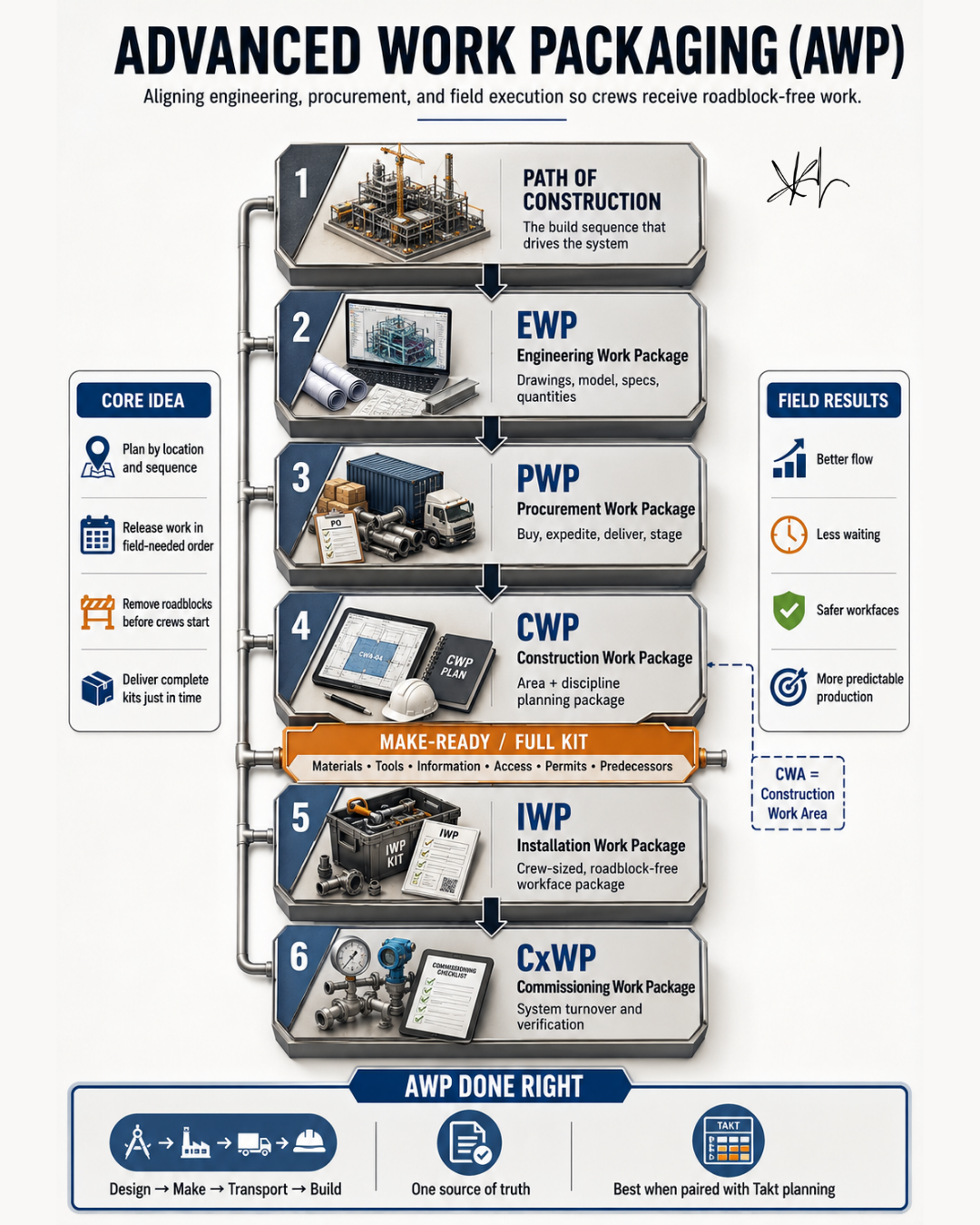
Advanced work packaging breaks a project into four connected layers, and understanding how they relate to each other is the whole key to sizing them correctly.

At the far end sits the engineering work package, which handles the design and engineering for a piece of scope. Before that scope can be built, it needs a procurement work package, which handles everything related to sourcing and delivering the materials and equipment involved. Once design and procurement are aligned, you get a construction work package, the actual chunk of physical work being planned and executed. And the construction work package gets sliced further into installation work packages, smaller pieces broken out by discipline, which in Takt planning terms is simply the task or Takt wagon moving through a zone.

The order matters because a mistake made at the construction work package level ripples through the installation work packages beneath it, and there is no fixing that downstream once the structure has been locked in.

Sizing a Construction Work Package the Right Way

Here is the sizing principle that most advanced work packaging literature never states clearly enough. A construction work package should be sized the same way you would size a phase in Takt planning, around a train of trades moving through its own unique set of zones.

Superstructure is a good example. The superstructure phase has its own zones and its own train of trades flowing through them, separate from anything else happening on the project. The interiors of a building are the same. All of the interior work has its own train tracks, its own zones, and its own sequence of trades. Each of those is a distinct phase, and each phase is what should define a construction work package. Once you have that phase correctly bounded, breaking it into installation work packages by discipline, fire sprinkler, priority walls, overhead mechanical, and so on, fits naturally into the progression of work through those zones.

That is the correct method. Size the construction work package around a real phase with real zones, not around whatever chunk of the building happens to be convenient to draw a boundary around.

Where Real Projects Go Wrong

Here is what actually happens on a lot of data center and industrial projects. Instead of sizing construction work packages around phases and zones, the entire building gets batched into one massive chunk. A small admin office area might get treated as its own package, while an enormous open area gets lumped into a single, undifferentiated construction work package with no internal zoning at all.

Once that structure gets built into a CPM schedule, and pairing advanced work packaging with CPM compounds the problem badly, the result is a completely unleveled plan. On one project like this, the time lost to improper breakdown ran into literal months, not weeks, purely because the construction work packages were sized wrong from the start.

Watch for these signs your advanced work packaging structure has already gone wrong:

  • A construction work package covering an entire building or an entire large open area with no internal zoning
  • Installation work packages that do not correspond to any recognizable train of trades moving through defined zones
  • No mechanism to adjust the work breakdown structure once it has been set in the scheduling software

Any one of these is a sign the schedule is about to waste months it did not need to lose.

The Real Problem: No Room to Optimize

Here is what makes this worse than a normal CPM problem. Once a general contractor builds the work breakdown structure in scheduling software like P6, both the GC and every trade partner are locked into following it exactly as drawn. There is no room left to optimize.

That is a genuinely dangerous trap, because with a standard CPM schedule alone, teams are at least often willing to run a pull plan and adjust zone sizes afterward to fix an unleveled sequence. Advanced work packaging, done wrong, removes even that option. The structure has already been decided, and everyone downstream has to live inside it whether it makes sense or not. In other words, advanced work packaging is not neutral. Done poorly, it does not just fail to help. It actively makes an unleveled schedule harder to fix than it would have been without it.

What Fixing This Actually Looks Like

The fix is not complicated in concept, even though it takes real discipline to execute. Optimize each phase using a proper Takt calculator, get the zoning genuinely right, and only then build the construction work packages from that leveled foundation. Done this way, a project can realistically gain back four to five months compared to the unleveled version, without changing a single thing about the actual scope of work.

That gain does not come from working faster or cutting corners. It comes entirely from sizing the work correctly the first time, so trades flow through zones evenly instead of colliding in an oversized package or sitting idle waiting for an undersized one. Queueing principles like Little’s Law and Kingman’s formula explain why this matters mathematically: uneven batch sizes and unleveled work in process reliably produce longer wait times and worse throughput, no matter how skilled the people executing the work happen to be. Ignore that math and you are fighting queueing theory itself, not just a scheduling preference.

Why This Deserves Attention Before You Lock In a Structure

None of this is really about scheduling software or a specific book on advanced work packaging. It is about protecting real project time, real trade partner relationships, and real budget from a structural mistake that becomes almost impossible to reverse once it is set.

A general contractor and trade partner both lose when a construction work package traps them inside an unleveled batch with no room to pull plan their way out of it. The fix has to happen before the work breakdown structure gets built into the scheduling software, because after that point, everyone is simply living inside whatever was decided, whether it reflects real zones and real flow or not.

If your project needs superintendent coaching, project support, or leadership development, Elevate Construction can help your field teams size construction work packages around real phases and real zones before they ever get locked into a rigid structure. Getting this right before the schedule freezes is worth months of recovered time later.

So here is the challenge. If you have a project heading toward advanced work packaging, or one already partway through it, check whether your construction work packages were sized around actual zones and a real train of trades, or around a convenient chunk of the building. If it is the latter, raise that now, while there is still room to correct it, rather than after the structure has been built into the schedule and everyone is locked in.

Jason Schroeder said it plainly: “Advanced work packaging isn’t helping. It is actually making this worse.” Get the zoning right before you lock the structure, and the same tool becomes an asset instead of a trap.

On we go.

FAQ

What is the difference between a construction work package and an installation work package?
A construction work package is the larger chunk of physical work tied to a specific phase, such as superstructure or interiors, defined by its own train of trades moving through its own zones. An installation work package is a smaller slice of that construction work package broken out by discipline, like fire sprinkler or overhead mechanical, which corresponds to a task or Takt wagon moving through those same zones.

Why is pairing advanced work packaging with a traditional CPM schedule especially risky?
Because a CPM schedule alone at least leaves room for a team to run a pull plan and adjust zone sizes after the fact if the sequence turns out unleveled. Advanced work packaging locks the general contractor and trade partners into the work breakdown structure once it is built into the scheduling software, removing that flexibility entirely. If the packages were sized wrong from the start, there is no later opportunity to fix it through a pull plan.

How much schedule time can be lost from improperly sized construction work packages?
On real industrial and data center projects, improperly batched construction work packages have caused delays measured in literal months rather than weeks. Correctly sizing those packages around real phases and Takt calculated zones has, in comparable cases, recovered four to five months of schedule without changing the underlying scope of work at all.

If you want to learn more we have:

-Takt Virtual Training: (Click here)
-Check out our Youtube channel for more info: (Click here) 
-Listen to the Elevate Construction podcast: (Click here) 
-Check out our training programs and certifications: (Click here)
-The Takt Book: (Click here)

Discover Jason’s Expertise:

Meet Jason Schroeder, the driving force behind Elevate Construction IST. As the company’s owner and principal consultant, he’s dedicated to taking construction to new heights. With a wealth of industry experience, he’s crafted the Field Engineer Boot Camp and Superintendent Boot Camp – intensive training programs engineered to cultivate top-tier leaders capable of steering their teams towards success. Jason’s vision? To expand his training initiatives across the nation, empowering construction firms to soar to unprecedented levels of excellence.
Professional A-Holes in Construction

Read 15 min

The Professional Toxicity Problem: Why Polish Is Not the Same as Respect

Here’s the deal. Some of the most damaging leaders in construction never raise their voice, never miss a deadline on paperwork, and never say a word out of place in a meeting. They are polished, buttoned up, and dressed to the nine. And they can still be the most toxic person on the project.

We have trained ourselves to equate professionalism with safety, as if a calm voice and a clean suit automatically mean the person is treating people well. It does not work that way, and field leaders need to know the difference.

The Leader Who Never Curses and Still Scares Everyone

Picture the corporate figure everybody in construction has met at least once. Immaculately dressed, perfectly composed, never a harsh word out of place. This person can walk into a room, say almost nothing, and leave everyone in it a little smaller than they were before. The intimidation is not loud. It is a stare, a tone, a way of looking down at the people who are actually trying to progress, learn, and grow in the company.

That is the pattern worth naming. Not the individual, the pattern. Because this style of leadership shows up on plenty of jobsites, and it is easy to miss if you are only watching for the obvious signs of a bad boss, yelling, cursing, visible anger. The quiet version does just as much damage, sometimes more, because it hides behind a surface that looks like exactly what our industry has been trained to reward.

Classical Business Management in a Nice Suit

Underneath the polish, this leadership style runs on a very specific order of priorities. Money first. Control of people second. Protection of the internal leadership team third. That is classical business management, and it does not need a single cuss word to be genuinely harmful, because the harm is not in the language. It is in the priorities.

A leader operating on that order treats people as instruments for hitting numbers rather than as the actual value creators on the project. Every interaction becomes a subtle test of who holds power. Contracts get used as leverage instead of agreements. Disagreement gets treated as a threat to manage rather than information worth hearing. None of that requires a raised voice. Composure is not the same thing as care, and a person can be completely professional in manner while being completely toxic in effect.

Watch for these signs of professional toxicity, because they rarely announce themselves the way an angry outburst does:

  • People leaving a conversation with that leader feeling smaller, not clearer
  • Disagreement quietly disappearing from meetings instead of being worked through
  • Contracts, policy, or process used as a weapon rather than a shared reference point

Any one of these, present consistently, is worth taking seriously, no matter how composed the person delivering it appears.

Why We Keep Getting Fooled By This

Part of the reason this pattern survives is that we have trained ourselves to look for the wrong signal. We watch for cursing, sloppiness, and visible anger as the warning signs of a bad leader, and we treat their absence as evidence that everything is fine. That is backwards. A calm, well dressed, perfectly professional exterior tells you almost nothing about whether that person actually respects the people in front of them.

Meanwhile, plenty of genuinely good leaders in the field are direct, a little rough around the edges, occasionally colorful in their language, and completely devoted to the people they lead. If we judge leadership on polish alone, we will consistently overrate the wrong people and underrate the right ones. Psychological safety, honest disagreement, and real respect for craft are the actual measures. Everything else is decoration.

What Real Leadership Looks Like Instead

The alternative is not simply the opposite of polish, roughness for its own sake. It is a different order of priorities entirely. People first. Then the process that supports them. Then the business results, which follow naturally when the first two are genuinely in place.

A leader operating from that order treats disagreement as useful information rather than a threat. A leader like that can hold a firm standard, the same firm standard we have talked about elsewhere, on cleanliness, safety, and organization, without needing intimidation to enforce it, because the standard is being held with respect rather than as a display of power. The measure is not how composed someone looks in a meeting. It is whether the people who report to them feel safe enough to tell the truth, disagree honestly, and bring a problem forward the moment they see one.

Why This Matters More in Construction Than Almost Anywhere Else

Construction runs on total participation. We have talked before about how one person, one crew, or one step not participating can bring an entire system to zero. A leader who quietly makes people feel small, intimidated, or unsafe is actively working against that participation every single day, even while appearing completely professional in the process.

Craft workers deserve leaders who make it safer to speak up, not harder. Foremen deserve leaders who treat disagreement as useful rather than dangerous. When a project is being run by someone whose polish is covering for a genuinely toxic set of priorities, the cost shows up exactly where it always does. Problems get hidden instead of surfaced. People stop raising issues early. Rework climbs. Turnover climbs. And none of it gets traced back to the actual cause, because the person responsible never raised their voice once.

If your project needs superintendent coaching, project support, or leadership development, Elevate Construction can help your field teams build leadership that holds a real standard without relying on intimidation to do it. The goal is never permissiveness on one end or fear on the other. It is confident, respectful leadership that makes people safer to speak up, not smaller.

So here is the challenge for this week. Think about the leaders on your project, at every level, and set polish aside entirely. Ask instead whether people leave conversations with them feeling more capable or less. Ask whether disagreement actually gets heard or quietly disappears. That is the real test, and it has nothing to do with how sharp anyone’s suit is.

Jason Schroeder said it plainly: “The first thing you’ll notice is that they’re completely put together. The second thing you’ll notice is that they’re completely toxic.” Do not let the first observation stop you from making the second one.

On we go.

FAQ

How is professional toxicity different from someone simply being reserved or formal?

Being reserved or formal is just a communication style, and plenty of reserved leaders are genuinely respectful and safe to work for. Professional toxicity is defined by the effect on the people around the leader, not the style itself. The test is whether people leave interactions feeling smaller, whether disagreement disappears instead of getting addressed, and whether policy or contracts get used as leverage rather than shared reference points.

Why does this pattern survive so easily in construction and other industries?
Because most organizations watch for the visible signs of bad leadership, like yelling, cursing, or visible anger, and treat their absence as proof that a leader is fine. That habit lets a calm, polished, intimidating leadership style go unchecked for years, since it never trips the alarm most people are actually watching for.

Can a leader hold a firm standard without becoming this kind of toxic figure?
Yes, and the difference lies entirely in the posture behind the standard. A leader can insist on cleanliness, safety, and quality with total consistency while genuinely respecting the people they are holding to that standard. The toxic version uses the standard as a tool for intimidation and control. The healthy version uses it as a shared commitment the whole team believes in together.

If you want to learn more we have:

-Takt Virtual Training: (Click here)
-Check out our Youtube channel for more info: (Click here) 
-Listen to the Elevate Construction podcast: (Click here) 
-Check out our training programs and certifications: (Click here)
-The Takt Book: (Click here)

Discover Jason’s Expertise:

Meet Jason Schroeder, the driving force behind Elevate Construction IST. As the company’s owner and principal consultant, he’s dedicated to taking construction to new heights. With a wealth of industry experience, he’s crafted the Field Engineer Boot Camp and Superintendent Boot Camp – intensive training programs engineered to cultivate top-tier leaders capable of steering their teams towards success. Jason’s vision? To expand his training initiatives across the nation, empowering construction firms to soar to unprecedented levels of excellence.
Engineering Guide To Temporary Construction Fence Standards

Read 24 min

Engineering Guide to Temporary Construction Fence Standards: Why Your Fence Line Is a Leadership Signal

Temporary does not mean negligent.

Here is the deal. The construction fence is the most publicly visible element on any project and the one that gets the least leadership attention. It is the first thing the public sees. It is the first thing an inspector sees. It is the first thing a pedestrian walking past your project at seven in the morning with a stroller sees. And what they see tells them exactly what kind of project this is before they ever meet the superintendent, review the schedule, or hear a single word about the team’s commitment to quality.

A taut screen, level posts, clean sidewalk access, and proper bracing communicates that this project is run by people who care about the details that nobody is watching. A loose screen blowing into pedestrian space, bent post tops leaning over the sidewalk, and scattered base supports communicates that nobody is watching at all.

The Pain That Walks Past Your Site Every Day

Every active construction project in an urban or suburban setting has a public interface. That interface is the fence line, and the condition of that fence line is producing a continuous, uncontrolled message about the project to every person who passes it.

A pedestrian who has to step around a sandbag that has shifted into the sidewalk is receiving a message. A parent who sees damaged panels and loose screen fabric blowing toward the path their child walks to school is receiving a message. A city inspector who drives past on the way to another project and notices bent post tops and missing braces is receiving a message. None of those messages are being sent intentionally, but all of them are being received clearly.

The problem is not that project teams do not understand this. Most superintendents know their fence should look good. The problem is that fence maintenance lives in the category of tasks that are important but never urgent, which means they get deferred in favor of whatever is urgent today. The screen that started pulling loose on Tuesday is still loose on Friday. The panel that got damaged by a delivery truck two weeks ago has not been replaced. The bracing that should have been checked after last week’s windstorm was not checked because last week’s windstorm also created three other problems that demanded immediate attention.

The fence degrades slowly, and slow degradation is the kind of problem construction leadership is worst at catching because it never announces itself as a crisis. It just gets a little worse each week until someone external, an inspector, a neighbor complaint, a project owner doing a drive-by, sees it and names it. By then, the fence has been communicating the wrong message for weeks.

The Failure Pattern

The failure pattern is treating the fence as a one-time installation rather than a maintained system.

The fence goes up during mobilization. The crew that installs it does a good job. Posts are level, screen is taut and secured on the interior face, panels are new, bracing is proper, base supports are uniformly placed. For the first two weeks, the fence looks excellent. Then the project starts. Deliveries come and go. Equipment moves along the perimeter. Weather hits. A panel gets clipped. A brace gets knocked out. The screen starts to pull free at one attachment point, then two, then a full section is loose and catching wind.

Nobody is assigned to the fence. That is the system failure. The fence is not on a maintenance schedule. It is not part of a daily or weekly walk with documented standards. It is not anyone’s specific responsibility after installation. It belongs to everyone in theory, which means it belongs to no one in practice. The degradation is incremental and distributed across dozens of small events, none of which individually feel like a problem worth stopping the day for.

By the time the fence is visibly non-compliant, the gap between the current condition and the standard has grown so large that fixing it feels like a project rather than a maintenance task. And a maintenance task that has grown into a project gets deferred even further because now it requires planning, material, and labor that have to be pulled from the real work.

They Didn’t Fail the System

When a project’s fence line looks bad, the instinct is to find someone to hold accountable. Who was supposed to be watching the fence? Why didn’t the foreman catch this? Why didn’t anyone report it?

The answer is usually that nobody was watching the fence because the system never assigned anyone to watch it. The foreman didn’t catch it because the foreman has eighty things competing for attention and the fence was not on the daily checklist. Nobody reported it because slow degradation does not produce a report-worthy event on any single day. It produces a hundred small events, each one below the threshold of attention, that accumulate into a visible failure over weeks.

The person is not the problem. The absence of a maintenance system is the problem. Build the system and the fence stays compliant. Leave the system absent and blame the person when it fails, and the fence will fail again on the next project exactly the same way.

What Compliant Actually Looks Like

The difference between a compliant fence setup and a non-compliant one is not ambiguous. It is specific, observable, and binary at every checkpoint.

Uniformly level post tops mean that the top line of the fence reads as straight and intentional from any viewing angle. Bent or uneven post tops create a visual signal of neglect and, more practically, reduce the structural integrity of the panel connections. A post that has been bent by contact with equipment is a post that is no longer carrying its share of the wind load, which means the adjacent panels are carrying more, which means they will fail sooner.

Screen secured tautly on the interior face is a safety specification, not an aesthetic preference. Screen mounted on the exterior catches wind and acts as a sail, pulling away from the fence and extending into pedestrian space. Screen mounted on the interior is pressed against the panels by wind rather than pulled away from them. That single installation decision, interior versus exterior, is the difference between a screen that stays put in wind and one that becomes a sidewalk hazard.

New, undamaged panels maintain the structural envelope of the fence and the visual standard of the project. A damaged panel is a weak point in the perimeter and a visual signal that the project tolerates degradation. Proper internal bracing keeps the fence stable under wind load and prevents the slow lean that eventually puts a post over pedestrian space. Clean, unobstructed sidewalk access is both a compliance requirement and a basic obligation to the public using the space adjacent to your project. Uniformly placed base supports distribute the load and prevent the shifting that leads to panels separating and opening gaps in the perimeter.

Each of those elements is a system input. When all six are maintained, the fence performs its function and communicates a standard. When any one of them degrades, the system starts to fail and the public sees it before the project does.

Why the Fence Is a Leadership Signal

The fence matters beyond compliance for a reason that most project leaders understand intuitively but rarely act on deliberately.

Standards are contagious. A project where the perimeter is clean, the fence is taut, the sidewalk is clear, and the base supports are uniform is a project that communicates a standard before anyone walks through the gate. Every trade partner arriving on site that morning receives the signal: this is a project where the details are maintained. That signal influences how they set up their work area, how they leave their zone at the end of the day, how they treat shared spaces, and how seriously they take the standards that the superintendent communicates in the morning meeting.

The reverse is equally true. A fence line with loose screen, bent posts, and obstructed sidewalks communicates that the standard here is flexible. That message does not stay at the perimeter. It migrates inward. The laydown yard gets a little less organized. The gang box gets a little less maintained. The zone handoffs get a little less clean. The tolerance for degradation that started at the fence line eventually touches the work itself, and by then it is a culture problem rather than a maintenance problem.

This is why the fence is a leadership system and not a facilities task. The condition of the perimeter is a statement about the project’s relationship with standards, and that statement is being read every day by every person who enters the site and every member of the public who walks past it.

Building a Fence Maintenance System

A compliant fence line does not maintain itself, and hoping someone will notice problems is not a system. The system needs three components to work.

First, the fence needs to be on a scheduled inspection cadence. Weekly at minimum, more frequently during weather events or periods of heavy delivery and equipment activity along the perimeter. The inspection is a walk of the full perimeter checking each of the six compliance points: post level, screen attachment and tension, panel condition, bracing integrity, sidewalk clearance, and base support placement. That walk takes fifteen to twenty minutes and prevents the slow degradation that turns a compliant fence into a liability.

Second, the inspection needs an owner. One person, with the authority to order replacement panels and the expectation that deficiencies found during the walk will be corrected within twenty-four hours. Shared responsibility for the fence is no responsibility for the fence.

Third, replacement materials need to be on site. A project that has to order a replacement panel and wait three days for delivery is a project that will run non-compliant for three days while the order processes. Having two or three spare panels, a roll of screen material, and replacement hardware staged on site means that any deficiency found during the walk can be corrected the same day.

Signals Your Fence System Needs Attention

Walk your perimeter today and look for these patterns:

  • Screen fabric that is loose, pulling away from attachment points, or mounted on the exterior face rather than the interior
  • Post tops that are no longer uniformly level, indicating equipment contact or wind damage that was not corrected
  • Panels with visible damage, holes, or separation at connection points
  • Base supports that have shifted, creating gaps between panels or allowing posts to lean
  • Any sidewalk obstruction, including shifted sandbags, scattered materials, or screen fabric extending into the pedestrian path

Each of those findings is a same-day correction, not a discussion item. The cost of fixing any one of them is measured in minutes. The cost of leaving them is measured in the message they send every hour to every person who passes your project.

The Standard Starts at the Property Line

Your project’s relationship with quality is visible before anyone walks through the gate. The fence line is the first page of the story the project is telling, and it is being read by the public, by inspectors, by trade partners arriving for their first day, and by the project owner driving past on a weekend.

That first page is yours to write. Make it clean, make it level, make it compliant, and make it maintained. The discipline that holds the perimeter standard is the same discipline that holds the schedule, the safety program, and the quality standard on the work itself. If your project needs superintendent coaching, project support, or leadership development, Elevate Construction can help your field teams stabilize, schedule, and flow. Jason Schroeder and the LeanTakt team teach that standards start at the smallest, most visible detail and scale inward from there, because the detail is the culture.

Here is your challenge. Walk your fence line this afternoon. Not tomorrow. Not after the next meeting. Today. Walk every linear foot of it with the six compliance points in mind. Fix what you find, assign what you cannot fix today, and schedule the walk as a weekly event that does not get skipped.

Edwards Deming said: “Quality is everyone’s responsibility.” Start at the fence line and let the quality work its way in. The public is already watching.

On we go.

FAQ

Why does it matter whether the screen is mounted on the interior or exterior face?
Screen mounted on the exterior catches wind and acts as a sail, pulling away from the fence and extending into pedestrian space. Screen mounted on the interior is pressed against the panels by wind rather than pulled away from them. The interior mounting is structurally more stable under wind load and eliminates the hazard of loose fabric blowing into the sidewalk. It is a safety specification, not a preference.

How often should the fence line be inspected?
Weekly at minimum during normal conditions, and additionally after any weather event with significant wind, after heavy delivery or equipment activity along the perimeter, and after any reported damage. The inspection is a full perimeter walk checking post level, screen condition, panel integrity, bracing, sidewalk clearance, and base supports. It takes fifteen to twenty minutes and prevents the slow degradation that makes fence problems invisible until they are severe.

Who should be responsible for fence maintenance?
One specific person with the authority to correct deficiencies and order replacement materials. Shared responsibility produces no responsibility. The assigned person does not need to make every repair personally, but they need to own the inspection cadence, the standard, and the follow-through on corrections.

If you want to learn more we have:

-Takt Virtual Training: (Click here)
-Check out our Youtube channel for more info: (Click here) 
-Listen to the Elevate Construction podcast: (Click here) 
-Check out our training programs and certifications: (Click here)
-The Takt Book: (Click here)

Discover Jason’s Expertise:

Meet Jason Schroeder, the driving force behind Elevate Construction IST. As the company’s owner and principal consultant, he’s dedicated to taking construction to new heights. With a wealth of industry experience, he’s crafted the Field Engineer Boot Camp and Superintendent Boot Camp – intensive training programs engineered to cultivate top-tier leaders capable of steering their teams towards success. Jason’s vision? To expand his training initiatives across the nation, empowering construction firms to soar to unprecedented levels of excellence.
The Advanced Japanese Toilet System

Read 22 min

The Advanced Japanese Toilet System: What Obsessive Design Teaches Construction About the Friction Nobody Reports

A modern Japanese toilet has more thoughtful design than most construction trailers, most field offices, and most project management systems combined.

Eleven distinct features. Each one solves a small problem most people never thought to articulate. A sensor-activated lid so nobody touches the surface. A heated seat with adjustable temperature. A pre-mist that coats the bowl before use so waste does not adhere. A self-cleaning nozzle that cleans itself before and after every cycle. An adjustable bidet wand for personalized hygiene. A warm air dryer so paper becomes unnecessary. Power-saving modes that optimize water and electricity automatically. An activated-carbon deodorizer. A dual-flush system with smart sensors. And a wireless remote that controls every function from a wall-mounted panel. Here is the deal. Nobody asked for most of those features. Nobody filed a complaint about the problems they solve. The designers found the friction by watching, not by waiting for someone to report it.

The Pain That Stopped Being Pain

Every industry has friction so familiar that people stop experiencing it as friction. They absorb it. They work around it. They develop habits that accommodate it. And eventually they forget there was ever a problem at all, because the workaround became the process and the process became invisible.

In construction, these invisible frictions are everywhere. The tool crib that requires a ten-minute walk and a conversation with someone who may or may not be there. The drawing set that is one revision behind because nobody walked the new set to the field. The material staged two zones away from where the work is happening because the laydown plan was drawn during mobilization and never updated. The daily report that gets filled out from memory at four in the afternoon because there is no system for capturing information at the point of work.

Nobody complains about these things anymore. That is not because they stopped being problems. It is because the people experiencing them got good enough at absorbing the cost that the cost became invisible to everyone upstream. The foreman does not report that the tool crib walk takes ten minutes because the foreman stopped timing it three months ago. The superintendent does not flag the material staging distance because the crew adapted by starting their day with a longer haul and the schedule absorbed it. The cost is real, it runs every day, and it lives in a category that no report captures: friction that was accepted rather than eliminated.

The Failure Pattern

The failure pattern is designing for the major functions and abandoning the small ones to the user.

A construction project gets real design attention on a handful of major systems. The schedule is designed. The budget is designed. The safety program is designed. The procurement process is designed. Those systems get meetings, reviews, software, and accountability structures. They are the heated seat and the automatic flush of the project, the features that are obviously important and obviously worth investing in.

Everything else gets left to the person doing the work. How the crew gets information in the morning. Where their water is. How far the walk is from parking to the work face. Whether the permit they need is findable in under sixty seconds. Whether the tool they need is staged where they need it or two hundred feet away. These are the pre-mist, the deodorizer, the self-cleaning nozzle of the project. Small, specific, high-frequency interactions that nobody designed and that compound into hours of lost capacity every single day.

The Japanese toilet refuses to make that division. It treats every moment of contact between the person and the product as worthy of design. That refusal is what makes it remarkable, and that refusal is what construction leadership needs to learn.

They Didn’t Fail the System

When a crew is slower than expected, when a foreman seems perpetually behind, when the schedule slips by small amounts that nobody can explain with a single cause, the diagnosis usually lands on the people. They need to move faster. They need better time management. They need more urgency.

That diagnosis misses the actual mechanism. A crew absorbing fifteen small frictions a day is a crew that has lost an hour of capacity before the first real problem even surfaces. They are not slow. They are navigating a system that never cleared the path for them. Every unnecessary walk, every search for a document, every wait for an answer, every material haul from the wrong staging area is a withdrawal from that crew’s productive capacity. The person looks slow because the system consumed their speed before they got to the work.

The Japanese toilet understood this at the product level. It did not assume the user would figure out cleanliness, odor management, and hygiene on their own. It watched the complete experience and built a response for every friction point. Construction projects need to make the same decision about the complete crew experience, and most have not made it yet.

What Eleven Features Teach About System Design

The lesson of the Japanese toilet is not about any individual feature. It is about completeness.

A single feature, the heated seat, is a nice addition. Two features together, the heated seat and the bidet, start to feel like a system. By the time you reach eleven features, each one addressing a specific friction in the user experience, you are looking at something qualitatively different from a product with upgrades. You are looking at a product where someone refused to stop watching until every friction was addressed.

That completeness produces an experience where the user never encounters a problem the system has not already handled. They do not need to think about hygiene because the self-cleaning nozzle handles it. They do not need to worry about odor because the activated-carbon deodorizer handles it. They do not need to manage flushing because the smart sensors handle it. The cognitive load of the experience approaches zero because every decision that could be made by the system was moved out of the user’s hands.

Apply that principle to a construction crew’s daily experience and ask yourself how close your project comes. How many decisions is the crew making that the system should have already made for them? How many walks are they taking that a better staging plan would have eliminated? How many searches for information are they running that a better communication system would have prevented? Each gap between the Japanese toilet standard and your project’s current state is a feature your system is missing, and your crew is absorbing the cost of every missing feature, every day.

The Pre-Mist as a Construction Principle

The pre-mist feature deserves specific attention because it captures a design principle that transfers directly.

Before the toilet is used, a fine mist of water coats the bowl surface. This prevents waste from adhering, which means the flush cycle is more effective and the bowl stays cleaner with less water and less effort. The feature is preventive. It addresses the problem before the problem exists. The user does not know it is happening. They just notice that the experience is cleaner than they expected.

In construction, this is make-ready planning. It is constraint removal before the crew arrives. It is kitting materials to the point of use before the trade enters the zone. It is clearing the work face before the Takt clock starts. Every one of those practices changes the conditions ahead of the work so the work flows clean rather than fighting friction that should have been eliminated upstream.

Projects that run make-ready planning well are projects where crews describe the work as smooth. Projects that skip it are projects where every day feels like a fight, where recovery is more common than execution, and where the people doing the work absorb the cost of upstream failures they had no part in creating. The pre-mist takes fifteen seconds and prevents hours of cleaning. Make-ready planning takes hours and prevents weeks of recovery. Same principle at a different scale.

Signals Your Project Has Unaddressed Friction

Go walk one complete crew experience from arrival to the work face and watch for these patterns:

  • A resource positioned for setup convenience rather than for the person who uses it forty times a day
  • A workaround so established that new hires learn it during onboarding as though it were the real process
  • Information that requires a person to go find it rather than having it arrive where and when it is needed
  • A task that takes more steps than it logically should, where the extra steps have become invisible to the people performing them
  • A small annoyance that everyone can name but nobody has proposed fixing because it feels too minor to escalate

Each one of those is a missing feature. Each one is running a cost that nobody is tracking.

Why the Small Frictions Cost the Most

The instinct in construction leadership is to focus attention on the large, named problems. The schedule recovery. The budget overrun. The safety incident. Those are real and they deserve real attention. But they are also visible, tracked, and assigned. Someone is working on them.

The small frictions are not assigned to anyone. They persist for the entire duration of the project, quietly consuming capacity from every person who encounters them. A two-minute friction that hits thirty people twice a day is two hours of lost capacity every day for the life of the project. That is worse than most items on the constraint log, and it will never appear on the constraint log because nobody named it.

Lean construction teaches exactly this discipline. Takt planning makes flow visible. Workface planning clears constraints before crews arrive. Kitting, point-of-use storage, and zone control position resources where the work happens rather than where they are convenient to store. If your project needs superintendent coaching, project support, or leadership development, Elevate Construction can help your field teams stabilize, schedule, and flow. Jason Schroeder and the LeanTakt team bring the discipline of seeing friction that everyone else has accepted and eliminating it systematically, which is the discipline that makes the difference between a project that functions and a project that flows.

Go Count What Nobody Counts

Here is your challenge. This week, walk one crew’s complete experience from their truck to the work face and back again. Do not fix anything. Just count. Count every unnecessary step, every search, every wait, every workaround. Write the number down and multiply it by the number of days remaining on the project.

That number is the cost of friction your project has been absorbing since mobilization. Now that you can see it, you can design for it. That is all the Japanese toilet did. Someone watched, counted, and refused to stop until every friction had a solution.

Epictetus wrote: “First say to yourself what you would be, and then do what you have to do.” The project you would be is one where no crew member fights a friction the system should have already solved. Go build that project, one missing feature at a time.

On we go.

FAQ

How does a Japanese toilet relate to construction management?
The connection is the design philosophy, not the product. The Japanese toilet demonstrates what happens when someone watches the complete user experience and eliminates every small friction systematically rather than designing for the major functions and abandoning the rest. That same discipline applied to a construction crew’s daily experience is what separates projects that flow from projects that grind through every day.

What is the pre-mist principle in practical construction terms?
It is preventive design applied before the work begins. Make-ready planning, constraint removal, kitting, and point-of-use material staging are all pre-mist equivalents. They change the conditions ahead of the crew so the work encounters clean surfaces rather than friction that should have been cleared upstream. The investment is small. The downstream cost it prevents is large.

How do you find friction that people have stopped seeing?
Walk the experience yourself with fresh eyes and count everything that requires extra effort, extra steps, or extra time. The other reliable method is to ask a new hire what surprised them in their first week. People who have not yet adapted to the friction can still see it clearly. Once someone has been on the project for three months, the adaptation has set in and the friction becomes invisible to them.

If you want to learn more we have:

-Takt Virtual Training: (Click here)
-Check out our Youtube channel for more info: (Click here) 
-Listen to the Elevate Construction podcast: (Click here) 
-Check out our training programs and certifications: (Click here)
-The Takt Book: (Click here)

Discover Jason’s Expertise:

Meet Jason Schroeder, the driving force behind Elevate Construction IST. As the company’s owner and principal consultant, he’s dedicated to taking construction to new heights. With a wealth of industry experience, he’s crafted the Field Engineer Boot Camp and Superintendent Boot Camp – intensive training programs engineered to cultivate top-tier leaders capable of steering their teams towards success. Jason’s vision? To expand his training initiatives across the nation, empowering construction firms to soar to unprecedented levels of excellence.

Why Do Trade Partners Stop Trusting General Contractors?

Read 16 min

Why Trade Partners Stop Trusting General Contractors

Here’s the deal. I love general contractors. I work for general contractors, I support general contractors, and I want them to win. And I am going to say something that will land hard anyway, because it needs to be said. Most GCs, even the big, well known ones, no longer know how to do the actual job that trust with trade partners depends on.

That job is simple to describe and hard to execute. Keep a remarkable environment. Keep every trade on a shared rhythm. Make sure information, materials, and payment actually reach the people who need them, on time, every time. Most GCs have quietly stopped doing that, and then act surprised when trust with their trade partners has eroded.

What the Job Actually Requires

A general contractor exists to create the conditions trades need to succeed. That means a jobsite that is organized and safe. It means a schedule with real rhythm, not chaos dressed up as urgency. It means the three resources every trade genuinely depends on arriving reliably: accurate information, available materials, and payment on time.

None of that is complicated to describe. It is a fundamentally supportive role, and when it is done well, trades show up, do excellent work, and want to come back for the next project. When it is not done well, the entire relationship starts from a place of suspicion instead of partnership, no matter how good the individual people involved might be.

What Has Actually Been Happening Instead

Here is the pattern I see repeating across projects, and it is not subtle once you name it. Trades get badmouthed behind closed doors. They get criticized publicly and run down in meetings where they are not present to respond. Payment gets delayed past when it was earned. Cure notices get issued as a default management tool instead of a genuine last resort. Credit for a well finished job goes to the GC’s own marketing, with no mention of the trade partners who actually built it.

Then, when the schedule slips, the question that gets asked is why the trade is not done yet. Nobody stops to ask whether the trade was actually given a system capable of letting them finish on time in the first place.

Watch for these as signs a GC has slipped into this pattern, whether intentionally or not:

  • Trade partners criticized in meetings they are not present to respond to
  • Payment consistently late relative to what the contract and completed work actually earned
  • Credit for finished work going entirely to the GC with no acknowledgment of the trades who built it

Any one of these erodes trust. All three together destroy it.

Nearly Everything That Goes Wrong Is the GC’s Responsibility

I want to be precise about this, because it is a strong claim and I mean it precisely. Assuming a supportive owner and a reasonably fair contract, nearly everything that goes wrong on a construction project traces back to the general contractor. Not most things. Nearly everything.

There are really only two things I would ever put on a trade partner. Either they do not participate, meaning they do not show up, engage, or follow through on what they committed to. Or they ask for more space than the project can reasonably give them. That is the complete list. Everything else, delays, quality problems, coordination failures, is the trade doing their honest best inside a system the GC built, and if that system did not set them up to succeed, the failure belongs to whoever built the system, not to the people trying to work inside it.

Failing Despite Their Best Efforts

Edwards Deming put it plainly: “A bad system will beat a good person every time.” That is exactly what is happening on a huge number of jobsites right now. Trade partners are genuinely trying, genuinely skilled, and genuinely failing, not because they lack competence or effort, but because the system around them, the schedule, the information flow, the payment cadence, the basic respect, was never built to let them succeed.

That distinction matters enormously, because it changes where the fix belongs. If you believe trades are failing because they are lazy or careless, you respond with more pressure, more cure notices, more criticism. If you recognize trades are failing despite real effort inside a broken system, you respond by fixing the system, which is the only response that actually works.

Why Trust Has Declined So Broadly

The honest reason a lot of trade partners no longer trust general contractors is not personal animosity. Most GCs are genuinely good people, and I say that without reservation. The problem is that the majority of general contractors, as an industry pattern, have become incompetent at the specific job that earns trust: creating an environment where trades can actually do their best work and be treated with basic respect while doing it.

That gap between good intentions and actual system competence is where trust dies. A trade partner does not need a GC to be perfect. They need a GC who pays on time, communicates clearly, protects their working conditions, and gives credit where it belongs. When those basics slip industry wide, trust erodes industry wide, and every individual GC, even the genuinely good ones, inherits the suspicion built up by the pattern as a whole.

What Rebuilding This Actually Requires

None of this is really about defending trades or attacking GCs. It is about naming a system failure clearly enough that it can actually be fixed, because vague guilt never changes behavior and specific accountability does.

A GC that wants to rebuild trust starts by treating the three resources, information, materials, and payment, as non negotiable commitments rather than variables that flex under pressure. It means removing the habit of criticizing trades in rooms they cannot respond in, and replacing cure notices as a default tool with genuine problem solving conversations first. It means giving credit publicly to the trades who actually built the work, consistently, not occasionally. And it means asking, before ever asking why a trade is not done, whether that trade was actually given a real system to succeed inside.

If your project needs superintendent coaching, project support, or leadership development, Elevate Construction can help general contractors build the kind of environment, rhythm, and resource flow that earns trust back, because that trust is not restored through better marketing. It is restored through a system that actually works the way it is supposed to for the people doing the physical work.

So here is the challenge. Look at your last project and ask honestly whether information, materials, and payment reached your trade partners reliably and on time. Ask whether any trade got criticized in a room they were not part of. Ask whether the credit for a job well done included the people who actually built it. Wherever the honest answer is uncomfortable, that is exactly where the system needs to be rebuilt.

Jason Schroeder said it plainly, echoing Deming: “A bad system will beat a good person every time.” Trade partners are not failing you. The system around them is failing them, and that system is yours to fix.

On we go.

FAQ

If a trade partner misses a deadline, how do you know whether it is their fault or the GC’s system?
Start by checking whether the trade actually received what they needed to succeed: accurate information on time, materials available when scheduled, and space in the zone that matched what was reasonably promised. If those were all genuinely in place and the trade still did not participate or engage, that is a legitimate trade issue. If any of those three were missing or unreliable, the responsibility sits with the system the GC built, not with the trade trying to work inside it.

Why does the article say only two things can be blamed on trade partners?
Because outside of a trade failing to participate or asking for more space than a project can reasonably provide, nearly every other failure traces back to conditions the general contractor controls, such as information flow, material availability, payment timing, and schedule design. Narrowing the list this tightly forces honest accountability rather than letting vague blame spread onto people who were genuinely doing their best inside a flawed system.

How does late payment specifically damage trust with trade partners?
Payment is one of the three core resources a trade depends on to keep their own crews paid, their materials ordered, and their business running. When payment consistently lags behind completed work, it signals that the GC’s commitments cannot be relied upon, which erodes the foundation trust is built on far faster than almost any other single factor, even when the actual construction relationship otherwise looks fine on paper.

If you want to learn more we have:

-Takt Virtual Training: (Click here)
-Check out our Youtube channel for more info: (Click here) 
-Listen to the Elevate Construction podcast: (Click here) 
-Check out our training programs and certifications: (Click here)
-The Takt Book: (Click here)

Discover Jason’s Expertise:

Meet Jason Schroeder, the driving force behind Elevate Construction IST. As the company’s owner and principal consultant, he’s dedicated to taking construction to new heights. With a wealth of industry experience, he’s crafted the Field Engineer Boot Camp and Superintendent Boot Camp – intensive training programs engineered to cultivate top-tier leaders capable of steering their teams towards success. Jason’s vision? To expand his training initiatives across the nation, empowering construction firms to soar to unprecedented levels of excellence.

Is Lean Construction Worth It or Is It Just Another Buzzword?

Read 17 min

Is Lean Construction Worth It, or Just a Buzzword?

Here’s the deal. Lean construction is both a buzzword and the real deal, and which one you get depends entirely on who is implementing it and why. For people willing to actually do the work, it is genuinely worth it. For people using the word to sound current, it is exactly the empty buzzword everybody suspects it is.

I have watched this pattern play out with client after client, and it is remarkably consistent. A company never does well with Lean if it does not care about people and hold high, innovative expectations at the same time. Miss either one and the whole thing collapses into talk.

The Two Ways Lean Fails Before It Starts

There are two specific failure modes worth naming, because they show up constantly and they are entirely predictable.

The first is treating Lean as a profit strategy first. Any company that adopts Lean primarily because they want to make more money will fail with it, every time. Lean built on that foundation optimizes for the wrong thing from day one, and the moment the cost savings slow down or a shortcut looks tempting, the whole system gets abandoned, because it was never really about the people or the process. It was about the number.

The second is weak leadership. If the leader will not lead the implementation themselves, personally, visibly, and consistently, Lean fails and becomes exactly the buzzword people accuse it of being. There are people in this industry who talk constantly about Lean theory, the frameworks, the terminology, and if you look at their own companies or their own lives, you find mess, waste, and disrespect. They are using the language of Lean to build a personal brand or make money off the idea, without ever actually living it. That is the gross version of this, and it is unfortunately common.

What Real Implementation Actually Looks Like

Contrast that with someone like Paul Akers, author of 2 Second Lean and one of the clearest examples of Lean actually being lived rather than just discussed. He genuinely respects people. He builds stable environments. He runs on real one piece flow, understands Takt time and bottlenecks in his own operation, and uses visual information the way it is meant to be used, not as decoration but as an actual management tool. His business is built around quality, not around talking about quality.

That kind of practitioner has what I would call a perfect, functioning home and a genuinely well run company, and has personally led thousands of people through tours in Japan to see Lean thinking up close. When someone operates at that level, something interesting happens. They reach what looks like one hundred percent of what Lean can offer, and then a whole additional two hundred percent of possibility opens up beyond that. Reach that two hundred percent, and another three hundred percent opens up past it. People who genuinely live this end up doing things that most companies cannot even imagine, because they have kept climbing past the point where everyone else stopped.

For most people talking about Lean, none of that ever happens, because it stays talk. No action behind the language.

Proof Has to Be Visible, Not Just Claimed

I am not perfect at this either, and I do not pretend to be. But at home, we are constantly working on improving how things run. In the company, we have published 360 Lean videos at last count, out of 86 produced every single week, most of which never even make it to a public platform. There is a morning huddle every day. Every process gets improved on a regular basis. There is a formal kaizen process and a formal training process, not an informal one that only happens when someone remembers to run it. At home, I am doing the same thing with my own kids, treating improvement as a genuine way of life rather than a professional performance.

When I ran a project as a superintendent, I videoed and podcasted about it the entire time, showing the bathrooms, the huddles, the cleanliness, everything, specifically because I knew someone would eventually claim I was making it up otherwise. If you have not actually implemented these things yourself, in a way other people can see and verify, you do not really know whether they work. Talk without visible proof is exactly the buzzword version of Lean people are rightly skeptical of.

Watch for these signs you are looking at the buzzword version rather than the real thing:

  • Heavy on Lean terminology, light on any visible proof of daily practice
  • A personal life or company that is messy, wasteful, or disrespectful behind the public message
  • Adoption driven primarily by cost savings rather than genuine respect for people

Lean Requires Strong Leadership to Start, Not Permission

Here is the part that surprises people. Lean was never butterflies and kittens. At the start, it requires decisive, non negotiable direction from leadership. Not permissiveness, not asking everyone whether they are comfortable with the change, not a slow consensus building process before anything actually moves. Real implementation starts with a leader who decides it is happening and leads it themselves, followed by genuine training, real buy in, and eventually a culture that carries itself forward without needing to be pushed.

Look at any authentic Lean culture you have ever encountered, whether it is the Japanese companies where a lot of this thinking originated, Paul Akers’s own operation, or Bob Chapman’s Barry-Wehmiller, the company behind his book Everybody Matters. None of them asked permission before they started. The leaders in every one of those cases were not weak, and they led from the top, decisively, at the outset.

That does not mean Lean stays top down forever. It means the launch requires firm direction, because a system built on permissiveness at the start never survives its first real test. Once the training happens and buy in is genuine, the team carries the culture forward on its own, which is the whole point. But that self sustaining phase only exists because someone was willing to lead firmly enough to get it started in the first place.

Why This Distinction Actually Matters for You

None of this is really about defending a buzzword. It is about protecting the real thing from getting drowned out by people using the language without doing the work.

If your team is skeptical of Lean or Takt because they have seen it done badly elsewhere, talked about constantly and never actually lived, that skepticism is earned, and it deserves a real answer rather than more theory. The answer is proof. Visible huddles. Documented improvement. Leadership that shows up and leads the change itself instead of delegating the hard parts and taking credit for the results.

If your project needs superintendent coaching, project support, or leadership development, Elevate Construction can help your field teams build a genuine Lean culture rather than a borrowed vocabulary, starting with leadership that is actually willing to lead the change itself. That distinction between talk and proof is the entire difference between a buzzword and a system that actually works.

So here is the challenge. Look honestly at your own implementation, whatever stage it is at. Is leadership genuinely leading this personally and visibly, or has it been handed off to a program or a consultant to run without them? Is there documented, visible proof of daily practice, huddles, kaizen, improvement, or is it mostly discussed in meetings and rarely seen in the field? Wherever the honest answer is uncertain, that is exactly where the buzzword risk is highest.

Jason Schroeder said it plainly: “Lean was never butterflies and kittens.” It takes real leadership to start, and real proof to keep it honest.

On we go.

FAQ

Why does implementing Lean primarily to cut costs tend to fail?
Because cost reduction as the primary goal optimizes the system for the wrong outcome from the very beginning. The moment savings slow down or a shortcut becomes tempting, a Lean effort built on that foundation gets abandoned, since it was never actually rooted in respect for people or genuine process improvement in the first place.

What does it mean that Lean requires strong leadership at the start rather than permission?
It means the initial rollout works best when a leader decides firmly that the change is happening and leads it personally and visibly, rather than building slow consensus or waiting for everyone to feel fully comfortable first. That firm start is followed by real training and genuine buy in, after which the team can carry the culture forward on its own. Without that decisive beginning, most Lean efforts stall before training or buy in ever really happen.

How can a team tell the difference between genuine Lean practice and buzzword usage?
Look for visible, ongoing proof rather than terminology alone. Daily huddles that actually happen, a real kaizen and training process, and leadership that documents and shows their own practice rather than only discussing theory are all signs of the genuine version. Heavy use of Lean language paired with a messy, disrespectful, or wasteful reality behind the scenes is the clearest sign of the buzzword version.

If you want to learn more we have:

-Takt Virtual Training: (Click here)
-Check out our Youtube channel for more info: (Click here) 
-Listen to the Elevate Construction podcast: (Click here) 
-Check out our training programs and certifications: (Click here)
-The Takt Book: (Click here)

Discover Jason’s Expertise:

Meet Jason Schroeder, the driving force behind Elevate Construction IST. As the company’s owner and principal consultant, he’s dedicated to taking construction to new heights. With a wealth of industry experience, he’s crafted the Field Engineer Boot Camp and Superintendent Boot Camp – intensive training programs engineered to cultivate top-tier leaders capable of steering their teams towards success. Jason’s vision? To expand his training initiatives across the nation, empowering construction firms to soar to unprecedented levels of excellence.

    Related Books

    The First Planner System: The Project Planning System for Executives, Project Managers, and Superintendents in Pre-construction - Book 2
    Pull Planning For Builders: How to Pull Plan Right, Respect People, and Gain Time (The Art of the Builder)
    The Ten Improvements to Production Planning: What Lean Builders Can Do To Improve Short Interval Planning (The Art of the Builder)

    Related Books

    The First Planner System: The Project Planning System for Executives, Project Managers, and Superintendents in Pre-construction - Book 2
    Built to Fail: Why Construction Projects Take So Long, Cost Too Much, And How to Fix It

    Related Books

    The First Planner System: The Project Planning System for Executives, Project Managers, and Superintendents in Pre-construction - Book 2
    The 10 Myths of CPM: How The Critical Path Method Systematizes Disrespect for People
    Calumet "K"

    faq

    General Training Overview

    What construction leadership training programs does LeanTakt offer?
    LeanTakt offers Superintendent/PM Boot Camps, Virtual Takt Production System® Training, Onsite Takt Simulations, and Foreman & Field Engineer Training. Each program is tailored to different leadership levels in construction.
    Who should attend LeanTakt’s training programs?
    Superintendents, Project Managers, Foremen, Field Engineers, and trade partners who want to improve planning, communication, and execution on projects.
    How do these training programs improve project performance?
    They provide proven Lean and Takt systems that reduce chaos, improve reliability, strengthen collaboration, and accelerate project delivery.
    What makes LeanTakt’s training different from other construction courses?
    Our programs are hands-on, field-tested, and focused on practical application—not just classroom theory.
    Do I need prior Lean or takt planning experience to attend?
    No. Our programs cover foundational principles before moving into advanced applications.
    How quickly can I apply what I learn on real projects?
    Most participants begin applying new skills immediately, often the same week they complete the program.
    Are these trainings designed for both office and field leaders?
    Yes. We equip both project managers and superintendents with tools that connect field and office operations.
    What industries benefit most from LeanTakt training?
    Commercial, multifamily, residential, industrial, and infrastructure projects all benefit from flow-based planning.
    Do participants receive certificates after completing training?
    Yes. Every participant receives a LeanTakt Certificate of Completion.
    Is LeanTakt training recognized in the construction industry?
    Yes. Our programs are widely respected among leading GCs, subcontractors, and construction professionals.

    Superintendent / PM Boot Camp

    What is the Superintendent & Project Manager Boot Camp?
    It’s a 5-day immersive training for superintendents and PMs to master Lean leadership, takt planning, and project flow.
    How long does the Superintendent/PM Boot Camp last?
    Five full days of hands-on training.
    What topics are covered in the Boot Camp curriculum?
    Lean leadership, Takt Planning, logistics, daily planning, field-office communication, and team health.
    How does the Boot Camp improve leadership and scheduling skills?
    Yes. You’ll learn how to run day huddles, team meetings, worker huddles, and Lean coordination processes.
    Who is the Boot Camp best suited for?
    Construction leaders responsible for delivering projects, including Superintendents, PMs, and Field Leaders.
    What real-world challenges are simulated during the Boot Camp?
    Schedule breakdowns, trade conflicts, logistics issues, and communication gaps.
    Will I learn Takt Planning at the Boot Camp?
    Yes. Takt Planning is a core focus of the Boot Camp.
    How does this Boot Camp compare to traditional PM certification?
    It’s practical and execution-based rather than exam-based. You learn by doing, not just studying theory.
    Can my entire project team attend the Boot Camp together?
    Yes. Teams attending together often see the greatest results.
    What kind of real-world challenges do we simulate?
    Improved project flow, fewer delays, better team communication, and stronger leadership confidence.

    Takt Production System® Virtual Training

    What is the Virtual Takt Production System® Training?
    It’s an expert-led online program that teaches Lean construction teams how to implement takt planning.
    How does virtual takt training work?
    Delivered online via live sessions, interactive discussions, and digital tools.
    What are the benefits of online takt planning training?
    Convenience, global accessibility, real-time learning, and immediate application.
    Can I access the virtual training from anywhere?
    Yes. It’s fully web-based and accessible worldwide.
    Can I access the virtual training from anywhere?
    Yes. It’s fully web-based and accessible worldwide.
    What skills will I gain from the Virtual TPS® Training?
    Macro and micro Takt planning, weekly updates, flow management, and CPM integration.
    How long does the virtual training program take?
    The program is typically completed in multiple live sessions across several days.
    Can I watch recordings if I miss a session?
    Yes. Recordings are available to all participants.
    Do you offer group access or company licenses for the virtual training?
    Yes. Teams and companies can enroll together at discounted rates.
    How does the Virtual TPS® Training integrate with CPM tools?
    We show how to align Takt with CPM schedules like Primavera P6 or MS Project.

    Onsite Takt Simulation

    What is a Takt Simulation in construction training?
    It’s a live, interactive workshop that demonstrates takt planning on-site.
    How does the Takt Simulation workshop work?
    Teams participate in hands-on exercises to learn the flow and rhythm of a Takt-based project.
    Can I choose between a 1-day or 2-day Takt Simulation?
    Yes. We offer flexible formats to fit your team’s schedule and needs.
    Who should participate in the Takt Simulation workshop?
    Superintendents, PMs, site supervisors, contractors, and engineers.
    How does a Takt Simulation improve project planning?
    It shows teams how to structure zones, manage flow, and coordinate trades in real time.
    What will my team learn from the onsite simulation?
    How to build and maintain takt plans, manage buffers, and align trade partners.
    Is the simulation tailored to my specific project type?
    Yes. Scenarios can be customized to match your project.
    How do Takt Simulations improve trade partner coordination?
    They strengthen collaboration by making handoffs visible and predictable.
    What results can I expect from an onsite Takt Simulation?
    Improved schedule reliability, better trade collaboration, and reduced rework.
    How many people can join a Takt Simulation session?
    Group sizes are flexible, but typically 15–30 participants per session.

    Foreman & Field Engineer Training

    What is Foreman & Field Engineer Training?
    It’s an on-demand, practical program that equips foremen and engineers with leadership and planning skills.
    How does this training prepare emerging leaders?
    By teaching communication, crew management, and execution strategies.
    Is the training on-demand or scheduled?
    On-demand, tailored to your team’s timing and needs.
    What skills do foremen and engineers gain from this training?
    Planning, safety leadership, coordination, and communication.
    How does the training improve communication between field and office?
    It builds shared systems that align superintendents, engineers, and managers.
    Can the training be customized for my team’s needs?
    Yes. Programs are tailored for your project or company.
    What makes this program different from generic leadership courses?
    It’s construction-specific, field-tested, and focused on real project application.
    How do foremen and field engineers apply this training immediately?
    They can use new systems for planning, coordination, and daily crew management right away.
    Is the training suitable for small construction companies?
    Yes. Small and large teams alike benefit from building flow-based leadership skills.

    Testimonials

    Testimonials

    "The bootcamp I was apart of was amazing. Its was great while it was happening but also had a very profound long-term motivation that is still pushing me to do more, be more. It sounds a little strange to say that a construction bootcamp changed my life, but it has. It has opened my eyes to many possibilities on how a project can be successfully run. It’s also provided some very positive ideas on how people can and should be treated in construction.

    I am a hungry person by nature, so it doesn’t take a lot to get to participate. I loved the way it was not just about participating, it was also about doing it with conviction, passion, humility and if it wasn’t portrayed that way you had to do it again."

    "It's great to be a part of a company that has similar values to my own, especially regarding how we treat our trade partners. The idea of "you gotta make them feel worse to make them do better" has been preached at me for years. I struggled with this as you will not find a single psychology textbook stating these beliefs. In fact it is quite the opposite, and causing conflict is a recipe for disaster. I'm still honestly in shock I have found a company that has based its values on scientific facts based on human nature. That along with the Takt scheduling system makes everything even better. I am happy to be a part of a change that has been long overdue in our industry!"

    "Wicked team building, so valuable for the forehumans of the sub trades to know the how and why. Great tools and resources. Even though I am involved and use the tools every day, I feel like everything is fresh and at the forefront to use"

    "Jason and his team did an incredible job passing on the overall theory of what they do. After 3 days of running through the course I cannot see any holes in their concept. It works. it's proven to work and I am on board!"

    "Loved the pull planning, Takt planning, and logistic model planning. Well thought out and professional"

    "The Super/PM Boot Camp was an excellent experience that furthered my understanding of Lean Practices. The collaboration, group involvement, passion about real project site experiences, and POSITIVE ENERGY. There are no dull moments when you head into this training. Jason and Mr. Montero were always on point and available to help in the break outs sessions. Easily approachable to talk too during breaks and YES, it was fun. I recommend this training for any PM or Superintendent that wants to further their career."

    agenda

    Day 1

    Foundations & Macro Planning

    day2

    Norm Planning & Flow Optimization

    day3

    Advanced Tools & Comparisons

    day4

    Buffers, Controls & Finalization

    day5

    Control Systems & Presentations

    faq

    UNDERSTANDING THE TRAINING

    What is the Virtual Takt Production System® Training by LeanTakt?
    It’s an expert-led online program designed to teach construction professionals how to implement Takt Planning to create flow, eliminate chaos, and align teams across the project lifecycle.
    Who should take the LeanTakt virtual training?
    This training is ideal for Superintendents, Project Managers, Engineers, Schedulers, Trade Partners, and Lean Champions looking to improve planning and execution.
    What topics are covered in the online Takt Production System® course?
    The course covers macro and micro Takt planning, zone creation, buffers, weekly updates, flow management, trade coordination, and integration with CPM tools.
    What makes LeanTakt’s virtual training different from other Lean construction courses?
    Unlike theory-based courses, this training is hands-on, practical, field-tested, and includes live coaching tailored to your actual projects.
    Do I get a certificate after completing the online training?
    Yes. Upon successful completion, participants receive a LeanTakt Certificate of Completion, which validates your knowledge and readiness to implement Takt.

    VALUE AND RESULTS

    What are the benefits of Takt Production System® training for my team?
    It helps teams eliminate bottlenecks, improve planning reliability, align trades, and reduce the chaos typically seen in traditional construction schedules.
    How much time and money can I save with Takt Planning?
    Many projects using Takt see 15–30% reductions in time and cost due to better coordination, fewer delays, and increased team accountability.
    What’s the ROI of virtual Takt training for construction teams?
    The ROI comes from faster project delivery, reduced rework, improved communication, and better resource utilization — often 10x the investment.
    Will this training reduce project delays or rework?
    Yes. By visualizing flow and aligning trades, Takt Planning reduces miscommunication and late handoffs — major causes of delay and rework.
    How soon can I expect to see results on my projects?
    Most teams report seeing improvement in coordination and productivity within the first 2–4 weeks of implementation.

    PLANNING AND SCHEDULING TOPICS

    What is Takt Planning and how is it used in construction?
    Takt Planning is a Lean scheduling method that creates flow by aligning work with time and space, using rhythm-based planning to coordinate teams and reduce waste.
    What’s the difference between macro and micro Takt plans?
    Macro Takt plans focus on the overall project flow and phase durations, while micro Takt plans break down detailed weekly tasks by zone and crew.
    Will I learn how to build a complete Takt plan from scratch?
    Yes. The training teaches you how to build both macro and micro Takt plans tailored to your project, including workflows, buffers, and sequencing.
    How do I update and maintain a Takt schedule each week?
    You’ll learn how to conduct weekly updates using lookaheads, trade feedback, zone progress, and digital tools to maintain schedule reliability.
    Can I integrate Takt Planning with CPM or Primavera P6?
    Yes. The training includes guidance on aligning Takt plans with CPM logic, showing how both systems can work together effectively.
    Will I have access to the instructors during the training?
    Yes. You’ll have opportunities to ask questions, share challenges, and get real-time feedback from LeanTakt coaches.
    Can I ask questions specific to my current project?
    Absolutely. In fact, we encourage it — the training is designed to help you apply Takt to your active jobs.
    Is support available after the training ends?
    Yes. You can access follow-up support, coaching, and community forums to help reinforce implementation.
    Can your tools be customized to my project or team?
    Yes. We offer customizable templates and implementation options to fit different project types, teams, and tech stacks.
    When is the best time in a project lifecycle to take this training?
    Ideally before or during preconstruction, but teams have seen success implementing it mid-project as well.

    APPLICATION & TEAM ADOPTION

    What changes does my team need to adopt Takt Planning?
    Teams must shift from reactive scheduling to proactive, flow-based planning with clear commitments, reliable handoffs, and a visual management mindset.
    Do I need any prior Lean or scheduling experience?
    No prior Lean experience is required. The course is structured to take you from foundational principles to advanced application.
    How long does it take for teams to adapt to Takt Planning?
    Most teams adapt within 2–6 weeks, depending on project size and how fully the system is adopted across roles.
    Can this training work for smaller companies or projects?
    Absolutely. Takt is scalable and especially powerful for small teams seeking better structure and predictability.
    What role do trade partners play in using Takt successfully?
    Trade partners are key collaborators. They help shape realistic flow, manage buffers, and provide feedback during weekly updates.

    VIRTUAL FORMAT & ACCESSIBILITY

    Can I access the virtual training from anywhere?
    Yes. The training is fully accessible online, making it ideal for distributed teams across regions or countries.
    Is this training available internationally?
    Yes. LeanTakt trains teams around the world and supports global implementations.
    Can I watch recordings if I miss a session?
    Yes. All sessions are recorded and made available for later viewing through your training portal.
    Do you offer group access or company licenses?
    Yes. Teams can enroll together at discounted rates, and we offer licenses for enterprise rollouts.
    What technology or setup do I need to join the virtual training?
    A reliable internet connection, webcam, Miro, Spreadsheets, and access to Zoom.

    faq

    GENERAL FAQS

    What is the Superintendent / PM Boot Camp?
    It’s a hands-on leadership training for Superintendents and Project Managers in the construction industry focused on Lean systems, planning, and communication.
    Who is this Boot Camp for?
    Construction professionals including Superintendents, Project Managers, Field Engineers, and Foremen looking to improve planning, leadership, and project flow.
    What makes this construction boot camp different?
    Real-world project simulations, expert coaching, Lean principles, team-based learning, and post-camp support — all built for field leaders.
    Is this just a seminar or classroom training?
    No. It’s a hands-on, immersive experience. You’ll plan, simulate, collaborate, and get feedback — not sit through lectures.
    What is the focus of the training?
    Leadership, project planning, communication, Lean systems, and integrating office-field coordination.

    CURRICULUM & OUTCOMES

    What topics are covered in the Boot Camp?
    Takt planning, day planning, logistics, pre-construction, team health, communication systems, and more.
    What is Takt Planning and why is it taught?
    Takt is a Lean planning method that creates flow and removes chaos. It helps teams deliver projects on time with less stress.
    Will I learn how to lead field teams more effectively?
    Yes. This boot camp focuses on real leadership challenges and gives you systems and strategies to lead high-performing teams.
    Do you cover daily huddles and meeting systems?
    Yes. You’ll learn how to run day huddles, team meetings, worker huddles, and Lean coordination processes.
    What kind of real-world challenges do we simulate?
    You’ll work through real project schedules, logistical constraints, leadership decisions, and field-office communication breakdowns.

    LOGISTICS & FORMAT

    Is the training in-person or virtual?
    It’s 100% in-person to maximize learning, feedback, and team-based interaction.
    How long is the Boot Camp?
    It runs for 5 full days.
    Where is the Boot Camp held?
    Locations vary — typically hosted in a professional training center or project setting. Contact us for the next available city/date.
    Do you offer follow-up coaching after the Boot Camp?
    Yes. Post-camp support is included so you can apply what you’ve learned on your projects.
    Can I ask questions about my actual project?
    Absolutely. That’s encouraged — bring your current challenges.

    PRICING & VALUE

    How much does the Boot Camp cost?
    $5,000 per person.
    Are there any group discounts?
    Yes — get 10% off when 4 or more people from the same company attend.
    What’s the ROI for sending my team?
    Better planning = fewer delays, smoother coordination, and higher team morale — all of which boost productivity and reduce costs.
    Will I see results immediately?
    Most participants apply what they’ve learned as soon as they return to the jobsite — especially with follow-up support.
    Can this replace other leadership training?
    In many cases, yes. This Boot Camp is tailored to construction professionals, unlike generic leadership seminars.

    SEO-BASED / HIGH-INTENT SEARCH QUESTIONS

    What is the best leadership training for construction Superintendents?
    Our Boot Camp offers real-world, field-focused leadership training tailored for construction leaders.
    What’s included in a Superintendent Boot Camp?
    Takt planning, day planning, logistics, pre-construction systems, huddles, simulations, and more.
    Where can I find Lean construction training near me?
    Check our upcoming in-person sessions or request a private boot camp in your city.
    How can I improve field and office communication on a project?
    This Boot Camp teaches you tools and systems to connect field and office workflows seamlessly.
    Is there a training to help reduce chaos on construction sites?
    Yes — this program is built specifically to turn project chaos into flow through structured leadership.