The Three Ms

Read 8 min

Here’s the deal. In Lean construction, we have been decoding concepts from Japanese car manufacturing, and from manufacturing in general. Now we are finding out how those concepts tie into the greater concept of how you actually build construction projects, and I am really excited about it. The three Ms are Muda, Mura, and Muri, and they allow us to analyze the system.

Short answer: The three Ms are Muda (waste), Mura (unevenness), and Muri (overburden). On a field walk, look at the crews for all three: waste like overproduction, excess inventory, and double handling; unevenness like unleveled zones, unleveled crews, and bottlenecks; and overburden like too much overtime, too many work areas, and not enough people for the task.

Looking at the Train

Whenever I see the train of trades moving through a project, through zones, I am always analyzing it. The things that adjust the speed of the train are called constraints. The things out ahead of the train are mostly roadblocks. If it is a mountain or a water feature, that is a constraint as well. But once you have built the train tracks, built the path around the constraints, anything on the tracks that could be in your way is a roadblock.

We have to get into the mindset of visualizing construction as this train going along the tracks through the zones. When I analyze it, and specifically when I look at the crews, I am always looking for waste, unevenness, and overburden. Muda is waste. Mura is unevenness. Muri is overburden. I love the little check card for this, and I wish everybody had one so they could look at it in the field.

What Is Muda (Waste)?

Let’s start with the common one. When we overproduce something, we then have excess inventory. Overproducing could be doing too much work in an area, or working too fast, or installing drywall in the building before the exterior is buttoned up so that it is going to get damaged. We have overproduced, and now we have an excess inventory of uninstalled or installed work.

The problem with excess inventory is that it can get damaged, or if it is not installed, it has to get moved. John Kauffman told me about a study that he did, or saw being done, on one of his projects where a bunk of plywood had to be moved nine times before it was actually installed.

From there, the waste chain continues.

  • Damage, trade damage, and movement produce defects.
  • The movement results in transportation, which is a waste because it costs money and time, and in motion, which is a waste because it injures or wears out our workers’ bodies.
  • Fixing those defects, plus the transportation and motion, is overprocessing, doing more work than would have been needed.
  • All of that results in waiting, and waiting means we are underutilizing talent, because all of the waste happened in the first place when we did not use the wisdom of the team.

Those are the eight wastes: defects, overproduction, waiting, unused talent, transportation, inventory, motion, and overprocessing. Everybody knows them. I have them on my card. If we got used to looking at them the way Paul Akers describes, we would be able to see what bugs us and then take incremental steps to fix what bugs us.

What Is Mura (Unevenness)?

When you are on your field walk, I am asking you to look for unevenness in the work. Niklas Modig describes three main causes of productivity loss, or a lack of flow, in This Is Lean, the book he wrote with Pär Åhlström. One is variation. Another is too much work in the queue per Little’s Law, meaning too many flow units in process, which means we are batching. The third is stops and restarts. A roadblock causes a stop and a restart, which interrupts our flow.

Here are the places I look for unevenness.

  • Delayed work, meaning work is not done out ahead or we do not have the right tools or materials.
  • Production loss, when the team is tired, fatigued, or slowed down, or something in the team dynamic is costing production.
  • Unleveled zones, where there is more work in one zone than another as you go from zone to zone.
  • Unleveled crews, where a crew in the train of trades is either understaffed or has too much work to do.
  • Too much variation.
  • Bottlenecks, which can come from a trade process or from a zone. The work itself can be a bottleneck in a certain part of the sequence, or a zone can simply be really, really difficult.

All of these things cause unevenness, and I want you to be looking out for them.

What Is Muri (Overburden)?

Overburden is what happens when workers are being pushed beyond their capacity. You will see that they are tired, fatigued, annoyed, and angry. I will remind all of us that portable toilet conditions, graffiti, and trashy jobsites come from workers who are angry, and that usually comes because they are overburdened. If you see graffiti or nasty bathrooms, either the jobsite has not made it clear that it is unacceptable, or the workers are trying to tell you something.

When we have to catch up somewhere, sometime, we never, ever, ever, ever push workers to go fast. We want to create flow so they can naturally flow, which means we fix things on the jobsite to increase capacity. Here is when you have overburden.

  • Workers are working too much overtime.
  • Workers have too many areas to work in. Not only does that overburden them, the waste of switching from area to area, or having too many areas to supervise, adds additional hours.
  • There is too much context switching from working in too many areas.
  • There is too much zone work density, meaning too much work in the zones for the time given.
  • There are not enough people for the task.
  • Working conditions cause fatigue, such as overly cold or overly hot conditions.
  • People are working beyond their training. We never do that, but if it is happening on your jobsite, it will overburden people.
  • There is a lack of needed resources, because people have to scramble, go on treasure hunts, and spend most of their time just getting what they need.
  • The work is too complex.
  • There is a lack of breaks or a lack of buffers in the work.

Memorize All Three

We are not just looking for the waste. Our construction industry has not even gotten to the point where we have memorized the waste. I have, but we need to get to the point where we have memorized waste, unevenness, and overburden.

Waste happens when we are doing things we should not do. Unevenness happens when the work that we should be doing does not flow. Overburden happens when the work that needs to happen and flow is beyond our current capacity.

I have cards for this. If you want to reference them, or want me to send them to you, let me know.

For more on creating flow without push, see Flowing Together on a Takt Time & Pull.

So here is the challenge. On your next field walk, look at the crews and ask whether any of the three Ms are affecting your people. Waste, unevenness, and overburden.

Bottom line: We never push workers to go fast. Fix the jobsite so they can flow.

If your project needs superintendent coaching, project support, or leadership development, Elevate Construction can help your field teams stabilize, schedule, and flow.

Want your team trained on this? See our Last Planner® System and Takt training.

On we go.

FAQ

What are the three Ms?

Muda is waste, Mura is unevenness, and Muri is overburden. They let you analyze the system, and I look for all three whenever I watch the train of trades moving through the zones.

What is the difference between a constraint and a roadblock?

Constraints adjust the speed of the train, like a mountain or a water feature. Once you have built the tracks around the constraints, anything on the tracks that could be in the way is a roadblock.

What are the three causes of lost flow according to Niklas Modig?

Variation, too much work in the queue per Little’s Law, which means too many flow units in process and batching, and stops and restarts.

What can graffiti and nasty bathrooms tell you?

Either the jobsite has not made it clear that those behaviors are unacceptable, or the workers are trying to tell you something, often because they are overburdened and angry.

People Also Read:
Lean Onboarding Series – Waste, Unevenness, & Overburden
8 Types of Waste in Lean Construction
Monthly Field Walks

If you want to learn more we have:

-Takt Virtual Training: (Takt Virtual Training)
-Check out our YouTube channel for more info: (Elevate Construction on YouTube)
-Listen to the Elevate Construction podcast: (Elevate Construction Podcast)
-Check out our training programs and certifications: (Training Programs and Certifications)
-The Takt Book: (The Takt Book on Amazon)

Discover Jason’s Expertise:

Meet Jason Schroeder, the driving force behind Elevate Construction. As the company’s Founder and COO, he’s dedicated to taking construction to new heights. With a wealth of industry experience, he’s crafted the Field Engineer Boot Camp and Superintendent Boot Camp – intensive training programs engineered to cultivate top-tier leaders capable of steering their teams towards success. Jason’s vision? To expand his training initiatives across the nation, empowering construction firms to soar to unprecedented levels of excellence.
Posted in All

Clear Walkways: Rocks in the Path Are Not Okay

Read 12 min

Rocks in the walkway are not okay.

Here is the deal. It sounds simple. It is simple. And yet walk almost any jobsite and you will find the path workers use every single day cluttered with loose rock, debris, and trip hazards that everyone has just learned to step around. We have normalized it. That is the actual problem, not the rocks themselves, but the fact that an entire crew has adapted to a hazard rather than removing it.

Short answer: A jobsite walkway is only safe if the space inside the marked lines is clear, level, and free of loose rock or debris every day, not just before a safety walk. Give one person the daily job of walking the main paths, and clear any hazard the same day it appears.

The Pain of a Hazard Everyone Has Learned to Navigate

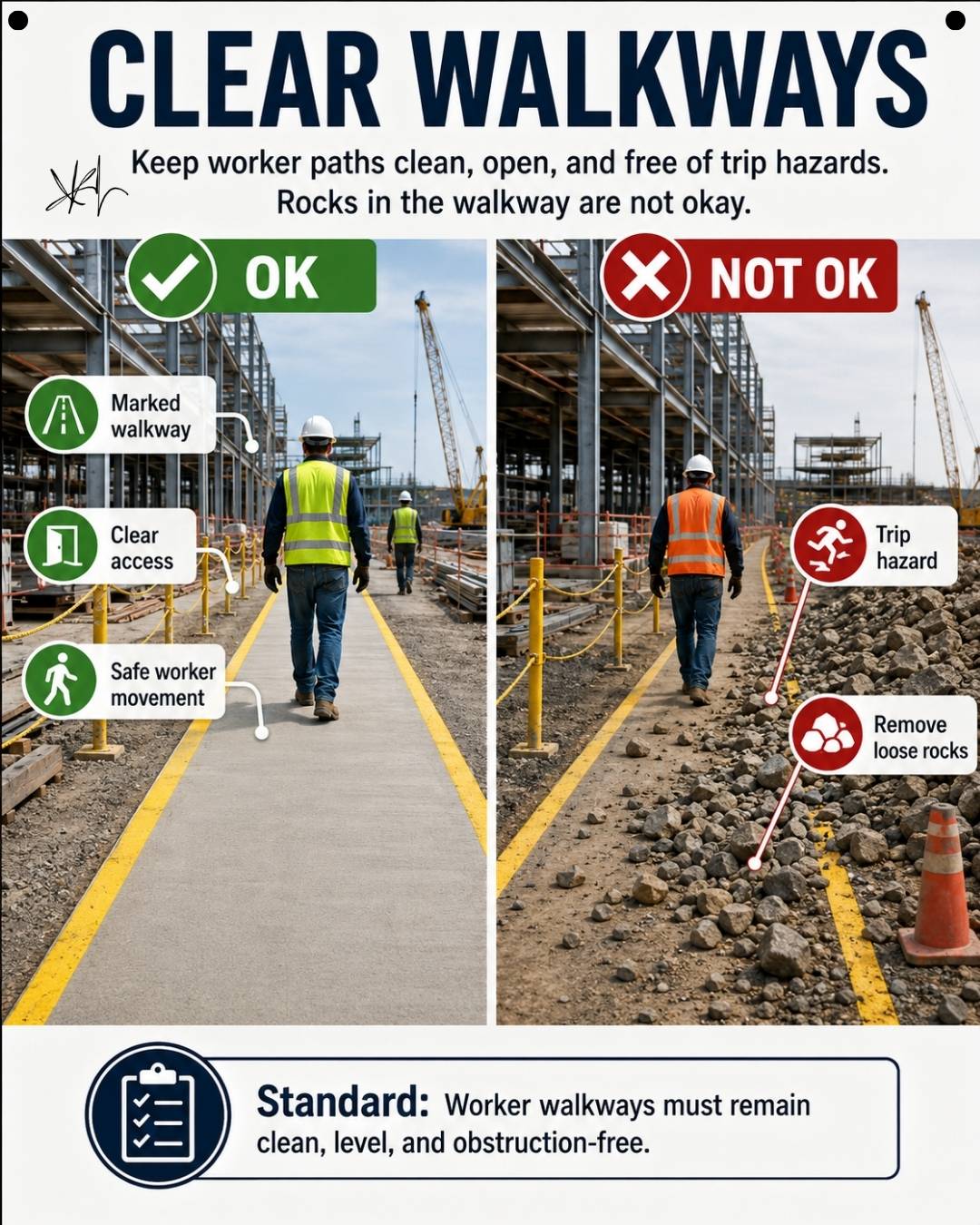
Look at the “Not OK” side of the graphic above. A marked path exists, yellow lines on either side, clearly intended to guide safe movement from one part of the site to another. Running directly through that marked path, instead of beside it, is a field of loose rock, the kind that shifts underfoot, rolls, and catches a boot at exactly the wrong angle. A worker walking that path every day has adapted. They watch their footing more carefully. They slow down slightly. They have built a small, constant mental tax into every trip across that section of the site, a tax that never shows up on any report because nobody logs the effort of watching your feet more carefully.

That adaptation is exactly the danger. The worker who has walked this path fifty times without incident is not evidence that the hazard is manageable. It is evidence that the hazard has not yet produced its consequence. The fifty-first trip, when someone is carrying material with both hands, distracted by a conversation, or moving faster because the schedule is tight, is the trip where the loose rock finally does what loose rock does. A near miss becomes a sprained ankle. A sprained ankle becomes a recordable incident. And the whole sequence traces back to a condition that everyone on site had already learned to work around instead of simply removing.

The Failure Pattern

The failure pattern is treating a walkway hazard as a known, tolerable condition rather than as an unfinished task.

Once a crew has walked past the same hazard enough times without incident, the hazard stops registering as something that needs fixing today. It becomes background, the same way any unaddressed friction becomes invisible once people have adapted to it. We will get to it later becomes the unspoken answer every time someone notices the rock, the debris, the uneven ground, because clearing it feels like a task that can always wait one more day without anyone paying a visible price for the delay.

That delay is the actual failure. A walkway covered in loose rock did not become hazardous gradually through nobody’s fault. It became hazardous the first day the rock landed there and nobody cleared it, and it stayed hazardous every single day after that until someone finally did. The gap between when a hazard appears and when it gets addressed is where incidents live, and that gap only exists because the project treated a walkway standard as optional rather than as a daily, non-negotiable requirement.

The Worker Didn’t Fail. The Path Did.

When a worker trips on loose rock in a walkway, the instinct is to ask why they were not watching where they were stepping. They should have been more careful.

Before reaching that conclusion, it is worth asking what the site actually gave that worker to walk on. If the marked path running directly through their daily route was covered in loose, shifting rock, then the worker was navigating a hazard the project placed in front of them, not a hazard they failed to notice through carelessness. Asking someone to be more careful is asking them to compensate, personally, for a condition the project should have corrected before it ever became something anyone had to navigate around. That is backwards accountability, and it puts the burden on exactly the wrong party.

What a Clean Walkway Actually Provides

A marked walkway establishes an unambiguous boundary for safe movement, the same clear boundary principle covered in the earlier corridor discipline practice. The yellow lines are not decoration. They define exactly where safe passage exists, which only works if the space inside those lines is actually kept clear.

Clear access means the path is genuinely open, not obstructed by material, debris, or the kind of loose rock shown on the “Not OK” side of the graphic. A marked walkway that is simultaneously blocked by obstruction is not actually providing access. It is providing the appearance of a path while the real hazard sits directly inside it.

Safe worker movement is the actual outcome every other standard exists to produce, a crew able to move from one point to another without thinking about where their next step lands, without the small, constant mental tax of watching their footing on a surface that should never have required that level of attention in the first place.

What Counts as a Walkway Hazard?

Loose rock in the walkway is the specific hazard called out directly in this standard, and it deserves specific attention because it is one of the easiest hazards to miss precisely because it looks so ordinary. Rock is everywhere on an active jobsite. It is not inherently dangerous in a laydown area or a non-traffic zone. It becomes dangerous the moment it sits inside a marked path that people are walking across every day, and the standard exists specifically to draw that line.

Trip hazards more broadly, whatever form they take, debris, uneven ground, material staged where it should not be, carry the same underlying risk and deserve the same immediate correction rather than a note for later. And we will get to it later is explicitly ruled out as an acceptable response, because later is exactly when the incident happens, on whichever day the hazard finally meets the distracted worker, the heavy load, or the moment someone was moving just a little too fast to notice.

The Condition of Your Walkways Tells Me How the Whole Job Is Run

Here is the builder-to-builder truth underneath this entire standard. The condition of your walkways tells an experienced observer how the whole job is being run, before they ever see the schedule, the budget, or a single quality metric. Flow does not just apply to the work. It applies to the people moving through the work, and if a team cannot walk its own site cleanly, that site is not actually under control, regardless of how good the schedule looks on paper.

This connects directly to the corridor discipline practice I have written about before, and it extends that same principle specifically to the walkway hazard that is easiest to dismiss as minor. A blocked corridor slows throughput. A walkway covered in loose rock does something worse. It puts a worker’s physical safety directly at risk, every single time they walk it, for as long as the condition is allowed to persist. The two problems share the same root cause, a perimeter or pathway element that nobody specifically owns, degrading quietly until someone outside the project notices, or until the degradation finally produces an incident.

Why This Is Never Just a Safety Walk Checklist Item

Hold the standard every day, not just before the safety walk. This line matters because it names the exact failure mode that makes walkway standards fail in practice even on projects that genuinely care about safety. A site that clears its walkways the morning before a scheduled inspection, and lets them degrade the rest of the week, is not actually holding a standard. It is performing one, briefly, for an audience, which produces exactly the same risk the rest of the time as a site that never addressed the standard at all.

A genuine walkway standard holds every single day, regardless of who is watching, because the worker walking that path at four in the afternoon on a Tuesday with nobody scheduled to inspect anything is carrying exactly the same risk as the worker walking it the morning of a formal safety walk. The standard either holds continuously or it does not actually function as a standard at all.

How Do You Know Your Walkways Need Attention?

Walk your marked paths right now and look for these patterns:

  • Loose rock, gravel, or debris sitting directly inside a marked walkway rather than cleared to the side
  • A path that requires careful footing or conscious attention to navigate safely, rather than allowing a worker to move without thinking about each step
  • A hazard that has been present long enough that the crew has visibly adapted to it, slowing down or routing around it rather than reporting it
  • No specific person assigned to clear and inspect walkways on a recurring, daily basis
  • Walkways that look clean specifically before a scheduled inspection and degrade again shortly after

Each of these is a same-day fix. None of them require significant resources. What they require is the decision that today is the day, not later, because later is exactly when the incident happens.

Respect for People Starts With the Ground They Walk On

Respect for people starts with the ground they walk on. This is not a slogan layered on top of a safety standard. It is the actual, literal truth of what a clear walkway communicates to every person who uses it. A crew given a clean, level, obstruction-free path to walk every day is being told, directly and physically, that their safety mattered enough to someone to keep that ground clear. A crew navigating loose rock on the same path every day is being told the opposite, whether or not anyone intended to send that message.

Our LeanTakt team treats walkway discipline as one of the clearest, most direct expressions of respect for people available on any jobsite, because it costs almost nothing to maintain and it protects the one thing that matters more than schedule or budget, the physical safety of the crew every time they take a step.

Clear One Walkway Today

Here is your challenge. Walk your site right now and find the one marked path your crew uses most often. Check it for loose rock, debris, or anything that requires careful footing to navigate. Clear it today, not before the next scheduled safety walk, today. Then assign someone the specific, recurring responsibility of checking it again tomorrow, and the day after that.

My own guiding belief applies directly here: respect for people is the basis of all decisions. A clear walkway is that belief made physical, under every single boot that crosses it. Keep the paths clean, open, and level. Remove the rock. Hold the standard every day.

Bottom line: A walkway is only safe if the space inside the lines is clear every day, so give someone the job of keeping it that way.

If your project needs superintendent coaching, project support, or leadership development, Elevate Construction can help your field teams stabilize, schedule, and flow.

On we go.

FAQ

Why does loose rock in a walkway deserve specific attention compared to other jobsite hazards?

Loose rock is uniquely easy to normalize because it looks ordinary and is present almost everywhere on an active site. The danger comes specifically from its placement inside a marked walkway where people walk repeatedly without expecting to navigate shifting, unstable footing. A hazard that looks mundane is often the one most likely to get ignored until it produces an actual incident.

How is this different from the corridor and walkway discipline practice I have written about before?

The earlier practice addressed corridor throughput broadly, staging encroachment, debris accumulation, and the production cost of blocked paths. This practice focuses specifically on the physical safety risk of trip hazards like loose rock inside a marked walkway, a more acute, immediate danger than the general productivity loss a blocked corridor creates, though both share the same underlying root cause of unassigned ownership.

Who should be responsible for keeping walkways clear on a daily basis?

A specific, assigned owner, the same principle behind fence maintenance, corridor discipline, and vegetation control. A recurring daily check, even a brief walk of the primary paths, catches a new hazard the same day it appears rather than letting it sit for a week before anyone notices.

What is the fastest way to tell if a project’s safety culture is genuine rather than performative?

Check the walkways on a day with no scheduled inspection. A site that only clears its paths the morning before a safety walk is performing a standard rather than holding one. A site where the walkways stay clean on an ordinary Tuesday afternoon, with nobody watching, is actually holding the standard it claims to have.

How does walkway discipline connect to respect for people?

Every jobsite practice that addresses worker welfare, the care hub, cord management, traffic control, shares the same underlying principle. A physical environment either communicates that the people working in it matter enough to design for, or it communicates the opposite through neglect. A clear, level, obstruction-free walkway is one of the most direct, literal expressions of that respect, because it protects the one thing every single worker does continuously throughout their entire shift, taking their next step.

If you want to learn more we have:

-Takt Virtual Training: (Takt Virtual Training)
-Check out our YouTube channel for more info: (Elevate Construction on YouTube)
-Listen to the Elevate Construction podcast: (Elevate Construction Podcast)
-Check out our training programs and certifications: (Training Programs and Certifications)
-The Takt Book: (The Takt Book on Amazon)

Discover Jason’s Expertise:

Meet Jason Schroeder, the driving force behind Elevate Construction. As the company’s Founder and COO, he’s dedicated to taking construction to new heights. With a wealth of industry experience, he’s crafted the Field Engineer Boot Camp and Superintendent Boot Camp – intensive training programs engineered to cultivate top-tier leaders capable of steering their teams towards success. Jason’s vision? To expand his training initiatives across the nation, empowering construction firms to soar to unprecedented levels of excellence.
Posted in All

Construction Fence Vegetation Control

Read 11 min

A clean construction fence line says a lot about the jobsite.

Here is the deal. Vegetation control around construction fencing is a small detail that has a big impact on safety, visibility, and site appearance. This is a natural continuation of the fence maintenance standard I have written about before, the one that focused on post alignment, screen tension, and panel integrity. Vegetation is the piece of perimeter maintenance that grows back on its own, continuously, and gets overlooked precisely because nobody assigned it the same ongoing attention as the fence hardware itself.

Short answer: Vegetation control means keeping grass cut to a uniform height, weeds cleared from the fence base, and clear sightlines along the whole construction fence. Add it to the weekly fence inspection, give it to the same owner, and tighten the cadence in growing season.

The Pain of a Perimeter That Grows Wild Without Anyone Noticing

When grass and weeds are allowed to grow along the fence line, several problems accumulate at once, and none of them announce themselves as a crisis the way a collapsed panel or a safety incident would. Visibility through and along the perimeter drops as growth thickens, meaning a security walk or a casual glance from inside the site can no longer actually confirm what is happening just outside the fence. Trip hazards get hidden under overgrowth, specifically at the fence base where uneven ground, debris, or base supports can disappear beneath grass that nobody cut back. Access points can become partially blocked as vegetation encroaches on a gate or a walkway that was clear at mobilization and has slowly narrowed ever since.

Pest issues follow naturally from unmanaged vegetation, since tall grass and weeds create exactly the habitat that attracts the kind of pest activity nobody wants near an active jobsite or its neighbors. And beyond all of the functional problems, there is a simpler, more immediate one. An overgrown perimeter communicates, instantly and without a single word, that the site is not being actively maintained, even if everything happening inside the fence is running exactly on schedule and exactly to standard.

The Failure Pattern

The failure pattern is identical to the one already covered for fence hardware maintenance, applied to a different element of the same perimeter. The fence goes up on a clean, maintained site at mobilization. From that point forward, grass and weeds keep growing on their own schedule, regardless of what the project schedule is doing, and nobody has assigned the recurring task of keeping that growth under control as part of anyone’s specific, ongoing responsibility.

This is precisely the kind of maintenance gap that degrades invisibly. A single week of uncut grass is barely noticeable. A month of uncut grass is a visibly overgrown fence line that every visitor, every inspector, and every neighbor driving past has now seen multiple times. The degradation compounds exactly the way fence hardware degradation compounds, through the accumulation of many small, individually unremarkable days where nobody specifically owned the task of correcting it.

The Team Didn’t Fail. Nobody Owned the Fence Line.

When a fence line looks overgrown, the instinct is to assume nobody on the project cared enough to keep it tidy. That instinct, as with every other unmanaged perimeter element, usually misses the real explanation.

Most projects assign clear, recurring ownership to the things that feel central to production, the schedule, the budget, material staging. Vegetation control along a fence line typically gets no such assignment. It is not on anyone’s daily checklist. It is not reviewed in any regular meeting. The team did not fail to care about the perimeter’s appearance. The project never built a system that made maintaining it anyone’s specific, recurring job, so the growth simply continued unchecked, exactly the way anything unmanaged continues unchecked, until someone outside the project finally noticed and said something.

What Does Good Fence Line Vegetation Control Look Like?

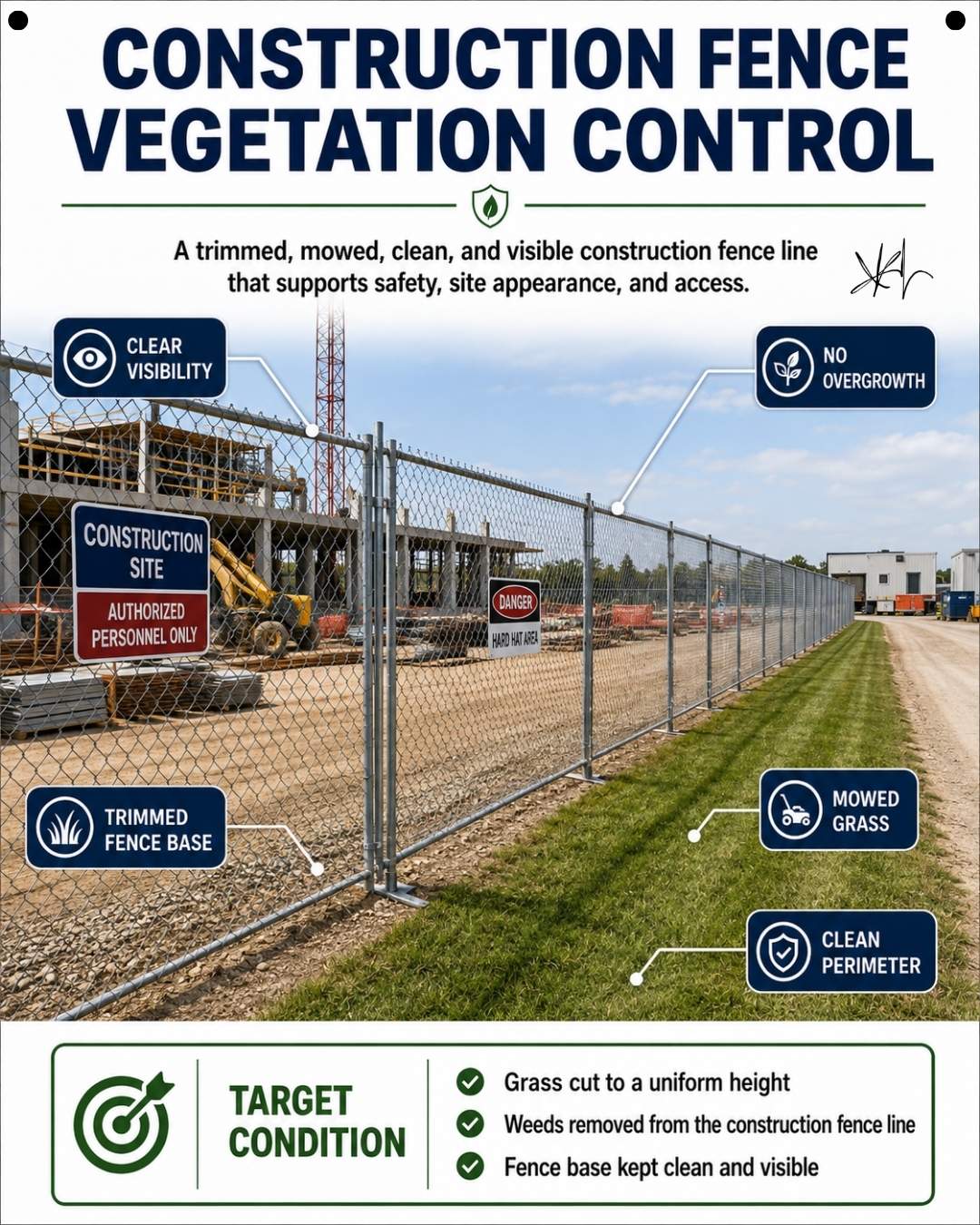
Grass cut to a uniform height. Cut it along the full length of the fence line, not patchy or inconsistent, which would itself suggest sporadic, reactive attention rather than a deliberate, scheduled standard. Weeds removed from the construction fence line specifically, since weeds tend to concentrate exactly at the fence base where mowing equipment often cannot reach cleanly, which is precisely why they require separate, deliberate attention rather than being swept up automatically during a routine mow.

Fence base kept clean and visible. This keeps the base supports and post connections inspectable at a glance, connecting this vegetation standard directly back to the fence hardware inspection standard covered earlier. A base buried in overgrowth cannot be properly checked for the shifting, leaning, or damage that the earlier fence maintenance practice specifically calls out as a weekly inspection point. Vegetation control is not separate from structural fence maintenance. It is the precondition that makes structural inspection actually possible.

Clear visibility through and along the perimeter restores the functional purpose that overgrowth quietly erodes, letting anyone walking the fence line actually see adjacent conditions rather than peering through or around a wall of uncut grass and weeds. And a neat, professional-looking site boundary ties every one of these functional improvements together into the single, immediate impression that every visitor, inspector, and passerby forms the moment they see the fence line, before they ever learn anything else about how the project is actually being run.

Why This Is Never Just About Appearance

This is not just about appearance. It supports better access, safer inspections, cleaner site logistics, and a stronger first impression for clients, inspectors, neighbors, and the public. Each of those benefits traces back to a specific, concrete mechanism, not simply to looking nicer.

Better access means gates and walkways stay genuinely clear rather than narrowing gradually as vegetation creeps inward, protecting the same throughput covered in the earlier walkway and corridor post. Safer inspections mean the fence base and the ground immediately around it stay visible enough that an actual inspection can catch a real problem, rather than missing it because it is hidden under growth. Cleaner site logistics means delivery routes and perimeter access points function the way they were designed to function at mobilization, rather than slowly degrading as unmanaged growth narrows the usable space along the boundary.

And the stronger first impression matters precisely because the perimeter, as I have written before about fence maintenance and traffic control, is the first and sometimes only part of a project that the public, inspectors, and neighbors ever actually see. A project with a meticulously run interior and an overgrown, neglected perimeter is sending a confusing, contradictory signal to everyone who only ever sees the outside.

Why the Perimeter Is Always the First Signal

In construction, the perimeter is often the first thing people see. This is the same principle that ran through the earlier fence maintenance practice and the traffic control practice. A perimeter, whether judged by its hardware condition or its vegetation control, communicates a standard before a single word gets exchanged with anyone from the project.

Standards are contagious, in both directions. A project that maintains a trimmed, mowed, visible fence line is telling every trade partner, every inspector, and every neighbor that someone here is paying attention to details that most people would never think to check. A project that lets its fence line grow wild is telling exactly the same audience the opposite message, inadvertently, and that message tends to travel further and shape more outside perception than almost any internal metric the project is actually tracking.

Signals Your Fence Line Needs Vegetation Attention

Walk your perimeter today and look for these patterns:

  • Grass or weeds growing tall enough to obscure the fence base or any portion of the fence hardware itself
  • Vegetation encroaching on a gate, walkway, or access point that was clear at mobilization
  • Uneven or patchy mowing, suggesting reactive rather than scheduled attention
  • No specific person or recurring task assigned to vegetation control along the perimeter
  • A fence line that, on first glance from a public road or adjacent property, reads as unmaintained

Each of these is a same-day or same-week fix once someone actually notices it. The real gap, as with every other unmanaged perimeter element, is the absence of a system ensuring someone looks on a regular basis.

Build Vegetation Control Into Your Existing Fence Standard

A vegetation control standard does not need to exist as a separate system from the fence hardware maintenance I have written about before. The same weekly perimeter walk that checks post level, screen tension, and panel condition can incorporate vegetation as a fourth category, assigned to the same owner, checked on the same cadence. Grass cut to uniform height, weeds cleared from the fence base, visibility maintained along the full line.

Our LeanTakt team treats every element of the public-facing perimeter, fencing, traffic control, vegetation, as one unified standard, because the public reading that perimeter does not distinguish between a leaning post and an overgrown fence base. They simply read the whole boundary as either maintained or neglected.

Walk Your Fence Line Today

Here is your challenge. Add vegetation control to the same perimeter walk you are already running for fence hardware. Check the grass height, clear the weeds from the fence base, confirm visibility along the full line. If that weekly walk does not currently exist, start it this week, covering both the hardware and the vegetation in a single pass.

Taiichi Ohno taught that where there is no standard, there can be no improvement, and a standard only holds if someone checks it on a regular basis. A perimeter is not a one-time installation. It is a living boundary that requires the same ongoing attention as the work happening inside it. Keep it clean. Keep it visible. Keep it controlled.

Bottom line: A perimeter is a living boundary, so keep the grass cut, the fence base clear, and the whole line visible, and check it every week.

If your project needs superintendent coaching, project support, or leadership development, Elevate Construction can help your field teams stabilize, schedule, and flow.

On we go.

FAQ

How often should vegetation along a fence line actually be mowed and cleared?

Weekly during active growing seasons is a reasonable minimum, matching the same cadence recommended for fence hardware inspection in the earlier fence maintenance practice. Growth rate varies by season and climate, so the cadence may need to tighten during peak growing periods and can relax somewhat during slower growth months.

Why does weed removal need separate attention from standard mowing?

Weeds often concentrate directly at the fence base, a narrow strip that standard mowing equipment frequently cannot reach cleanly without additional trimming. This is precisely the area where visibility and inspection access matter most, since it is where the fence’s structural base supports and post connections actually live.

Who should be responsible for vegetation control along the perimeter?

The same assigned owner already responsible for fence hardware inspection, incorporating vegetation as an additional checkpoint in the same recurring walk, rather than creating a separate, disconnected responsibility that is easier to let fall through the gaps.

Does vegetation control really affect safety, or is this mainly about appearance?

Both, and the safety impact is concrete. Overgrowth hides trip hazards at the fence base, can obscure gaps or damage in fence hardware that would otherwise be caught during inspection, and narrows access points over time if left unchecked. The appearance benefit is real, but the safety and access benefits are equally direct consequences of the same maintenance gap.

How does this connect to fence hardware maintenance and traffic control?

All three share the identical underlying principle. A project’s perimeter, whatever form it takes, fence hardware, vegetation, traffic control devices, is the first and most visible signal the public receives about how the entire project is run. Each element requires the same ongoing ownership and recurring inspection cadence to avoid the slow, invisible degradation that happens whenever a standard exists without anyone specifically assigned to maintain it.

Related: Clear Walkways

If you want to learn more we have:

-Takt Virtual Training: (Takt Virtual Training)
-Check out our YouTube channel for more info: (Elevate Construction on YouTube)
-Listen to the Elevate Construction podcast: (Elevate Construction Podcast)
-Check out our training programs and certifications: (Training Programs and Certifications)
-The Takt Book: (The Takt Book on Amazon)

Discover Jason’s Expertise:

Meet Jason Schroeder, the driving force behind Elevate Construction. As the company’s Founder and COO, he’s dedicated to taking construction to new heights. With a wealth of industry experience, he’s crafted the Field Engineer Boot Camp and Superintendent Boot Camp – intensive training programs engineered to cultivate top-tier leaders capable of steering their teams towards success. Jason’s vision? To expand his training initiatives across the nation, empowering construction firms to soar to unprecedented levels of excellence.
Posted in All

The Construction Design Scrum Board

Read 12 min

Most design teams are busy. But busy does not always mean coordinated.

Here is the deal. A design team juggling RFIs, submittals, BIM coordination, permit comments, owner decisions, and drawing updates can be working at full capacity every single day and still be badly out of sync, because all of that work is living in scattered inboxes, side conversations, and individual memory rather than in one place the whole team can actually see together. That is where Scrum can help. Used well, a Scrum board gives a construction design team a simple visual system to coordinate daily work, remove roadblocks, and keep commitments visible, replacing a fog of individual busyness with a single shared picture of what is actually happening.

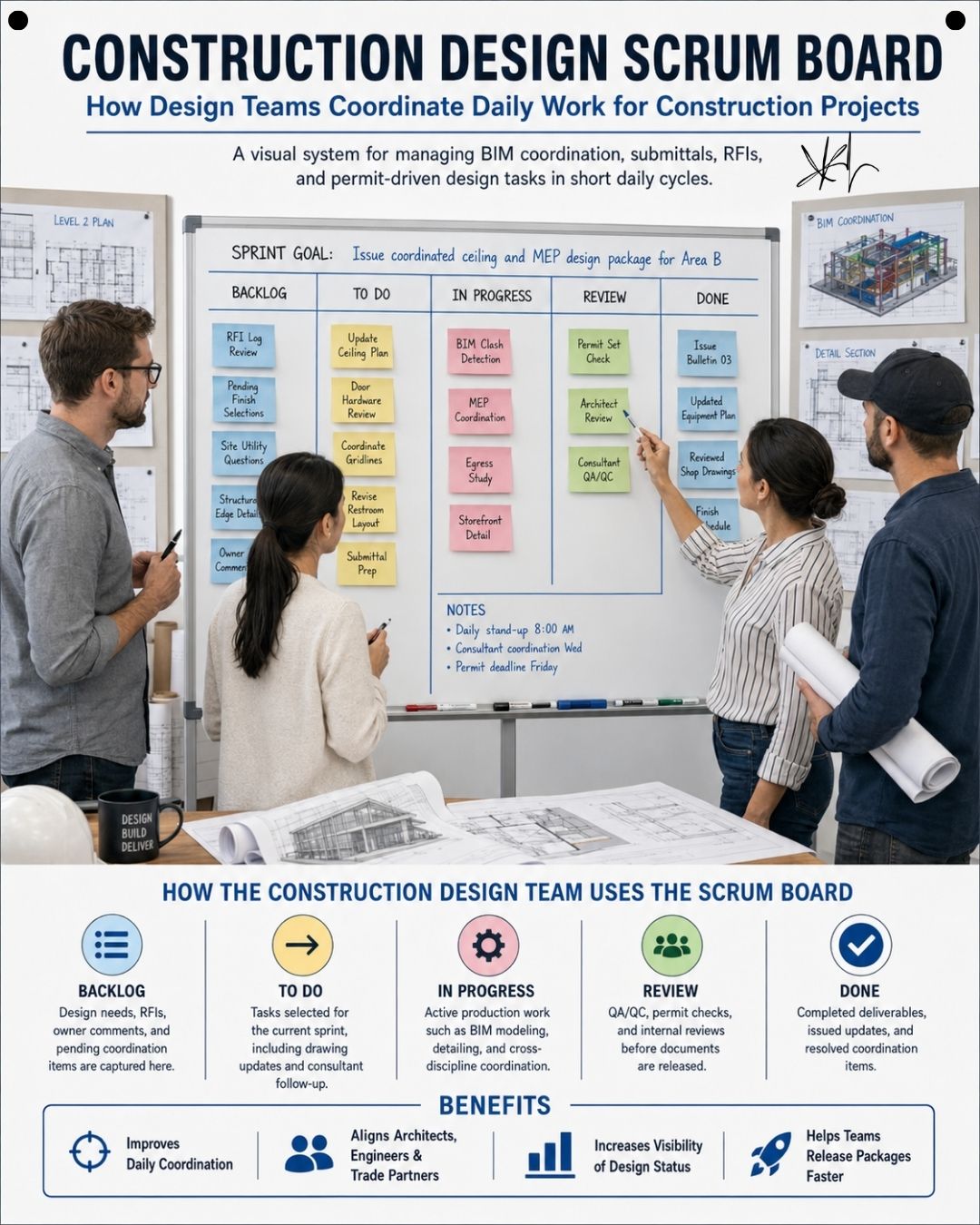
Short answer: A construction design Scrum board is a five-column board (backlog, to do, in progress, review, done) that puts every RFI, submittal, BIM clash, permit comment, and owner decision in one place. The team runs a short daily stand-up at the board, so blockers show up the day they appear.

The Pain of Work That Lives Everywhere and Nowhere

Picture a typical design team coordinating a complex construction project without a shared visual system. The architect is tracking RFIs in their own email inbox. The structural engineer is managing drawing revisions in a personal file naming convention nobody else fully understands. The MEP coordinator knows what BIM clashes still need resolving, but that knowledge exists only in their own head and the occasional meeting mention. An owner comment arrives and gets forwarded somewhere, acted on by someone, and then effectively disappears from anyone else’s visibility once the immediate response is sent.

Every individual piece of this is being handled by someone. Nothing is being outright dropped, most of the time. But nobody on the team, including the people doing the work, has an actual, accurate picture of the whole. A permit deadline on Friday might be at real risk because three dependent items are still stuck in someone’s queue, and nobody notices that risk until the deadline is suddenly very close, because the dependency was never visible anywhere except inside separate people’s individual workflows. The team is busy. The team is also, in a very real sense, blind to its own collective status.

The Failure Pattern

The failure pattern is treating coordination as something that happens automatically through individual competence and occasional meetings, rather than as something that requires a deliberate, shared system to actually produce.

Design teams are typically staffed with highly capable individuals, each managing their own piece of a complex coordination puzzle well. The assumption, often unstated, is that if everyone manages their own piece competently, the whole will somehow stay coordinated through the accumulation of individual diligence plus periodic status meetings. That assumption breaks down specifically at the handoffs and dependencies, the places where one person’s work depends on another’s, because individual competence within a silo does not automatically produce visibility across silos. A status meeting held weekly can catch some of what fell through those gaps. It rarely catches all of it, and it never catches it early enough to prevent the gap from costing real time.

Nobody Dropped the Ball. Nobody Could See It.

When a permit deadline gets missed, or a BIM clash surfaces late and disrupts a release schedule, the instinct is to ask who dropped the ball. Whoever owned that task should have flagged it sooner.

Before reaching that conclusion, it is worth asking what visibility that person actually had into how their piece connected to everyone else’s. If the team had no shared board, no common view of backlog, in-progress work, and pending review, then the person who seemed to drop the ball was likely working diligently within their own silo, with no reliable way to see that a dependency elsewhere in the system was quietly putting their own deadline at risk. The failure was never a person failing to care enough. It was a system that gave nobody a complete picture, which means nobody could have caught the gap reliably, no matter how conscientious any individual happened to be.

How the Board Actually Works

The backlog captures design needs, RFIs, owner comments, and pending coordination items, everything that the team knows needs attention but has not yet been pulled into active work. This is the team’s complete inventory of what exists, visible in one place rather than scattered across individual inboxes and side conversations that nobody else can see.

The to-do column holds tasks selected for the current sprint, including drawing updates and consultant follow-up, representing the specific, committed slice of the backlog the team has decided to actually tackle in this cycle. This selection step matters because it forces an explicit decision about priority, rather than letting whoever happens to be loudest or most recent determine what gets worked on next.

In progress tracks active production work, BIM modeling, detailing, and cross-discipline coordination, the tasks actually being executed right now. Seeing this column populated accurately gives the whole team a real-time view of where effort is currently concentrated, which matters enormously for spotting when too much is piling up in one area while another area sits idle.

Review holds QA and QC, permit checks, and internal reviews before documents are released, the critical gate that catches problems before they become expensive. A visible review column means nothing slips through to release without the verification step the project actually requires, because the step is explicit and tracked rather than assumed.

Done captures completed deliverables, issued updates, and resolved coordination items, giving the team a visible, cumulative record of actual progress, not just a sense that things have generally been happening.

Why Daily Stand-Ups Change Completely

Daily stand-ups become shorter and more effective because the board drives the conversation. This is one of the most immediate, practical benefits a team experiences once a shared board is actually in use. Without a board, a stand-up tends to drift into open-ended status updates, each person describing their own work in whatever depth seems appropriate, with no structure guiding the conversation toward what actually matters.

With a board, the stand-up becomes a walk through the actual state of the work, what moved into progress, what is stuck in review, what just landed in the backlog that needs attention. The conversation stays anchored to visible reality rather than to whatever happens to come up verbally, which means constraints and blockers show up earlier, often the very day they first appear, rather than surfacing a week later once the consequence has already compounded.

Why This Is Not About Adding Software

For construction design, Scrum is not about adding a software process. It is about creating visibility, accountability, and team alignment in a fast-moving environment. This distinction matters because a team that adopts the format of Scrum, the backlog, the columns, the daily stand-up, without actually committing to the underlying discipline of keeping the board current and honest, gets a worse version of the old problem, a board that looks organized but does not reflect reality any more accurately than scattered inboxes did.

The real value comes from the discipline of actually moving items across the board the moment their status changes, rather than updating it periodically or treating it as documentation rather than a living tool. A board that reflects reality in real time is what actually produces the benefits. A board that gets updated once a week as an afterthought produces very little beyond the appearance of organization.

What the Board Actually Coordinates

A good design Scrum board can manage an enormous range of the coordination work that defines a complex construction project.

  • BIM coordination, catching clashes and cross-discipline conflicts before they become field problems.
  • Drawing updates, keeping revisions visible and tracked rather than scattered across individual file systems.
  • Submittals, tracking status so nothing stalls silently in someone’s queue.
  • RFIs, surfacing questions and answers so dependent work does not wait unnecessarily.
  • Permit responses, keeping deadline pressure visible to the whole team rather than known only to whoever is directly handling the permit conversation.
  • QA and QC reviews, ensuring the verification step actually happens before release.
  • Consultant coordination, keeping external parties’ commitments visible alongside internal ones.
  • Owner comments, making sure feedback actually gets addressed rather than disappearing into a single person’s inbox.
  • Design decisions, tracking what has been decided and what is still open.
  • Release packages, giving the team a clear, shared understanding of what is actually ready to issue.

If the Work Is Visualized, the Team Can Improve It

This is the principle underneath the whole practice. If the work is visualized, the team can improve it. If the team can improve it, the project moves faster with less chaos. A team cannot improve a process it cannot see clearly, and most design coordination failures trace back not to a lack of effort or skill, but to a lack of shared visibility into how all the individual pieces actually connect. Design teams need flow too, the same flow that Takt planning brings to field execution, and a Scrum board is simply the mechanism that makes that flow visible and manageable in a fast-moving, cross-discipline design environment.

Signals Your Design Team Needs This

Look for these patterns in your own coordination process:

  • RFIs, submittals, and owner comments live primarily in individual inboxes rather than one shared, visible location
  • Status meetings routinely surface problems that had actually existed for days or weeks before anyone else knew about them
  • Different disciplines on the design team have no consistent, shared view of what is actually in progress versus what is still pending
  • Permit or release deadlines are frequently at risk because of a dependency that nobody noticed until it was nearly too late
  • Daily or weekly meetings tend to drift into unstructured status updates rather than a focused walk through actual, visible work

Each of these signals a team that is working hard without working visibly, and that gap is exactly what a Scrum board is designed to close.

Build Your Board Before Your Next Sprint

Our LeanTakt team applies this same visual management discipline across every phase of a project, because design coordination and field execution both depend on the identical principle, making the work visible so the whole team can see reality and act on it together.

Here is your challenge. Build a simple board this week, even a whiteboard with five columns, and move your team’s actual active work onto it honestly. Hold your next stand-up walking through the board instead of talking through individual status updates. Watch how quickly a blocker that would have stayed hidden for a week becomes visible on day one instead.

W. Edwards Deming put it this way: “If you can’t describe what you are doing as a process, you don’t know what you’re doing.” A Scrum board is exactly that description made visible, shared, and current. Make the work visible, and the team finally gets the chance to actually improve it.

Bottom line: Put the work on one shared board and keep it current, and the team finally gets the chance to improve it.

If your design or field teams need help with Scrum, Takt planning, or coaching, Elevate Construction can help your teams stabilize, schedule, and flow.

Want the full preconstruction planning system? Read The First Planner System.

On we go.

FAQ

How is a design Scrum board different from a standard project tracking spreadsheet?

A spreadsheet is typically updated periodically and reviewed individually, which means it rarely reflects true real-time status and rarely drives a shared daily conversation. A Scrum board, used well, is updated continuously as work moves and becomes the visual centerpiece of a daily stand-up, making it a living coordination tool rather than a static record reviewed occasionally.

Does every discipline on the design team need to physically gather around the same board?

A physical board works well for a co-located team, but the same principle applies equally to a digital board for distributed teams, as long as the discipline of keeping it current and using it to structure the daily conversation remains intact. The format matters less than the commitment to real-time accuracy and shared visibility.

How often should items actually move across the board?

As soon as their status genuinely changes, not on a fixed weekly schedule. The value of the board comes directly from its accuracy in the moment, so a team that only updates it once a week is working from a picture that is already stale for most of that week.

What is the biggest mistake teams make when adopting a Scrum board for design coordination?

Treating the board as documentation to update after the fact rather than as a live tool that drives the actual daily conversation. A board updated as an afterthought produces the appearance of organization without the actual coordination benefit, since the team is still making decisions based on whatever they happen to remember rather than what the board currently shows.

How does this connect to Takt planning and visual management practices used in the field?

The underlying principle is identical across both. A Takt board makes field production rhythm visible so the whole team can coordinate around it. A design Scrum board makes design coordination work visible so the whole team can manage dependencies, catch blockers early, and move faster with less chaos. Design teams and field teams both depend on the same discipline, making the work visible, to actually achieve flow rather than simply staying busy.

Related: How To Use Scrum In Construction Management

If you want to learn more we have:

-Takt Virtual Training: (Takt Virtual Training)
-Check out our YouTube channel for more info: (Elevate Construction on YouTube)
-Listen to the Elevate Construction podcast: (Elevate Construction Podcast)
-Check out our training programs and certifications: (Training Programs and Certifications)
-The Takt Book: (The Takt Book on Amazon)

Discover Jason’s Expertise:

Meet Jason Schroeder, the driving force behind Elevate Construction. As the company’s Founder and COO, he’s dedicated to taking construction to new heights. With a wealth of industry experience, he’s crafted the Field Engineer Boot Camp and Superintendent Boot Camp – intensive training programs engineered to cultivate top-tier leaders capable of steering their teams towards success. Jason’s vision? To expand his training initiatives across the nation, empowering construction firms to soar to unprecedented levels of excellence.
Posted in All

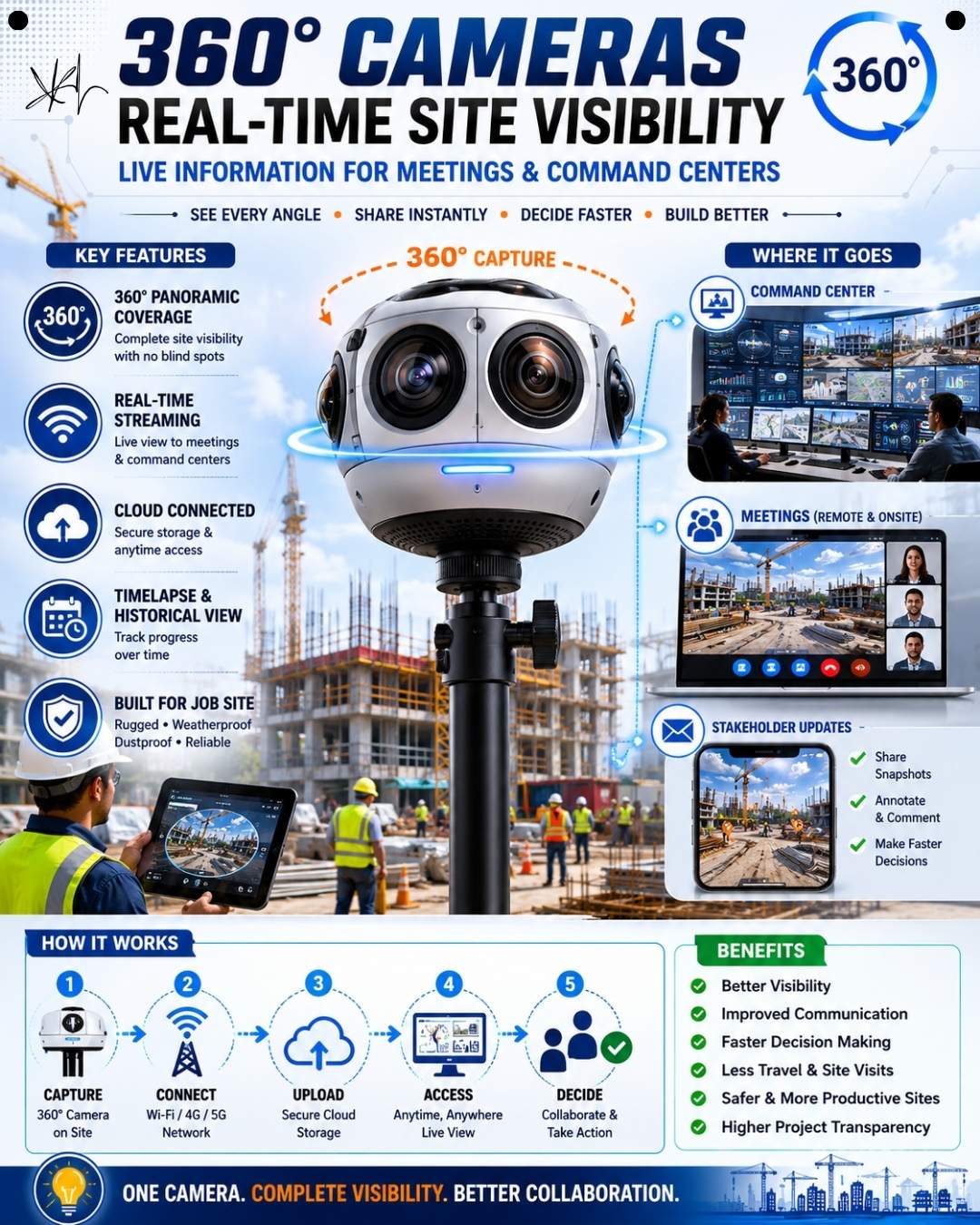
360° Cameras: Real-Time Site Visibility

Read 12 min

360-degree cameras might be the most underrated tool on a jobsite right now.

Here is the deal. The problem they solve is simple to state and expensive to ignore. Too many decisions get made by people who cannot actually see the work. A stakeholder calls in from across the country. A command center is tracking six projects at once. A meeting room full of people is trying to picture a condition someone described in words. Everybody is working off a secondhand version of reality, and the field crew pays for the gaps that secondhand version always contains.

Short answer: A 360-degree jobsite camera captures the whole site from one fixed point and streams it live to meetings and command centers, with cloud storage and timelapse. It lets people decide from what they can see instead of from a verbal description, and it works best when it’s introduced as a way for crews to show conditions, not as surveillance.

The Pain of Deciding Based on a Description

Picture a typical stakeholder update call. Someone on the project team describes a current condition verbally, a logistics layout, a structural progress milestone, a safety concern in a specific zone. Everyone on the call is now building their own mental image of that condition, based entirely on the words used to describe it. Different listeners construct different pictures, shaped by their own assumptions and experience, and nobody on the call has any way to verify whose mental image actually matches reality.

Decisions get made from those mismatched pictures anyway, because the call has to end and the project has to move forward. Sometimes the decision happens to be fine, because the gap between description and reality was small enough not to matter. Often it is not fine, because a verbal description cannot carry the kind of spatial, visual precision that an actual decision about a physical jobsite condition genuinely requires. The field crew ends up executing a decision built on a picture that was wrong from the start, and the wrongness traces back not to anyone’s judgment, but to the simple fact that nobody in the room actually saw what they were deciding about.

The Failure Pattern

The failure pattern is accepting secondhand description as an adequate substitute for direct visibility, simply because direct visibility has historically been expensive or impractical to provide remotely.

For most of construction history, seeing a jobsite condition in real time from somewhere else was genuinely difficult. A stakeholder wanting to see current conditions had to travel to the site, or wait for someone to capture and send photos, which were already outdated by the time they arrived. Given that constraint, verbal description became the default, not because it was good enough, but because it was the only practical option available. The problem is that the constraint has changed. Real-time, remote visual access to a jobsite is now genuinely available, and a project still relying on verbal description is choosing a worse option than the one it actually has access to.

They Didn’t Explain It Badly. They Had No Way to Show It.

When a decision made remotely turns out to be wrong once it reaches the field, a logistics plan that does not match actual site conditions, a stakeholder approval based on a misunderstood scope, the instinct is to question whoever described the condition inaccurately. They should have explained it better.

Before reaching that conclusion, it is worth asking what tool that person actually had available to communicate the condition. If the only option was a verbal description over a phone call, then the gap between what they said and what was actually true in the field was not a communication failure. It was the predictable limit of trying to convey spatial, visual information through words alone. Give that same person a live camera feed instead, and the entire category of this mistake disappears, not because they suddenly became better communicators, but because they were finally given a tool that could actually show, rather than merely describe.

What Does a 360-Degree Jobsite Camera Do?

Complete site visibility with no blind spots means exactly what it says. A single, fixed device captures the full surrounding environment simultaneously, rather than requiring someone to manually pan a traditional camera toward whatever happens to seem relevant at that moment. This matters because the thing someone needs to see is often not the thing anyone thought to point a camera at in advance. A 360-degree capture removes that guesswork entirely.

Live streaming straight to meetings and command centers turns a stakeholder call from a verbal description into a shared visual reference everyone in the conversation can actually look at together. The difference this makes to decision quality is immediate and obvious once a team has experienced it, because ambiguity about what a condition actually looks like simply stops being a factor in the conversation.

Cloud storage with anytime access means the view is not limited to the exact moment of a live stream. Anyone who needs to check a condition, days or weeks after it occurred, can pull up the footage directly rather than relying on someone’s memory or a written report of what was observed at the time.

Timelapse and historical tracking let a team see progress over time in a continuous, visual record, rather than reconstructing progress from a series of disconnected status updates. This is particularly valuable for stakeholders who want to understand a project’s trajectory without requiring a formal report every time they want an update.

Rugged, weatherproof hardware built to live on the job ensures the device actually survives the environment it is meant to operate in continuously, rather than being a piece of equipment that requires careful handling incompatible with an active construction site.

The Workflow Is Deliberately Simple

Capture happens through the 360-degree camera positioned on site. Connect happens over Wi-Fi, 4G, or 5G network access, giving the device reliable connectivity regardless of a project’s specific site conditions. Upload moves the footage to secure cloud storage automatically, removing any manual step that could introduce delay or inconsistency. Access means anyone with the appropriate permission can view the footage anytime, anywhere, rather than being limited to whoever happened to be present at the moment of capture. Decide is the actual point of the whole system, collaboration and action based on an accurate, shared view of reality rather than a secondhand reconstruction of it.

What Comes Out the Other End

Fewer wasted site visits happen because a stakeholder or a remote team member can verify a condition visually without physically traveling to confirm it. Faster decisions happen because the time normally spent clarifying a verbal description, or discovering later that the description was wrong, simply disappears from the process. Better communication happens because everyone in a conversation is referencing the same visual reality rather than their own individually constructed mental image. More transparency happens because a project operating with visible, verifiable conditions naturally builds more trust with every stakeholder touching it, since nobody has to simply take someone’s word for what the site actually looks like.

This Is Not About Surveilling the Field

Here is the part that matters most. This is not about surveilling the field. It is about giving the crews doing the work a way to show the rest of the team what is actually happening, so the people in the meeting rooms finally understand what the people in the boots already know.

That framing is important and worth holding onto deliberately. A camera system introduced with a surveillance mindset, watching crews to catch mistakes, produces resentment and defensiveness. A camera system introduced with this framing, giving the field a voice that finally reaches decision-makers accurately, produces something very different. The crew is not being watched. The crew is finally being seen, in the specific sense that the conditions they deal with daily, the ones that are hardest to explain in a status report, become visible and legible to the people making decisions that affect their work. This is the same philosophy running through the auto-launch drone system: Mieruka, making the work visible so the whole team can see reality and respond to it, rather than operating from assumption or incomplete description.

Signals Your Project Needs Real-Time Visibility

Look for these patterns on your current project:

  • Stakeholder calls routinely involve long verbal descriptions of physical conditions that would be far clearer shown directly
  • Remote team members or executives frequently travel to the site specifically to verify a condition they could not adequately understand from a description
  • Decisions made remotely occasionally turn out to be based on a misunderstanding of actual field conditions
  • There is no consistent, verifiable visual record of site conditions over time that stakeholders can reference independently
  • The field crew has no reliable way to show decision-makers the specific conditions that affect their daily work

Each of these signals a gap between description and reality, and that gap is exactly what a 360-degree camera system is built to close.

Give the Field a Way to Show, Not Just Tell

Our LeanTakt team treats real-time visibility tools like this as a direct extension of Mieruka, because a project that makes its actual conditions visible to everyone touching it, rather than relying on secondhand description, makes better decisions faster and builds more trust across every level of the team.

Set Up Your First Camera This Month

Here is your challenge. Identify one recurring communication gap on your project, a condition that is hard to describe accurately over a call, a stakeholder who keeps traveling just to verify something visually, a command center managing multiple sites with no consistent view of any of them. Put a camera there this month, and watch how many conversations change once the people deciding can actually see what the people in the boots already know.

Toyota calls it genchi genbutsu: go and see for yourself to grasp the actual situation, rather than deciding from a report or a secondhand account. A 360-degree camera is that exact principle extended to anyone who cannot physically be on site. See the work. Then decide.

Bottom line: Give the people making decisions a live view of the site, so they decide from what they can see instead of from a description.

If your project needs superintendent coaching, project support, or leadership development, Elevate Construction can help your field teams stabilize, schedule, and flow.

On we go.

FAQ

How is a 360-degree camera different from a standard fixed security camera on a jobsite?

A standard camera captures a single fixed angle, requiring someone to guess in advance what direction will matter. A 360-degree camera captures the complete surrounding environment simultaneously, eliminating blind spots and removing the need to predict what will be relevant before it happens.

Does introducing cameras like this create trust issues with the field crew?

It can, if the system is introduced with a surveillance framing. Introduced instead as a tool that gives the field crew a direct, accurate way to show decision-makers what they are actually dealing with, the tool tends to build trust rather than erode it, because it finally closes the gap between what the field knows and what leadership understands.

How much bandwidth or connectivity does a system like this require on a remote jobsite?

The system is designed to work over Wi-Fi, 4G, or 5G networks, giving flexibility depending on what connectivity a specific site actually has available. Projects in areas with limited connectivity may need to rely more heavily on timelapse and stored footage rather than continuous live streaming, but the cloud upload and access functions still work effectively.

Who should have access to the live feed and stored footage?

Access should be scoped to the people who actually need it for decision making, project leadership, relevant stakeholders, and command center staff tracking multiple projects. Broad, unrestricted access tends to undermine the trust-building framing this tool depends on, while scoped access keeps the tool focused on its actual purpose.

How does this connect to an auto-launch drone system?

Both tools serve the identical underlying purpose, replacing assumption and secondhand description with accurate, current, shared visibility of actual site conditions. The drone system captures aerial, whole-site perspective on a scheduled daily basis. The 360-degree camera provides continuous, ground-level, real-time visibility for specific locations and ongoing stakeholder communication. Projects benefit most from using both together, since each closes a different kind of visibility gap.

Related: Seeing at the Gemba

If you want to learn more we have:

-Takt Virtual Training: (Takt Virtual Training)
-Check out our YouTube channel for more info: (Elevate Construction on YouTube)
-Listen to the Elevate Construction podcast: (Elevate Construction Podcast)
-Check out our training programs and certifications: (Training Programs and Certifications)
-The Takt Book: (The Takt Book on Amazon)

Discover Jason’s Expertise:

Meet Jason Schroeder, the driving force behind Elevate Construction. As the company’s Founder and COO, he’s dedicated to taking construction to new heights. With a wealth of industry experience, he’s crafted the Field Engineer Boot Camp and Superintendent Boot Camp – intensive training programs engineered to cultivate top-tier leaders capable of steering their teams towards success. Jason’s vision? To expand his training initiatives across the nation, empowering construction firms to soar to unprecedented levels of excellence.
Posted in All

Auto-Launch Drone Daily Visibility System

Read 12 min

Your jobsite changes every single day. So why are most teams flying blind?

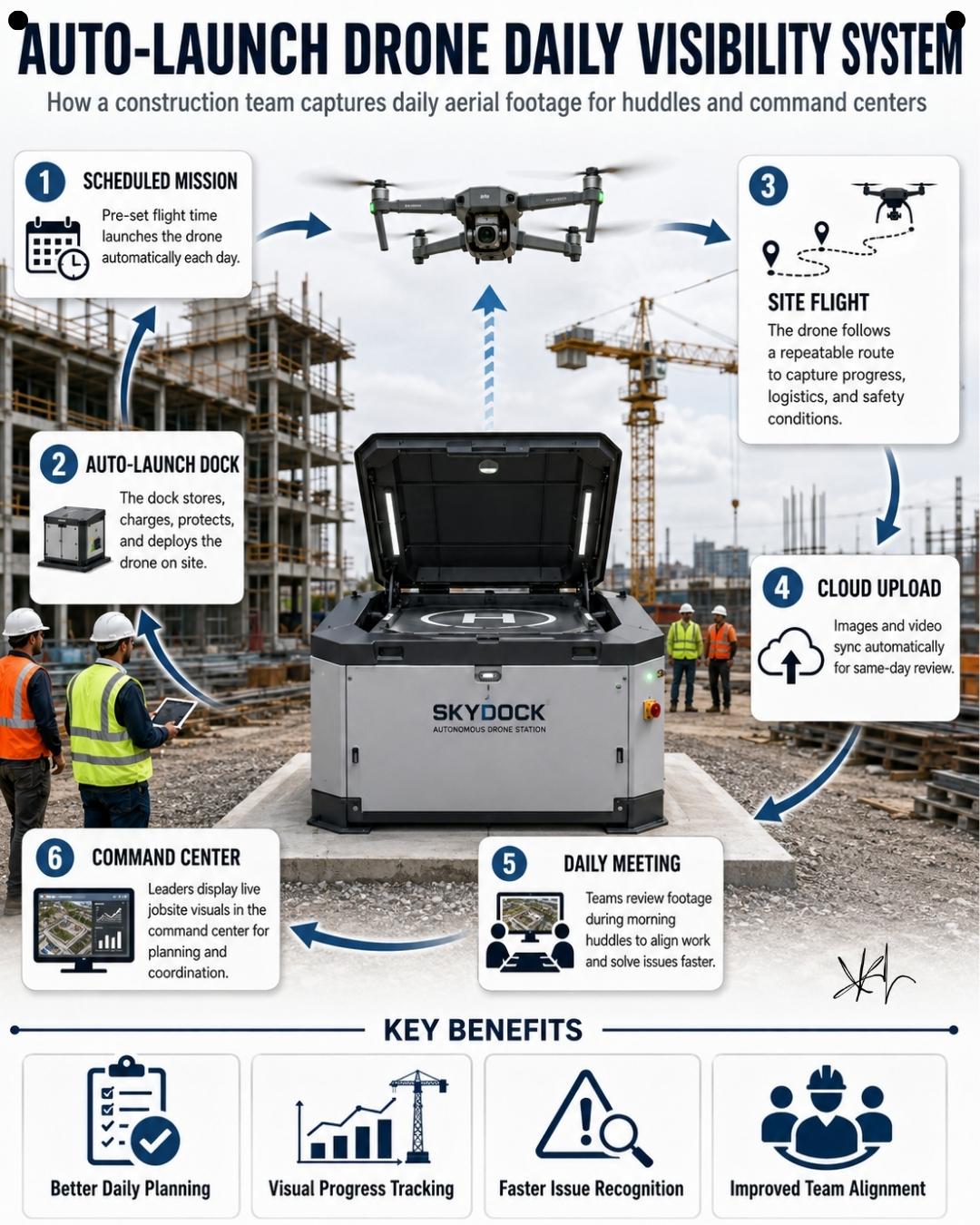
Here is the deal. A construction project is one of the most dynamic physical environments imaginable, material staged today, gone tomorrow, a crane positioned differently than it was last week, a zone that looked clear on Monday and is congested by Thursday. And yet most leadership teams are working from a mental picture of the site that is already out of date by the time they walk into their morning huddle. An auto-launch drone daily visibility system closes that gap automatically, every single day, without requiring anyone to remember to capture it.

Short answer: An auto-launch drone system keeps a drone in a dock on site and flies it on the same route at the same time every day, then uploads the footage for the morning huddle. The team plans from a current picture of the site instead of yesterday’s memory. You can start the same habit today with a daily photo walk.

The Pain of Planning From a Picture That No Longer Exists

Picture a typical morning huddle without this system. The superintendent walks in with a mental image of the site built from yesterday’s walk, maybe supplemented by a quick conversation with a foreman who happened to be around last night. Decisions get made based on that picture, where material should go today, which zone needs attention, what logistics conflict might be developing. The problem is that the picture is already stale. Overnight deliveries shifted the laydown yard. A crew working late changed the state of a zone nobody walked again before the meeting. The plan gets built on a version of reality that no longer exists, and the team does not discover the gap until they are already out in the field, encountering a condition the morning meeting never accounted for.

This is not a failure of attentiveness. It is the predictable result of relying on a manual, inconsistent method, someone remembering to walk a specific area, someone happening to notice a developing issue, to capture a site that changes constantly and does not wait for anyone’s schedule. A system that depends on a person remembering to look is a system that will eventually miss exactly the thing that mattered most on the day attention happened to be somewhere else.

The Failure Pattern

The failure pattern is treating site visibility as something that happens opportunistically, whenever someone has time for a walk or a drone flight, rather than as a non-negotiable daily input that the whole team’s planning depends on.

Most projects that do use drone footage treat it as an occasional tool, deployed for a milestone photo, a progress report to the owner, or a specific investigation when something has already gone wrong. That occasional use means the footage exists exactly when it is least useful, after a problem has already surfaced, rather than consistently enough to catch the problem while it is still small and still cheap to correct. A tool used inconsistently cannot become the reliable daily input that genuine visibility requires.

The Team Didn’t Fail to Look. Nothing Looked for Them.

When a coordination conflict surfaces in the field that nobody saw coming, two trades converging on the same zone, a logistics plan that no longer matches current site conditions, the instinct is to ask why nobody caught it sooner.

Before reaching that conclusion, it is worth asking what information anyone actually had available to catch it. If the team’s picture of the site was built from a walk several days old, or from secondhand reports rather than current, consistent visual data, then the conflict was not missed through carelessness. It was invisible, because nobody had a reliable, automatic system capturing the site’s actual current condition every single day. The team did not fail to look. They were never given a tool that looked consistently enough to catch what mattered.

How the System Actually Runs

The scheduled mission starts the entire loop automatically. A pre-set flight time launches the drone every day, with no person needing to remember or be available to trigger it. This single design choice removes the dependency on human memory that undermines most manual visibility efforts. The drone flies whether or not anyone thought about it that morning.

The auto-launch dock stores, charges, protects, and deploys the drone on site, functioning as a fully self-contained piece of infrastructure rather than equipment someone has to manage, transport, or maintain manually. Set it and forget it is not an exaggeration here. The dock exists specifically to remove every point of friction that would otherwise require a person’s ongoing attention to keep the system running.

One rule to plan for: daily flights need an FAA Part 107 pilot and may need airspace approval near airports.

The site flight follows a repeatable route to capture progress, logistics, and safety conditions, and the repeatability is what actually makes the footage valuable. A different flight path every day produces inconsistent, hard-to-compare footage. The same path, flown at the same time, every single day, creates a visual record where change becomes immediately apparent, because the baseline never shifts, only the site does.

Cloud upload syncs images and video automatically for same-day review, meaning the footage is available before the day’s work has even really started, rather than arriving days later once someone finally has time to download and review it. Same-day availability is what makes this footage a planning input rather than a historical record.

The daily meeting is where the footage actually earns its value. Teams review it during the morning huddle to align work and solve issues faster, replacing a stale mental picture with an actual, current image of the site that the whole team can look at together, rather than relying on one person’s secondhand description of conditions they walked yesterday.

The command center displays live jobsite visuals for ongoing planning and coordination beyond the morning huddle itself, giving leadership a continuously available reference point throughout the day rather than a single snapshot reviewed once each morning.

Why This Is Not About the Drone

Here is the one thing that matters more than any piece of hardware in this system. This is not about the drone. It is about Mieruka, making the work visible so the whole team can see reality and respond to it. The drone, the dock, the cloud upload, all of it is simply the mechanism. The actual value is the principle underneath the mechanism, that a team working from an accurate, current, shared picture of reality makes better decisions than a team working from assumption, memory, or secondhand description.

This is the exact same principle running through every visual management practice I have written about, the project KPI tracker, the Circle of Trust, quality at the source floor markings. Each one exists to replace a hidden or assumed condition with something visible that the whole team can reference together. A drone system simply applies that principle to the physical condition of the entire site itself, captured automatically, consistently, and daily, rather than relying on anyone’s manual effort to walk it and remember what they saw.

Most Coordination Problems Are Visibility Problems, Not Effort Problems

Most coordination problems are not problems of effort. They are problems of visibility. A trade that stacks up behind another trade, a logistics conflict that develops overnight, a safety condition that emerges without anyone noticing in time, none of these happen because anyone failed to work hard enough. They happen because nobody had an accurate, current picture of the site at the moment the decision that led to the conflict was actually made.

When everyone is working off the same picture of the site, progress, logistics, safety, better daily planning, visual progress tracking, faster issue recognition, and team alignment stop being aspirations and start being the default outcome of the system, rather than something a particularly diligent team manages to achieve through extra effort. The system produces the outcome. The team does not have to fight for it.

Signals Your Project Is Flying Blind

Look for these patterns on your current project:

  • The morning huddle is built from a mental picture of the site that is more than a day old
  • Coordination conflicts between trades or logistics are discovered in the field rather than caught the day before they become a problem
  • Drone footage, when it exists at all, gets used only for milestone photos or occasional investigation rather than daily planning
  • Leadership’s understanding of current site conditions depends heavily on secondhand reports rather than direct, current visual data
  • The team has no consistent, repeatable method for seeing the whole site every day before the first task begins

Each of these signals a visibility gap, and that gap is exactly what an automated, daily aerial capture system is built to close.

We Don’t Guess Our Way to Flow

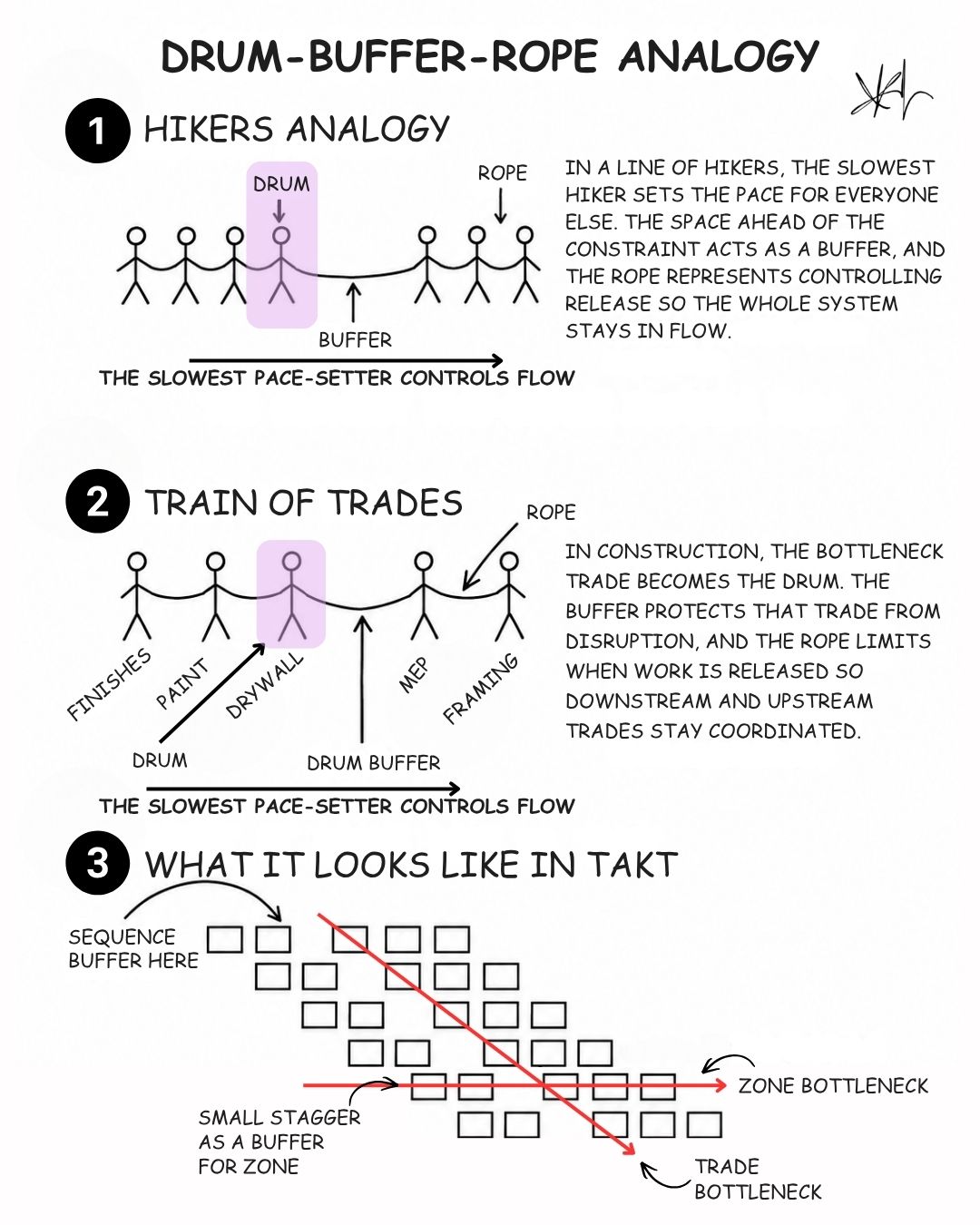
We do not guess our way to flow. We make the work visible, then we go solve the constraint. This connects directly to Drum-Buffer-Rope and Takt planning. You cannot protect a constraint you cannot see clearly. You cannot manage flow you cannot observe consistently. An automated daily visibility system gives a project exactly the kind of current, reliable, shared picture of reality that every other Lean practice depends on to function well.

Our LeanTakt team builds visibility systems like this because a team that genuinely sees the site, every single day, solves problems the day they appear instead of the week after they compound.

Build Your Daily Visibility Loop This Month

Here is your challenge. Whether or not an automated drone system is within reach for your project right now, build the habit this system represents. Capture the actual current condition of your site consistently, daily, before the morning huddle, and bring that real picture into the room instead of a memory from yesterday.

Taiichi Ohno put it this way: “Data is of course important in manufacturing, but I place the greatest emphasis on facts.” A stale mental picture is an opinion about what the site probably looks like. A current photograph is a fact. Build the system that gives your team facts every single morning, and watch how much faster the real problems actually get solved.

Bottom line: Make the work visible every morning, then go solve the constraint.

If your project needs superintendent coaching, project support, or leadership development, Elevate Construction can help your field teams stabilize, schedule, and flow.

On we go.

FAQ

Does a project need expensive drone infrastructure to apply the underlying principle here?

No. The core principle, capturing the actual current condition of the site consistently and bringing that real picture into daily planning, can start with a manual daily walk and photo capture before investing in automated infrastructure. The automated system simply removes the dependency on someone remembering to do it, which matters most once a project reaches a scale where manual consistency becomes difficult to sustain.

Why does the repeatable flight path matter so much?

A consistent route creates a comparable baseline from one day to the next, which makes change immediately visible. A different path every day produces footage that is interesting but hard to compare, since the viewer cannot easily tell whether a difference reflects an actual site change or simply a different camera angle.

How is this different from periodic drone footage used for owner progress reports?

Progress reports are typically occasional and retrospective, documenting milestones after they happen for an external audience. A daily visibility system is continuous and forward-looking, feeding the team’s own planning and coordination decisions every single morning, before problems have a chance to compound.

Who should be responsible for reviewing the footage each morning?

The same people who are already making daily coordination decisions, typically the superintendent and field leadership team, reviewing the footage together as part of the existing morning huddle rather than as a separate, additional meeting. The value comes from integrating the footage into decisions that are already being made, not from creating a new review process layered on top.

How does this connect to Drum-Buffer-Rope and Takt planning?

Both of those practices depend on an accurate, current understanding of where the actual constraint sits and how the work is genuinely flowing through the site. A daily visibility system is the mechanism that makes that understanding possible and current, rather than based on assumption or outdated memory. You cannot protect a constraint or manage a Takt rhythm effectively without first seeing, clearly and consistently, what is actually happening on the ground.

Related: 360° Cameras, Real-Time Site Visibility

If you want to learn more we have:

-Takt Virtual Training: (Takt Virtual Training)
-Check out our YouTube channel for more info: (Elevate Construction on YouTube)
-Listen to the Elevate Construction podcast: (Elevate Construction Podcast)
-Check out our training programs and certifications: (Training Programs and Certifications)
-The Takt Book: (The Takt Book on Amazon)

Discover Jason’s Expertise:

Meet Jason Schroeder, the driving force behind Elevate Construction. As the company’s Founder and COO, he’s dedicated to taking construction to new heights. With a wealth of industry experience, he’s crafted the Field Engineer Boot Camp and Superintendent Boot Camp – intensive training programs engineered to cultivate top-tier leaders capable of steering their teams towards success. Jason’s vision? To expand his training initiatives across the nation, empowering construction firms to soar to unprecedented levels of excellence.
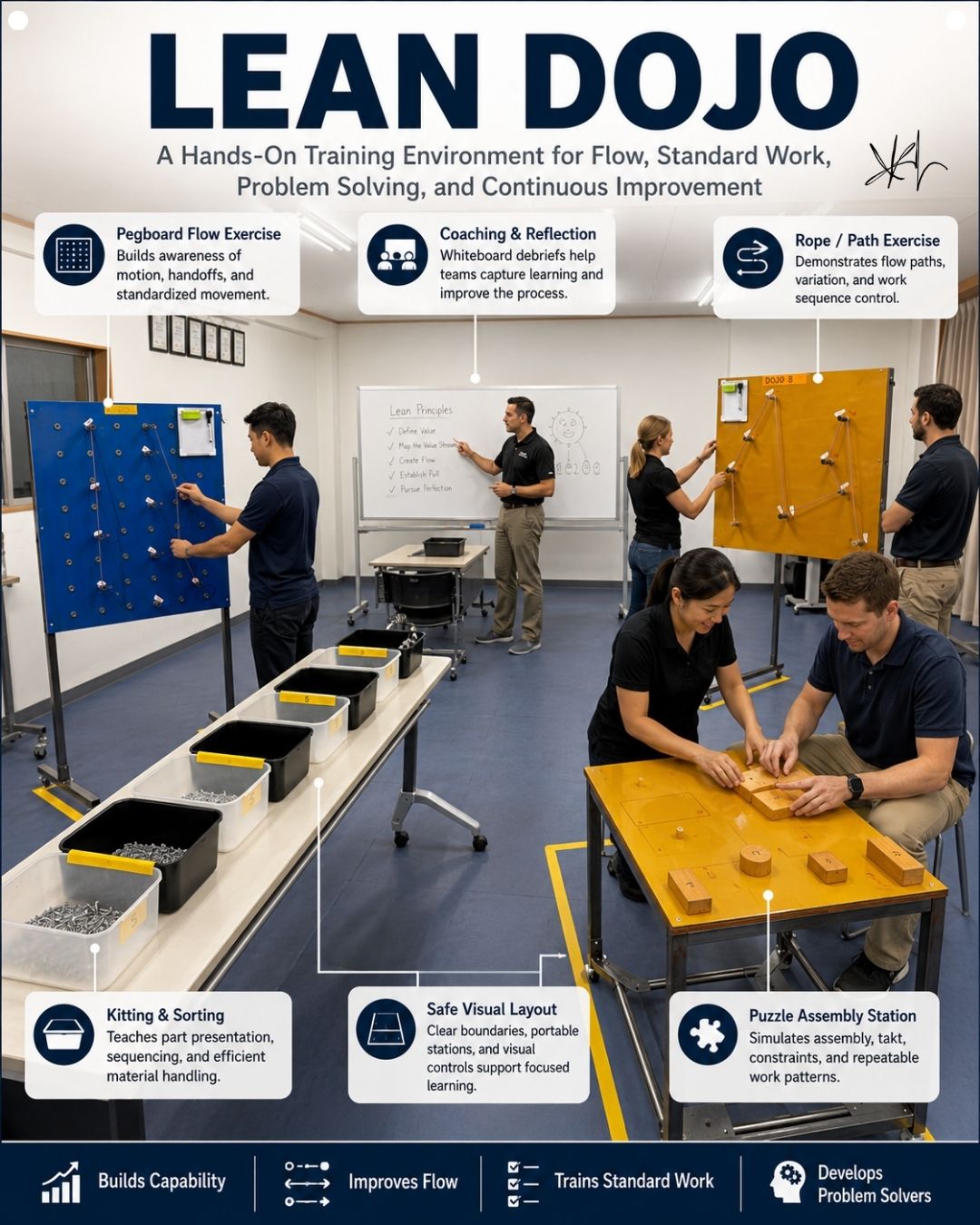
Posted in All

Drum-Buffer-Rope Analogy: The Constraint Sets the Pace

Read 12 min

Drum-Buffer-Rope: The Constraint Sets the Pace, Not the Schedule

The constraint sets the pace, not the schedule.

Here is the deal. Eli Goldratt gave us a simple truth that most teams still fight against every single day. The slowest pace setter controls flow. Picture a line of hikers on a trail. The slowest hiker sets the pace for everyone behind them. Goldratt tells this story in The Goal (written with Jeff Cox), where the slowest scout, Herbie, sets the pace for the whole troop. You can yell at the front of the line all you want. The system moves at the speed of the constraint, not at the speed anyone wishes it would move. That slow hiker is your Drum. The space you protect ahead of them is your Buffer. The Rope is how you control release so the whole line stays together instead of stringing out and breaking apart.

Short answer: In Drum-Buffer-Rope, the bottleneck trade is the Drum and sets the pace for the whole job. The Buffer is a small stock of ready work in front of it so it never sits idle, and the Rope limits how fast new work is released so trades don’t pile up. You speed up the job by protecting the bottleneck, not by pushing every trade harder.

The Pain of Fighting a Constraint Instead of Managing It

Here is what most projects do when a bottleneck trade starts falling behind. They push harder. More crew gets added to the struggling trade. More pressure gets applied in the weekly meeting. More material gets released to that trade in hopes that volume will force speed. None of it works, because none of it addresses what is actually happening. The trade is not slow because it lacks motivation or resources. It is slow because it is the physical constraint in the system, the one activity that genuinely takes longer than everything around it, and no amount of pressure changes the physics of how long that specific work actually takes.

What happens instead is predictable and costly. Flooding a constrained trade with more released work does not make that trade move faster. It creates a pile of work in front of the bottleneck that the bottleneck still has to process at its own fixed rate, while simultaneously starving every trade downstream that was waiting on that bottleneck to finish and release work forward. The system does not speed up. It just moves the congestion to a different, more visible place, and the schedule absorbs the cost of everyone’s confusion about why pushing harder made things worse instead of better.

The Failure Pattern

The failure pattern is treating every trade as equally responsive to pressure, rather than recognizing that one trade in the sequence is genuinely different from the rest, because it is the one actually setting the pace for everyone.

Most schedules get built and managed as if every activity deserves equal attention and equal pressure when it falls behind. That approach works fine for activities that have real slack in the system, trades that are not actually constraining the overall flow. It fails completely for the one trade that is the actual constraint, because pressuring a non-constraint to go faster simply produces inventory that sits waiting on the real bottleneck anyway. The system never identifies which trade is actually the Drum, so it applies the same blunt pressure everywhere, wasting effort on activities that were never the problem while leaving the actual constraint unprotected and unmanaged.

The Slow Trade Didn’t Fail. The Plan Never Named It.

When a project falls behind, the instinct is to look at every trade and ask who needs to move faster. That question, asked broadly, usually produces the wrong answer, because most trades in the sequence are not actually limiting the system’s overall pace. They have capacity to absorb some variation without becoming the reason the whole level slips.

The trade that is genuinely struggling, genuinely the Drum, did not fail by being slow. It is doing the work at the rate the work actually requires, and the project failed by never identifying it as the constraint and managing around that reality. A superintendent who treats every trade identically, applying the same pressure to the Drum as to every other trade, is not managing flow. They are managing noise, while the one variable that actually determines the project’s pace goes unprotected and unmanaged.

How Do You Find the Drum on a Jobsite?

Your bottleneck trade becomes the Drum. Maybe it is drywall. Maybe it is MEP. Whatever it is, that trade sets the rhythm for paint, finishes, and everything behind it, because everything downstream of the Drum can only move as fast as the Drum releases work to it. Once you identify which trade is genuinely the Drum, not which trade is simply having a bad week, but which trade structurally sets the system’s pace, three specific actions follow.

You let the Drum set the pace instead of overloading it. This means matching the rate of work released to that trade with the rate that trade can actually absorb and process, rather than flooding it with more work than it can handle in hopes that volume forces speed. A constraint overloaded with excess inventory does not move faster. It simply accumulates a backlog while everyone downstream waits longer.

You build a Buffer ahead of it so disruption upstream does not starve it. The Drum’s pace only matters if the Drum always has work available to process. If an upstream disruption, a delayed material delivery, a coordination conflict, a weather event, interrupts the flow of work reaching the Drum, the Drum sits idle, and idle time at your actual constraint is the single most expensive form of lost capacity on the entire project. A Buffer, a deliberate stock of ready work positioned ahead of the Drum, absorbs that upstream variation so the constraint never runs dry.

You use the Rope to limit when work gets released, so downstream and upstream trades stay coordinated instead of tripping over each other. The Rope is the control mechanism tying release of new work to the actual pace of the Drum, rather than releasing work based on availability or urgency elsewhere in the system. Without the Rope, upstream trades keep producing at their own pace regardless of whether the Drum can actually absorb what they are producing, creating exactly the pileup of unprocessed work that flooding the bottleneck always creates.

What This Looks Like Inside a Takt Plan

In a Takt plan, this dynamic shows up in two distinct forms, and recognizing both matters for keeping the whole system in flow.

The zone bottleneck is the slowest zone holding up an entire level. Within a given level of work, certain zones take genuinely longer to complete than others, due to complexity, access, or scope. That slowest zone functions as a Drum at the zone level, and the system needs to be managed around that zone’s actual pace rather than expecting every zone to move identically.

The trade bottleneck is the slowest trade holding up the entire train, the same Drum dynamic described earlier, but viewed across the full sequence of trades moving through every zone. A small stagger between wagons becomes your buffer at this level, a deliberate, planned gap between when one trade finishes a zone and when the next trade enters it, absorbing minor variation without letting it cascade into a larger disruption. A sequence buffer up front absorbs the early variation specifically, protecting the very start of the Takt sequence from the kind of early stumbles that, left unprotected, compound through every zone that follows.

The One Thing Most Teams Get Backward

Here is the one thing that matters most in all of this. You do not fix flow by pushing harder. You fix it by protecting the constraint and controlling release. Most teams do the exact opposite. They flood the bottleneck with more work and wonder why everything slows down instead of speeding up. That instinct, more pressure produces more speed, is intuitive and almost always wrong when applied to an actual system constraint, because a constraint’s pace is determined by its own physical capacity, not by how much pressure or inventory gets stacked in front of it.

This is the same discipline running through every practice in Lean construction covered across this series. Takt planning works because it protects a rhythm rather than chasing maximum output in every zone simultaneously. The crane demand analysis works because it schedules the hook deliberately rather than letting every trade compete for it reactively. Drum-Buffer-Rope applies that identical logic to the whole trade sequence, identifying the one point in the system that actually governs pace and managing everything else in support of protecting that point, rather than treating every trade as an equally urgent problem to push against.

How Do You Know Your Project Has an Unmanaged Drum?

Look for these patterns on your current project:

  • One trade consistently determines how fast every downstream trade can start, yet nobody has formally identified it as the project’s constraint
  • Work keeps getting released to a struggling trade faster than that trade can actually process it, creating a growing backlog in front of them
  • The constrained trade frequently sits idle waiting on upstream deliveries or coordination, with no deliberate buffer protecting it from that disruption
  • Pressure and additional crew keep getting applied to the bottleneck trade without any corresponding improvement in overall project pace
  • Zones or trades downstream of the actual constraint are being pushed to move faster, even though they were never the reason the schedule slipped

Each of these signals a system fighting its constraint instead of managing around it, and that fight rarely produces the speed anyone is actually hoping for.

Find Your Drum This Week

Our LeanTakt team builds Takt plans around exactly this logic, identifying the real constraint in a trade sequence and designing the buffer and release strategy around protecting it, rather than applying equal pressure everywhere and hoping the system somehow speeds up on its own.

Want to build a Takt plan around your constraint? Join the Takt Production System Masterclass.

Here is your challenge. Walk your current Takt plan and identify your actual Drum, the one trade or zone genuinely setting the pace for everything else. Stop pushing it harder. Build a buffer ahead of it so upstream disruption cannot starve it. Control the rope so work gets released at the rate the Drum can actually absorb, not the rate everyone upstream wants to produce.

Goldratt put it simply: an hour lost at the bottleneck is an hour lost for the entire system. Drum-Buffer-Rope is that exact principle made concrete. Find your Drum. Buffer it. Rope it. Then watch the whole system move the way it was actually designed to move.

Bottom line: You don’t fix flow by pushing harder. You fix it by protecting the constraint and controlling release.

If your project needs superintendent coaching, project support, or leadership development, Elevate Construction can help your field teams stabilize, schedule, and flow.

Want your team trained on this? See our Last Planner® System and Takt training.

On we go.

FAQ

How do you actually identify which trade is the Drum on a real project?

Look for the trade that consistently determines when downstream trades can start, regardless of how fast those downstream trades could otherwise move. The Drum is not necessarily the trade with the most schedule complaints. It is the trade whose pace genuinely governs the pace of everything after it in the sequence.

Isn’t adding more crew to a struggling trade a reasonable way to speed it up?

Sometimes, if the trade’s capacity is genuinely limited by available labor. But if the trade’s pace is limited by something other than labor availability, access constraints, coordination dependencies, inspection cycles, adding crew does not remove the actual constraint and often just creates more congestion without improving the real bottleneck.

How large should the buffer in front of the Drum actually be?

Large enough to absorb the realistic variation in upstream delivery without creating so much inventory that it defeats the purpose of controlled flow. This typically requires observing actual upstream variation over several cycles and sizing the buffer to the pattern you see, rather than guessing at an arbitrary number upfront.

What happens if you try to protect the Drum but never actually control the rope?

The buffer alone is not sufficient. Without controlling release through the rope, upstream trades keep producing work at their own pace regardless of whether the Drum can absorb it, which recreates the same pileup problem the buffer was meant to prevent, just one step further back in the sequence.

Does the Drum ever change over the life of a project?

Yes, and this is one of the more important things to watch for. As a project moves through different phases and scopes of work, the trade or zone that constrains the system’s pace can shift. A project that identified its Drum correctly in an early phase needs to reassess that identification as the work changes, rather than assuming the same trade remains the constraint for the entire project duration.

People Also Read:
Goldratt’s Rules of Flow

If you want to learn more we have:

-Takt Virtual Training: (Takt Virtual Training)
-Check out our YouTube channel for more info: (Elevate Construction on YouTube)
-Listen to the Elevate Construction podcast: (Elevate Construction Podcast)
-Check out our training programs and certifications: (Training Programs and Certifications)
-The Takt Book: (The Takt Book on Amazon)

Discover Jason’s Expertise:

Meet Jason Schroeder, the driving force behind Elevate Construction. As the company’s Founder and COO, he’s dedicated to taking construction to new heights. With a wealth of industry experience, he’s crafted the Field Engineer Boot Camp and Superintendent Boot Camp – intensive training programs engineered to cultivate top-tier leaders capable of steering their teams towards success. Jason’s vision? To expand his training initiatives across the nation, empowering construction firms to soar to unprecedented levels of excellence.
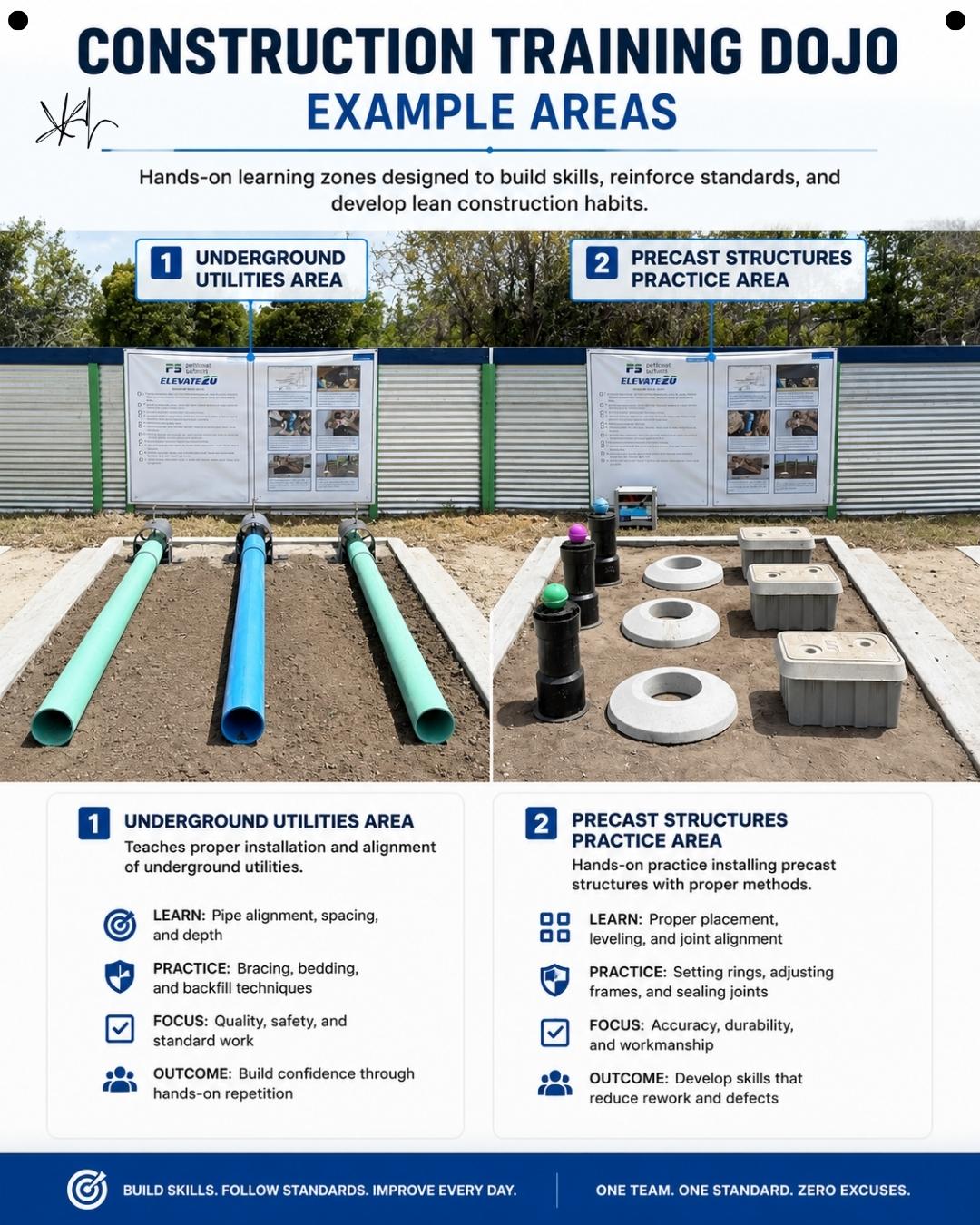
Posted in All

Lean Dojo

Read 12 min

The Lean Dojo: Why the Best Training Happens With Your Hands, Not a Slideshow

The best training does not happen in a slideshow. It happens with your hands.

Here is the deal. We call it the Lean Dojo, a hands-on environment where teams do not just learn about flow, standard work, and problem solving. They feel it. You can tell someone about waste, variation, and flow all day long, but the moment they live it, build it, and get stuck inside it, the lesson sticks in a way no slide ever could.

Short answer: A Lean Dojo is a hands-on training space where construction teams learn flow, waste, and standard work by doing short physical exercises (pegboard flow, kitting and sorting, puzzle assembly, and a rope and path layout), each followed by a whiteboard debrief. People remember what they feel far longer than what they see on a slide.

The Pain of Training That Never Transfers

Picture a typical Lean training session without a dojo. A facilitator walks a room through the five principles on a whiteboard. Define value. Map the value stream. Create flow. Establish pull. Pursue perfection. The explanation is clear, the examples are relevant, and everyone in the room nods along, understanding the concepts intellectually. Then the session ends, everyone returns to their actual work, and within a week the concepts have faded into vague background knowledge that rarely changes how anyone actually behaves on the job.

This happens not because the training was poorly delivered, but because understanding a concept and internalizing it through direct experience are two fundamentally different things. A person can understand, in the abstract, that unnecessary motion wastes time and that handoffs introduce variation and risk. They have never actually felt what it is like to be the bottleneck in a flow, to watch a handoff go wrong in real time, to experience the specific frustration of a process that was not standardized correctly. Without that direct, physical experience, the concepts stay theoretical, and theoretical knowledge rarely survives contact with the pressures of an actual job.

The Failure Pattern

The failure pattern is treating Lean training as information transfer rather than as skill building, and those two things require completely different methods.

Information transfer works well for facts, dates, procedures, the kind of knowledge that can be stated clearly and verified through a quiz. Skill building, particularly the kind of intuitive, felt understanding of flow and waste that Lean actually depends on, requires practice, repetition, and direct physical engagement with the problem. A slideshow can transfer information about what flow looks like. It cannot build the actual capability to recognize flow problems in real time, under pressure, on an actual jobsite. That capability only develops through doing, which is exactly what a classroom format structurally cannot provide.

The Team Didn’t Fail to Learn. The Training Never Let Them Practice.

When a team completes Lean training and then fails to actually apply the principles consistently on the job, the instinct is to question whether they were paying attention, whether the training was memorable enough, whether they simply did not care enough to internalize it.

Before reaching that conclusion, it is worth asking what format the training actually took. If it was delivered entirely as information, slides, lectures, written material, then the team did not fail to internalize it. They were never given the chance to build the actual skill, because skill requires practice and the training never provided any. A classroom lecture about flow is not a failed attempt to build flow capability. It is a different kind of activity entirely, one that can inform but cannot substitute for direct, hands-on experience.

What Exercises Are in a Lean Dojo?

The Pegboard Flow Exercise builds awareness of motion, handoffs, and standardized movement, using a physical board, pegs, and a defined path that forces participants to actually experience what efficient versus inefficient motion feels like, in their own hands, in real time. This is not a diagram of motion waste. It is motion waste, happening right now, to the person doing the exercise, which makes the lesson impossible to forget the way an abstract explanation never could.

Kitting and sorting teaches part presentation, sequencing, and efficient material handling, using actual bins and actual components that participants physically organize and retrieve. The difference between a well-organized kitting system and a poorly organized one becomes immediately, physically obvious once someone is actually trying to retrieve parts quickly and accurately, rather than simply hearing a description of why organization matters.

The Puzzle Assembly Station simulates assembly, Takt, constraints, and repeatable work patterns, giving participants a physical task with real time pressure and real sequencing requirements. This exercise translates the abstract concept of a Takt rhythm into something participants physically experience, including the frustration of being out of sync and the satisfaction of finding a smooth, repeatable pattern.

The Rope and Path Exercise demonstrates flow paths, variation, and work sequence control, using a physical rope or path layout that makes variation in a process visually and physically obvious. Participants can see, directly, how a small deviation in sequence or path creates downstream disruption, a lesson that lands completely differently when experienced physically rather than described verbally.

Coaching and reflection close the loop. Whiteboard debriefs help teams capture learning and improve the process, turning each hands-on exercise into a structured conversation about what actually happened, what worked, what did not, and how the experience connects back to the underlying Lean principles. This reflection step matters enormously, because the physical exercise alone builds experience, but the debrief is what turns that experience into transferable understanding that participants can actually apply back on the job.

Why the Physical Layout Itself Matters

All of this runs on a safe, visual layout, clear boundaries, portable stations, and visual controls that keep the learning focused. This is not incidental. A dojo that is itself disorganized, with unclear boundaries and no visual structure, would undermine the very lessons it is trying to teach. The space has to model the discipline it is instructing, because participants absorb the environment around them as much as they absorb the explicit lesson of any single exercise.

Portable stations also matter practically, because a dojo that can be set up, used, and broken down in a defined space makes this kind of training accessible to projects and organizations that cannot dedicate permanent square footage to a training facility. The physical flexibility of the format is part of what makes it genuinely scalable.

Why This Connects Directly to the Training Dojo Concept Already Covered

This practice sits alongside the Construction Training Dojo covered earlier in this series, applying the same underlying philosophy to a different layer of skill. Where the underground utilities and precast structures training areas build hands-on competence in specific physical construction tasks, the Lean Dojo builds hands-on competence in the underlying thinking patterns, recognizing waste, understanding flow, controlling variation, that apply across every task a team performs. Both share the identical core insight. Every defect prevented in training is a defect you do not chase in the field, and every flow problem a team learns to recognize in a dojo exercise is a flow problem they will recognize faster and correct sooner once they encounter the real version of it on an actual project.

Why Problem Solvers Matter More Than Process Followers

A dojo builds capability. It improves flow. It trains standard work. And most importantly, it develops problem solvers. This last point deserves real emphasis, because it is the difference between a team that merely follows a process correctly and a team that actually understands why the process exists and can improve it when conditions change.

A team trained purely through verbal instruction tends to follow a process rigidly, without a deep enough understanding to recognize when the process itself needs to adapt to a new situation. A team that has physically experienced waste, flow, variation, and constraint through dojo exercises develops a genuine, felt intuition for these concepts, which means they can recognize a flow problem they have never seen before, because they understand the underlying pattern rather than simply memorizing a specific procedure. That is how you build a team that does not just follow the process, but actually improves it, continuously, on their own initiative.

How Do You Know Your Team Needs Hands-On Training?

Look for these patterns in your own organization:

  • Lean principles get explained in meetings and trainings but rarely show up in how the team actually behaves on the job afterward
  • Team members can define concepts like flow and waste accurately but struggle to identify them in real, live situations
  • Training consistently takes the form of slides and lectures, with no hands-on, physical component
  • New hires take significantly longer than expected to develop an intuitive feel for standard work and flow
  • The team follows established processes correctly but rarely identifies opportunities to improve those processes on their own

Each of these signals a gap between information transferred and skill actually built, and that gap is exactly what a hands-on dojo is designed to close.

Build Your Dojo Before the Next Training Session

If your project needs superintendent coaching, project support, or leadership development, Elevate Construction can help your field teams stabilize, schedule, and flow.

See all of our training programs here.

Here is your challenge. Identify one Lean concept your team struggles to apply consistently, whether it is flow, standard work, or waste recognition, and build a simple, physical exercise that lets people actually experience the concept rather than simply hear about it. It does not need to match every element shown here on day one. Start with one station, run it, debrief it, and build from there.

Taiichi Ohno said it plainly: “Progress cannot be generated when we are satisfied with existing situations.” A dojo exists precisely to make a team feel the gap between where they are and where they could be, physically, in their own hands, so that dissatisfaction with the current state becomes something real enough to act on. Build it with your hands, and watch how much faster the lesson sticks.

Bottom line: The best training doesn’t happen in a slideshow. It happens with your hands.

On we go.

FAQ

How is a Lean Dojo different from the Construction Training Dojo covered earlier in this series?

The Construction Training Dojo builds hands-on competence in specific physical construction skills, pipe alignment, precast placement, using real materials in a practice environment. The Lean Dojo builds hands-on competence in the underlying thinking patterns of Lean itself, flow, waste, variation, and standard work, using simplified physical exercises that make those abstract concepts tangible. Both apply the same core philosophy, learning through doing, to different layers of a team’s overall capability.

How long does a typical Lean Dojo session take to run effectively?

Sessions can range from a few hours to a full day depending on how many stations are included and how much time is dedicated to the coaching and reflection debrief after each exercise. The debrief is not optional. Skipping it turns the exercise into an interesting activity without the structured reflection that actually connects the physical experience back to applicable, transferable understanding.

Does a dojo like this require significant investment to build?

The core stations, a pegboard, bins for kitting, simple wooden blocks for the puzzle assembly station, a rope for the path exercise, are inexpensive relative to the capability they build. The investment is primarily in the thoughtful design of each exercise and the discipline of running a genuine debrief afterward, not in expensive equipment or a permanent facility.

Who should facilitate the coaching and reflection portion of each exercise?

Someone with a genuine, practical understanding of the Lean principle being taught, able to connect what participants just physically experienced back to how that same pattern shows up on an actual jobsite. The facilitator’s job is not to lecture about the principle again, but to ask the right questions that help the team articulate what they just felt and how it applies beyond the exercise itself.

How do you know if dojo training is actually working, rather than just being an enjoyable team activity?

Track whether the team’s behavior on actual projects changes in the weeks following the training, whether they start identifying flow problems or waste on their own initiative, without being prompted, and whether they begin proposing process improvements rather than simply following existing procedures. A dojo that only produces a fun afternoon without any visible change in on-the-job behavior has likely skipped or rushed the coaching and reflection component that turns experience into transferable skill.

People Also Read:
How To Level Up Your Construction Team With Effective Training

If you want to learn more we have:

-Takt Virtual Training: (Takt Virtual Training)
-Check out our YouTube channel for more info: (Elevate Construction on YouTube)
-Listen to the Elevate Construction podcast: (Elevate Construction Podcast)
-Check out our training programs and certifications: (Training Programs and Certifications)
-The Takt Book: (The Takt Book on Amazon)

Discover Jason’s Expertise:

Meet Jason Schroeder, the driving force behind Elevate Construction. As the company’s Founder and COO, he’s dedicated to taking construction to new heights. With a wealth of industry experience, he’s crafted the Field Engineer Boot Camp and Superintendent Boot Camp – intensive training programs engineered to cultivate top-tier leaders capable of steering their teams towards success. Jason’s vision? To expand his training initiatives across the nation, empowering construction firms to soar to unprecedented levels of excellence.

Posted in All

Construction Training Dojo: Example Areas

Read 12 min

The Construction Training Dojo: Where Confidence Gets Built One Rep at a Time

This is where confidence gets built, one rep at a time.

Here is the deal. The best construction companies do not throw people into the field and expect them to figure it out. They build a place to learn first. Too often crews get handed the work with no reps behind them, and then everyone wonders why rework, defects, and self-doubt follow. That sequence is backwards. A Construction Training Dojo flips it. You learn the standard, you practice the standard, and you build muscle memory before any of it costs you on the live job.

Short answer: A construction training dojo is a dedicated practice area where crews rehearse real tasks, like aligning and bedding underground pipe or setting precast rings and frames, before they do them on the live job. Mistakes made in the dojo cost nothing, so new hires build confidence and the project sees less rework.

The Pain of Learning Under Live Conditions

Picture a typical onboarding process without a dedicated training space. A new hire gets paired with an experienced worker and learns by watching, then learns by doing, with the live job itself serving as the training ground. The first pipe they align, the first precast ring they set, happens on an actual installation, under actual schedule pressure, with actual consequences if something goes wrong. If their alignment is off, if their joint sealing is incomplete, if their understanding of proper depth and spacing is incorrect, the project absorbs that mistake directly, as rework, as a defect caught later in inspection, or worse, as a defect that never gets caught until it becomes a much larger problem downstream.

This is an expensive and unreliable way to build a skilled workforce. The live job is not designed to tolerate mistakes gracefully. It is designed to move forward on schedule, and every mistake made while someone is still learning the fundamentals competes directly against that schedule. The new worker, meanwhile, is forming their understanding of the correct standard in an environment where getting it wrong carries real cost, which produces exactly the kind of hesitation and self-doubt that follows people for years after a rough start. Confidence built under pressure, with real consequences attached to every early mistake, is confidence built slowly and expensively. Confidence built through dedicated repetition, in a space designed specifically for learning, is confidence built fast and cheap.

The Failure Pattern

The failure pattern is treating the live job as the default training ground, simply because it is always available, rather than building a dedicated space specifically designed for repetition without consequence.

Most projects do not lack the will to train people well. They lack a place to do it. Training happens informally, whenever there is downtime, using whatever materials happen to be around, taught by whoever happens to be available at that moment. That informality means the quality of training a new worker receives depends entirely on circumstances outside anyone’s control, who was free to teach them, what materials were on hand, how much pressure the live schedule was already under. A dedicated dojo removes that dependency on circumstance. The space exists specifically to teach a specific standard, with purpose-built materials, in an environment where getting it wrong costs nothing except the time it takes to try again.

The New Hire Didn’t Fail. They Never Got the Reps.

When a new worker makes repeated mistakes on a live installation, misaligned pipe, an improperly sealed joint, the instinct is to question their aptitude or their attention to detail. They should have paid closer attention. They are not picking this up fast enough.

Before reaching that conclusion, it is worth asking what that worker actually had the chance to practice before the live job became their first real attempt. If the answer is nothing, if their very first alignment, their very first joint seal, happened on an actual installation with real consequences attached, then the mistakes they made were not a failure of aptitude. They were the predictable result of learning under conditions that never allowed for genuine, consequence-free repetition. Give that same worker a dedicated space to practice the exact same skill a dozen times before it ever matters, and the mistakes that showed up on the live job largely disappear, not because the worker became smarter, but because they were finally given the repetitions their skill actually required.

What Does a Construction Training Dojo Teach?

The Underground Utilities Area teaches the proper installation and alignment of underground utilities, using real pipe, real spacing, and a real training environment built specifically for repetition. Workers learn pipe alignment, spacing, and depth, the foundational measurements that determine whether an installation meets standard from the very first attempt. They practice bracing, bedding, and backfill techniques, the supporting skills that surround the core installation and determine its long-term durability. The focus throughout is quality, safety, and standard work, reinforced the same way every time, with no shortcuts and no variation based on whoever happens to be supervising that day. The outcome is confidence built through hands-on repetition, the kind of confidence that only comes from having actually done something correctly multiple times before being asked to do it under live conditions.

The Precast Structures Practice Area provides hands-on practice installing precast structures with proper methods, using actual rings, frames, and joints in a controlled setting. Workers learn proper placement, leveling, and joint alignment, the precision skills that determine whether a precast structure performs as designed over its full service life. They practice setting rings, adjusting frames, and sealing joints, the specific physical techniques that separate work done correctly from work that merely looks correct. The focus is accuracy, durability, and workmanship, and the outcome is skills that reduce rework and defects, because the worker has already made and corrected their early mistakes in a space where those mistakes carried no real cost.

Every Defect Prevented in Training Is a Defect You Don’t Chase in the Field

Here is the Lean truth underneath the whole practice. Every defect prevented in training is a defect you do not chase in the field. The best builders are not slowing down to train. They are speeding up everything that comes after, because a worker who has already built genuine competence through repetition moves faster, with fewer corrections, fewer second-guesses, and fewer callbacks than a worker whose first real attempt at a skill happened on the live job under schedule pressure.

This connects directly to the same principle behind the field quality checklist system and lift drawings covered earlier in this series. Both of those practices are about catching problems and building understanding before the cost of a mistake becomes expensive. The training dojo applies that exact same logic one step earlier, before the worker ever picks up a tool on an actual installation. It is quality at the source applied not to a specific task, but to the skill itself.

Why Repetition Builds What Instruction Alone Cannot

There is a meaningful difference between being told the correct standard and actually practicing it enough times that the correct motion becomes automatic. A worker who has been told the correct pipe alignment procedure understands it intellectually. A worker who has physically aligned pipe correctly a dozen times in a training area has built something deeper, a muscle memory and an intuitive feel for what correct actually looks and feels like, that no amount of verbal instruction alone can produce.

This is exactly why the dojo format matters more than a classroom or a written procedure. Physical skills, pipe alignment, joint sealing, ring setting, are learned through physical repetition, not through reading or watching alone. A dedicated training area that lets a worker fail safely, correct themselves, and try again, repeatedly, without any live consequence attached to the early attempts, is the only environment that actually produces the muscle memory the live job depends on.

How Do You Know Your Team Needs a Dedicated Training Space?

Look for these patterns on your own project or organization:

  • New hires are learning foundational skills, pipe alignment, joint sealing, precast placement, for the first time on an actual live installation
  • Rework and defect rates trace back consistently to workers early in their tenure rather than being evenly distributed across experience levels
  • Training currently depends entirely on informal pairing with whoever happens to be available, rather than a consistent, repeatable curriculum
  • New workers show visible hesitation or lack of confidence on tasks they have never had the chance to practice before being asked to perform them live
  • The organization has never built a space specifically designed for repetition without consequence, relying entirely on the live job as the default training ground

Each of these signals a gap between the skill level the live job actually requires and the preparation workers are given before they are asked to meet that standard.

Building Your Own Dojo

A training dojo does not require a large footprint or significant capital investment. The example areas shown here use actual pipe, actual precast components, and simple visual instruction boards, built in a defined space that can be revisited repeatedly by every new worker who joins the team. The investment is in dedicating that space specifically to training, rather than treating every available surface as either live work or unused space, and in building clear, repeatable instruction that teaches the same standard consistently, regardless of who is supervising a given session.

Jason Schroeder and the LeanTakt team build training dojos into their development programs specifically because the cost of training deliberately, before the live job, is consistently lower than the cost of training accidentally, through rework and defects discovered after the fact.

For a step-by-step training plan, see Elevating Construction Field Engineers.

Build Your Dojo Before the Next Hire Starts

Here is your challenge. Identify the one skill your team most commonly gets wrong on the live job, the recurring rework item, the defect that keeps showing up in inspection. Build a small, dedicated space where that specific skill can be practiced repeatedly, with no consequence attached to early mistakes, before the next new hire ever attempts it live.

Lean has always taught that real skill comes from doing, not from being told, and from practicing the standard until it becomes automatic. A construction training dojo is that philosophy made physical. Build skills. Follow standards. Improve every day. One team, one standard, zero excuses.

Bottom line: Every defect prevented in training is a defect you don’t chase in the field.

If your project needs superintendent coaching, project support, or leadership development, Elevate Construction can help your field teams stabilize, schedule, and flow.

On we go.

FAQ

How much space does a construction training dojo actually require?

The example areas shown here fit within modest, defined footprints, using real materials arranged specifically for repeated practice rather than live installation. A project or organization does not need a large dedicated facility to start. A single defined area with the right materials and clear instruction can teach one or two foundational skills effectively.

Should training dojos be built on every project, or maintained as a permanent organizational resource?

A permanent, organization-level dojo allows every new hire across every project to build foundational skills before their first live assignment, which produces more consistent results than building a one-time training area on a single project and then losing that investment once the project closes out. Organizations running multiple projects over time generally benefit most from a permanent training resource.

How do you decide which skills deserve a dedicated training area?

Start with the skills most commonly associated with rework, defects, or new hire hesitation on your actual projects. If underground utility installation or precast structure placement are recurring sources of callbacks or inspection failures, those are strong candidates for a dedicated practice area, since the training investment directly targets your highest-cost failure points.

Does a training dojo replace the need for on-the-job mentorship from experienced workers?

No. A dojo complements mentorship rather than replacing it. The dojo gives a new worker the chance to build foundational repetition and muscle memory in a consequence-free setting. Experienced mentorship on the live job still matters for teaching judgment, site-specific conditions, and the countless situational factors that a controlled training area cannot fully replicate.

How does this connect to other quality practices, like field quality checklists and lift drawings?

All three practices share the same underlying principle, catching problems and building genuine understanding before the cost of a mistake becomes expensive. Field quality checklists verify installation quality in real time during live work. Lift drawings force coordination understanding before concrete is placed. A training dojo applies that same quality at the source discipline one step earlier, building the worker’s actual skill and muscle memory before they ever perform the task on a live, consequence-bearing installation.

People Also Read:
Lean Dojo

If you want to learn more we have:

-Takt Virtual Training: (Takt Virtual Training)
-Check out our YouTube channel for more info: (Elevate Construction on YouTube)
-Listen to the Elevate Construction podcast: (Elevate Construction Podcast)
-Check out our training programs and certifications: (Training Programs and Certifications)
-The Takt Book: (The Takt Book on Amazon)

Discover Jason’s Expertise:

Meet Jason Schroeder, the driving force behind Elevate Construction. As the company’s Founder and COO, he’s dedicated to taking construction to new heights. With a wealth of industry experience, he’s crafted the Field Engineer Boot Camp and Superintendent Boot Camp – intensive training programs engineered to cultivate top-tier leaders capable of steering their teams towards success. Jason’s vision? To expand his training initiatives across the nation, empowering construction firms to soar to unprecedented levels of excellence.

Posted in All