
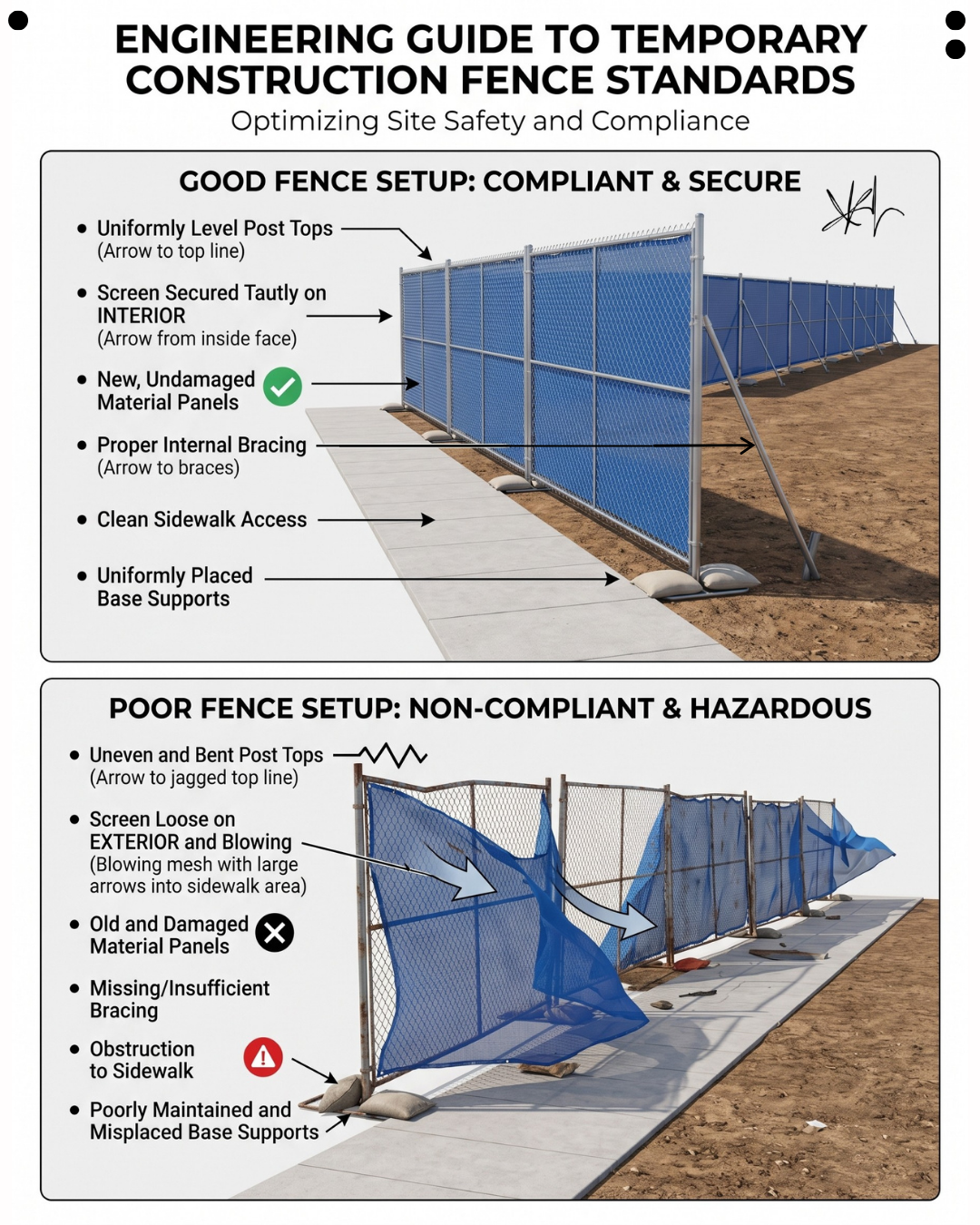
Engineering Guide to Temporary Construction Fence Standards: Why Your Fence Line Is a Leadership Signal
Temporary does not mean negligent.
Here is the deal. The construction fence is the most publicly visible element on any project and the one that gets the least leadership attention. It is the first thing the public sees. It is the first thing an inspector sees. It is the first thing a pedestrian walking past your project at seven in the morning with a stroller sees. And what they see tells them exactly what kind of project this is before they ever meet the superintendent, review the schedule, or hear a single word about the team’s commitment to quality.
A taut screen, level posts, clean sidewalk access, and proper bracing communicates that this project is run by people who care about the details that nobody is watching. A loose screen blowing into pedestrian space, bent post tops leaning over the sidewalk, and scattered base supports communicates that nobody is watching at all.
The Pain That Walks Past Your Site Every Day
Every active construction project in an urban or suburban setting has a public interface. That interface is the fence line, and the condition of that fence line is producing a continuous, uncontrolled message about the project to every person who passes it.
A pedestrian who has to step around a sandbag that has shifted into the sidewalk is receiving a message. A parent who sees damaged panels and loose screen fabric blowing toward the path their child walks to school is receiving a message. A city inspector who drives past on the way to another project and notices bent post tops and missing braces is receiving a message. None of those messages are being sent intentionally, but all of them are being received clearly.
The problem is not that project teams do not understand this. Most superintendents know their fence should look good. The problem is that fence maintenance lives in the category of tasks that are important but never urgent, which means they get deferred in favor of whatever is urgent today. The screen that started pulling loose on Tuesday is still loose on Friday. The panel that got damaged by a delivery truck two weeks ago has not been replaced. The bracing that should have been checked after last week’s windstorm was not checked because last week’s windstorm also created three other problems that demanded immediate attention.
The fence degrades slowly, and slow degradation is the kind of problem construction leadership is worst at catching because it never announces itself as a crisis. It just gets a little worse each week until someone external, an inspector, a neighbor complaint, a project owner doing a drive-by, sees it and names it. By then, the fence has been communicating the wrong message for weeks.
The Failure Pattern
The failure pattern is treating the fence as a one-time installation rather than a maintained system.
The fence goes up during mobilization. The crew that installs it does a good job. Posts are level, screen is taut and secured on the interior face, panels are new, bracing is proper, base supports are uniformly placed. For the first two weeks, the fence looks excellent. Then the project starts. Deliveries come and go. Equipment moves along the perimeter. Weather hits. A panel gets clipped. A brace gets knocked out. The screen starts to pull free at one attachment point, then two, then a full section is loose and catching wind.
Nobody is assigned to the fence. That is the system failure. The fence is not on a maintenance schedule. It is not part of a daily or weekly walk with documented standards. It is not anyone’s specific responsibility after installation. It belongs to everyone in theory, which means it belongs to no one in practice. The degradation is incremental and distributed across dozens of small events, none of which individually feel like a problem worth stopping the day for.
By the time the fence is visibly non-compliant, the gap between the current condition and the standard has grown so large that fixing it feels like a project rather than a maintenance task. And a maintenance task that has grown into a project gets deferred even further because now it requires planning, material, and labor that have to be pulled from the real work.
They Didn’t Fail the System
When a project’s fence line looks bad, the instinct is to find someone to hold accountable. Who was supposed to be watching the fence? Why didn’t the foreman catch this? Why didn’t anyone report it?
The answer is usually that nobody was watching the fence because the system never assigned anyone to watch it. The foreman didn’t catch it because the foreman has eighty things competing for attention and the fence was not on the daily checklist. Nobody reported it because slow degradation does not produce a report-worthy event on any single day. It produces a hundred small events, each one below the threshold of attention, that accumulate into a visible failure over weeks.
The person is not the problem. The absence of a maintenance system is the problem. Build the system and the fence stays compliant. Leave the system absent and blame the person when it fails, and the fence will fail again on the next project exactly the same way.
What Compliant Actually Looks Like
The difference between a compliant fence setup and a non-compliant one is not ambiguous. It is specific, observable, and binary at every checkpoint.
Uniformly level post tops mean that the top line of the fence reads as straight and intentional from any viewing angle. Bent or uneven post tops create a visual signal of neglect and, more practically, reduce the structural integrity of the panel connections. A post that has been bent by contact with equipment is a post that is no longer carrying its share of the wind load, which means the adjacent panels are carrying more, which means they will fail sooner.
Screen secured tautly on the interior face is a safety specification, not an aesthetic preference. Screen mounted on the exterior catches wind and acts as a sail, pulling away from the fence and extending into pedestrian space. Screen mounted on the interior is pressed against the panels by wind rather than pulled away from them. That single installation decision, interior versus exterior, is the difference between a screen that stays put in wind and one that becomes a sidewalk hazard.
New, undamaged panels maintain the structural envelope of the fence and the visual standard of the project. A damaged panel is a weak point in the perimeter and a visual signal that the project tolerates degradation. Proper internal bracing keeps the fence stable under wind load and prevents the slow lean that eventually puts a post over pedestrian space. Clean, unobstructed sidewalk access is both a compliance requirement and a basic obligation to the public using the space adjacent to your project. Uniformly placed base supports distribute the load and prevent the shifting that leads to panels separating and opening gaps in the perimeter.
Each of those elements is a system input. When all six are maintained, the fence performs its function and communicates a standard. When any one of them degrades, the system starts to fail and the public sees it before the project does.
Why the Fence Is a Leadership Signal
The fence matters beyond compliance for a reason that most project leaders understand intuitively but rarely act on deliberately.
Standards are contagious. A project where the perimeter is clean, the fence is taut, the sidewalk is clear, and the base supports are uniform is a project that communicates a standard before anyone walks through the gate. Every trade partner arriving on site that morning receives the signal: this is a project where the details are maintained. That signal influences how they set up their work area, how they leave their zone at the end of the day, how they treat shared spaces, and how seriously they take the standards that the superintendent communicates in the morning meeting.
The reverse is equally true. A fence line with loose screen, bent posts, and obstructed sidewalks communicates that the standard here is flexible. That message does not stay at the perimeter. It migrates inward. The laydown yard gets a little less organized. The gang box gets a little less maintained. The zone handoffs get a little less clean. The tolerance for degradation that started at the fence line eventually touches the work itself, and by then it is a culture problem rather than a maintenance problem.
This is why the fence is a leadership system and not a facilities task. The condition of the perimeter is a statement about the project’s relationship with standards, and that statement is being read every day by every person who enters the site and every member of the public who walks past it.
Building a Fence Maintenance System
A compliant fence line does not maintain itself, and hoping someone will notice problems is not a system. The system needs three components to work.
First, the fence needs to be on a scheduled inspection cadence. Weekly at minimum, more frequently during weather events or periods of heavy delivery and equipment activity along the perimeter. The inspection is a walk of the full perimeter checking each of the six compliance points: post level, screen attachment and tension, panel condition, bracing integrity, sidewalk clearance, and base support placement. That walk takes fifteen to twenty minutes and prevents the slow degradation that turns a compliant fence into a liability.
Second, the inspection needs an owner. One person, with the authority to order replacement panels and the expectation that deficiencies found during the walk will be corrected within twenty-four hours. Shared responsibility for the fence is no responsibility for the fence.
Third, replacement materials need to be on site. A project that has to order a replacement panel and wait three days for delivery is a project that will run non-compliant for three days while the order processes. Having two or three spare panels, a roll of screen material, and replacement hardware staged on site means that any deficiency found during the walk can be corrected the same day.
Signals Your Fence System Needs Attention
Walk your perimeter today and look for these patterns:
- Screen fabric that is loose, pulling away from attachment points, or mounted on the exterior face rather than the interior
- Post tops that are no longer uniformly level, indicating equipment contact or wind damage that was not corrected
- Panels with visible damage, holes, or separation at connection points
- Base supports that have shifted, creating gaps between panels or allowing posts to lean
- Any sidewalk obstruction, including shifted sandbags, scattered materials, or screen fabric extending into the pedestrian path
Each of those findings is a same-day correction, not a discussion item. The cost of fixing any one of them is measured in minutes. The cost of leaving them is measured in the message they send every hour to every person who passes your project.
The Standard Starts at the Property Line
Your project’s relationship with quality is visible before anyone walks through the gate. The fence line is the first page of the story the project is telling, and it is being read by the public, by inspectors, by trade partners arriving for their first day, and by the project owner driving past on a weekend.
That first page is yours to write. Make it clean, make it level, make it compliant, and make it maintained. The discipline that holds the perimeter standard is the same discipline that holds the schedule, the safety program, and the quality standard on the work itself. If your project needs superintendent coaching, project support, or leadership development, Elevate Construction can help your field teams stabilize, schedule, and flow. Jason Schroeder and the LeanTakt team teach that standards start at the smallest, most visible detail and scale inward from there, because the detail is the culture.
Here is your challenge. Walk your fence line this afternoon. Not tomorrow. Not after the next meeting. Today. Walk every linear foot of it with the six compliance points in mind. Fix what you find, assign what you cannot fix today, and schedule the walk as a weekly event that does not get skipped.
Edwards Deming said: “Quality is everyone’s responsibility.” Start at the fence line and let the quality work its way in. The public is already watching.
On we go.
FAQ
Why does it matter whether the screen is mounted on the interior or exterior face?
Screen mounted on the exterior catches wind and acts as a sail, pulling away from the fence and extending into pedestrian space. Screen mounted on the interior is pressed against the panels by wind rather than pulled away from them. The interior mounting is structurally more stable under wind load and eliminates the hazard of loose fabric blowing into the sidewalk. It is a safety specification, not a preference.
How often should the fence line be inspected?
Weekly at minimum during normal conditions, and additionally after any weather event with significant wind, after heavy delivery or equipment activity along the perimeter, and after any reported damage. The inspection is a full perimeter walk checking post level, screen condition, panel integrity, bracing, sidewalk clearance, and base supports. It takes fifteen to twenty minutes and prevents the slow degradation that makes fence problems invisible until they are severe.
Who should be responsible for fence maintenance?
One specific person with the authority to correct deficiencies and order replacement materials. Shared responsibility produces no responsibility. The assigned person does not need to make every repair personally, but they need to own the inspection cadence, the standard, and the follow-through on corrections.
If you want to learn more we have:
-Takt Virtual Training: (Click here)
-Check out our Youtube channel for more info: (Click here)
-Listen to the Elevate Construction podcast: (Click here)
-Check out our training programs and certifications: (Click here)
-The Takt Book: (Click here)
Discover Jason’s Expertise:
Meet Jason Schroeder, the driving force behind Elevate Construction IST. As the company’s owner and principal consultant, he’s dedicated to taking construction to new heights. With a wealth of industry experience, he’s crafted the Field Engineer Boot Camp and Superintendent Boot Camp – intensive training programs engineered to cultivate top-tier leaders capable of steering their teams towards success. Jason’s vision? To expand his training initiatives across the nation, empowering construction firms to soar to unprecedented levels of excellence.