
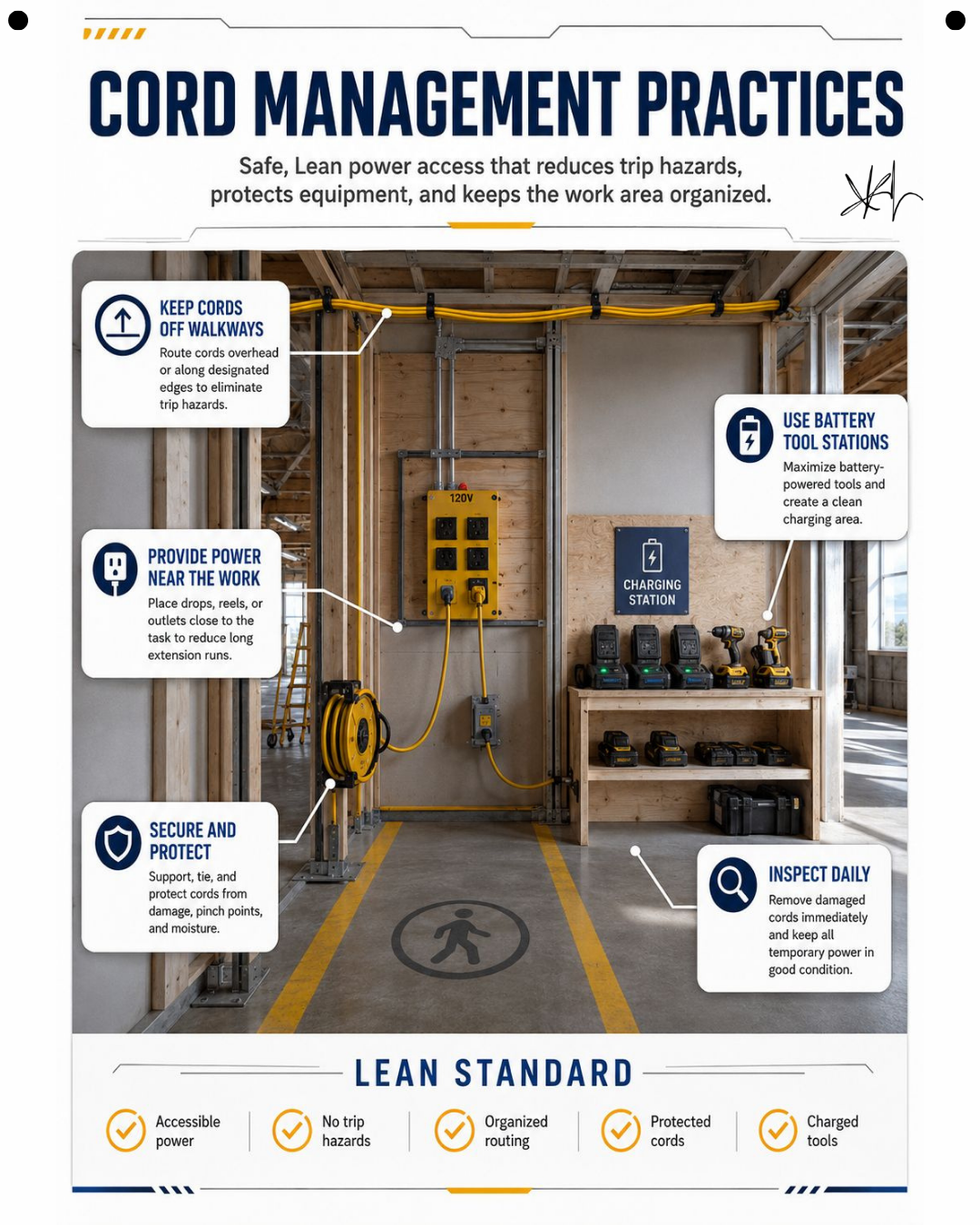
Cord Management Practices: Why Temporary Power Tells You Everything About How a Site Is Run
Cord management is not glamorous. Walk any jobsite and you will find extension cords snaking across walkways, daisy chained reels stacked three deep, and damaged cords nobody flagged because flagging them felt like more trouble than it was worth. Small stuff. Until someone trips, a tool fails mid task because the power dropped, or a cord gets pinched at a doorway and shorts out.
Here is the deal. Temporary power is one of the most overlooked systems on any construction project, and it is also one of the clearest leading indicators of how well the rest of the operation is being run. A site with cords snaking across every walkway, damaged jackets nobody replaced, and reels tangled into a pile is telling you something about its housekeeping standard, its inspection discipline, and its overall attention to detail. That signal is not subtle once you know to look for it.
The Pain of a Hazard Everyone Has Learned to Step Over
Picture a typical work area three weeks into an active phase. An extension cord runs from a panel across the main walkway to a saw station forty feet away, because the outlet closest to the work was already occupied and nobody set up a secondary drop. A reel sits half unwound near the base of a stairway, its cord looping across the bottom two steps. Somewhere near the back of the space, a cord with a visibly cracked jacket has been in use for two weeks because pulling it would mean stopping to find a replacement, and stopping felt like a bigger cost than the risk felt like a problem.
None of this happened because anyone wanted to create a hazard. It happened because temporary power gets treated as an afterthought, something that gets set up quickly at the start of a task and then left alone until the task is finished, rather than something maintained continuously with the same discipline applied to any other safety system. Everyone on the crew has walked past that cord across the stairway a dozen times. They have learned to step over it without thinking. That adaptation is exactly what makes it dangerous. The moment someone new to the space, distracted, or carrying material with both hands walks that same path, the hazard that everyone else learned to avoid becomes the incident nobody saw coming.
The Failure Pattern
The failure pattern is treating temporary power as a setup task rather than a maintained system.
Cords get run when a task starts. A reel gets pulled out, a drop gets connected, and the immediate power need is solved. What rarely happens is a plan for how that power access will be maintained as the task continues, as other trades move through the same space, and as conditions around the drop change. The cord that made sense on day one, running along a clear path to an empty work area, becomes a hazard on day five once material has been staged nearby, other crews have started working adjacent tasks, and foot traffic through that specific corridor has increased.
Because nobody owns temporary power as an ongoing responsibility, it degrades the same way any unmanaged system degrades. A cord gets moved to accommodate a delivery and never gets rerouted properly afterward. A pinch point develops where a cord crosses a door threshold repeatedly, and the damage accumulates invisibly until the jacket finally splits. A reel that was neatly wound at the start of the week becomes a tangled mess by Friday because nobody was responsible for re coiling it during the daily cleanup. Each of these small degradations feels too minor to address on its own. Together they produce exactly the chaotic power setup that signals a site running without real housekeeping discipline.
They Didn’t Fail the System
When a crew member trips over a cord, or a damaged cord causes a tool failure mid task, the instinct is to ask why that person was not paying closer attention. Why didn’t they see it? Why didn’t they report the damaged cord sooner?
The more useful question is what the site gave that person to work with. If cords are routinely run across primary walkways because no one designed a routing plan that keeps power access away from foot traffic, the crew member did not fail to notice a hazard. They were navigating a hazard that the system placed directly in their path. If a damaged cord stayed in service for two weeks, that is not one person’s oversight. That is the absence of a daily inspection practice that would have caught the damage on day one instead of day fourteen.
People adapt to whatever environment they are given. A crew working in a space with cords consistently kept off walkways, power reliably positioned near the task, and damaged equipment pulled the same day it is found will maintain that standard without much prompting, because the environment reinforces it. A crew working in a space where cords have always been in the way and damage has always gone unaddressed will adapt to that instead, and the adaptation looks like carelessness even though it is actually a rational response to an unmanaged system.
What a Lean Standard for Cord Management Actually Requires
Keeping cords off walkways is the foundation, and it requires actual routing decisions rather than hoping cords happen to end up out of the way. Overhead routing or placement along designated edges removes the trip hazard entirely rather than just minimizing it, and the decision about where cords will run should be made at the same time the work area is set up, not improvised after the fact when the walkway is already established and the cord has nowhere else to go.
Providing power near the work addresses the root cause of most of the long, snaking runs that create hazards in the first place. Drops, reels, or outlets positioned close to the actual task mean the distance a cord has to travel is short, which means fewer opportunities for that cord to cross a walkway, wrap around a corner, or stretch across a space where other crews are moving. This is the same principle behind point of use material staging applied to power access specifically. Bring the resource to where the work is happening instead of asking the work to reach across a long, exposed run to get to it.
Securing and protecting cords addresses the damage that accumulates invisibly over time. Supporting cords so they are not lying loose across high traffic areas, tying them to keep routing consistent, and shielding them from pinch points and moisture all extend the working life of the equipment while also keeping the routing itself predictable rather than shifting day to day as cords get kicked, stepped on, or repositioned informally.
Battery tool stations reduce the entire problem at its source by reducing how much temporary power infrastructure a site needs in the first place. A clean, organized charging area that maximizes cordless tool use means fewer cords running at all, which means fewer opportunities for any of the other failure modes to occur. This is not a replacement for good cord management on the tasks that still require corded power. It is a genuine reduction in total exposure.
Daily inspection is what keeps the entire system from degrading the way unmanaged systems always degrade. Pulling damaged cords immediately, rather than letting them stay in service until someone finally has time to deal with it, is the difference between a hazard caught in hours and a hazard that persists for weeks. This inspection does not need to be elaborate. It needs to be consistent, assigned to someone specific, and treated as a non negotiable part of the daily routine rather than something that happens when time allows.
Why This Is a Leading Indicator, Not Just a Safety Item
Clean power access tells you something about a site that extends well beyond the cords themselves. A team that maintains disciplined cord routing, inspects daily, and pulls damaged equipment immediately is a team that has built genuine housekeeping discipline into its daily rhythm. That same discipline almost always shows up in how the team manages material staging, tool organization, and general site cleanliness, because the underlying habit, noticing small degradation and correcting it before it compounds, is the same habit across every one of those systems.
The reverse is equally reliable. A site where temporary power looks chaotic, cords everywhere, reels tangled, damaged jackets in service, is very rarely a site that has excellent discipline everywhere else and simply happens to be sloppy about cords. Chaotic temporary power is almost always one visible symptom of a broader pattern, the same pattern that shows up in an unmanaged connex box, an undisciplined corridor, or a laydown yard nobody has organized in weeks. Cord management is easy to observe and hard to fake, which is exactly what makes it such a useful leading indicator for anyone trying to read the actual condition of a site quickly.
Signals Your Cord Management Needs Attention
Walk your active work areas and look for these patterns:
- Cords crossing primary walkways or stairways rather than routed overhead or along designated edges
- Long extension runs from a distant outlet instead of power positioned close to the actual task
- Cords with visible damage, cracked jackets, or exposed wire still in active use
- Reels left tangled or unwound at the end of the day rather than recoiled and stored
- No specific person or routine assigned to inspect temporary power daily
Each of these is a small, fixable gap, and each one is worth taking seriously precisely because of what it tends to indicate about the rest of the operation.
Building the Standard Into the Daily Rhythm
A Lean standard for cord management does not require significant investment. It requires a routing decision made when each work area is set up, power positioned close enough to the task that long runs are rarely necessary, cords secured and protected from the pinch points and moisture that cause premature damage, a genuine push toward battery tool use where it is practical, and a daily inspection that treats a damaged cord as something to pull immediately rather than something to note for later. If your project needs superintendent coaching, project support, or leadership development, Elevate Construction can help your field teams stabilize, schedule, and flow. Jason Schroeder and the LeanTakt team treat clean temporary power as one of the fastest ways to read the real condition of a site, because a team that maintains this discipline is very rarely cutting corners anywhere else.
Walk Your Power Setup Today
Here is your challenge. Walk your active work areas today and specifically look at the cords. Where are they routed. How far is power from the actual task. Is anything damaged and still in service. Fix what you find, and build the daily inspection into your routine going forward rather than waiting for the next walkthrough to catch it.
Edwards Deming put it plainly: “In God we trust, all others bring data.” Walk the site, look at the cords, and let what you actually see tell you the truth about how the rest of the operation is running.
On we go.
FAQ
Why does cord placement matter so much if the hazard seems minor?
A single cord across a walkway is a low probability, low severity event on any given day, but the same cord crossed hundreds of times by dozens of people over weeks accumulates real exposure. Trip hazards in high traffic corridors carry more cumulative risk than the same hazard in a rarely used area, simply because of how often people encounter it.
How often should temporary power be inspected?
Daily during active phases of work, ideally as part of a broader daily site walk that also covers housekeeping and material staging. Damage that goes unnoticed for even a few days can worsen quickly, especially in areas exposed to moisture or repeated foot and equipment traffic.
Is switching to battery tools a full replacement for cord management practices?
Not entirely. Battery tools reduce how much cord infrastructure a site needs, which reduces overall exposure, but most active sites will still require corded power for certain equipment. The two practices work together rather than one replacing the other.
If you want to learn more we have:
-Takt Virtual Training: (Click here)
-Check out our Youtube channel for more info: (Click here)
-Listen to the Elevate Construction podcast: (Click here)
-Check out our training programs and certifications: (Click here)
-The Takt Book: (Click here)
Discover Jason’s Expertise:
Meet Jason Schroeder, the driving force behind Elevate Construction IST. As the company’s owner and principal consultant, he’s dedicated to taking construction to new heights. With a wealth of industry experience, he’s crafted the Field Engineer Boot Camp and Superintendent Boot Camp – intensive training programs engineered to cultivate top-tier leaders capable of steering their teams towards success. Jason’s vision? To expand his training initiatives across the nation, empowering construction firms to soar to unprecedented levels of excellence.