
Field Quality Checklists: A Visual System for Doing It Right the First Time
Quality does not live in a spec book. It lives in the field.
Here is the deal. Most quality systems on construction projects exist as documentation, a binder in the trailer, a spec section nobody references after the pre construction meeting, a QC plan that describes standards in language nobody carries onto the deck. That documentation is not wrong. It is just disconnected from the moment quality actually gets decided, which is the moment a crew is installing a specific piece of work in a specific location. A field quality checklist system closes that gap by moving the standard out of the binder and into the crew’s hands, work package by work package, exactly where the decisions that determine quality are actually being made.
The Pain of Quality Discovered Too Late
Picture the standard quality process on a project without a field system like this. Work gets installed based on a crew’s general understanding of the specification and their own experience. An inspector or QC manager reviews it later, sometimes days or weeks after installation, checking against a standard that lives in a document the crew never directly referenced while doing the work. When something does not meet the standard, the finding comes back as a punch item or a non conformance report, discovered after the work is complete and often after subsequent trades have already built on top of it.
That sequence, install first, verify later, guarantees that any quality gap gets discovered at the most expensive possible point. A connection that was not properly secured, a clearance that was not verified, a step in the installation sequence that got skipped under time pressure, all of these are cheap to correct in the moment they happen and expensive to correct after the fact, especially once the work is covered by drywall, buried underground, or built over by a subsequent trade. The gap between when quality actually gets determined and when quality actually gets checked is where rework, punch lists, and non conformance reports come from, and that gap exists specifically because the standard was never physically present with the crew while they worked.
The Failure Pattern
The failure pattern is treating quality control as an inspection function that happens after the work, rather than a standard that travels with the work as it happens.
A specification document defines what good work looks like, but a specification document sitting in a trailer or a project management system does nothing to influence the actual installation happening on the deck at that moment. The crew installing a specific connection is relying on training, memory, and habit, not on a document they are actively referencing step by step. When memory and habit are accurate, the work meets standard. When they drift, even slightly, the work does not, and nobody catches the drift until an inspection happens later, disconnected from the moment the decision was actually made.
This pattern repeats across every trade and every work package on a project that has not built quality verification into the actual workflow. The specification exists. The standard exists. What is missing is the bridge between that standard and the crew’s hands at the exact moment the work is being done, and that missing bridge is exactly what a field quality checklist is built to provide.
They Didn’t Fail the System
When a quality issue surfaces during inspection, a connection installed incorrectly, a step skipped, a clearance not maintained, the instinct is to ask why the crew did not follow the specification. They should have known better. They should have checked the drawing.
Before reaching that conclusion, it is worth asking what the crew actually had in their hands while doing the work. If the answer is nothing beyond memory and general training, then the crew was working without the tool that would have prevented the deviation, not because they were careless, but because the system never gave them a physical, in hand reference to check against in the moment. A photo guided, step by step checklist changes that completely. It puts the correct sequence directly in front of the crew while they work, which means the standard is present at the exact moment it matters most, rather than arriving later as a correction after the fact.
What the System Actually Contains
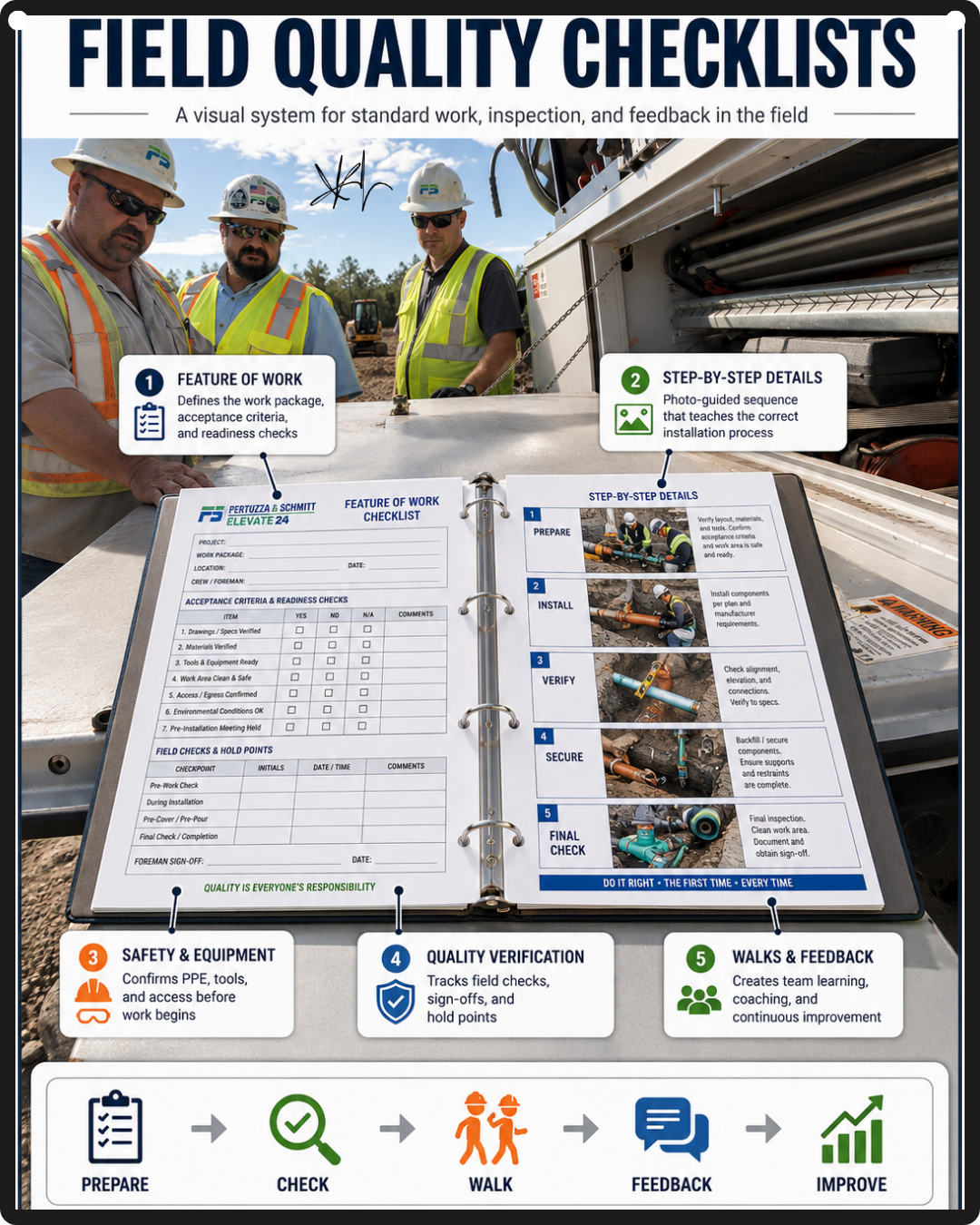
The Feature of Work checklist defines the work package, the acceptance criteria, and the readiness checks that need to be confirmed before anyone touches the work. Drawings verified. Materials verified. Tools and equipment ready. Work area clean and safe. Pre installation meeting held. This checklist front loads the verification that normally would not happen until an inspection catches its absence, confirming before the work starts that every prerequisite is actually in place, rather than discovering mid installation that a required material was never delivered or a drawing revision was never communicated to the crew.
Step by step details use photo guided sequences to teach the correct installation process directly. Prepare, install, verify, secure, final check, each step illustrated with actual photographs rather than paragraphs of written specification language. This format matters specifically because pictures communicate a physical sequence far more reliably than text does. A foreman can train a new hire directly from this checklist. A worker unfamiliar with a specific installation can follow the photo sequence and understand exactly what correct looks like at every stage, without needing to interpret written specification language that may be technically accurate but is not built for quick field reference.
Hold points and sign offs create accountability at each critical stage: pre work, during installation, pre cover, and final completion. Initials and dates at each hold point mean there is no ambiguity about who checked what, and when. This structure catches problems at the stage where they are cheapest to fix. A pre cover hold point specifically exists to catch anything that needs correction before it becomes permanently inaccessible behind a finish material, which is exactly the moment where catching an issue costs the least and missing it costs the most.
The Loop That Makes It Work
The checklist itself is the tool, but the loop that surrounds it is what actually drives improvement. Prepare, check, walk, feedback, improve. Each stage in that loop has a specific function, and skipping any one of them weakens the whole system.
Preparation is the Feature of Work checklist confirming readiness before work begins. Checking is the hold point verification happening at each critical stage of the installation. Walking is where a superintendent physically reviews the work in progress, using the checklist as the shared reference point for the conversation. Feedback is the coaching conversation that happens during that walk, specific, tied to the actual standard, and delivered while the work is still fresh rather than days later in a punch list email. Improvement is what happens when that feedback actually changes how the next work package gets executed, closing the loop rather than letting the same issue repeat indefinitely.
The walks and the feedback are where the real value gets unlocked. That is where superintendents coach instead of catch. A superintendent who only shows up after the work is complete to identify what is wrong is playing a different role than a superintendent who walks the work in progress with the crew, checklist in hand, and coaches toward the standard while there is still time to adjust before completion. The first role produces a punch list. The second role produces a crew that gets better at the work over time, because they are learning the standard through direct, timely coaching rather than through a list of corrections handed to them after the fact.
Why Photos Beat Paragraphs
The decision to use photo guided sequences instead of written specification language is not a stylistic preference. It reflects how people actually learn a physical installation process. A written paragraph describing the correct sequence for securing a connection requires the reader to translate text into a mental image of the physical action, and that translation introduces room for error, especially for someone less experienced or someone who learns better visually than verbally. A photograph of the actual correct connection, at the actual correct stage, removes that translation step entirely. The crew is not interpreting a description. They are matching what they are doing to what they can see.
This is the same principle behind quality at the source floor markings, which put design intent directly on the physical surface where the work happens rather than leaving it as an abstraction in a drawing set. Field quality checklists apply that same principle to the installation sequence itself, making the standard visually concrete and immediately referenceable rather than something the crew has to recall from training or interpret from a written specification.
Signals Your Project Needs This System
Look for these patterns on your current project:
- Quality issues consistently discovered during inspection rather than caught during the installation itself
- New workers or crews unfamiliar with a specific installation relying entirely on verbal instruction rather than a visual reference they can check against
- Punch lists that repeat the same category of issue across multiple work packages, suggesting a standard that is not being consistently communicated at the point of installation
- Superintendents spending more time identifying completed work that does not meet standard than coaching work while it is still in progress
- No clear hold point structure that confirms readiness and verifies work at defined stages before it becomes inaccessible
Each of these signals a gap between where the standard lives and where the work actually happens, and that gap is exactly what a field quality checklist system closes.
Quality Becomes Everyone’s Responsibility
The deepest shift this system produces is not procedural. It is cultural. When quality only lives in a QC department’s inspection process, quality becomes something that happens to a crew, a judgment delivered after the fact by someone external to the actual installation. When quality lives in a checklist the crew carries themselves, checks against themselves, and gets coached through during a superintendent’s walk, quality becomes something the crew owns directly. That ownership is what actually drives the standard higher over time, far more reliably than an inspection process ever could on its own.
Do it right. The first time. Every time. That is not just a slogan printed at the bottom of a checklist. It is the practical outcome of moving the standard from a document in the trailer into the crew’s hands, work package by work package, at exactly the moment it matters. If your project needs superintendent coaching, project support, or leadership development, Elevate Construction can help your field teams stabilize, schedule, and flow. Jason Schroeder and the LeanTakt team build field quality systems like this because a standard that only exists on paper never actually changes what happens on the deck, and a standard that travels with the crew changes everything.
Build the Checklist Before the Next Work Package Starts
Here is your challenge. Pick one recurring work package on your project, one that has produced punch list items before, and build a simple Feature of Work checklist for it. Acceptance criteria, readiness checks, photo guided steps, and hold points with sign offs. Put it in the crew’s hands before the next installation, not after.
Taiichi Ohno taught that the goal is to build quality into the process itself rather than inspecting it in after the fact. A field checklist that travels with the crew is exactly that principle made physical. Stop catching what went wrong. Start building it right the first time.
On we go.
FAQ
How is this different from a standard quality control inspection process?
A standard inspection process checks completed work against a specification after installation. A field quality checklist system puts the standard directly in the crew’s hands during the installation itself, using hold points and photo guided steps to verify quality at each stage rather than only at the end. Inspection catches problems after they exist. This system is designed to prevent the problem from existing in the first place.
Who should be responsible for creating the photo guided step by step sequences?
Typically a superintendent or quality manager with direct field experience in the specific installation, working alongside the trade partner performing the work, since the photos need to accurately represent what correct execution actually looks like for that specific task. Involving the trade partner in creating the checklist also builds buy in, since they are helping define the standard rather than simply being handed one.
How many hold points should a typical checklist include?
Most effective checklists use four stages: pre work, during installation, pre cover, and final completion. Pre cover is often the single most important hold point on any work that will become inaccessible once covered, since it is the last opportunity to catch and correct an issue before the cost of correction increases significantly.
If you want to learn more we have:
-Takt Virtual Training: (Click here)
-Check out our Youtube channel for more info: (Click here)
-Listen to the Elevate Construction podcast: (Click here)
-Check out our training programs and certifications: (Click here)
-The Takt Book: (Click here)
Discover Jason’s Expertise:
Meet Jason Schroeder, the driving force behind Elevate Construction IST. As the company’s owner and principal consultant, he’s dedicated to taking construction to new heights. With a wealth of industry experience, he’s crafted the Field Engineer Boot Camp and Superintendent Boot Camp – intensive training programs engineered to cultivate top-tier leaders capable of steering their teams towards success. Jason’s vision? To expand his training initiatives across the nation, empowering construction firms to soar to unprecedented levels of excellence.