What Good Traffic Control Looks Like

Read 12 min

What Good Traffic Control Looks Like: The First Thing the Public Sees

I have walked a lot of jobsites, and you can tell a lot about a project by its traffic control.

Here is the deal. Faded cones. Crooked barricades. A sidewalk closed sign tipped over in the gutter. When the traffic control is sloppy, it is almost never just the traffic control. It is a signal of how the whole operation is being run. Traffic control is not the lowest priority item on a site. It is the first thing the public sees, the first line of safety for your crew, and a daily reflection of your standards, whether anyone intended it to communicate that or not.

Short answer: Good construction traffic control is clean and new, highly visible, properly oriented, and kept to the same standard on day one and day two hundred. Assign one person to walk the perimeter on a set schedule, keep spare cones and panels on site, and fix any damaged or misplaced device the same day.

The Pain of a Perimeter Nobody Is Watching

Picture a typical project a few months into construction. The traffic control went up correctly at mobilization, new cones, clean barricades, properly angled panels. Then time passes. A cone gets clipped by a delivery truck and rolls into the gutter, where it sits for a week before anyone notices or replaces it. A barricade panel fades in the sun until its stripes are barely visible at dusk. The sidewalk closed sign gets knocked over by wind and nobody rights it until a pedestrian mentions it, annoyed, three days later.

None of this happens because anyone decided safety did not matter. It happens because traffic control, once installed, rarely gets the same ongoing attention that the actual construction work receives. Nobody is assigned to walk the perimeter daily and check it the way someone is assigned to check the schedule or the budget. The degradation is slow, distributed across small events, and by the time it is visibly bad, the project has been sending the wrong message to every driver, pedestrian, and inspector passing by for weeks.

The Failure Pattern

The failure pattern is treating traffic control as a one-time installation rather than a maintained system, the exact same pattern that governs temporary fencing and every other perimeter element a project is responsible for.

A traffic control plan gets approved, the devices get installed, and the box gets checked. From that point forward, the devices exist in a kind of institutional blind spot. They are not part of the schedule. They are not part of the budget conversation. They are not part of the daily huddle. They simply sit at the edge of the site, degrading at whatever rate weather, traffic, and incidental contact happen to produce, with no one specifically responsible for noticing and correcting that degradation before it becomes visible to the public.

The Crew Didn’t Fail. Nobody Owned the Perimeter.

When a project’s traffic control looks faded, crooked, or incomplete, the instinct is to ask why nobody on site cared enough to fix it. That instinct misses what actually happened. Most projects never assigned anyone the specific job of maintaining traffic control as an ongoing standard. Installation happened once, correctly, and after that the devices became background, competing for nobody’s attention against the schedule pressures that consume every other hour of a superintendent’s day.

The crew did not fail to notice a faded cone. They were never given a system that made noticing and correcting it part of anyone’s daily responsibility. Build that system, and the same crew that walked past the faded cone for weeks will replace it the same day it happens, because now someone’s job includes seeing it.

What Does Good Traffic Control Actually Look Like?

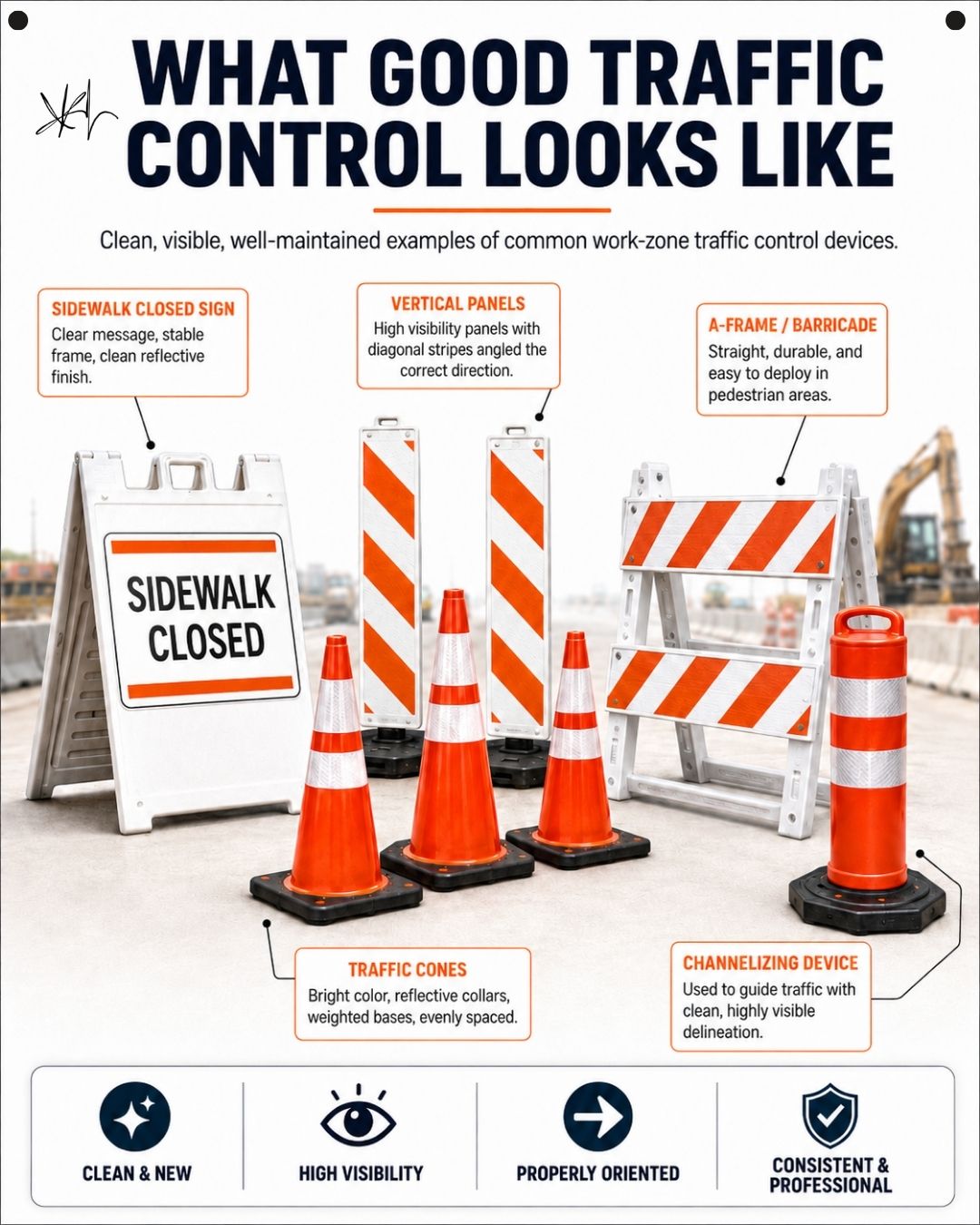
A sidewalk closed sign with a clear message, a stable frame, and a clean reflective finish communicates its instruction instantly, to anyone, regardless of lighting or weather. A sign that is faded, leaning, or propped against something instead of standing on its own frame asks the pedestrian to do interpretive work the sign should be doing for them.

Vertical panels with high-visibility diagonal stripes, angled the correct direction, guide a driver’s eye along the path the project actually wants them to take. The direction of the stripe is not decorative. It communicates which way traffic should move around an obstruction, and a panel installed backward or faded past legibility actively works against the safety function it exists to serve.

The A-frame barricade, straight, durable, and easy to deploy in pedestrian areas, holds its position and its message under real conditions, wind, foot traffic, incidental contact. A barricade that has started to lean or has lost a panel is no longer doing the job it was installed to do, even if it is still technically present.

Traffic cones, bright-colored, with reflective collars, weighted bases, and even spacing, create a continuous, legible line that a driver or pedestrian can track without conscious effort. Uneven spacing or a missing cone breaks that continuity, forcing anyone navigating the perimeter to guess at where the boundary actually is.

The channelizing device guides traffic with clean, highly visible delineation, functioning as the connective tissue between every other device on the perimeter. When this element is maintained well, the whole system reads as one coherent, intentional path. When it degrades, the perimeter starts to look like a collection of separate, disconnected objects rather than a designed system.

In the U.S., traffic control devices must follow the MUTCD (Part 6 covers work zones) and your approved traffic control plan.

What Are the Four Standards of Good Traffic Control?

Clean and new means gear that is actually maintained, not beat up and forgotten at the edge of the site. This is not about replacing every device constantly. It is about having a system that catches degradation and corrects it before the public notices it first.

High visibility means bright color, reflective collars, and devices people actually see, in daylight, at dusk, and in poor weather. A device that technically exists but has faded past real visibility is not providing the safety function it was installed to provide, even though it is still physically present at the perimeter.

Properly oriented means panels and stripes angled the correct direction, every single time, with no exceptions for convenience or time pressure during installation. A device facing the wrong way does not just fail to help. It can actively mislead a driver about which direction to move, which is a worse outcome than no device at all.

Consistent and professional means the same standard on day one and day two hundred. This is the hardest standard to maintain precisely because it requires sustained attention long after the installation excitement has faded and the project has moved deep into its routine, where traffic control competes for attention against everything else demanding a superintendent’s time.

Why This Is Never Just About the Cones

When a driver slows down appropriately, when a pedestrian is guided safely around your work, when a crew member trusts the perimeter protecting them from traffic, that is not luck. That is the direct result of intentional work design, carried out consistently rather than installed once and left to degrade.

This connects directly to the same principle behind temporary fencing standards covered earlier in this series. A perimeter, whether it is a construction fence or a traffic control zone, is the first thing the public interacts with before they ever encounter anyone from the project directly. It communicates a standard before a single word gets exchanged. A project that maintains a clean, consistent, properly oriented perimeter is telling every person who passes it that someone here is paying attention. A project that lets its perimeter fade and lean is telling the same audience the opposite, whether or not that message was ever intended.

That signal does not stay at the edge of the site either. The same discipline that keeps traffic control maintained daily, assigning ownership, building an inspection cadence, correcting degradation immediately, is the discipline that keeps a laydown yard organized, a connex box labeled, and a quality checklist actually followed. A project that lets its most visible, most public-facing element slide is rarely holding a tighter standard somewhere less visible. We protect people by caring about the details most folks walk right past, and traffic control is one of the clearest, most public tests of whether that care is genuine or just a phrase on a safety banner.

Signals Your Traffic Control Has Become an Afterthought

Walk your perimeter today and look for these patterns:

  • Cones that are faded, cracked, or missing their reflective collar
  • Barricade panels leaning, damaged, or facing the wrong direction
  • A sign that has fallen or shifted out of its stable, upright position
  • Uneven spacing between devices, creating gaps in the visual line a driver or pedestrian is supposed to follow
  • No specific person assigned to inspect traffic control as part of a regular daily or weekly routine

Each of these is a same-day fix once someone notices it. The real gap is not the broken device. It is the absence of a system ensuring someone actually looks.

Build the Maintenance System, Not Just the Installation

A traffic control plan deserves the same ongoing ownership I’ve already covered for temporary fencing, corridors, and cord management. Assign a specific person to walk the perimeter on a regular cadence, checking visibility, orientation, and condition against the same four standards every time. Keep a small stock of replacement cones, panels, and signage on site so a degraded device gets corrected the same day it is found, not weeks later once someone outside the project finally says something.

Our LeanTakt team treats the public-facing perimeter of a project with the same discipline applied to the work itself, because the perimeter is often the only part of the project most of the public ever actually sees.

Walk Your Perimeter Today

Here is your challenge. Walk your traffic control zone this afternoon, not next week. Check every cone, every panel, every sign against the four standards: clean and new, high visibility, properly oriented, consistent and professional. Fix what you find today, and assign the walk as a recurring responsibility so the next degradation gets caught before the public catches it first.

Marcus Aurelius wrote, “If it is not right, do not do it; if it is not true, do not say it.” A faded, leaning perimeter is not telling the truth about the standard your project actually holds. Fix the perimeter, and let it tell the truth you want it to tell.

Bottom line: Traffic control isn’t a one-time installation. It’s a maintained system, held to the same standard on day one and day two hundred.

If your project needs superintendent coaching, project support, or leadership development, Elevate Construction can help your field teams stabilize, schedule, and flow.

On we go.

FAQ

Why does traffic control matter so much if it is not part of the actual construction scope?

Traffic control is the first and often only part of a project that the general public interacts with directly, since most passersby never see the interior work at all. A degraded perimeter communicates a lack of attention to the entire project, regardless of how well the actual construction is being managed, which makes it a disproportionately important signal relative to its small cost.

How often should traffic control devices actually be inspected?

Daily during active phases with heavy equipment or delivery traffic near the perimeter, since incidental contact and weather exposure cause most of the degradation that accumulates unnoticed. A quick daily walk takes only a few minutes and catches problems while they are still a same-day fix.

What is the most commonly overlooked traffic control standard?

Proper orientation, specifically panels and stripes facing the correct direction. This detail is easy to get right during initial installation and easy to lose track of after a device gets bumped, moved, or reset by weather, since a misoriented panel still looks present and functional from a distance even though it is no longer communicating the correct directional guidance.

Who should be responsible for maintaining traffic control throughout the project?

A specific, assigned person, the same principle that governs fence maintenance and corridor discipline. Shared responsibility across the whole team tends to produce the same gradual neglect that happens whenever an important standard has no single owner checking it on a consistent cadence.

How does traffic control connect to a project’s broader safety culture?

If your traffic control looks like an afterthought, your safety culture probably feels like one too. The public cannot see your internal safety meetings, your toolbox talks, or your incident rate, but they can see the perimeter every single day. A maintained, professional perimeter is one of the only safety signals visible to anyone outside the project, and it often shapes outside perception of the entire operation more than any internal metric ever will.

People Also Read:
Construction Fence Vegetation Control
How Long Can Construction Stop Traffic?

If you want to learn more we have:

-Takt Virtual Training: (Takt Virtual Training)
-Check out our YouTube channel for more info: (Elevate Construction on YouTube)
-Listen to the Elevate Construction podcast: (Elevate Construction Podcast)
-Check out our training programs and certifications: (Training Programs and Certifications)
-The Takt Book: (The Takt Book on Amazon)

Discover Jason’s Expertise:

Meet Jason Schroeder, the driving force behind Elevate Construction. As the company’s Founder and COO, he’s dedicated to taking construction to new heights. With a wealth of industry experience, he’s crafted the Field Engineer Boot Camp and Superintendent Boot Camp – intensive training programs engineered to cultivate top-tier leaders capable of steering their teams towards success. Jason’s vision? To expand his training initiatives across the nation, empowering construction firms to soar to unprecedented levels of excellence.
Posted in All

Zone Control: How to Manage the Speed of the Train

Read 9 min

Here’s the deal. Flow on a project is centered around everyone following the same plan, going the same direction in the same sequence, adding the same amount of value per crew, every zone having the same amount of work, and the train of trades going the same speed, the same distance apart. So when that train is moving through the zones, how do we actually control that speed and leverage our ability to flow? That is zone control.

Short answer: Zone control is how a superintendent keeps the train of trades moving at Takt time. Walk each zone with the foreman twice a day: five minutes punching yesterday’s work so it’s finished before the crew moves on, and five minutes checking that tomorrow’s area is ready. Then use the afternoon foreman huddle to clear what isn’t.

I want to give a shout-out to Grit at PC Construction. He came up with this concept after implementing the Takt Production System on his project, and on that project he called his assistant superintendents zone managers. I thought that was brilliant, so we immediately put together a guide.

Where Does Zone Control Fit in the Day?

Every project should be doing the daily worker huddle. After that, the crews go do the crew preparation huddle, where they fill out their pre-task plans, look over quality preparation steps, do two minutes of training or whatever that looks like, do their bend and stretch, 5S their area, look for waste, and set up their day.

That brings us to the superintendent. No superintendent should ever go outside without something in their hand, meaning their schedule and their zone maps. If they want it on an iPad, that is fine. We never go empty-handed. Ever. The schedule and zone maps are the crystal ball to see into the future and control the zones.

So supers take their Takt plan and zone maps with them as they walk the job, with the focus on finishing, preparing for zone management, and looking for the three Ms, which I explain in The Three Ms. The daily rhythm goes like this.

  • Early morning, they go out and do their walks.
  • They come back in and report in the daily team huddle with the internal office team, where they report roadblocks and collaborate as a team.
  • In the afternoon, they go back out to take action and create flow for the next day.
  • They prepare for the afternoon foreman huddle, where the next day is planned.

The Walk Itself

When the superintendent, or the zone manager if you want to call them that, goes out on their floors, they go from zone to zone. I am using interiors as a reference here, but this works for civil, exterior, wherever.

The first thing they do is say, “Hey, how’s it going? Do you have a couple of minutes? Can you walk for five minutes with me on the work you did yesterday, so we can just punch it as we go?” I am not going to put it on a list. We are not going to do a fancy punch list program. We are not going to waste our time. I just want to make sure your crew grabs these items before they move on.

Imagine interiors, maybe a hospital, multifamily, or a hotel. You go through the units or rooms they finished the day before, whether that was paint, drywall, metal stud framing, in-wall roughing, or installing cabinets. You punch it out as you go. You can use tape. I do not care how you mark it. Then you get a commitment from the foreman to have their people finish it while they are there.

There is no need to wait. If we wait, there are fifteen to twenty-five additional steps, and it just wastes the team’s time.

Then You Look Ahead

Next you say, thank you, I love that you are finishing as you go. Let’s look at the next day’s work out ahead of you. Are these rooms prepared?

Then you walk those rooms or areas for five minutes, inspect, and ask whether it is ready. The answer will come back, yeah, I think it is ready. No. Look deep. Is this area ready? Yeah, I told you it is ready, what else do you want?

Find three or four things that are not ready. Then you will finally start to get real feedback. I need that soffit. I need these materials. If you want something to do, the other foreman should clean out ahead of me.

Then the zone manager walks to the next zone, and guess what is on the list for that foreman. The things that need to be made ready for the foreman behind them.

Now when you go to the afternoon foreman huddle, the superintendent has the Takt plan and the zone maps and can work to clear the way for tomorrow and get commitments. It is a perfect and beautiful system.

What Are the Five Rules of Zone Control?

  1. Every trade needs to be working by zones, and all supervisors must be able to see the zone boundaries, whether painted on the floor, marked by signs, or on laminated zone maps that everyone carries. We have to be able to see the zones.
  2. We punch and finish as we go, completely, with the crew while we are there. The only things that go on a punch list are things we could not complete right away.
  3. Foremen and supers must prepare the work out ahead together, daily.
  4. No going slower than your Takt time in your zones. If you are tracking behind, we have to recover that.
  5. No going faster than your Takt time in your zones unless you are one hundred percent finished, all work is inspected and signed off, you have used your buffer to train your people, you have prepared your next work area, the next and previous trades agree to it, and it does not overproduce and cause waste.

A lot of trades want to go faster or slower. We cannot go slower. And if you want to go faster, it is like asking mom when you can have dessert. Not until you finish your meal.

What Do You Do When a Trade Is Going Slower?

If you do have a trade going slower, consider the following options.

  • Stop the Takt phase and swing to workable backlog, so people either finish their area or work on something else in the building that is ready but not critical, while you figure out the delay option.
  • Stop the train, wait, and prepare. Workers will make more money staying there and waiting until we fix the problem than if you dispatch them to unneeded work or demobilize them.
  • Pull the delayed work out of the Takt plan or phase and onto a separate pull plan or Scrum board.
  • Pull the car out of the Takt train and onto its own train.
  • Pull out of the Takt time, as long as there are no dependencies with the predecessor or successor.
  • Recover within the wagon or boxcar. This is my preferred method, getting people to swarm so we recover within that area.
  • Swarm the delay with swing capacity, meaning if you have capacity from another part of the building, you can swarm that area so everyone keeps going the same speed, the same distance apart.
  • Delay an individual train, but be careful not to stack trades in the same zone.

Summary

We are always looking for waste, unevenness, and overburden on our crews, and we are able to see that within zone control.

Zone control is where everyone can see and understand their zones, and the supers and foremen punch daily, prepare as they go, and do it in a systematic fashion, so that in the afternoon foreman huddle we are always looking ahead, preventing roadblocks and removing roadblocks out ahead. This is a genius concept.

So here is the challenge. Tomorrow morning, take your Takt plan and your zone maps out with you, ask a foreman for five minutes on yesterday’s work, and then five more on the area out ahead of them.

Bottom line: never walk the job empty-handed.

If your project needs superintendent coaching, project support, or leadership development, Elevate Construction can help your field teams stabilize, schedule, and flow.

Want to run zone control on your own Takt plan? Join the Takt Production System Masterclass.

Want your team trained on this? See our Last Planner® System and Takt training.

On we go.

FAQ

What is zone control?

It is how a project controls the speed of the train of trades. Everyone can see and understand their zones, supers and foremen punch work daily and prepare as they go, and the afternoon foreman huddle is used to look ahead and remove roadblocks.

What are the two five-minute walks with a foreman?

The first covers the work the crew did yesterday, punching items as you go and getting a commitment to finish them before the crew moves on. The second covers the area out ahead, inspecting and asking what is not ready.

Why not put those punch items on a list?

Because waiting adds fifteen to twenty-five additional steps and wastes the team’s time. The only things that belong on a punch list are items that could not be completed right away.

When can a trade go faster than Takt time?

Only when the area is one hundred percent finished, all work is inspected and signed off, the buffer has been used to train people, the next work area is prepared, the next and previous trades agree, and it does not overproduce and cause waste.

People Also Read:
Last Planner in Construction: Zone Control for Flow (Zones + Takt Execution)
Takt Steering & Control Book: Zone Control
How Foremen Run the Day: Tactical Meetings, Huddles & Zone Control

If you want to learn more we have:

-Takt Virtual Training: (Takt Virtual Training)
-Check out our YouTube channel for more info: (Elevate Construction on YouTube)
-Listen to the Elevate Construction podcast: (Elevate Construction Podcast)
-Check out our training programs and certifications: (Training Programs and Certifications)
-The Takt Book: (The Takt Book on Amazon)

Discover Jason’s Expertise:

Meet Jason Schroeder, the driving force behind Elevate Construction. As the company’s Founder and COO, he’s dedicated to taking construction to new heights. With a wealth of industry experience, he’s crafted the Field Engineer Boot Camp and Superintendent Boot Camp – intensive training programs engineered to cultivate top-tier leaders capable of steering their teams towards success. Jason’s vision? To expand his training initiatives across the nation, empowering construction firms to soar to unprecedented levels of excellence.

Posted in All

CPM Is Just a List, Takt Is a Recipe

Read 13 min

A CPM Schedule Is a List of Ingredients, Not a Recipe

I have tried to be patient about CPM for quite some time, and it is not working. There is so much stubbornness about it that at some point patience stops being useful. Let me tell you a story, and then give you the analogy that explains the whole problem.

Short answer: A CPM schedule is a list of ingredients: activities logic-tied in sequence. A Takt plan is the recipe: leveled zones, a Takt time, work packages, crew sizes and a sequence the field can see and follow. A list is easy to write and hard to build from. A recipe is hard to write and easy to build from.

The 231-Page Plan

I was on a project, not as a consultant, just talking with them about their operations and giving advice. They were not following the schedule. Nobody knew what they were supposed to be doing from a schedule standpoint. There were no visuals and no clear information out in the field. It was a very large project.

I was talking about the beauties of Takt construction and Takt planning and how it could fix that, when the schedulers came into the room. They said, “Before you offer the Takt production system or Takt training, why don’t you just look at the schedule we already have?”

I will admit I probably handled this wrong and picked a fight. I said, why would I want to see your schedule? I know it is not working. If it was, I would see it out in the field.

They said, we have a really good plan, we just need to show it to you. So I said, show me right now, you have five seconds. They said it would take longer than that, because they had a Synchro video and a whole presentation, and a lot of context they would want to explain.

I said, then you do not have a plan. I offered five minutes instead. Same answer. They would need to show me the video and sit me down. So I said, if you cannot show me the plan right now, if it is not on the wall right now, if your teams are not showing where people are supposed to be right now, then you do not have a plan.

They said, let me email it to you. Guess how many pages. 231 pages.

I went through it and told them it was the most beautiful, well-organized, descriptive schedule I had ever seen, and that I did not understand any of it. I had no idea what was going on, where people were supposed to be, or where they were going. They told me the Synchro video explains how to read it. I asked whether the workers have access to the Synchro video. No. The foremen? No.

So nobody can see your plan. They said they would spend the next three weeks educating people on how to look at it. Fine. In three weeks, they would be calling me to come help solve the problem.

And here is the other thing. Even if you put that Synchro video on a YouTube channel, which takes forever to make, I know because I have made them myself, it is static and locked in time. It is not current the day you publish it.

Ingredients or Recipe

Here is the analogy. What is easier to create, a list of ingredients or a recipe?

Think about a cake, not something simple, something like you would see on a baking competition show. I could find out what is in it by guessing or with a quick internet search. But that is not how you make a cake. It is all about the recipe. The recipe deals with timing, temperature, method, approach, the sequence of operations, and how long you let the dough proof. A recipe is so much harder.

You need a list of ingredients to have a recipe. But you do not need a recipe to have a list of ingredients.

A CPM schedule is just a list of ingredients. That is it. Somebody went through page by page and asked what the steps are. Anyone can do that. Then we logic-tie them together in sequence. That is it. I have compared CPM vs. Takt and other scheduling methods in more detail before.

What Else Is Actually in a Schedule

There’s a lot more to scheduling than activities in sequence. I did not know about these things before I started learning about scheduling either, so I do not fault you if this is new. Creating a simple schedule is not just activities in sequence.

  • Zoning, including how many zones you have and the leveling of those zones so each has the same amount of work.
  • Takt time, meaning when trades move from zone to zone and area to area.
  • Work packaging, meaning how you package the work to go into the schedule and level the energy given to those leveled zones.
  • The sequence, the labor counts within the crews, and the trade processes streamlined to fit perfectly within that sequence.
  • Zone configuration to make sure you are running around constraints.
  • Throughput, since you will not go as fast as you can if you do not know how many zones you should have and what your ideal square footage is, based on Little’s law.
  • Labor productivity, reducing variation, focusing on one process flow instead of batching, creating standard work, adjusting the site configuration to run through the schedule more seamlessly, and any other unforeseen conditions.

It is all part of system design.

What Does Flow Require?

Flow only happens when trades are working the same long-term plan, going the same direction, moving in the same sequence, providing the same amount of value to each zone, doing the same amount of work in each zone, going the same speed, the same distance apart, receiving all needed resources to perform the work on time, being on the same team, working toward the same short-interval plan, given the same level of respect and input as the general contractor, and flowing without stops and starts.

Ask yourself this. Will a list of activities put together in a sequence get them going the same direction, the same sequence, the same amount of value in each work package, doing the same work in each zone, going the same speed, the same distance apart, being on the same team?

No. You need Takt, Last Planner, and Scrum for all of that.

Who Does a CPM Schedule Make the Work Harder For?

So, when somebody says they know how to schedule because they do CPM, what they know how to do is put together a list of ingredients. Congratulations, because not a lot of people even know how to do that. But only a true master chef knows how to turn that into a recipe. When do we do it? How many zones? What is our Takt time? How will we work package it? How will we level the crews and the zones? How will we address the constraints? We do not know the recipe until we know those things.

Now consider both sides of the difficulty.

  • If you are a chef following a list of ingredients, it is harder. If you are following a recipe, it is easier.
  • If you are the person writing it down, a list of ingredients is easier to write. A recipe is harder.

That is the heart of the problem. We have scheduling professionals writing lists of ingredients, CPM schedules, because it is easier for them. It does not take the same skill. They can make it look pretty. And it makes the work harder on the people in the field who have to follow it and translate it into a recipe themselves.

Then there are other professionals who say, I will learn CPM, Takt, Last Planner, and Scrum, and I will write a recipe. That recipe is harder on me, because it takes more words, more description, and more thought. It takes longer to design a Takt plan and an actual production system schedule. But it is easier on the people out in the field, the people we respect and care for so much. I will do it anyway.

What I Am Asking Owners to Stop

I sometimes wonder whether I should calm down and be quiet about this. Let me be the bad guy. Everyone can say Jason was the one who always badmouthed CPM. Fine.

For owners, we have to stop.

  • Stop ramming these schedules down contractors’ throats.
  • Stop preventing contractors from getting time extensions just because something is not on the critical path.
  • Stop stealing float from the contractor.
  • Stop dictating that contractors use CPM on your projects, which locks them into practices that prevent flow.
  • Stop hiring CPM and P6 experts as the leaders of your scheduling departments.

Critical path is not a way to measure the success of anything. It always changes. It is a projection. It does not tell you whether your project is behind schedule.

On hiring, let me be fair about why it matters. Whatever I know is going to be the basis for what I do. I am a superintendent used to building by zones and working with the craft, so whatever system I come up with is based around building in the field by zones and helping craft persons implement. If you hire someone trained in CPM and P6, that is going to be their solution for everything. It will not come from research or new wisdom. They will say, I already know this, let’s implement it. CPM and P6 are not inherently evil, but if you keep hiring that way, that is all you will ever get, and we perpetuate the same contracts and the same scheduling system.

I Switched the First Time I Saw Something Better

How did so many smart people in construction decide to tolerate this? I was sent to the trainings. I read the CPM books. I was sent to a scheduling seminar. I was taught the program. I have made dozens and dozens of them.

And the first time I saw the Hensel Phelps SIPS (short interval production scheduling) schedule from the Pentagon renovation, I knew it was better. I grabbed it and said I am going to implement it. I switched immediately, because I knew.

What is everyone else’s excuse? We cannot just take something we have learned and trust that it is the way it is supposed to be. Think a little bit. Dig into it.

It does not make sense to schedule a bunch of sequences and tie them activity to activity. Imagine walking into a Toyota plant and being asked to schedule it. You go into each pod, schedule it, then logic-tie them pod to pod and activity to activity, put one sequence in a pod and another conveyor line on a different sequence, tie those individual activities to each other, and announce the critical path. They would ask what you were doing. They do not need a critical path. They need the production rate of each line, and those lines need to flow in a sequence according to Takt time and pull.

Where This Leaves Us

I even had somebody tell me recently that they could not let me use Takt logic inside the CPM schedule because it would not display correctly. Let me translate that. I cannot allow workers, trades, and crews to flow through the project zone by zone, because it does not match the prescriptive CPM format the owner requires in the contract. That nearly made me lose it.

A CPM schedule is an ingredient list, a list of activities logic-tied together, laid out in a confusing format. A Takt plan is a highly visible, understandable, readable, logical, mathematical, scientific, simple recipe for how to finish a project on time the right way.

If CPM is going to exist at all, it should only exist for finding the critical path between phases, not activities.

We have got to stop the insanity. Do the job. Learn what you are supposed to learn. Dig into it. I cannot read the books for you and I cannot do the research for you. Stop worrying about your own significance and security, because it is hurting other people.

If your project needs superintendent coaching, project support, or leadership development, Elevate Construction can help your field teams stabilize, schedule, and flow.

Want your team trained on this? See our Last Planner® System and Takt training.

Want the full argument? Read The 10 Myths of CPM. Then learn to write the recipe in our Takt Production System Masterclass.

So here is the challenge. Ask someone to show you your project’s plan right now, with no video and no presentation. If they cannot show it to you on the wall, and your teams cannot show where people are supposed to be, you do not have a plan.

Bottom line: anyone can write a list of ingredients. It takes a master chef to write the recipe, and that’s what a Takt plan is.

On we go.

FAQ

What is the difference between a list of ingredients and a recipe in scheduling?

A list of ingredients is the activities, logic-tied together in sequence, which is what a CPM schedule provides. A recipe covers timing, temperature, method, approach, and the sequence of operations, which in construction means zoning, Takt time, work packaging, crew leveling, constraints, and throughput.

Why does a 231-page schedule fail even when it is well organized?

Because nobody in the field can see the plan or understand where they are supposed to be. If the plan requires a video and a sit-down presentation to interpret, and the workers and foremen do not have access to either, then the plan is not visible to the people who have to follow it.

What else goes into a schedule beyond activities and sequence?

Zoning and zone leveling, Takt time, work packaging, labor counts, trade processes, zone configuration around constraints, throughput and number of zones based on Little’s law, labor productivity, reducing variation, one process flow instead of batching, standard work, and site configuration.

Is there any use for CPM in construction?

Yes, at the phase level. Use CPM to find the critical path between phases, not between activities.

If you want to learn more we have:

-Takt Virtual Training: (Takt Virtual Training)
-Check out our YouTube channel for more info: (Elevate Construction on YouTube)
-Listen to the Elevate Construction podcast: (Elevate Construction Podcast)
-Check out our training programs and certifications: (Training Programs and Certifications)
-The Takt Book: (The Takt Book on Amazon)

Discover Jason’s Expertise:

Meet Jason Schroeder, the driving force behind Elevate Construction. As the company’s Founder and COO, he’s dedicated to taking construction to new heights. With a wealth of industry experience, he’s crafted the Field Engineer Boot Camp and Superintendent Boot Camp – intensive training programs engineered to cultivate top-tier leaders capable of steering their teams towards success. Jason’s vision? To expand his training initiatives across the nation, empowering construction firms to soar to unprecedented levels of excellence.
Posted in All

The Praising and Shaming of Behaviors, Never People

Read 8 min

Shame the Behavior, Never the Person

Let me give you a quote that will probably offend you at first, and then afterward I think you will be fine with it, because I will have explained it. People will begin behaviors that are praised and stop the behaviors that are shamed. This is a sensitive topic, so stay with me.

Short answer: Praise people by name, and criticize only behaviors, cultures, systems and processes, never people. Shout out good work by company, level and area; talk about bad behaviors in general terms with no names. Good people can then step away from the bad behavior without losing face, and the culture starts to correct itself.

Why Do We Never Blame People?

We never blame people. We blame cultures, behaviors, systems, and processes. But we are very clear about which cultures, behaviors, systems, and processes are right and which ones are wrong.

People are not good or bad. People are inherently good, and they just make choices. The mistake many belief systems have made in the past is associating these things together, saying that a person who does a bad thing must be a bad person. That is not how it works, and if you do not believe me, just give it time. One of these days you will say, “You know, Jason was right.”

There may be a situation where a person is not a cultural fit, or where they refuse to abandon a behavior because they have attached the awesome person that they are to that behavior. In that case, they will be invited to work elsewhere. But people are not inherently bad.

There Absolutely Are Bad Cultures, Behaviors, Systems, and Processes

I want to be very, very clear about one thing. There are good and bad cultures. There are good and bad behaviors. There are good and bad systems. And there are good and bad processes.

On project sites, I will rail against and demonize bad cultures, behaviors, systems, and processes. I will criticize and shame those things, and I will never shame people.

  • A culture where women are treated badly is a bad culture.
  • A behavior that puts other people in danger is a bad behavior.
  • A system that burns people out, pollutes the environment, creates inequality, wastes investors’ money, or injures the end users is a bad system.
  • A process or a schedule that hurts people is a bad process.

I have no reservations about making those distinctions. Shaming people is wrong. Shaming cultures, behaviors, systems, and processes is not wrong. When you make that distinction, people who are inherently good can then clearly choose which one they want to be part of.

How Do You Praise and Call Out on a Jobsite?

On a jobsite, I will say this behavior is amazing, and that is the only time I will specifically call someone out. I will say Company A did this good behavior on Level 3, Area B, and I want to shout you out and give you a round of applause. I will do that.

Then I will speak to the group without mentioning names. I will say there are some people in this industry who will disrespect you. They will go into the bathrooms and trash them and leave them plugged up. They will leave a mess. They will graffiti the stalls. They will disrespect other people, and they do that because they have a behavior of not respecting people. We do not do that. I do not tolerate that. We are not about that on this jobsite.

Somebody might say that is passive-aggressive. So be it, because it works. When I speak that way and target the behavior or the culture, there might be a person or two in the crowd who has that behavior, but not for long. There will be a time when they realize, as the culture shifts, that they had better get on the bus or get off. Getting on the bus means aligning with the acceptable behaviors and cultures, and not aligning with the unacceptable ones.

That is how you shape a culture. It is then clearly their choice. They can elevate to the standard, or they can leave.

Nobody Should Be Able to Hide Below the Line

Here is the key thing I want you to remember. No one should be able to hide below the line.

There should be nobody on the project site who feels like they can hide, feels like they cannot be caught, feels like they are hidden, or feels like no one will see that they are dissenting. By virtue of the transparent environment on the project site, and the standards and the culture, they should realize just from being in proximity with others whether they are welcome there or not.

That means the superintendent does not have to send somebody off and be the crazy guy. The superintendent creates such positive reinforcement of the right behaviors, and such demonizing of the wrong behaviors, that when everyone sees the bad behavior, it becomes a self-correcting culture and a self-correcting social group. That is how you do it. There are a lot of things I’m not good at, but this is one I’m really good at. And yes, it has gotten me in trouble before.

How Do You Keep This From Becoming Toxic?

Let me explain what I have learned about how to do this right. This works only as long as it is delivered in a non-toxic environment.

  • We never target people or companies, and we never specifically shame a person or a company.
  • We never, ever punish people.
  • We never accuse or offend.
  • We discuss general behaviors and demonize the behavior, so good people can detach themselves from the bad behavior.
  • We shout out the right behavior over and over and say, “This right here is the measure of success.”

People have to be connected, and you have to be an inspirational leader that they want to follow.

Can Zero Tolerance Be Respectful?

If I have zero tolerance consequences, they will always be out of respect and never about punishment. If somebody is not being safe, and safety is the standard on the project, that is a behavior we do not tolerate. I will invite that worker to leave the project, to go to a safe place, to go home, to get retraining, or to get the supplies they need. I will never do it because I am mad or because I am punishing that person. Ever.

My approach is shaping a culture and winning people over with love. That means being such a good leader, such a good superintendent, so caring, so into the worker, so bought in, and so right about this culture that people want to follow it. It does not mean pointing, accusing, and being mean.

The biggest differentiator is this. Do the workers believe in, buy into, and care about their leader to the point that they will follow him or her?

If your project needs superintendent coaching, project support, or leadership development, Elevate Construction can help your field teams stabilize, schedule, and flow.

So here is the challenge. The next time you address a problem on your jobsite, target the behavior and never the person. Then go shout out the right behavior by name, company, level, and area.

Bottom line: people start the behaviors that are praised and stop the ones that are shamed. So praise people, and shame only behaviors.

On we go.

FAQ

What is the difference between shaming a behavior and shaming a person?

People are inherently good and make choices, so we never blame or shame people. Cultures, behaviors, systems, and processes can be good or bad, and those can be criticized directly, which lets good people detach themselves from a bad behavior.

When should a superintendent call someone out by name?

Only to praise. Name the company, level and area and give them a round of applause. Talk about negative behaviors only in general terms, with no names.

What does it mean that nobody should be able to hide below the line?

Nobody on the project should feel they can hide, avoid being caught, or dissent unseen. In a transparent environment with clear standards, people recognize from being around others whether they are welcome, which creates a self-correcting culture.

How can zero tolerance be respectful rather than punitive?

If someone is not being safe, they are invited to leave the project to go somewhere safe, go home, get retraining, or get the supplies they need. The action is never taken out of anger or as punishment.

If you want to learn more we have:

-Takt Virtual Training: (Takt Virtual Training)
-Check out our YouTube channel for more info: (Elevate Construction on YouTube)
-Listen to the Elevate Construction podcast: (Elevate Construction Podcast)
-Check out our training programs and certifications: (Training Programs and Certifications)
-The Takt Book: (The Takt Book on Amazon)

Discover Jason’s Expertise:

Meet Jason Schroeder, the driving force behind Elevate Construction. As the company’s Founder and COO, he’s dedicated to taking construction to new heights. With a wealth of industry experience, he’s crafted the Field Engineer Boot Camp and Superintendent Boot Camp – intensive training programs engineered to cultivate top-tier leaders capable of steering their teams towards success. Jason’s vision? To expand his training initiatives across the nation, empowering construction firms to soar to unprecedented levels of excellence.
Posted in All

The Insanity of Punch List Processes

Read 8 min

The Insanity of Punch Lists

The concept of the punch list has been on my mind for a while, and I want to make a statement. Don’t get mad at me yet. Just stay with me. When a project team decides to take an issue and not finish it right there, and instead wait, put it on a list, and manage it through a punch list process, there are at least ten to twenty additional steps that must be taken by the project team.

Short answer: Every punch list item you could have fixed on the spot adds 10 to 20 steps: photos, software entries, emails, trade verification, the fix, and re-verification. Finish as you go instead. Spend 10-30 minutes a day in zone control with each foreman, punch the area before the crew leaves it, and only list what truly can’t be done right then.

When Does a Punch List Make Sense?

Let me say this first so you are not defensive. There are times when a list is the right tool.

  • If you cannot get something done right away, by all means, put it on a list.
  • If it is a major defect, by all means, put it on a list.
  • If it is a missing piece of equipment or some really large roadblock, by all means, put it on a list.

What I am talking about is the idea of having hundreds and thousands of punch list items, the way the industry has taught us. That is absolutely insane, and it is not Lean.

One Process Flow and Zone Control

When we get into the concept of one-piece flow, and one process flow within zones, we are going to be set. It is going to change the entire construction industry, because then we have parameters we can follow to finish work as we go. One-piece flow and one process flow will always be better than batching things.

This is what I call zone control. A foreman is working in a zone with a superintendent, and every day they punch as they go. That means they finish their work as they go. They get those little odds and ends as they go. They do not leave defects. They grab them with the crew while the crew is there.

The foreman is also looking ahead every day, whether it is rooms, units, areas, or square footage, and asking, “Is this prepared?” That is when we really do well and increase our productivity.

What It Looks Like

The foreman works in the zone, and the superintendent does daily walks. I have a guide on this. Here is how it goes.

The superintendent comes up and says, “Foreman, how’s it going? Can I have five minutes of your time?” They walk through the units or the area the crew is working, and they punch it out right then and there. They get a commitment that the crew will finish before they demobilize from that area and move on to the next zone.

Then the superintendent says, “Foreman, can I have five more minutes, or ten, who cares? Can we walk the next areas, the next units out ahead, and make sure they are ready for you? If they are not, I will talk to the next foreman out ahead, or you can, but I want to make sure it is ready and that there are no roadblocks.”

If we spent ten to thirty minutes in zone control every day finishing tasks, we would eliminate hundreds or thousands of punch list items. Is it easy? No, it is not easy. It takes an advanced superintendent to do something like that. But I am telling you, it is possible.

What Does Go on a List

If you find something where you say, we are not going to be able to do that while we are here because we are missing something, that is when it goes on a list. Only that item goes on the list, not all the other fifteen or thirty things in the room.

How Many Steps Does One Punch List Item Take?

Now let me walk through the process for a non-essential item, something you could have just finished right there with the crew, but instead you leave it and say you will come back and put it on a list. Here are the steps. First, on the project team side.

  1. You have to go to the walk and identify the location.
  2. You have to take a picture and write a description of it.
  3. You have to enter it into your project management software and upload it after the walk.
  4. It has to be aggregated and sent out to the trade partners, and most of the time the lists need to be filtered.
  5. It must be emailed, and most of the time it is emailed multiple times to the trade partners.

Then on the trade partner side.

  1. The trade partner has to receive the email, go through it, understand what is going on, and associate it with a timeline.
  2. They decide to print the list, or get it on their iPad and sync it to the iPad.
  3. They decide to go out and walk the area, observe the actual punch list item, and verify that it is theirs.
  4. Once they verify it is theirs, they decide to go grab a worker and talk to that worker.
  5. The worker stops what they are doing, grabs their tools, and goes to fix the punch list item.

Then to close it out.

  1. The worker tells the foreman it is done, and the foreman goes and verifies that it is done.
  2. The foreman takes a picture, marks the item complete, and syncs it to the computer or marks it off on a physical list.
  3. That gets sent by email to the superintendent or the field engineer.
  4. The superintendent receives the email, understands and digests it, and goes to the location to verify the item is done or not done.
  5. The superintendent signs off the item, syncs it up, and verifies that the item is complete.

I am disgusted at the waste here. It is absolutely ridiculous, and that’s when the process works the way it’s supposed to.

Stop Doing This

We have to stop doing this. It is absolute insanity. There are ten to twenty additional steps where we do not just finish as we go. So embrace zone control. Only use the punch list when you absolutely must, and let’s remove the insanity of unnecessary punch list items.

If your project needs superintendent coaching, project support, or leadership development, Elevate Construction can help your field teams stabilize, schedule, and flow.

So here is the challenge. Ask a foreman for five minutes. Walk the area they are working, punch it out right then and there, and get a commitment that the crew will finish before they demobilize and move to the next zone.

Bottom line: only use the punch list when you absolutely must.

On we go.

FAQ

Why is the punch list process so wasteful?

Because for an item you could have finished right there with the crew, putting it on a punch list adds at least ten to twenty additional steps, from taking a picture and entering it into software to emailing it, having the trade partner verify it, fix it, and the superintendent verify it again.

When is it appropriate to put an item on a punch list?

When you cannot get something done right away, when it is a major defect, or when it is a missing piece of equipment or a really large roadblock. Only that item goes on the list, not everything else in the room.

What is zone control?

A foreman works in a zone with a superintendent, and every day they punch as they go, finishing odds and ends and not leaving defects. The foreman also looks ahead at rooms, units, or areas to confirm they are prepared.

How much time does zone control take?

Ten to thirty minutes a day. The superintendent asks the foreman for five minutes to walk the current area and punch it out, and then another five or ten minutes to walk the next areas to make sure they are ready.

If you want to learn more we have:

-Takt Virtual Training: (Takt Virtual Training)
-Check out our YouTube channel for more info: (Elevate Construction on YouTube)
-Listen to the Elevate Construction podcast: (Elevate Construction Podcast)
-Check out our training programs and certifications: (Training Programs and Certifications)
-The Takt Book: (The Takt Book on Amazon)

Discover Jason’s Expertise:

Meet Jason Schroeder, the driving force behind Elevate Construction. As the company’s Founder and COO, he’s dedicated to taking construction to new heights. With a wealth of industry experience, he’s crafted the Field Engineer Boot Camp and Superintendent Boot Camp – intensive training programs engineered to cultivate top-tier leaders capable of steering their teams towards success. Jason’s vision? To expand his training initiatives across the nation, empowering construction firms to soar to unprecedented levels of excellence.

Posted in All

When You Mess Up, Fess Up!

Read 7 min

If You Mess Up, Fess Up

There is a phrase I love, and it comes down to six words. If you mess up, fess up. I want to share two examples of why it matters, one from an airline I have been loyal to for years and one from a construction company CEO who taught me how to handle a mistake.

Short answer: When you make a mistake, own it right away. Say it plainly (“I messed this up, I’m sorry”), tell people what you’re going to do, and come with an action plan and a timeline. Be open with your team, your customer and your company. It builds trust, and you never have to manage a trail of lies.

An Airline I Have Always Liked

I have always really liked Southwest Airlines and its culture. I have read books about them. They are Lean, in my view. They use the same planes, they have the same operations, and they keep planes on the ground as little as possible. They were a scrappy startup in Texas, low price and very focused. I have been flying them for a long, long time, even without power outlets, the frills, or the little TVs on the back of the seats. I have just been loyal to them.

Over the 2022 holidays, they had weather problems, and their software systems went down and delayed what seemed like thousands upon thousands of flights. The U.S. Department of Transportation later fined Southwest $140 million, the largest consumer-protection penalty it had ever issued. Instead of coming out and saying, we messed this up, we totally tanked this, our systems are not up to speed, and we are going to make this right, they blamed it mostly on the weather, with a kind of veiled response.

Kate Schroeder, our CEO, teased me a little about it, and I told her they were still the best. Then I started looking into it. From what I read, the real root cause was outdated crew-scheduling technology, which their own employees had warned about. And the response should have been much more caring toward the passengers and much more proactive about rescheduling and making accommodations to get people where they needed to be for the holidays.

Many big companies give a veiled response when something else is really going on. It is something to seriously think about.

What Should Southwest Have Said?

From my perspective as a loyal passenger, imagine if they had said it plainly. We screwed this up. I am so sorry. We love you all. We made a bad decision. We are going to make this right by doing the following. We are rethinking our software upgrade decision. Our rollout plan is to get this done over the next six months. Please stay with us. We love you.

I would have said, I love you guys, I am so staying. I will be patient with you, as long as you keep the planes upgraded and maintained. It would not have been a big deal. Instead, I looked at Kate and said, if that is how they are going to treat me, let’s just switch to United. That is what your customers do when you are not owning the mistake.

What Did Bill Okland Teach Me About Mistakes?

I learned this from Bill Okland at Okland Construction. He is the CEO, and he is one of the best at customer service I have ever seen. If his company makes a mistake, they are immediately saying, “Yep, I did this, I made this mistake, how can I fix it?” Everyone leans in and gets it done. There is total transparency, total humility, and an effort to see the situation from the customer’s perspective.

As project teams, we were always coached by him to follow the same steps.

  • If something happens, go and own it.
  • Say it plainly, something like, I am not perfect, I apologize, I messed this up.
  • Tell them what you are going to do.
  • Come to them with an action plan.

I worked at Okland long enough that this became part of my culture. It was not beaten into my head. He was really sweet about it. It simply saturated into how I operate, and it is the approach I have taken in starting a business.

We Mess Up All the Time

In our own business, we mess up all the time. Sometimes we mess up in the translation of information. Sometimes we mess up the scheduling of a date. Sometimes we mess up in setting clear expectations of the outcome. Sometimes I miss an email that I should not have missed.

In each case, I get to say something like: I totally tanked that. I am so sorry. This is my plan. This is what I want to do. This is the timeline. What would make this right for you? It has been a game-changer.

You also never have to manage a trail of lies. Never lie. Just tell people what is going on. Tell people what is happening, and be open and transparent about it. It will always work out.

How Does This Apply in Construction?

I will be brief. When something happens, always be open and transparent with your team. When something happens, always be open and transparent with your customer. When something happens, always be open and transparent with the company you work for. Get it out there and get it done.

It will immediately unburden you. It will immediately build trust and connection. Everybody makes mistakes, and it will always work in the right direction. Nothing good ever comes from lying, and nothing good ever comes from taking the non-transparent road.

If your project needs superintendent coaching, project support, or leadership development, Elevate Construction can help your field teams stabilize, schedule, and flow.

So here is the challenge. The next time something goes wrong, be open and transparent with your team, your customer, or your company, and come with a plan. Remember, if you mess up, fess up.

Bottom line: nothing good ever comes from lying. If you mess up, fess up.

On we go.

FAQ

What does “if you mess up, fess up” mean?

When you make a mistake, say so right away, apologize, and come with an action plan, rather than hiding it or giving a veiled response.

Where does “if you mess up, fess up” come from?

I learned it from Bill Okland, CEO of Okland Construction, who coached project teams to own a mistake, apologize, and come to the customer with an action plan.

What kinds of mistakes do leaders make every week?

At Elevate we mess up in the translation of information, in scheduling a date, in setting clear expectations of the outcome, and sometimes I miss an email.

Who should you be transparent with in construction?

Your team, your customer, and the company you work for. Getting it out there immediately unburdens you and builds trust and connection.

If you want to learn more we have:

-Takt Virtual Training: (Takt Virtual Training)
-Check out our YouTube channel for more info: (Elevate Construction on YouTube)
-Listen to the Elevate Construction podcast: (Elevate Construction Podcast)
-Check out our training programs and certifications: (Training Programs and Certifications)
-The Takt Book: (The Takt Book on Amazon)

Discover Jason’s Expertise:

Meet Jason Schroeder, the driving force behind Elevate Construction. As the company’s Founder and COO, he’s dedicated to taking construction to new heights. With a wealth of industry experience, he’s crafted the Field Engineer Boot Camp and Superintendent Boot Camp – intensive training programs engineered to cultivate top-tier leaders capable of steering their teams towards success. Jason’s vision? To expand his training initiatives across the nation, empowering construction firms to soar to unprecedented levels of excellence.
Posted in All

The Superintendent’s Crystal Ball

Read 8 min

The Superintendent’s Crystal Ball

I was recently touring and walking several projects, and we were talking about how to really implement Takt steering and control and be as productive as we possibly could in the field. One thing came out of those conversations with the professionals on site. A superintendent should never go outside empty-handed. Ever.

Short answer: A superintendent’s crystal ball is the Takt plan and the zone maps. Never walk the site empty-handed: carry the plan, the zone maps and something to write on, take notes during zone control with each foreman, and bring them back to the afternoon foreman huddle. A plan in your head helps only you. A plan on paper lets the whole team see the future.

What Should a Superintendent Carry on a Site Walk?

A superintendent should always have their Takt plan, their zone maps, and something they can write on.

  • The Takt plan.
  • The zone maps.
  • Something to write on, such as a tablet, an iPad, a pad of paper, or printed drawings.
  • At a minimum, a phone to write things down.

A superintendent never just walks around without something. Superintendents are paid to look into the future, and the same goes for foremen.

Why Can’t the Plan Live in Your Head?

If you look into the future through your mind, then the huddle board and the crystal ball are in your mind. But if you use a schedule and zone maps to look into the future, and you choose that as your crystal ball, then everyone can see through the crystal ball.

People are not effective on a construction project when the plan is in one person’s head. The only way anyone can access that plan is through the telephone, and ineffectively at that. The only way to make sure the plan is accurate is if the understanding and the ideas in everyone’s mind are on a piece of paper or in a visual. If the plan is visual only in somebody’s mind and not actually on paper, no one can see the plan.

If you are thinking, “Jason, I’m fine, I can visualize the plan in my head and I don’t need a piece of paper,” you might be partially right. But that also means the plan is hidden from everyone else. That doesn’t help anyone.

How to Know You Are Using It

If you have to open the plan on your computer, write notes on a Takt plan, see it on paper, or write notes on a piece of paper to scheme and think about what is going on from zone to zone, then you know that information is in a collective spot. The only way your brain can see it and understand it, and the only way you can lead the project, is through the Takt plan and the zone maps. When you are dependent on the Takt plan and the zone maps, you are in a spot where you can really communicate to the rest of the team.

If you can still do it all in your mind, you know you are not using the crystal ball, and the plan is probably not communicated to the rest of the team.

Forming the Right Neural Pathways

We have to get into the right habits and form the right neural pathways. You might think all this neural pathway talk is not that practical, but here is what happens. As soon as you start to think in zones, in production systems, in Takt, as soon as you visualize the zones and the Takt plan really well, as soon as you think with production principles in mind from zone to zone to zone, and as soon as you start to think in one-piece flow, your mind will auto-solve other problems.

It will do that at night, when you are driving, and in other places, because you have given your brain the proper mental frame. Your brain has those principles, and it uses them as building blocks to solve other problems. You will get better and better at every single thing you do.

The Map Analogy

It is kind of like using a map. How many of us think we can run around town, or into a new area, and know where we are going with no directions and no map? If you see a guy doing that, eventually he is going to get lost. And the passengers in the car have no idea where he is going.

But when the driver navigates through a map or a GPS system, and it is up on the screen, that is the only time everyone else knows where the car is headed, and everyone else can help. You have real-time data and feedback loops.

How Does Zone Control Work?

A superintendent never walks out of the office without the schedule and the zone maps. Superintendents should also run zone control, which I cover in my zone control post. Here is how it works.

  • Go talk to the foreman and have a discussion about what has been finished and what needs to be prepared ahead of the foreman.
  • Make notes on the zone maps and on the Takt plan.
  • Bring those notes back to the office and coordinate them with the rest of the team.
  • Bring the notes up in the afternoon foreman huddle, and update them as part of the master Takt plan.

I do not care if you do this with printed drawings, where some transcription is needed, or in Bluebeam, where everybody has real-time copies on their iPads and computers. It has to be done.

What Happens Without a Crystal Ball?

A superintendent, any level of superintendent, has to have a crystal ball. The schedule and the zone maps are the crystal ball. If you do not have a crystal ball, you are not seeing into the future. If you are not seeing into the future, you are reactive. You are behind the eight ball, you are going to run into problems you cannot solve, and you are going to stop the production line. It is going to hurt you from a production standpoint.

So never walk out of the office without your crystal ball. Never fail to use your crystal ball. And never fail to have your crystal ball be the same crystal ball that everyone else can see through and uses on a constant basis.

If your project needs superintendent coaching, project support, or leadership development, Elevate Construction can help your field teams stabilize, schedule, and flow.

Want your team trained on this? See our Last Planner® System and Takt training.

For the full system, read Takt Steering & Control.

So here is the challenge. Before you walk out of the office, check that you have your crystal ball with you. Then make sure it is the same one everyone else on your team can see through.

Bottom line: every superintendent needs a crystal ball, and it has to be one the whole team can see through. Never go outside empty-handed.

On we go.

FAQ

What is the superintendent’s crystal ball?

It is the schedule and the zone maps. A superintendent is paid to look into the future, and using the Takt plan and zone maps for that lets everyone see the same plan, instead of the plan living only in one person’s head.

What should a superintendent carry when walking the project?

Their Takt plan, their zone maps, and something to write on, whether that is a tablet, an iPad, a pad of paper, or printed drawings. At a minimum, they should have their phone to write things down.

What is zone control?

It is when the superintendent talks with the foreman about what has been finished and what needs to be prepared ahead of the foreman, makes notes on the zone maps and Takt plan, and brings those notes back to be coordinated with the team, discussed in the afternoon foreman huddle, and updated in the master Takt plan.

What happens if a superintendent does not use a crystal ball?

They are not seeing into the future, so they are reactive and behind the eight ball. They will run into problems they cannot solve and stop the production line, which hurts production.

If you want to learn more we have:

-Takt Virtual Training: (Takt Virtual Training)
-Check out our YouTube channel for more info: (Elevate Construction on YouTube)
-Listen to the Elevate Construction podcast: (Elevate Construction Podcast)
-Check out our training programs and certifications: (Training Programs and Certifications)
-The Takt Book: (The Takt Book on Amazon)

Discover Jason’s Expertise:

Meet Jason Schroeder, the driving force behind Elevate Construction. As the company’s Founder and COO, he’s dedicated to taking construction to new heights. With a wealth of industry experience, he’s crafted the Field Engineer Boot Camp and Superintendent Boot Camp – intensive training programs engineered to cultivate top-tier leaders capable of steering their teams towards success. Jason’s vision? To expand his training initiatives across the nation, empowering construction firms to soar to unprecedented levels of excellence.
Posted in All

Larry & Earl: How to Deal With Negative Thoughts

Read 9 min

Meet Larry and Earl: The Part of Your Brain That Files Reports About Things That Are Not Real

Here’s the deal. I want to talk about a concept of my own invention called Larry and Earl. I thought about it because so many people are struggling with negative thoughts and believing the thoughts are them. When I talk to my kids, to people at church, and to people at boot camps, the number one issue people deal with is their own thoughts, the negative ones. It is an issue, but it can become an opportunity.

Short answer: Larry and Earl are my name for the part of your brain whose only job is to keep you safe. With no lions, tigers or bears around, they file reports about things that aren’t real, like a text that’s worded wrong or a small mistake at work. When a negative thought shows up, remember it’s not real and it’s not you. Let it float off, or write it down, cross it out, and write the truth next to it.

Why Does Your Brain Create Negative Thoughts?

I have learned this from some pretty reputable sources, some good books and some trainings on mindset and spirituality. If you want the references, reach out. Here is the point. You have a survival brain. Some people call it a caveman brain. It is designed to keep you safe. It is not designed to tell you the truth. It is a survival method.

Back in the day, we dealt with lions and tigers and bears. People in some parts of the world still do, and if it is not lions and tigers and bears, it is something else. Our brains are designed to keep us safe from those things.

Now put that same brain into modern society, with electricity, clean running water, sanitary sewer systems, comfortable homes, heating and cooling, vehicles, and more acceptable social structures. We are safe and protected. Our brain does not see lions and tigers and bears anymore, so it has to make mountains out of molehills to do its job.

Who Are Larry and Earl?

Let’s say you have one hundred employees inside your brain, all doing different things. It is a little like the movie Inside Out, where little operators in the mind each handle an emotion. One employee is in charge of creativity. One is in charge of happiness. One is in charge of logic.

Then you have Larry and Earl over in the corner. They are little emotional, neural pathway employees, and they are employed to keep you safe. That is the only skill they went to school for. They have a master’s degree in keeping you safe, and now they have doctorates in it. They have no other hobbies. They cannot flex into other roles. All they know is how to keep you safe.

Larry and Earl do not want to lose their job. They want to add value, according to the only thing they know how to do. The problem is that nobody has seen a lion or a tiger or a bear in forever. So they sit in the corner and think, this is bogus. Larry says, the boss is going to fire us if we do not start doing something. Earl says, there is nothing to do. Then Larry has an idea. Maybe we can make him or her scared or paranoid about things that do not actually exist.

Your brain often reacts to an imagined threat the same way it reacts to a real one, so they check the rules. Nothing says the danger has to be real for them to write a report. Real is not part of their criteria. So, they get back to their desks and start typing up reports and sending them to the mainframe.

What Reports Do Larry and Earl File?

Larry and Earl start telling us to be afraid, paranoid, or neurotic about very small things. Here are some of the reports.

  • Your boyfriend sent a text that is not worded perfectly, so he must hate you or want to dump you.
  • Your parents asked you to clean up your room, so they must not respect your time.
  • You made a mistake at work, so you must be really bad at what you are doing and you are probably about to get fired.
  • As a mother, you did not spend that time reading a story to little Johnny, so you must be a bad mother.

They make mountains out of molehills. One superintendent once described it as pole vaulting over mouse droppings.

What Happens When We Believe the Reports?

The problem comes when we stop remembering that it is Larry and Earl. This happens with our teenagers, our coworkers, our employees, the people in the congregation at church, and ourselves. We start to believe the reports. We start to think they have substance. Then we worry about them, fear them, and get paranoid about them, and that is when everything takes a turn for the worse.

Is it easy to control and maintain our thoughts? No. Is it totally normal to struggle with these things? Yes. But when you have an argument with your daughter and leave the house, and your brain tells you she does not love you, it helps to realize it is Larry and Earl. It is not real, and it is not you. Let me say that again. It is not real, and it is not you.

What Can You Do With a Negative Thought?

You can choose, and this is where the hard part comes in, how to handle it.

  • Let the thought float off into space.
  • Write it down, cross it out, and write the truth behind it to get clarity on what is actually going on.
  • Filter through the titles of Larry and Earl’s reports, and only pick up and believe a report when it actually has a bear, a lion, a tiger, or someone hanging over the side of a cliff about to fall.

All the other reports, we just let pile up on the desk. We do not have to tell Larry and Earl we are not reading them, because it is not worth our time.

Why Does This Matter in Construction?

This matters to construction because we are not going to reach the measure of who we can be and who we can become until we can understand what is real and what is noise. Hal Macomber recommended The Signal and the Noise by Nate Silver, which I have not read yet. What he told me is that there are real signals you should pay attention to, and there is just noise. We cannot loop all of it together and waste our time.

A lot of those really stupid thoughts, and I call them stupid because you did not come up with them and they are not you, are just noise. They are not true. If we can discern between signal and noise, and understand that Larry and Earl are just trying to be busy, we can filter out those thoughts, live a happier life, and respond to real concerns.

Do Larry and Earl Still Have a Job?

We care about Larry and Earl. One of these days we are going to be out in the wilderness and see a bear, and they will have a real function. So we are not going to take them out, numb them, surgically remove them, or criticize them. They are doing their job great. The key is to understand they are trying to stay busy. Say thank you, Larry and Earl, and appreciate them being busy, but filter through the titles of their reports.

You are not your thoughts, and Larry and Earl produce a whole lot of thoughts that are not true, because our brains are designed to keep us safe. In modern society, without lions and tigers and bears, the brain is quite confused about what to do without that frame of reference.

So here is the challenge. The next time you have a thought that is not productive, ask whether it is Larry and Earl. Let it float off, or write it down, cross it out, and write the truth behind it. If you ever want additional resources on what to do with your thoughts after that, please reach out to me. And if your thoughts ever turn to hurting yourself, call or text 988 right away.

If your project needs superintendent coaching, project support, or leadership development, Elevate Construction can help your field teams stabilize, schedule, and flow.

Bottom line: it’s not real, and it’s not you. Learn to tell the signal from the noise.

On we go.

FAQ

Who are Larry and Earl?

They’re a metaphor I came up with for the little emotional, neural pathway employees inside your brain whose only job is to keep you safe. They have no other skills, and without real lions or tigers or bears to report on, they make reports about things that are not real.

Why does the brain make mountains out of molehills?

The brain is a survival brain, designed to keep you safe, not to tell you the truth. In modern society we are safe and protected, so the brain no longer sees lions and tigers and bears and has to make mountains out of molehills to do its job.

What can someone do with a negative thought?

They can let it float off into space, or write it down, cross it out, and write the truth behind it. They can also filter through the titles of the reports and only believe one when it actually has a bear, a lion, a tiger, or someone about to fall.

Why does this matter to construction?

Because we will not reach the measure of who we can be and who we can become until we understand what is real and what is noise. Discerning signal from noise lets us filter out untrue thoughts and respond to real concerns.

If you want to learn more we have:

-Takt Virtual Training: (Takt Virtual Training)
-Check out our YouTube channel for more info: (Elevate Construction on YouTube)
-Listen to the Elevate Construction podcast: (Elevate Construction Podcast)
-Check out our training programs and certifications: (Training Programs and Certifications)
-The Takt Book: (The Takt Book on Amazon)

Discover Jason’s Expertise:

Meet Jason Schroeder, the driving force behind Elevate Construction. As the company’s Founder and COO, he’s dedicated to taking construction to new heights. With a wealth of industry experience, he’s crafted the Field Engineer Boot Camp and Superintendent Boot Camp – intensive training programs engineered to cultivate top-tier leaders capable of steering their teams towards success. Jason’s vision? To expand his training initiatives across the nation, empowering construction firms to soar to unprecedented levels of excellence.

Posted in All

Lean Display Area

Read 11 min

The Lean Display Area: Plan the Work, Work the Plan, Improve Every Day Made Physical

This is what plan the work, work the plan, improve every day looks like in the field.

What Is a Lean Display Area?

A Lean Display Area is not decoration. It is visual management that drives performance, and every single element in it earns its place. Walk up to a jobsite with a setup like this and you do not need a verbal explanation of the site’s standards. The standards are visible, organized, and self-reinforcing, built into a single, deliberate space rather than scattered across a dozen disconnected locations or existing only as unwritten expectations that new people have to learn through trial and error.

Short answer: A Lean Display Area is one spot at the site entrance where the standards are visible: bathroom care rules, a crew board with the daily plan and safety numbers, labeled logistics bins, the floor marking color code, standard signage, a Lean gangbox and a supplies station. It costs little more than a pop-up tent, whiteboards and bins.

The Pain of Standards That Only Exist in Someone’s Head

Picture a jobsite without a display area like this. Bathroom care standards exist only as a vague cultural expectation, communicated inconsistently and enforced even less consistently. Daily plans and safety metrics live in a superintendent’s notebook or a report nobody checks, rather than somewhere the whole crew passes by every day. Materials get requested, searched for, and returned haphazardly because there is no organized system that makes return location obvious. Floor markings, if they exist at all, vary by whoever happened to apply them that week, with no consistent color code that lets any trade walk onto the site and immediately understand what a given marking means.

None of these gaps look dramatic individually. But together they produce a site where standards are implied rather than visible, where a new worker has to learn through observation and correction rather than through a system that teaches the standard simply by existing. That gap between implied and visible standards is exactly where inconsistency creeps in, and inconsistency is where waste, confusion, and safety risk compound quietly over the life of a project.

The Failure Pattern

The failure pattern is treating visual management as an afterthought, something to add once budget allows, rather than recognizing it as one of the lowest-cost, highest-leverage investments available on any jobsite.

Most project teams invest real planning attention in the schedule, the budget, and the safety program. Far fewer invest equivalent attention in the physical space where the crew gathers daily information, materials, and expectations. That space gets whatever happens to be convenient, a folding table here, a whiteboard propped against a trailer there, no coherent system tying any of it together. The result is a site where good intentions exist but nothing organizes them into a consistent, visible standard that reinforces itself every time someone walks past.

It’s the Site, Not the Crew

When a jobsite looks disorganized, when materials go missing or get left in the wrong place, when safety expectations seem inconsistently followed, the instinct is to assume the crew needs more reminders or stricter enforcement.

Before reaching that conclusion, it is worth asking what the site actually gave people to work with. If there is no designated logistics bin system with clear labeling, materials will end up wherever is convenient, not because anyone is careless, but because no system exists to make the correct location obvious. If safety metrics are not posted anywhere the crew sees daily, the number of days since the last recordable injury stays abstract rather than becoming a point of visible, shared pride. The crew did not fail the standard. The site never built a system that made the standard visible, consistent, and easy to follow.

What Goes in a Lean Display Area?

Bathrooms and care set clear expectations that keep facilities clean, safe, and respected, covering the basics that are easy to overlook and easy to let slide once nobody is actively reinforcing them. Keep it clean. Flush. Wipe down surfaces. Throw trash in the bin. Report issues. These expectations seem minor individually, but a jobsite that cannot maintain basic facility standards rarely holds a higher standard anywhere else either. A clean site is a safe site, and that principle starts at the most basic, least glamorous level of jobsite care.

The crew board keeps the team aligned through daily plans, safety metrics, and announcements posted somewhere everyone passes by. A number like 127 days since the last recordable injury is a number worth posting, because a number that lives in someone’s notebook does nothing for collective pride or collective vigilance. Posted visibly, it becomes something the whole crew owns together, a shared record that reinforces the behavior that produced it.

Logistics bins organize common materials with a simple, consistent rule: get what you need, return what you don’t. That single rule, backed by actual labeled bins for electrical, hardware, and plumbing supplies, eliminates the ambiguity that produces rogue materials scattered across a site. A bin system works precisely because it removes the decision of where something goes. The decision was already made, visibly, in advance.

The bin colors are their own system. Don’t confuse them with the floor marking code.

The floor marking color code standardizes how information gets communicated across every trade on the site. Red for safety and hazard. Yellow for electrical. Blue for mechanical. Green for plumbing. Purple for temporary. Black for path of travel. Once every trade understands this code, a floor marking communicates instantly and consistently, regardless of which trade applied it or which trade is reading it. This is the same principle behind quality at the source floor markings applied specifically to a standardized visual language that spans the whole site.

Standard signage reinforces safety expectations through consistent, visible reminders. Danger. Caution. Notice. Think. These are not decorative. They are a visual vocabulary that every person entering the site, regardless of trade or tenure, can read and understand immediately, without requiring a verbal explanation from whoever happens to be standing nearby.

The Lean gangbox keeps tools and supplies secure, organized, and owned by the crew. A gangbox that is the crew’s own, maintained with the same discipline covered in the earlier work on Lean Connex boxes, becomes a point of pride rather than a source of chronic searching and frustration.

The Lean supplies station ensures the right items exist in the right quantity, in the right place, ready when needed. Tool shadow foam, tape, labels, bags, organized bins by size, all positioned so retrieval never requires a search. This is point-of-use staging applied at the scale of general jobsite supplies rather than a single task’s materials.

Why This Is Built on Lean Principles, Not Just Organization

All of it traces back to the same foundational Lean principles: eliminate waste, improve flow, empower people. Eliminating waste shows up in the logistics bins and supplies station, where organized access removes the wasted time and wasted material that comes from disorganized storage. Improving flow shows up in the floor marking color code and standard signage, which let information move instantly across the whole site without requiring verbal explanation at every interaction. Empowering people shows up across every element, because a crew given a clean, organized, well-labeled environment is a crew given the tools to maintain a standard independently, rather than one that depends entirely on constant supervision to stay consistent.

Does a Lean Display Area Need a Big Budget?

Here is the part that matters most for any team hesitant to invest in something like this. None of it requires a significant budget. A pop-up tent, some whiteboards, a consistent color code, and a team that believes a clean site is a safe site, and a safe site is a productive site. The investment is intention, not capital. A gangbox, some labeled bins, a few sheets of standard signage, and a crew board updated daily cost a fraction of what a single day of confused material searching or a single preventable safety incident costs the project.

This is the same lesson that has run through every practice in this series, from the Lean Connex Box to cord management to corridor discipline. The highest-leverage investments on a jobsite are rarely expensive. They are deliberate. Someone has to decide that visual management deserves the same planning attention as the schedule, and then build a space that makes the standard visible rather than assumed.

How Do You Know Your Site Needs One?

Look for these patterns on your current project:

  • Materials routinely end up in the wrong place because there is no labeled, organized system for where they belong
  • Safety metrics and daily plans are tracked somewhere, but not posted anywhere the whole crew sees them regularly
  • Floor markings vary in meaning depending on which trade applied them, with no consistent color code across the site
  • New workers learn the site’s standards through trial and correction rather than through a visible, self-explanatory system
  • Basic facility care, bathrooms, cleanliness, trash, is inconsistently maintained because expectations were never posted clearly

Each of these signals a gap between the standard the project wants and the standard the environment actually reinforces, and a Lean Display Area closes that gap directly.

Build Yours This Week

Here is your challenge. You do not need to build all seven elements at once. Pick one, a crew board with the daily plan and safety metrics posted, or a set of labeled logistics bins, and build it this week. Watch how quickly the crew starts referencing it, maintaining it, and expecting the next element to follow the same standard.

Lean has always been about making problems and standards visible, because a team can’t maintain what it can’t see. A Lean Display Area takes that principle and makes it physical, right at the entrance to the site, where every single person who walks in encounters the standard before they encounter anything else.

If your project needs superintendent coaching, project support, or leadership development, Elevate Construction can help your field teams stabilize, schedule, and flow.

Our templates can get your boards and signage started.

On we go.

FAQ

What is the single most important element to build first if a project is starting from nothing?

The crew board typically delivers the fastest visible impact, since posting the daily plan and safety metrics somewhere the whole team sees regularly immediately changes how aligned the crew feels without requiring significant material investment. From there, logistics bins and the floor marking color code are natural next additions.

Does the floor marking color code need to match a specific industry standard?

The code should be consistent across the entire site and communicated clearly to every trade working there, whether it follows a broader industry convention or a project-specific standard. What matters most is that every trade understands and follows the same code, so a marking means the same thing regardless of who applied it or who is reading it. Keep it clearly separate from the APWA utility locate colors used outside (red = electric), so nobody mixes them up.

How does the Lean gangbox differ from a standard tool storage box?

A standard toolbox is simply a container. A Lean gangbox is organized with the same discipline covered in the Lean Connex Box practice, labeled, maintained, and owned by the crew rather than treated as an afterthought storage location that degrades over time without anyone taking responsibility for it.

Is a pop-up tent really sufficient, or does this need a permanent structure?

A pop-up tent is sufficient for most projects, since the value comes from the organization and consistency of what is displayed, not from the permanence of the structure housing it. The tent simply provides weather protection for the boards, bins, and signage, which are the actual visual management tools doing the work.

If you want to learn more we have:

-Takt Virtual Training: (Takt Virtual Training)
-Check out our YouTube channel for more info: (Elevate Construction on YouTube)
-Listen to the Elevate Construction podcast: (Elevate Construction Podcast)
-Check out our training programs and certifications: (Training Programs and Certifications)
-The Takt Book: (The Takt Book on Amazon)

Discover Jason’s Expertise:

Meet Jason Schroeder, the driving force behind Elevate Construction. As the company’s Founder and COO, he’s dedicated to taking construction to new heights. With a wealth of industry experience, he’s crafted the Field Engineer Boot Camp and Superintendent Boot Camp – intensive training programs engineered to cultivate top-tier leaders capable of steering their teams towards success. Jason’s vision? To expand his training initiatives across the nation, empowering construction firms to soar to unprecedented levels of excellence.

Posted in All