Weekly Construction Updates

Read 13 min

Here’s the deal. Most jobsites are full of amazing work that nobody ever sees. The crews show up. The structure rises. The wins stack up week after week. And then, silence. No one shares it. No one celebrates it. The momentum stays invisible, locked inside the daily grind of production, known only to the handful of people physically present to witness it. That is exactly the gap a weekly construction update closes, and it closes it with almost nothing more than a few photos, a few words, and thirty minutes of deliberate attention.

Short answer: A weekly construction update is a short, recurring update that shares progress, creates momentum, recognizes the team, and builds confidence with owners, stakeholders, and trade partners. It takes about thirty minutes a week: two photos from the same vantage point, a few sentences about what moved forward, and a specific shout-out to a person or team by name. This is not marketing. It is leadership.

The Pain of Invisible Progress

Picture a typical project running without any kind of recurring visibility practice. Real, substantial work happens every single week: foundations get poured, structures rise, milestones get hit, and a trade partner does something genuinely excellent that deserves recognition. None of it reaches anyone beyond the small circle physically on site that week. The owner, checking in periodically, sees only a status report full of percentages and schedule language that communicates almost nothing about the actual, visible momentum happening in the field. Trade partners working in isolation from each other have no sense of the broader project’s trajectory, only their own narrow slice of it. The crew that worked hard to hit a milestone gets no acknowledgment beyond whatever their immediate foreman happened to say in passing.

This invisibility costs the project more than most people realize. An owner who cannot see progress starts to feel uncertain regardless of how well the schedule is actually tracking, because uncertainty fills the vacuum left by silence. A crew that never sees its own wins celebrated loses a source of energy that would otherwise carry them through the harder weeks. And a culture of genuine momentum, the kind that compounds week over week into real morale and trust, never gets the chance to form, because nobody ever took the time to actually show anyone what was happening.

The Failure Pattern

The failure pattern is treating visibility as something that happens automatically through the quality of the work itself, rather than as something that requires a deliberate, recurring practice to actually produce.

Good work does not advertise itself. A foundation poured correctly, on schedule, with genuine craftsmanship, is invisible to anyone not physically standing in front of it, unless someone takes a photo, writes a few words, and puts it in front of the people who need to see it. Most projects assume that strong execution will naturally translate into stakeholder confidence and crew morale, without recognizing that translation requires an actual communication step that someone has to deliberately perform. Skip that step, and even the best project in the world can feel uncertain from the outside and unrecognized from the inside, purely because nobody built the simple system that would have made the progress visible.

The Project Didn’t Fail. Nobody Could See It.

When an owner grows anxious about a project that is actually on track, or a crew seems to lose energy despite genuinely strong weekly progress, the instinct is to assume something is actually wrong and that confidence or morale naturally tracks actual project health.

Before reaching that conclusion, it is worth asking what anyone outside the immediate work was actually shown that week. If the answer is nothing beyond a status report full of numbers, then the anxiety or the flagging morale is not a sign of a troubled project. It is the predictable result of genuine progress happening in a vacuum, with no one taking the simple step of making that progress visible to the people who needed to see it to feel confident or energized. The project did not fail to perform. It failed to show what it had already accomplished.

What Does a Weekly Construction Update Actually Do?

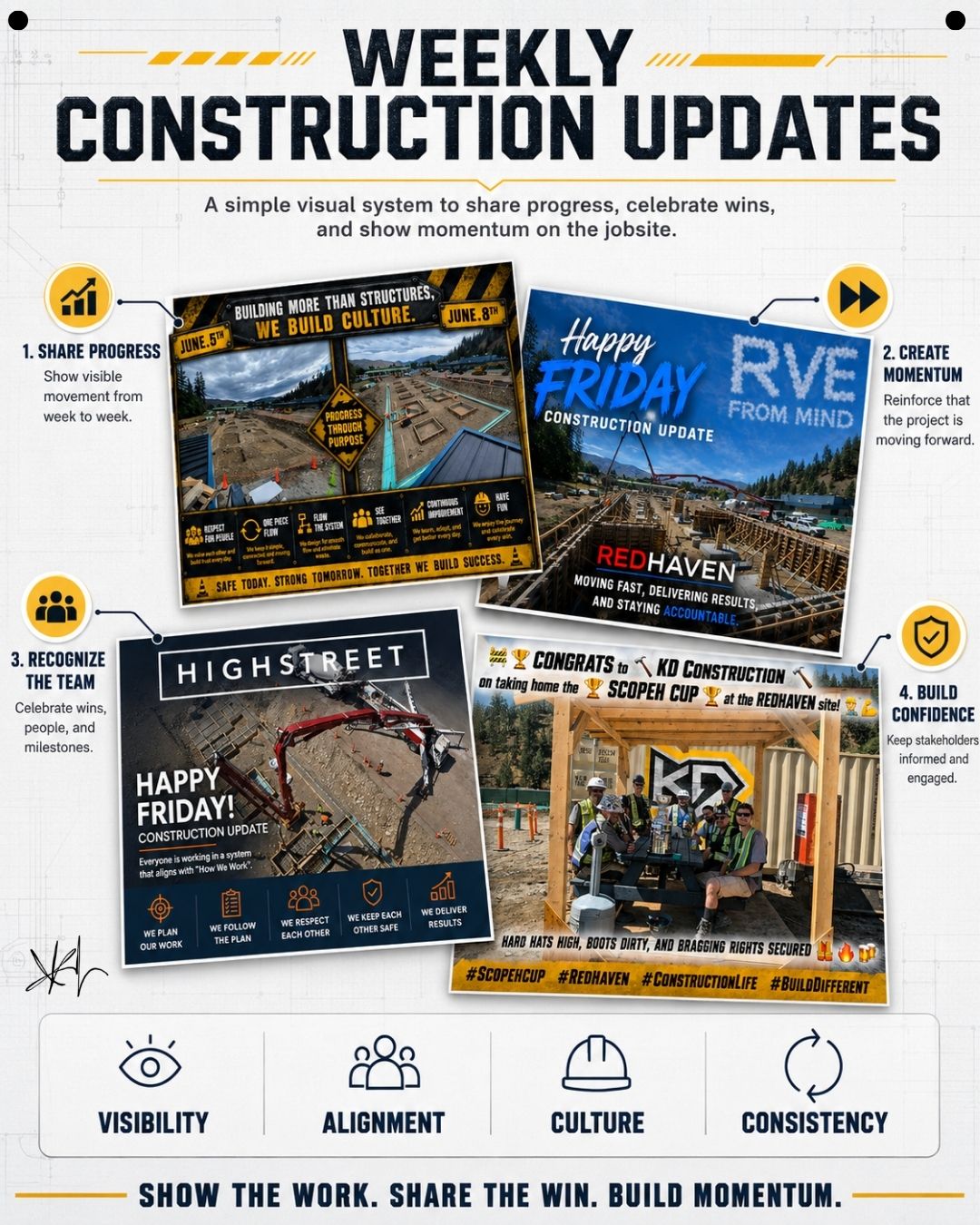
  1. Sharing progress means showing visible movement from week to week, in a form people can actually see rather than infer from a schedule percentage. A photo comparing site conditions from one week to the next communicates momentum instantly, in a way a status report full of numbers never quite manages. People need to see the project moving, because seeing is what actually produces the feeling of confidence that a written update alone rarely creates.
  2. Creating momentum follows directly from that visibility. When the team sees progress, they feel progress, and momentum genuinely builds on itself once it becomes visible rather than staying buried in the daily grind. A crew that sees its own accumulated progress laid out clearly, week after week, experiences something different than a crew that simply shows up and works without ever stepping back to see the larger trajectory they are actually building.
  3. Recognizing the team means celebrating wins, people, and milestones explicitly and publicly, rather than letting genuine achievement pass by unnoticed. A specific shout-out to a trade partner for a real accomplishment, a recognition tied to an actual event rather than generic praise, does something a private thank-you never quite accomplishes, because it makes that recognition visible to peers, to leadership, and to the whole project community at once.
  4. Building confidence keeps owners, stakeholders, and trade partners informed and genuinely engaged, rather than left to construct their own mental picture of project health from whatever fragments of information happen to reach them. A stakeholder who sees consistent, visible progress every week develops a trust in the project that a quarterly formal report, however accurate, simply cannot build at the same pace or depth.

This Is Leadership, Not Marketing

Here is the distinction that matters most. This is not marketing. It is leadership. A marketing update exists to make a project look good for an external audience: polished, curated, and designed to manage perception. A leadership update exists to actually build the things a project needs to succeed: visibility that produces trust, recognition that produces morale, and momentum that produces the kind of compounding energy that carries a crew through the harder weeks that inevitably come.

When you show the work and share the win, you build more than structures. You build belief. That belief is not a soft, decorative byproduct of good communication. It is a genuine operational asset. A crew that believes in the project’s momentum works differently than a crew that has no visibility into whether their effort is actually adding up to anything. A stakeholder who believes in the project’s trajectory behaves differently than one left anxious by silence. That stakeholder is more patient with the inevitable friction of a complex build and more willing to extend trust when something does need to be worked through together.

How Long Does a Weekly Construction Update Take?

This system does not require a marketing department, a communications budget, or a significant time commitment. It takes maybe thirty minutes a week. A few photos. A few words. A little recognition. That is genuinely the entire investment required, and the return on that thirty minutes compounds every single week it continues, because each update builds on the visible momentum of the last one, creating a cumulative record of progress that becomes more valuable the longer it runs.

This connects directly to the same principle running through the auto-launch drone visibility system and the 360-degree camera practice I have written about before. Mieruka, making the work visible so the whole team and every stakeholder can see reality, does not require expensive infrastructure to start. A weekly update built from a phone camera and a few sentences achieves the same fundamental goal as a sophisticated automated capture system, closing the gap between what is actually happening on the project and what the people who need to know about it can actually see.

What Shows Up in a Good Weekly Update

A strong update typically anchors on a recognizable visual comparison, the same vantage point photographed across two dates, making the week’s actual physical progress immediately obvious to anyone looking at it. It names the project and situates the audience, whether that is a specific site, a specific phase, or a specific team. It reinforces the project’s stated values or working principles explicitly, connecting the week’s visible progress back to the deeper culture the team is trying to build: respect for people, one-piece flow, continuous improvement, safety, and consistency.

And critically, it makes space for genuine recognition: a specific team or individual called out by name for a specific accomplishment, not generic praise but something tied directly to a real event, such as a cup won, a milestone hit, or a specific piece of excellent work that deserves to be seen by more than the handful of people who happened to witness it directly.

Sample: Medical office building, Week 12. Two photos from the same spot. What moved forward: Level 2 drywall is hung and taped. Shout-out: the drywall crew for finishing Zone B a day early. Next week: prime and paint Level 2.

Signals Your Project Needs This Habit

Look for these patterns on your own project:

  • Genuine weekly progress exists but nobody outside the immediate crew or trailer ever sees it.
  • Owners or stakeholders express uncertainty or anxiety about a project that is actually tracking well.
  • Trade partners have no sense of the broader project’s trajectory beyond their own narrow scope.
  • Real wins and milestones happen and pass without any public recognition.
  • The only communication reaching stakeholders is a formal status report, with no visual, momentum-building counterpart.

Each of these signals a visibility gap, not a performance gap, and that gap closes with almost no investment once someone decides to spend thirty minutes a week closing it.

How Do You Start a Weekly Construction Update?

Our LeanTakt team treats this kind of visible, recurring momentum building as a direct leadership responsibility, not an optional extra, because a team and a stakeholder base that can actually see progress behaves fundamentally differently than one left to guess at it.

So here is the challenge. This Friday, before you close out the week, take two photos from the same vantage point you can return to next week. Write three sentences about what moved forward. Name one person or team that did something worth recognizing, specifically, by name. That is the entire system. Do it again next Friday.

My own guiding belief applies directly here: respect for people is the basis of all decisions. A weekly update that takes the time to actually show people what they built, and to name the people who built it, is that belief put into practice, every single Friday, for the cost of thirty minutes.

Bottom line: When you show the work and share the win, you build more than structures; you build belief.

If your project needs superintendent coaching, project support, or leadership development, Elevate Construction can help your field teams stabilize, schedule, and flow.

On we go.

FAQ

How is a weekly construction update different from a standard weekly progress report sent to the owner?

A standard progress report typically communicates schedule percentages and status language that is accurate but difficult to actually feel. A weekly update is built around visible, photographic progress and specific recognition, designed to be felt rather than merely read, which produces a very different emotional and motivational response from both stakeholders and the crew itself.

Who should be responsible for putting the weekly update together?

Typically a superintendent or project leader with direct visibility into the week’s actual progress and the people who contributed to it. The task does not require design skill or specialized software, only the discipline of taking a couple of photos and writing a few honest, specific sentences every single week.

Does this only work for projects with a strong visual story, like a vertical structure rising?

No. Every project has some form of visible weekly progress, even underground or infrastructure work that is less dramatic visually than a rising structure. The same vantage-point comparison technique works for a trench progressing along its planned route or a utility system taking shape underground, as long as the same reference point gets photographed consistently from week to week.

How do you keep this from feeling repetitive or losing its impact over time?

Vary the specific recognition each week, since there is always a different person, team, or milestone worth calling out, and let the visible progress comparison itself carry the weight of showing momentum. The consistency of the format is actually part of what builds trust over time. Stakeholders and crews come to expect and look forward to it, in the same way a reliable weekly rhythm builds trust in any other recurring practice.

How does this connect to drone and 360-degree camera visibility systems?

All three practices share the same underlying goal: Mieruka, making the actual state of the work visible to the people who need to see it rather than leaving them to construct their own picture from secondhand description or silence. The drone and camera systems automate that visibility continuously and in real time. A weekly update achieves a lighter version of the same goal manually, with almost no infrastructure investment, which makes it the right starting point for any project not yet ready to invest in automated capture systems.

People Also Read:
Monthly Field Walks
Roadblock Tracking Maps
What Is 5S and How It Applies to Construction

If you want to learn more we have:

-Takt Virtual Training: (Takt Virtual Training)
-Check out our YouTube channel for more info: (Elevate Construction on YouTube)
-Listen to the Elevate Construction podcast: (Elevate Construction Podcast)
-Check out our training programs and certifications: (Training Programs and Certifications)
-The Takt Book: (The Takt Book on Amazon)

Discover Jason’s Expertise:

Meet Jason Schroeder, the driving force behind Elevate Construction. As the company’s Founder and COO, he’s dedicated to taking construction to new heights. With a wealth of industry experience, he’s crafted the Field Engineer Boot Camp and Superintendent Boot Camp – intensive training programs engineered to cultivate top-tier leaders capable of steering their teams towards success. Jason’s vision? To expand his training initiatives across the nation, empowering construction firms to soar to unprecedented levels of excellence.
Posted in All

Keep Extension Cords Off the Ground

Read 13 min

Here’s the deal. Keep extension cords off the ground. It sounds small. It is not. Walk any jobsite and you can tell within thirty seconds whether that team has a system or not. Cords are one of the biggest tells. Cords snaking across walkways say we are just surviving out here. Cords hung, routed, and protected say we respect our people and our work. Nobody has to explain the difference. It is visible the moment you step onto the site, before anyone says a single word about the project’s actual standards.

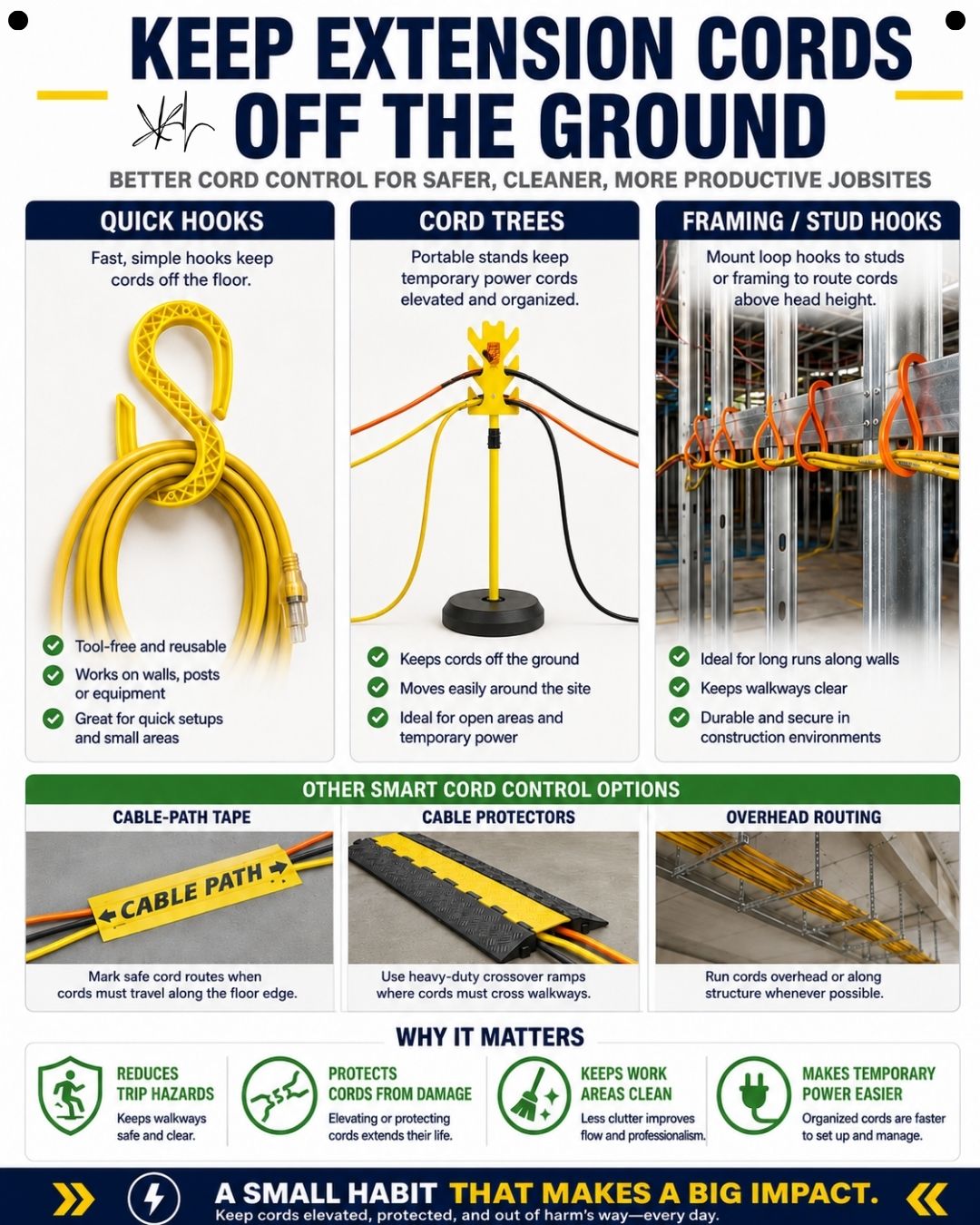
Short answer: Keeping extension cords off the ground means elevating every cord the moment it gets run, using quick hooks for short runs, cord trees for open areas, and framing or stud hooks for long runs. When a cord must cross a walkway, use cable protectors or cable path tape. It cuts trip hazards, extends cord life, keeps work areas clean, and takes a habit, not a budget.

The Pain of a Cord Nobody Elevated

Picture the ordinary version of this problem on a typical active jobsite. A temporary power run gets dropped at the start of a task, routed in whatever direction happens to reach the outlet, and left exactly where it landed for the rest of the day, and often for the rest of the week. It crosses a primary walkway because that was the shortest path when someone first ran it. Foot traffic passes over it dozens of times a day. Equipment occasionally rolls across it. Nobody specifically decided this was acceptable. It is simply what happened when a cord got run quickly and nobody circled back to elevate it once the immediate need was met.

This is the exact same degradation pattern I have written about before in cord management, but it deserves separate attention because the specific fix here is not inspection or replacement. It is elevation. A cord lying on the ground, even a brand-new, undamaged one, is a trip hazard and a wear point simply by virtue of being on the ground. The fix is not waiting for it to fail. It is never letting it touch the ground in the first place.

The Failure Pattern

The failure pattern is treating cord elevation as an extra step rather than as the default way a cord gets run.

Running a cord along the ground is faster in the moment. It requires no hook, no stand, no extra five minutes of setup. That speed is exactly why it becomes the default, and exactly why the default needs to be intentionally overridden with a better habit rather than left to whatever feels quickest under time pressure. A project that never names elevation as the expected standard will default to the ground every single time, because the ground option is always the path of least resistance in the moment, even though it creates far more cost over the life of that cord run than the few minutes saved at setup.

The Crew Didn’t Fail. They Had Nothing to Hang It On.

When a crew member trips over a cord, or a cord gets crushed and damaged by equipment traffic, the instinct is to ask why nobody moved it. They walked past it a dozen times. Why didn’t someone fix it?

Before reaching that conclusion, it is worth asking what tool that crew actually had on hand to elevate the cord quickly and without friction. If nobody provided quick hooks, cord trees, or stud-mounted routing options, then running the cord along the ground was not a failure of attention. It was the only practical option available in the moment, given the materials and time at hand. Give the same crew a tool-free hook they can hang in seconds, and the ground stops being the default, not because anyone became more careful, but because the faster option and the safer option finally became the same option.

What Tools Keep Extension Cords Off the Ground?

  1. Quick hooks solve the immediate, small-area problem. Tool-free and reusable, these hooks work on walls, posts, or equipment, and they are ideal for fast setups where a cord just needs to be lifted off the floor for a short run or a temporary task. The entire value proposition is speed. If elevating a cord takes longer than leaving it on the ground, the ground wins by default every time. A hook that requires no tools and takes seconds to deploy removes that excuse entirely.
  2. Cord trees address open areas and temporary power setups where a single fixed hook will not reach. A portable stand with multiple cord loops keeps several runs elevated and organized at once, and because the stand itself is portable, it moves easily around the site as work progresses, following the actual point of need rather than requiring a fixed installation that becomes outdated the moment the crew relocates.
  3. Framing and stud hooks handle the long-run problem specifically. Mounted directly to studs or framing members, these hooks route cords above head height along an entire wall or corridor, keeping walkways clear for the full length of the run rather than just at a single point. This option is especially valuable precisely because long runs are where the ground becomes most tempting, since elevating a short cord feels manageable but elevating fifty feet of cord along a corridor feels like a bigger task. A row of simple loop hooks mounted once along the framing turns that long run into the same quick, repeatable action as a single short hook, just repeated along the path. Use insulated, non-conductive hooks or cord hangers. Never staple, nail, or wire-tie a cord to the framing, and keep it off sharp edges. OSHA requires flexible cords to be protected from damage and kept away from sharp corners (29 CFR 1926.405(a)(2)(ii)(I)).

What Do You Do When a Cord Must Cross the Ground?

Elevation is not always possible for the full length of a run, and the standard accounts for that honestly rather than pretending every cord can be lifted off the floor in every situation.

Cable path tape marks a safe, intentional route when a cord genuinely has to travel along the floor edge, turning an unplanned, incidental path into a deliberate, marked one that anyone on site can recognize and respect. Cable protectors, the heavy-duty crossover ramps, exist specifically for the point where a cord must cross an active walkway, covering the cord so foot and equipment traffic pass over a protected ramp rather than over bare cable exposed to repeated crushing and the trip hazard of an unprotected edge. And overhead routing, running cords along structure whenever the physical layout allows it, keeps cords entirely out of the walking and working plane altogether. It is the single most effective option available whenever the site conditions make it possible.

Tool Best for
Quick hooks Short runs and fast, temporary setups on walls, posts, or equipment
Cord trees Open areas and temporary power, moving with the work
Framing and stud hooks Long runs along a wall or corridor, above head height
Cable path tape A marked route when a cord must run along the floor edge
Cable protectors The point where a cord must cross an active walkway
Overhead routing Running cords along structure whenever the layout allows

Why Keep Extension Cords Off the Ground?

Reduced trip hazards are the most immediate benefit, keeping walkways safe and clear in exactly the way I have written about before for loose rock and general pathway discipline. A cord lying across a walkway is functionally the same hazard as any other obstruction in a marked path, just one that happens to also carry an electrical current.

Protecting cords from damage matters because elevation genuinely extends a cord’s working life. A cord lying on the ground gets stepped on, rolled over by equipment, and exposed to moisture and abrasion in ways an elevated cord simply does not experience. That extended life is a direct cost savings: fewer cords replaced over the life of a project, purely as a byproduct of how they were routed.

Keeping work areas clean follows naturally once cords stop accumulating on every available floor surface, and the resulting reduction in clutter improves both flow and the professional appearance of the site. It is the same signal I have written about before for the Lean Display Area and the perimeter fence line. And making temporary power easier to manage is the operational payoff that often gets overlooked. Organized, elevated cords are genuinely faster to set up, track, move, and manage than a tangle of ground-level runs that nobody can trace back to its source without physically following the cord by hand.

This Takes a Habit, Not a Budget

Here is the part that matters most for any team hesitant to invest time in this. This does not take a budget line. Quick hooks, cord trees, and stud-mounted loops are inexpensive, widely available, and require no specialized installation skill. The investment is a habit: the decision to spend the extra few seconds elevating a cord the moment it gets run, rather than leaving it on the ground and planning to deal with it later.

That habit, once it becomes the default rather than the exception, costs the project nothing in time, because elevating with a tool-free hook is no slower than letting a cord lie flat. The only real cost is the discipline of making elevation the first instinct rather than an afterthought reserved for whenever someone eventually notices the hazard and corrects it.

Set It, Model It, Make It the Expectation

For superintendents, this is one of those small-habit, big-impact standards I have written about before. A clean, organized jobsite is not cosmetic. It is the foundation for safety, flow, and morale, and cord elevation is one of the fastest, cheapest ways to demonstrate that standard in a way every single trade partner on site can see and copy immediately.

This connects directly to the standards I have written about before around fence maintenance, walkway discipline, and cord management, each one a small, visible element of the perimeter and the working environment that signals, before a single word is exchanged, whether a project genuinely holds a standard or merely talks about one. Our LeanTakt team treats small, visible habits like this as the actual proof of a culture, because anyone can post a safety policy, but only a team that has genuinely internalized the standard keeps its cords off the ground on an ordinary Tuesday with nobody watching.

Start With One Cord

So here is the challenge. Walk your site right now and find the first cord you see lying on the ground. Elevate it, with a quick hook, a stud mount, or whatever is already available. Then make that the expectation for every cord run going forward, for your own crew and for every trade partner working alongside you.

Epictetus taught that no man is free who is not master of himself, and a habit this small, repeated consistently until it becomes automatic, is exactly what mastery over the small stuff actually looks like in practice. Your crews deserve a site where they can move fast without looking down.

Bottom line: Keep cords elevated, protected, and out of harm’s way, every single day.

If your project needs superintendent coaching, project support, or leadership development, Elevate Construction can help your field teams stabilize, schedule, and flow.

On we go.

FAQ

Is elevating cords really worth the extra effort compared to just running them along the ground?

The extra effort is seconds, not minutes, once a team has quick hooks or stud-mounted loops readily available. Against that small cost, elevation removes a genuine trip hazard, extends the working life of the cord itself, and keeps walkways clear for the full duration of the run. The investment is nearly free relative to the risk and cost it prevents.

What is the best option when a cord absolutely must cross an active walkway?

A heavy-duty cable protector, the crossover ramp style device, is the right tool specifically for this situation. It allows foot and equipment traffic to pass directly over the protected cord without crushing it or creating a trip hazard, which is a better solution than simply hoping people will step carefully around an exposed cord crossing their path.

How is this different from a daily cord management system?

My earlier post on cord management addressed the full daily maintenance system: routing decisions, power positioned near the task, and a daily inspection cadence that catches damage before it worsens. This post focuses specifically on the physical tools and habit of elevation itself: the quick hooks, cord trees, and stud-mounted routing that make keeping a cord off the ground the fast, default choice rather than an extra step nobody has time for.

Does overhead routing work on every type of jobsite, or only certain site configurations?

Overhead routing depends on having structure available to route along, such as exposed framing, ceiling grids, or similar elements that a cord can be secured to above head height. On sites where that structure is not yet in place or not accessible, quick hooks and cord trees become the more practical elevation tools until overhead routing becomes feasible later in the project.

How do you get an entire crew, including multiple trade partners, to actually adopt this as a consistent habit?

Model it personally and make it the explicit, stated expectation rather than an unspoken preference. A superintendent who elevates their own cords every single time, and who provides the simple tools (hooks, stands, and stud mounts) needed to make elevation the fast choice, sets a visible standard that trade partners tend to follow naturally, especially once they see that the elevated approach is genuinely no slower than leaving a cord on the ground.

People Also Read:
Clean, Safe, and Organized: The Foundation of a High-Performing Job Site
What Is 5S and How It Applies to Construction
Monthly Field Walks

If you want to learn more we have:

-Takt Virtual Training: (Takt Virtual Training)
-Check out our YouTube channel for more info: (Elevate Construction on YouTube)
-Listen to the Elevate Construction podcast: (Elevate Construction Podcast)
-Check out our training programs and certifications: (Training Programs and Certifications)
-The Takt Book: (The Takt Book on Amazon)

Discover Jason’s Expertise:

Meet Jason Schroeder, the driving force behind Elevate Construction. As the company’s Founder and COO, he’s dedicated to taking construction to new heights. With a wealth of industry experience, he’s crafted the Field Engineer Boot Camp and Superintendent Boot Camp – intensive training programs engineered to cultivate top-tier leaders capable of steering their teams towards success. Jason’s vision? To expand his training initiatives across the nation, empowering construction firms to soar to unprecedented levels of excellence.
Posted in All

Lean Trailer Coffee & Break Area

Read 12 min

Here’s the deal. Want to know if a team is serious about Lean? Look at their break area. Not the jobsite. Not the trailer walls covered in schedules. The coffee station. If a team cannot keep cups, pods, and filters stocked with a simple visual system, how is that same team going to flow the actual work? The break area is small, low-stakes, and almost nobody is watching it closely. That makes it the single best test of whether Lean principles actually live in a team’s habits, or whether they only show up where someone might be grading the performance.

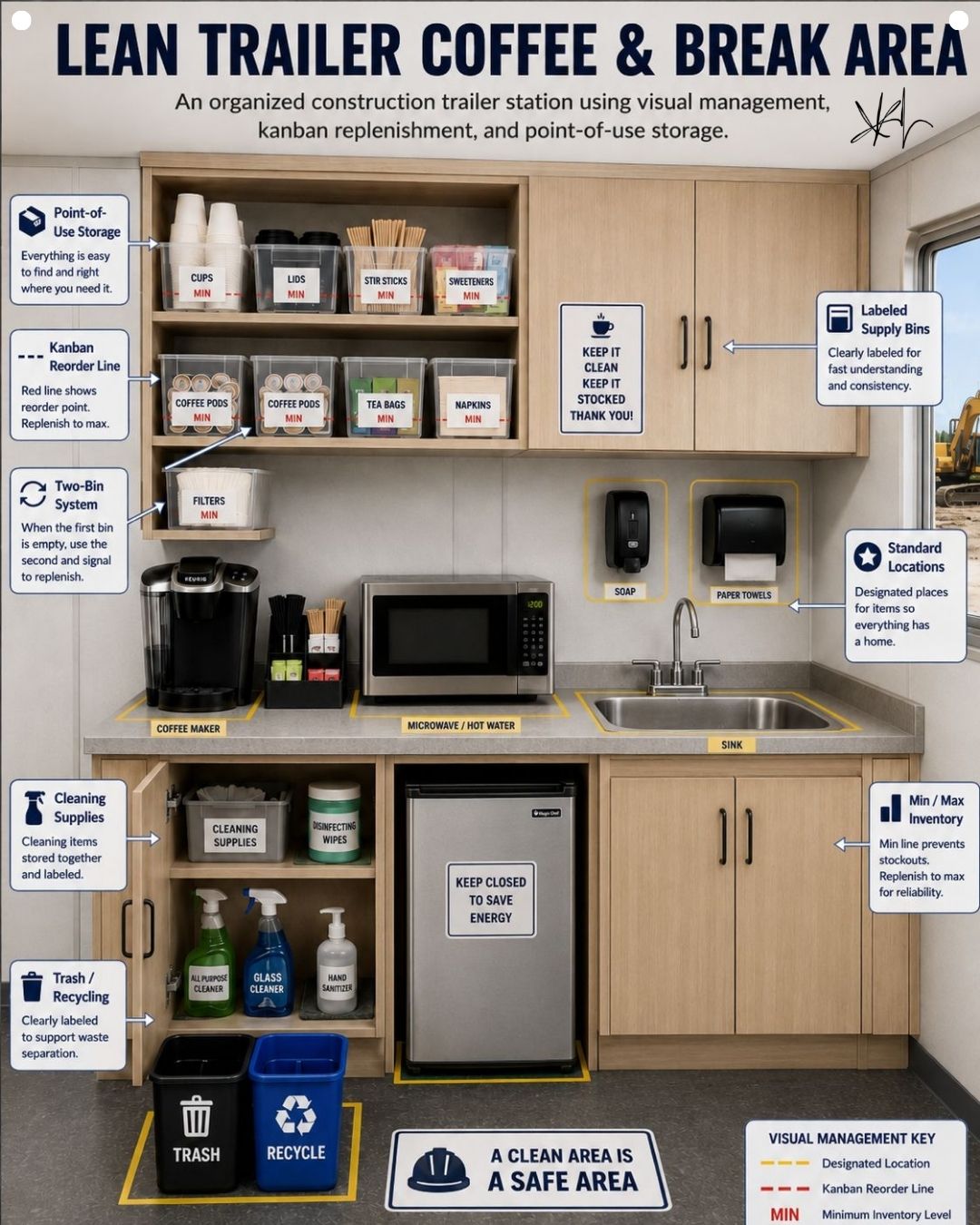
Short answer: A Lean break area applies the same tools you use on the jobsite to the trailer coffee station: point-of-use storage, kanban reorder lines, a two-bin system, standard locations, and min and max inventory levels. Because almost nobody is watching it, the break area is the best test of whether Lean lives in a team’s habits. It is also a daily message of respect for the crew.

The Pain of a Break Area Nobody Designed

Picture a typical jobsite trailer kitchen without any deliberate system behind it. Supplies get bought in whatever quantity seemed reasonable at the time, stored wherever there happened to be space, and used until they run out, at which point someone discovers the shortage the hard way, usually at six in the morning when the whole crew wants coffee and there are no pods left. Cleaning supplies sit mixed in with snacks. Nobody knows at a glance whether the filters are running low, because nothing in the space signals that information until the moment the box is actually empty.

This is a small, low-consequence version of exactly the same failure pattern that shows up everywhere else on a project with no inventory discipline: a connex box with no labeled bins, or a material laydown area with no staging plan. The stakes here are genuinely tiny: a missed cup of coffee rather than a missed schedule milestone. But the pattern is identical, and that is exactly the point. A team that cannot solve this version of the problem, in a space this forgiving, is unlikely to be quietly solving the much harder version of the same problem somewhere less visible.

The Failure Pattern

The failure pattern is assuming that Lean discipline applies to the places people are actually watching and does not need to apply anywhere else.

A trailer break area receives almost no scrutiny on most projects. Nobody audits the coffee station. No inspector checks whether the supply bins are labeled. No owner representative walks through and grades the kanban system on the snack shelf. Precisely because nobody is watching, this space becomes a clean, honest test of whether a team’s Lean habits are genuine or performative. A team that only applies organization and standard work where an audience exists is a team that has learned to perform Lean rather than practice it, and that distinction matters enormously once the schedule gets tight and nobody has time to perform anything.

The Team Didn’t Fail. Nobody Pointed Lean at the Coffee Station.

When a break area runs chaotically (supplies missing, nobody quite sure where anything lives), the instinct might be to dismiss it as simply not a priority, understandably, given everything else competing for a team’s attention on an active project.

That dismissal misses something important. A disorganized break area is not evidence that the team does not care about Lean. It is evidence that nobody has yet applied the same thinking they already use everywhere else to this one small, overlooked corner. The same crew running a disciplined Takt plan and a well-labeled connex box has simply never turned that identical thinking toward the coffee station, because nobody told them this space deserved the same attention. Once someone does, the fix is fast and nearly free, because the principles are already familiar. The gap was never caring. It was scope.

What Does a Lean Break Area Contain?

  1. Point-of-use storage puts everything right where it is needed, with no hunting required. Cups, lids, stir sticks, and sweeteners each have their own labeled bin, positioned directly above the coffee maker rather than scattered across whatever shelf had room. This is the exact same principle behind the Lean Connex Box applied at a much smaller scale: every item has a home, and the home is close enough to the point of use that retrieval never interrupts the actual task.
  2. Kanban reorder lines give a simple, visual signal for when to replenish. A red line drawn directly on a bin tells anyone looking at it, instantly, whether that item needs restocking, with no guessing and no need to actually dig to the bottom of a container to check remaining quantity. This removes the single most common failure mode in any informal supply system: the shortage that only becomes visible the moment it is already a problem.
  3. The two-bin system solves the same problem from a different angle. When the first bin empties, the second bin is already there, ready to use immediately, and emptying the first bin becomes the signal to restock before the second bin runs out too. This creates a built-in buffer against exactly the kind of six-in-the-morning coffee crisis that otherwise catches a team by surprise on the one morning everyone was counting on it being there.
  4. Standard locations mean every item has a designated, taped, and labeled home, so a new crew member or a visitor to the trailer can find anything without asking. This single element removes the dependency on tribal knowledge. It is the same dependency I have written about before in the Lean Connex Box practice, where only the people who happen to already know where things are can actually find them quickly.
  5. Min and max inventory levels prevent the stockout crisis directly, with a visible minimum line signaling exactly when to replenish and a maximum level that prevents the opposite problem: overstocking supplies that then clutter the space and complicate the visual system everyone is relying on.

None of This Is About Coffee

Here is the part that actually matters. None of this is about coffee. It is about respect. When a builder walks in cold, tired, and early, and everything is stocked, labeled, and ready, that is a message. It says we thought about you before you got here.

This connects directly to the Construction Worker Care Hub, which I have written about before. A crew member’s physical experience on a project (whether they have what they need, when they need it, without friction) is not separate from how seriously the project takes production. It is the same discipline, applied to the person rather than only to the work. A team that designs a coffee station this carefully is demonstrating, in a tiny, low-stakes way, exactly the same care it hopefully extends to the much higher-stakes decisions about safety, staging, and schedule.

Lean is love in action, and love shows up in the small stuff. That line captures something genuinely important about why this particular practice deserves attention rather than dismissal as a minor or even trivial example. A system built around someone else’s comfort, even in a space as small as a coffee station, is a visible, daily demonstration that this project actually cares about the people working on it, not just the deliverable they are producing.

A Clean Area Is a Safe Area

A clean area is a safe area. A stocked area is a cared-for area. These are not separate claims stitched together for effect. They describe the same underlying mechanism running through every practice I have written about here, from the Lean Display Area to the Lean Gangbox to the connex box itself. A space that is organized, labeled, and visually managed signals a standard, and that standard tends to spread outward from wherever it starts. A team that maintains this discipline in its break area is far more likely to maintain the same discipline in spaces that actually matter for safety and production, because the habit of noticing and correcting small degradation is the same habit everywhere it shows up.

Why Start Lean in the Break Area?

If a builder who never studied Lean can learn to see waste in a coffee bin, anyone on the team can learn to see it too. This is the most practical, most accessible starting point available for teaching Lean thinking to a crew that has never formally studied it. The break area asks nothing of anyone beyond basic observation and a willingness to label a few bins. There is no technical barrier, no software, no capital investment beyond a handful of containers and some tape.

Starting here, in the space with the lowest stakes and the easiest fix, builds the exact muscle a team needs before applying the same thinking somewhere harder. A crew that has practiced noticing waste and designing a simple visual system in a break room is a crew genuinely better prepared to notice the same patterns in a connex box, a laydown yard, or a Takt zone, because the thinking does not change with the scale of the problem, only the stakes.

Our LeanTakt team starts exactly here when introducing Lean to a new team, in the smallest, most forgiving space available, because the principles that organize a coffee station and the principles that organize a production system are the identical principles, taught at a scale where mistakes cost nothing and the lesson lands fast.

How Do You Build a Lean Break Area?

So here is the challenge. Walk your own trailer break area and ask honestly whether it reflects the same discipline your team applies everywhere else on the project. Label a few bins. Draw a kanban line. Set up a simple two-bin system for whatever runs out most often. Watch how quickly the crew notices and starts maintaining it on their own.

Taiichi Ohno had people stand in one spot and watch until they could see the waste, and a break area is exactly the kind of space most teams never stop to watch.

Bottom line: Start small, start where people take their breaks, and then watch the same thinking spread to everywhere else that actually matters.

If your project needs superintendent coaching, project support, or leadership development, Elevate Construction can help your field teams stabilize, schedule, and flow.

Want tools to help you set this up? Check out our templates page.

On we go.

FAQ

Is building a Lean break area really a good use of a superintendent’s limited time?

The time investment is small (a few labeled bins and a kanban line drawn once), and the return is twofold. The crew gets a reliable, stocked break area, and the team practices the exact same Lean thinking it needs everywhere else, in a space with essentially zero risk if the first attempt is imperfect.

How does a two-bin system actually work in practice for something like coffee pods?

Two identical bins sit side by side, both stocked with the same item. The crew uses from the first bin exclusively until it empties, at which point that empty bin becomes the visual signal to restock, while the second, still-full bin is immediately available with no interruption in supply. The person restocking simply refills the empty bin and it becomes the new second bin in the rotation.

What is the actual purpose of a kanban reorder line if someone could just check whether the bin looks low?

A visual line removes subjectivity and delay. Checking whether a bin looks low requires someone to actually stop and look closely, and different people will judge low differently. A clear red line marked at a specific fill level means anyone glancing at the bin, even briefly, gets the same unambiguous signal, which is exactly the point of visual management applied at any scale.

Does this level of organization actually connect to anything that matters on a project, or is it purely a morale gesture?

Both. The practical function (never running out of basic supplies) saves real time and avoids a genuinely disruptive morning crisis. The deeper function (demonstrating that the project thought about the crew’s comfort before they arrived) builds the same kind of trust and care behind the Construction Worker Care Hub I have written about before. Neither function depends on the other, but they reinforce each other well.

How does this connect to the Lean Connex Box and Lean Display Area?

All three apply the identical underlying principles: point-of-use storage, labeled standard locations, and visual signals for replenishment, at different scales and to different kinds of materials. The connex box organizes tools and construction materials. The display area organizes jobsite information and safety signage. The break area organizes the small daily comforts a crew depends on. The thinking transfers completely across all three, which is exactly why starting with the smallest, lowest-stakes version builds a skill the team can then apply everywhere else.

People Also Read:
What Is 5S and How It Applies to Construction
Clean, Safe, and Organized: The Foundation of a High-Performing Job Site
Lean Heaven feat. Paul Akers

If you want to learn more we have:

-Takt Virtual Training: (Takt Virtual Training)
-Check out our YouTube channel for more info: (Elevate Construction on YouTube)
-Listen to the Elevate Construction podcast: (Elevate Construction Podcast)
-Check out our training programs and certifications: (Training Programs and Certifications)
-The Takt Book: (The Takt Book on Amazon)

Discover Jason’s Expertise:

Meet Jason Schroeder, the driving force behind Elevate Construction. As the company’s Founder and COO, he’s dedicated to taking construction to new heights. With a wealth of industry experience, he’s crafted the Field Engineer Boot Camp and Superintendent Boot Camp – intensive training programs engineered to cultivate top-tier leaders capable of steering their teams towards success. Jason’s vision? To expand his training initiatives across the nation, empowering construction firms to soar to unprecedented levels of excellence.
Posted in All

Before Phase Planning: Work Packages, Buffers, and Multi-Train Flow

Read 9 min

Here’s the deal. I am continuing the before phase planning list, and before I go on, I want to say that I do not want to overwhelm anybody. This is not something where everybody has to do every single thing, and I am not trying to make anyone’s job harder, although installation should be the easiest thing we do. In my last post on before phase planning, I finished with more detailed installation work packages, and in this post I am picking up from there. You will find the links to the other parts of the before phase planning series at the bottom of this post

Short answer: Before phase planning is the work you do before a Takt phase starts so the phase flows. This part of the list covers work package breakdowns with the designers, classifying installation work package complexity, zone maps leveled by density, deliberate buffer placement, multi-train design, the Lego sheet, and the 3D model as a single source of truth. You do not have to do every one. Start where the risk is highest.

What This Part of the List Covers

None of these are meant to be done all at once. Here is the list for this post:

  • Construction work package, engineering work package, and procurement work package breakdown sessions.
  • Classifying the complexity of installation work packages.
  • Zone maps plus a density and leveling analysis.
  • Buffer placement.
  • Multi-train design.
  • Building your Lego sheet.
  • Confirming the 3D model as a single source of truth.

Breakdown Sessions With the Designers

One thing you can do for before phase planning is align the designers and make sure you have construction work packages, engineering work packages, and procurement work packages for each Takt wagon in the Takt phase. Make sure everything is detailed and broken out for that wagon, so the crew that installs it is not working from a batched set of documents.

Essentially, that is what a lift drawing is. Shop drawings are, to a certain extent, but a lift drawing is really trying to unbatch drawings. Drawings should not be batched into the whole project: architectural, structural, and mechanical. Instead, they should reflect building one phase, interiors for example, and then within that you have the structural, architectural, mechanical, electrical, plumbing, and IT drawings. We should be designing to the work packages and to how we are going to build the actual project. The design world is not there yet, but this is where it is headed.

Why Classify Installation Work Package Complexity?

Another practice is to classify installation work package complexity, which means sizing each package as low, medium, or high before committing. Complexity is not duration. A short package can be high risk, and it deserves more preparation, not less.

So if you are thinking, this installation work package talk has me nervous, how am I going to create a visual definable feature of work for each trade, then just focus on the more complex or higher-risk packages and make sure those are planned and prepared. You do not have to start with everything. Start where the risk is highest.

Zone Maps With a Density and Leveling Analysis

We do this all the time at LeanTakt, so it is a given for us, and it is a given for the Takt Production System. But if you are heading into a phase, one of the things you can really do is carve out zones beautifully, so the trades do not have any difficulty going from zone to zone to zone. You have your horizontal flows and your vertical flows. You have identified workable backlog. You have done a good job of identifying zones, and you have leveled them according to density, not square footage.

Where Should Buffers Go in a Takt Phase?

This is really cool. In some approaches, the buffer sits at the end of the entire schedule, which is how it works according to critical chain. But what we can do instead is decide deliberately where our capacity, time, space, and planned backlog buffers sit.

That is a different way of thinking about buffers. We need to understand that buffers are not slack you forgot to remove. They are protection you placed on purpose, where the risk analysis told you to.

The other thing is that according to drum-buffer-rope, we should know where our most complex zone and our most complex trade are, and put a buffer ahead of them. In before phase planning, and in any kind of planning, especially in the Takt Production System, we had better know where our constraints are. We can do so much by way of optimizing and getting ahead of things if we just know these things. Obviously, buffer your constraints, because that is where the protection counts the most.

Multi-Train Design

I have written about this before. It is frustrating when people keep treating single train as the only option, because that is absolutely not true. Multi-train lets trades run at their own natural rhythms rather than forcing every trade onto one beat.

Here is how trains of trades flow through a phase.

When you do the analysis, a lot of times multi-train is faster from a throughput standpoint, and it is better buffered. It is better buffered because you do not have so much dependency between one trade and another. We have to be really intelligent when we design these things, and make the call according to what the project needs and wants. If you want to do single train, that is your decision. But looking at it in a deeper way is helpful for the overall phase, and it can also enable other strategies.

The Freeway and Germany

Single train is one single train on the train tracks. Multi-train is more like a well-flowing freeway. You have fast cars going, trucks going slower, and a camper in the slow lane, and everybody is flowing beautifully.

When people are really strict about single-train Takt planning, I wonder why. Even in Germany, the whole country does not run just on rail lines. You have surface roads, the Autobahn, vehicles, and bicycles. There is a lot of variation in how you choose to travel somewhere. Focusing only on single-train Takt planning is like saying, all right Germany, everybody can only travel by train, which would be absolutely ridiculous.

What Is a Lego Sheet?

Your Lego sheet should be built before the pull plan if you really want to leverage it. But if you did not build one before the pull plan, building it afterward is still pretty phenomenal. It is a sheet that enables the trade to understand its durations, its Takt time, and its crew composition. Then the trade can plan and package a nicely organized crew within the cycle time that fits within the Takt time. It is additional planning to make sure all of the numbers pan out, in order to keep the rhythm. The sheet gives the trade a way to check, before the work starts, that its crew and its durations actually fit the Takt time.

The 3D Model as a Single Source of Truth

Make sure your 3D model is a single source of truth. Here is what that means:

  • You have one federated model.
  • Everything is coordinated, and the model is clash-free for the areas you are installing.
  • You have access to it in the field, and it is used for install.
  • The data is tagged, and the quantities and component IDs are aligned.
  • You can get quantities from it, and it is ready to go in the field.
  • It is broken out by room or by area, on something like Autodesk Construction Cloud.

What Is Not on the List

That finishes the list for this post. There might be things that are not on the list as I keep going through these, like really amping up your field engineering team, getting a great layout person to run at the building, or setting up your logistics system. The question is, what things can we do before the phase starts to pull out all the stops and make sure it goes well, one hundred percent?

So here is the challenge. Pick one practice from this list that fits your next phase, such as placing buffers deliberately, building a Lego sheet, or confirming your 3D model, and do it before the phase starts.

If your project needs superintendent coaching, project support, or leadership development, Elevate Construction can help your field teams stabilize, schedule, and flow.

Want your team trained on this? See our Last Planner System and Takt training.

Go deeper with the Advanced Work Packaging Done Right book and the Takt Production System Masterclass.

Bottom line: Buffers are not slack you forgot to remove; they are protection you placed on purpose, where the risk analysis told you to.

On we go.

FAQ

What is before phase planning?

It is the work I do before a Takt phase starts so the phase flows, such as work package breakdowns, zone leveling, buffer placement, multi-train design, and a Lego sheet. You do not have to do all of it, so start where the risk is highest.

What is a lift drawing?

It is a drawing that unbatches the drawing set. Instead of one set for the whole project by discipline, it reflects building one phase, with the structural, architectural, mechanical, electrical, plumbing, and IT drawings within it, designed to the work packages.

Why classify installation work package complexity?

Because complexity is not duration. A short package can be high risk and deserves more preparation. If creating a visual definable feature of work for every trade feels overwhelming, focus on the more complex or higher-risk packages.

What is a Lego sheet?

It is a sheet that lets a trade understand its durations, Takt time, and crew composition, so it can plan a crew within the cycle time that fits the Takt time and keep the rhythm.

Why consider multi-train design?

Because it lets trades run at their natural rhythms instead of one beat. When I do the analysis, multi-train is often faster in throughput and better buffered, since there is less dependency between trades.

Before Phase Planning Series:
Set the Standard and Rehearse the First Run
Stress-Test the Plan Before Crews Mobilize.
The Work That Makes Every Construction Phase Succeed.
Build the Right Crew Before Work Begins

If you want to learn more we have:

-Takt Virtual Training: (Takt Virtual Training)
-Check out our YouTube channel for more info: (Elevate Construction on YouTube)
-Listen to the Elevate Construction podcast: (Elevate Construction Podcast)
-Check out our training programs and certifications: (Training Programs and Certifications)
-The Takt Book: (The Takt Book on Amazon)

Discover Jason’s Expertise:

Meet Jason Schroeder, the driving force behind Elevate Construction. As the company’s Founder and COO, he’s dedicated to taking construction to new heights. With a wealth of industry experience, he’s crafted the Field Engineer Boot Camp and Superintendent Boot Camp – intensive training programs engineered to cultivate top-tier leaders capable of steering their teams towards success. Jason’s vision? To expand his training initiatives across the nation, empowering construction firms to soar to unprecedented levels of excellence.
Posted in All

Before Phase Planning: Rehearse the Work Before the First Run

Read 9 min

Here’s the deal. I am continuing the before phase planning list. I originally drafted a before phase planning checklist, a little like a manual, and I also have a summarized guide. I am thinking about turning it into a full-fledged book, because it is just that important and I want to expand on these concepts. In this post, I am covering set the standard and rehearse the first run. It is a really cool section. You will find the links to the other parts of the before phase planning series at the bottom of this post.

Short answer: Before phase planning includes setting the standard and rehearsing the first run before a phase begins. The six practices are a mock-up, a benchmark control sample or first-in-place inspection, clear conditions of satisfaction and handoff acceptance criteria, a quality checklist for each trade, first run studies, and testing any work before it is concealed. Each one finds problems while mistakes are still cheap.

The Six Practices in This Section

Before you start a phase in construction, here are the things you can do to set the standard and rehearse the first run:

  1. Build a mock-up.
  2. Set a benchmark control sample, or do a first-in-place
  3. Define the conditions of satisfaction, the definition of done, and the handoff acceptance criteria in the pre-construction meeting.
  4. Create a quality checklist for each trade.
  5. Run first run studies.
  6. Flag any work that will be concealed, and test before it is covered.

They all share a purpose. Each one is a way to set the standard before the phase starts, and to rehearse the first run while mistakes are still cheap, so the trades are not discovering problems in the middle of the work. Let me walk through each one.

Why Build a Mock-Up Before the Phase?

One of the things you can do before a phase is focus on your mock-up. In a Takt simulation I always talk about first run studies, and a first run study can be as simple as visiting the crew, or practicing a first-of-a-kind. You could do it in a mock-up, or it could be the first install on your site, but I really do like mock-ups.

There are faster, cheaper ways to build them. If you build a mock-up on site, you have to build it and tear it down. It is super expensive, and it is in your way. I know of exterior consulting companies that allow you to build your structural and exterior mock-up at their shop, where they do all their testing. It is much cheaper, and the bottom line is that I love mock-ups.

I will tell you a story. One time we did a mock-up for a project. It was the first project where I was the project superintendent, and everything went pretty well. But the steel that needed to be attached to the structure for the masonry took three times as long as we had anticipated. The trade partner said it took that long in the mock-up, but he did not think it would be a problem on the jobsite. I am not blaming him. I should have known better. Sure enough, it took three times as long on the job as well.

Mock-ups are a thing. Build it once for real before you build it a hundred times. The mock-up is where the method, the materials, and the sequence get argued out at full scale while mistakes are still cheap. It is one of the best things you can do to get ahead.

The Benchmark Control Sample

The next practice is a benchmark control sample, or a first-in-place inspection. This is where you set and approve the real standard on the actual first installation, in your first zone. Everyone now has a physical reference for what right looks like, which ends the debate before it starts.

This one is risky on its own, because if the first installation is built on the wrong information, you find out when it is too late. If you cannot do a mock-up, cannot visit another job, and cannot do a first-of-a-kind somewhere else, and the first zone is your only chance to set the standard, then at least make sure it is well controlled with a good pre-construction meeting.

Conditions of Satisfaction and Acceptance Criteria

Make sure you are absolutely clear about the conditions of satisfaction, the definition of done, and the handoff acceptance criteria inside the pre-construction meeting. Write down exactly what the receiving trade is entitled to expect from the trade before it. A handoff without acceptance criteria is a disagreement waiting to happen. So be very clear, and write it down. When the receiving trade knows exactly what it is entitled to expect, and the trade before it knows exactly what it is expected to deliver, the handoff stops being a matter of opinion.

A Quality Checklist for Each Trade

Turn the conditions of satisfaction into a short checklist that each trade signs off on for its own work. That way, quality is built in, in the wagon or the task, and not inspected in at the end. It can be visual as well, so the crew has a single page to install from.

What Is a First Run Study?

Video the very first cycle of a repeating task, and improve the method before it sets. In a Takt phase, the first cycle becomes the template for every zone after it. So a five-minute improvement multiplies across the whole line. That is why it matters so much to improve the method during the first cycle, before it sets, instead of after it has been repeated in every zone.

This can also be done offsite. You can do a first run study for a crew before it ever arrives at your project site, and that would be my preference. I would rather that we not be catchers of chaos, receiving these problems. I would rather we pitch excellence before a trade ever comes on site. You can do that with a first run study offsite or with a mock-up, and I think that is really cool.

Test Before It Is Concealed

Any work that gets hidden should be tested before it is hidden. Underground work is tested before backfill. In-wall work is tested before close-up. The confirm, test, and accept step is sequenced before the concealment, not discovered after it. Make sure that anything you are going to cover up has standard checks, inspections, and gates, especially if that is not dictated by the authority having jurisdiction.

Why Is the Phase the Central Unit of Construction?

That was section 4.2, and it is a shorter one. Let me close by saying something else. The phase is the central unit of all construction. It is how we think, and it is how we see. Here is what the phase does:

  • You can sequence it with a pull plan.
  • You can get the right line of balance within the pull plan.
  • You can identify the right amount of buffers through your risk analysis.
  • It is the core unit for your historical reference class.
  • It sets your milestone.
  • It triggers the pull plan three months ahead.
  • Every first wagon triggers your pre-construction meeting.
  • It is what you align your supply chain to, and it is how you do your lookahead planning.

Everything that we do is based on this phase concept. The phase also ties into advanced work packaging, because the phase is the construction work area. Each Takt wagon or activity has its own construction work package, engineering work package, and procurement work package. Each Takt wagon or activity in each zone should have its own installation work package. It is all beautifully aligned. The phase is where the planning, the supply chain, the work packages, and the first rehearsals all meet.

These phases also tie together to create your macro-level Takt plan, where you should be able to see your path of critical flow. Before you get to these phases, identify the things that must be done for each phase to go well.

So here is the challenge. Pick your next phase and decide how you will rehearse the first run. Will it be a mock-up, a first run study offsite, or at least a well-controlled first zone with a good pre-construction meeting?

If your project needs superintendent coaching, project support, or leadership development, Elevate Construction can help your field teams stabilize, schedule, and flow.

Want your team trained on this? See our Last Planner System and Takt training.

Go deeper with the Quality & Continuous Improvement book and the Takt Production System Masterclass.

Bottom line: Build it once for real before you build it a hundred times.

On we go.

FAQ

What is before phase planning?

It is everything I do before a phase starts so the phase goes well. This part covers setting the standard and rehearsing the first run, with mock-ups, a first-in-place inspection, acceptance criteria, trade checklists, first run studies, and testing before work is concealed.

What is a first run study?

It is when you video the very first cycle of a repeating task and improve the method before it sets. In a Takt phase, the first cycle becomes the template for every zone after it, so a five-minute improvement multiplies across the whole line.

Why does Jason like mock-ups?

Because the mock-up is where the method, the materials, and the sequence get argued out at full scale while mistakes are still cheap. On my first project as project superintendent, the steel for the masonry took three times as long in the mock-up and then three times as long on the job.

What is a benchmark control sample?

It is where you set and approve the real standard on the actual first installation in your first zone, so everyone has a physical reference for what right looks like and the debate ends before it starts.

Why test before concealment?

Because the confirm, test, and accept step should be sequenced before the work is hidden, not discovered after, especially when the authority having jurisdiction does not dictate it.

Before Phase Planning Series:
Stress-Test the Plan Before Crews Mobilize.
The Work That Makes Every Construction Phase Succeed.
Build the Right Crew Before Work Begins
Work Packages, Buffers, and Multi-Train Flow

If you want to learn more we have:

-Takt Virtual Training: (Takt Virtual Training)
-Check out our YouTube channel for more info: (Elevate Construction on YouTube)
-Listen to the Elevate Construction podcast: (Elevate Construction Podcast)
-Check out our training programs and certifications: (Training Programs and Certifications)
-The Takt Book: (The Takt Book on Amazon)

Discover Jason’s Expertise:

Meet Jason Schroeder, the driving force behind Elevate Construction. As the company’s Founder and COO, he’s dedicated to taking construction to new heights. With a wealth of industry experience, he’s crafted the Field Engineer Boot Camp and Superintendent Boot Camp – intensive training programs engineered to cultivate top-tier leaders capable of steering their teams towards success. Jason’s vision? To expand his training initiatives across the nation, empowering construction firms to soar to unprecedented levels of excellence.
Posted in All

Behaviors Have Consequences

Read 10 min

Here’s the deal. I want to share an observation about how people operate within a company, and I want to be upfront that I am not entirely sure I am one hundred percent accurate about it. So I am going to frame it as a question. The observation comes first, and the question comes at the end.

Short answer: Behaviors have consequences. When a company avoids accountability and difficult conversations, performance drifts, and the cost lands on the workers and foremen in the field, and sometimes on the people who later get laid off. Holding high standards takes an operating system, scaled training, and monthly field walks. I think it is kinder to hold high standards in a psychologically safe way and keep jobs for good people.

What I See in Some Companies

There are companies that say they are not into holding people accountable. They are not into protecting their culture. They are not going to be consistent with asking their project delivery teams to perform in a certain way. I do not want to use the word forceful, and I do not want to use the word strict. But anytime these companies get anywhere near even a little bit of conflict, they shy away from it. They say, no, that is not our culture. We want to be soft and nice and fluffy all the time.

That is their business, and that is fine. The pattern is easy to recognize. A conversation that might be a little uncomfortable gets avoided, and the avoidance gets described as culture. But the result, in what I have seen, is drift. When expectations are not held consistently, performance drifts, and nobody quite knows what the standard is anymore.

What Does a Company Need to Hold High Standards?

We have seen again and again that a company needs three things: an operating system, training, and field walks. If you are missing any one of them, performance suffers. Here is what I mean:

  1. You get to have an operating system that your company uses.
  2. You get to scale training. I think “get to” is a better word than “get to.”
  3. You do monthly field walks, for the purpose of working shoulder to shoulder, helping people out, and providing support.

Each of the three covers something the others do not. The operating system tells people what the company does. The training equips people to do it. The field walks show whether it is actually happening, and they are where you say, this is what we expect, and we are going to expect to see progress. We call the guides yellow brick road documents. As in, “Follow the yellow brick road. They hold the instructions from one field walk to the next field walk. You get to do that if you want progress.

What Companies Do With That

I know there are companies that say, I am fine to adopt the system. Elevate will even work with your operating system. We will buy all the books. I am also fine to do boot camps. Last year, three companies had us go out to their location for Super PM Boot Camps, at considerable expense, I might say, and train their people. It was remarkable and very effective.

After that, some companies say, yes, let’s do the field walks, and within months they take it all the way. They scale it, and they have the results.

Other companies say something different:

  • The jobsite teams would not like us checking in.
  • We do not like that much transparency.
  • I know they are not following the system, but you get to let the superintendent run it his own way.
  • I do not want to have that difficult conversation.

Each of those statements is about avoiding a difficult conversation or avoiding transparency. My answer to that is, that is fine. That is your company culture.

Where I Have a Problem With It

I do not think it is fine in two situations. It is fine for you to say you are going to be nice, and it is fine for you to say you are not going to hold people accountable. It becomes a problem when it affects the workers and foremen in the field. That is when the following happens:

  • It disrespects a trade partner.
  • Somebody gets hurt.
  • Somebody is disrespected.
  • Workers get to live in chaotic conditions and environments.

When I say it is a problem, I mean the cost lands on somebody. If standards are not held, the people who pay for it are not the leaders who avoided the conversation. They are the people in the field. On a project, that might be a superintendent who never addresses a trade partner leaving its area cluttered, until a foreman trips on the debris and gets hurt.

The Economy and Layoffs

The second thing I have seen recently, with the economy, is that companies that were too nice to hold their people accountable, to actually perform and hold standards, will then go lay people off.

I am not saying I am innocent of thinking about laying people off. As companies get big, candidly, I have thought about it. I know it is a possible reality in the future for some companies, maybe even for us. But I do not like it being the default. Let me frame it this way.

One scenario is that, as a company, we help everybody succeed. We train them. We invest in them. We hold them accountable, and we hold ourselves accountable, and we perform. Then the market turns, and we get to downsize the company. That is one thing.

The other scenario is being irresponsible. We lose track of finances. We do not hold teams accountable, and we do not hold ourselves accountable. We do not perform, and we lose work and margins because of complacency,because we were “nice.”. And then we turn around and immediately terminate people or lay people off. That sounds a little gross to me.

I want to be clear that I am not criticizing any company’s right to choose its culture. I am describing what I have watched, and what I wonder about. I am not perfect, and I do not have the perfect stance on this. Candidly, I probably have a million miles to grow in this regard. But recently I was watching this happen, and I thought, did it really come down to being soft on standards, only to lose performance, only to then get to lay people off?

Is It Kinder to Hold High Standards?

Here is the question that I hope turns this from an okay post into a good one. Which is nicer? One option is to provide jobs in a company, for good people, on a consistent basis, where we have high standards, say something when we need to, do the field walks, and perform. The other is to be super sweet until we dump somebody on their butt and they do not have a job.

I personally think it would be nicer, kinder, to hold high standards, to actually do those field walks, and to actually perform and have jobs for the people around us. That is my personal stance.

But I am not any kind of authority on this. I may not even know what I am talking about. So I am going to leave the answer to you, because you know how to gauge it in your own company. Should I hold project delivery teams accountable or not? Should I say something? Should I have high standards?

Can You Hold High Standards in a Psychologically Safe Way?

I would just encourage us to ask whether it can be done in a psychologically safe way. I have not done that perfectly. Maybe I have not even done it well at all. But if it can be done in a psychologically safe manner, while still holding teams accountable and driving progress, is that kinder than dumping somebody once we stop performing or we are not making money? I will leave it to you. If you are thinking about your own company right now, sit with that question, and decide which approach is truly the kinder one for the people you serve.

So here is the challenge. Look at your own company and ask which of the three is missing: the operating system, the training, or the monthly field walks. Then ask which approach is really the kinder one for the people you serve.

Bottom line: I personally think it is kinder to hold high standards, do the field walks, and perform so we have jobs for the people around us.

If your project needs superintendent coaching, project support, or leadership development, Elevate Construction can help your field teams stabilize, schedule, and flow.

On we go.

FAQ

Why do behaviors have consequences in a company?

When expectations are not held consistently, performance drifts, and the cost lands on the workers and foremen in the field. In what I have seen, companies that stay soft on standards sometimes end up laying people off.

What are the three things Jason says a company needs for performance?

A company needs an operating system it uses, scaled training, and monthly field walks done shoulder to shoulder to help people, provide support, and set the expectation of progress. If any one is missing, there is a lack of performance.

What are yellow brick road documents?

They are the instructions that carry from one field walk to the next, so people know what progress is expected.

When does a soft culture become a problem, according to Jason?

When it affects workers and foremen in the field, meaning it disrespects a trade partner, someone gets hurt or disrespected, or workers get to live in chaotic conditions.

What question does Jason leave with readers?

Which is nicer: holding high standards, in a psychologically safe way, and having jobs for people, or being very nice until the company has to lay people off? My personal stance is that holding high standards is kinder, but I leave the answer to you.

People Also Read:

Conversations & Consequences
Authenticity for Leaders: It’s Not About You
The Ladder of Accountability

If you want to learn more we have:

-Takt Virtual Training: (Takt Virtual Training)
-Check out our YouTube channel for more info: (Elevate Construction on YouTube)
-Listen to the Elevate Construction podcast: (Elevate Construction Podcast)
-Check out our training programs and certifications: (Training Programs and Certifications)
-The Takt Book: (The Takt Book on Amazon)

Discover Jason’s Expertise:

Meet Jason Schroeder, the driving force behind Elevate Construction. As the company’s Founder and COO, he’s dedicated to taking construction to new heights. With a wealth of industry experience, he’s crafted the Field Engineer Boot Camp and Superintendent Boot Camp – intensive training programs engineered to cultivate top-tier leaders capable of steering their teams towards success. Jason’s vision? To expand his training initiatives across the nation, empowering construction firms to soar to unprecedented levels of excellence.
Posted in All

Work and Worship

Read 11 min

Here’s the deal. This post has two parts that connect more than you might expect. The first is a story about what I told a contractor about organizing a maintenance shop. The second is a conversation from a panel about work and worship, and what it means to love hard work without burning people out. Both come back to the same idea. The places and habits we build around work should be remarkable.

Short answer: To organize a Lean maintenance shop, map the shop’s capacity to your maintenance need, organize around value streams instead of departments, set up bays to match them, time the work through each bay and fix the bottlenecks, then 5S, eliminate waste, and create standard work. Every area should be remarkable, a place people want to work.

A Quick Update From Our Own Shop

Brandon Montero works with us full-time now, and he is jamming out and doing so many cool Lean improvements to our shop. The trailer has been leaned out. Boot camp has been leaned out. Our fabrication area has been leaned out. We are a million miles away from where we need to be, but it is so fun to work in an environment that is standardized and stable, with visual work.

It is starting to happen for us at Lean Logistics, where we manufacture and assemble things, and we are going to do it out on the job at LeanBuilt as well. It set the stage for a conversation I had with a contractor in New Mexico.

How Do You Organize a Lean Maintenance Shop?

I went to visit a contractor in New Mexico, and I want to be clear that they are really smart people. They invited me into their shop and asked what I would encourage them to do. Their shop maintains lots of equipment, lots of trucks, and large equipment. Here is what I told them, as best I can remember it.

  • Map the capacity of the shop to the need of your maintenance. Total up all the different types of pieces you have throughout the company and look at their maintenance intervals. AI can help with this. Then look at how much of that maintenance is done mobile, out in the field, and how many of those pieces of equipment actually come into the shop.
  • Look at your value streams. A lot of times companies silo and organize by department, convenience, or leader. Usually in Lean thinking, it is best to organize around value streams, market segments, customers served, or product types.
  • Organize your shop, by location and by bay, to accommodate those value streams or clusters.
  • Once that is organized, start timing everything that moves through those bays and find out where the bottlenecks are. Optimize the bottlenecks.
  • Then standardize, eliminate waste, and improve. Once you have your bays organized, go through and 5S, eliminate the waste, create standard work for literally everything, and improve from there.

Value Streams and Bays

Instead of organizing a company into business development, finance, pre-construction, construction, warranty, and commissioning, all separate and sub-optimized, perhaps we should have all of those players in a cluster around a single project, market, or customer, so there is flow through the value stream. For the shop, that means asking whether you spend most of your time maintaining large equipment, small equipment, or trucks. If you do very little large equipment maintenance, but you have three large equipment bays and only one truck bay and one small equipment bay, then you do not have your location mapped by value stream.

The Order Matters

Mapping capacity to need reduces overburden. Finding and optimizing bottlenecks reduces unevenness. Then you standardize, eliminate waste, and improve.

There Should Not Be a Place in the Shop That Is Not Remarkable

The point I made at the end is that there should not be anywhere in the shop that is not remarkable. Marie Kondo had this right: keep what sparks joy. Picture the opposite. You go stand in an area, and it is nasty, dirty, dark, and cold. Tools are everywhere. You have to get up off your cold, old knees and go grab a tool that is somewhere in the dirt or the oil absorbent, and you look through dusty, dirty drawers.

Now picture what it could be.

  • A piece of equipment comes in, and there is a hydraulic lift, if the equipment is capable, and it is really easy to service.
  • You have rolling chairs you can sit on and scoot around to do the lower-level maintenance.
  • You have steps to go up and maintain higher areas.
  • You have gang boxes and drawers with standardized tools that are all cut out in Lean foam, so you know where everything is supposed to go.
  • Your tools are on lanyards, so they are right there.
  • Your workstation is beautiful, clean, and remarkable, and you say, I like working in here.
  • Everything you look at is visual from ten feet away, and everything is five and five. In five seconds, and five steps away, you can access anything you need.

There is a standard for literally everything. Who would not want to work in that kind of environment? Everything should bring you joy.

For more on building standard work, see Stability & Standardization.

The Panel and the Question of Calling

Now for the second part. I was at the Lean Solutions Global Summit, a really neat event, and I was honored to be a keynote speaker. I had six, seven, eight months to prepare, so I nailed it, because I had experts helping me get everything ready. I also got to be on a panel where we were asked what advice we would give anybody growing up, just one bit of advice.

Mine was kind of silly, but here it is. Whether it is God, the universe, the collective consciousness, pantheism, or whatever it is out there, something out there is talking to us. Find out from that thing, entity, wisdom, knowledge, or enlightenment what your specific calling is in life. Then go do it without restraint. Give it your all, have some fun, really live this life, and fulfill the measure of your creation, for lack of a better way of saying it.

What Does Work as Worship Mean?

The other keynote speakers liked that. But the one that I want to talk about is what the speaker after me said. He said that if you look in the scriptures at the word work, some of the original Greek and Hebrew translations tie the word work to worship as well. I think he was also a preacher, and he did a good job. He said he has always thought of work in line with worship, that when he is working, he is worshiping God.

You can extend that. When I am working, I am serving humanity and the well-being of others. Sometimes I do not dig stuff like that, but for some reason I liked it.

But You Talk About Balance

It brings me to something that somebody once said to me. Jason, you talk a lot about balance, and about blessing people’s lives with balance, but you work so hard and you work so much. I thought it would be a neat thing to talk about.

I am mainly trying to unburden the workers and foremen in the field. I am assembling research into a book, using AI tools along with my own thoughts and human wisdom, about how to help the human brain be more Lean. One chapter talks about how injury risk climbs sharply after a certain number of hours, after a certain time in the day, when we are doing shift work, when the body has not eaten, and when we do not have the right systems to support our environment.

The point is that the following all raise the chance of injury or accident.

  • Working harder.
  • Not having eaten.
  • Working overtime.
  • Working shifts through the whole night.

I am trying to prevent accidents and injuries for a group of people who are at higher risk because of their circumstances. We also have to loop in project delivery teams, even if they do not have physical injuries, from a mental health standpoint. If you are super stressed out all the time, you are not getting what you need, you are working a bunch of overtime, you are away from your families, and you are in chaotic, stressful, toxic environments, you need to be protected as well.

So I talk about team balance and health. I talk about personal organization systems. I talk about making sure we take our PTO, go to the doctor, and take care of ourselves. That gives you a really good base. If you do those things well and you follow Getting Things Done by David Allen, you will be highly effective.

Why I Love Work

What I am talking about, though, is that I love working because I want to. I love working in positive environments. I love working on passion projects. I like working when I am being creative, when it works, when I am staying ahead, advancing, and growing. If you watched me in my natural environment, you would see that I have a fantastic time working.

Here is my typical routine when I am not on a job site or consulting. I get up at about six o’clock and spend the time until about 7:45 helping the family get out the door. I work until about 3:30, hang out with the family, and then work another two hours from about 6:30 to 8:30. When I am consulting, it is pretty much six to six. On a job site, it ends up being about five to four.

Those are not crazy hours, but I work very hard, I am very focused, and I am very productive. Because I am so organized, I am able to grind and do some really cool things to elevate my family, myself, and humanity.

Never Anti-Work

I am never anti-work. I am a hardworking person to the core, and I absolutely love it. I probably will never retire. I will probably work until the day I die. I just want to make sure nobody ever gets a false impression of what I am trying to say. I love work and I love hard workers. People who are not putting in the time, and who are not focused when they are here, have not made it in our company, and that will always be the way it is, because that is who we are. We grind and we serve because we are here to make a difference in life and to give.

So here is the challenge. Walk through your own shop, trailer, or jobsite, and ask whether every area is remarkable. Then ask whether the people working there are protected by good systems, good rest, and good food.

Bottom line: Everything should bring you joy.

If your project needs superintendent coaching, project support, or leadership development, Elevate Construction can help your field teams stabilize, schedule, and flow.

On we go.

FAQ

What are the five steps Jason gave the contractor for organizing a maintenance shop?

Map the shop’s capacity to the maintenance need, look at value streams, organize the shop by location and bay to match them, time everything through the bays and optimize the bottlenecks, and then standardize, eliminate waste, and improve with 5S and standard work.

Why organize by value stream instead of department?

Because separate departments are sub-optimized. Clustering the players around a project, a market, or a customer lets work flow through the value stream.

What does Jason mean by work as worship?

A panelist said that in the original Greek and Hebrew, the word for work is tied to worship. I extend that to working for humanity and the well-being of others, and I love work for that reason.

How does Jason reconcile loving hard work with caring about balance?

I am trying to unburden workers and foremen. I point to research showing higher injury risk from working harder, skipping meals, overtime, and night shifts, and I promote team balance, personal organization systems, taking PTO, and caring for your health.

People Also Read:
What Is 5S and How It Applies to Construction
Organize Your People Around Value Streams
The Truth About Overtime

If you want to learn more we have:

-Takt Virtual Training: (Takt Virtual Training)
-Check out our YouTube channel for more info: (Elevate Construction on YouTube)
-Listen to the Elevate Construction podcast: (Elevate Construction Podcast)
-Check out our training programs and certifications: (Training Programs and Certifications)
-The Takt Book: (The Takt Book on Amazon)

Discover Jason’s Expertise:

Meet Jason Schroeder, the driving force behind Elevate Construction. As the company’s Founder and COO, he’s dedicated to taking construction to new heights. With a wealth of industry experience, he’s crafted the Field Engineer Boot Camp and Superintendent Boot Camp – intensive training programs engineered to cultivate top-tier leaders capable of steering their teams towards success. Jason’s vision? To expand his training initiatives across the nation, empowering construction firms to soar to unprecedented levels of excellence.
Posted in All

The System Asking for Help

Read 8 min

Here’s the deal. This is one of the most interesting topics to me, and I want to give you the history behind it, because it changed how I think about Lean. The idea is that a system should ask a human for help.

Short answer: Jidoka is one of the two principles of the Toyota Production System, along with just in time. It’s usually translated as “autonomation” or “automation with a human touch,” but the simplest way to say it is this: Jidoka is when a machine, a process, or a system asks a human for help. On a construction project, your logistics, schedule, contracts, and safety system should all flag problems visually so people can act.

Where This Started for Me

I learned from the book This Is Lean by Niklas Modig and Pär Åhlström that the Jidoka principle is not commonly taught in Lean circles. Here is how he frames it, at least as it makes sense to me. He frames Lean as just in time, and his definition of just in time is not just bringing materials just in time when you need them. It is just in time in a flow. So for him, just in time really means flow.

The concept is that you first have to be on a flow. Once you are on a flow, you can see whether there are problems with that flow. If you know the flow and can see it, or if there is an established flow, ask whether there are problems with it. Are there what he calls stops and restarts? Are there interruptions? Are there the bottlenecks Eliyahu Goldratt talked about? Are there roadblocks for the train of trades? Are there system problems hindering your progress? These are all things you must notice.

What Modig is saying is that the principle behind Jidoka is simple: once you have a flow, you can see the problems in that flow. Then the concept of Kaizen comes in, where you fix the problem you saw. And it is all based on respect for people. You have to understand your flow, understand where there are problems, and improve them, with a fundamental respect for people. It is one of the simplest and most effective frameworks in Lean that I know of.

What I Found in Japan

Then I went to Japan with Paul Akers, on his Lean trip with a group. I found out that the two principles of the Toyota Production System are actually Jidoka and just in time. I also learned that Japanese culture is based around Kaizen, making things better, with a never-ending search for improvement. As I understand it, that goes back through the Meiji Restoration and the time of the Shoguns. It is part of Japanese culture, not something they learned from Western society, even if Western society had things to teach.

As I understand it, in their Shinto and Buddhist backgrounds, they do not believe in throwing away human beings. They honor the inherent value of a human being. So again we see this pattern. Respect for people is at the base, then just in time and Jidoka, and this always elevating, magnetizing concept of Kaizen.

Toyoda’s Loom

In Japan, Sakichi Toyoda invented his famous loom. The Jidoka principle was that he had little metal pieces on each strand. If a thread broke, the metal piece dropped and hit a lever, and that lever stopped that loom. One person could watch many looms and only step in when a machine asked for help. So a machine was asking a human for help.

Jidoka is translated as autonomation, or automation with a human touch. You do not really get much from that translation. I think one of the biggest problems is that we are not translating some of these Japanese words and concepts well. What am I supposed to understand from automation with a human touch?

What really landed with me, and this is where it gets remarkable, is that Jidoka is when a machine asks a human for help. It is when a machine asks a human for help. When a process asks a human for help. When a system asks a human for help. When AI asks a human for help. You can plug anything into it.

What Does Jidoka Mean in Practice?

So what does that mean? Here are the implications.

  • Machines should notice, according to poka-yoke, and stop if there is a problem and ask a human for help.
  • A process should immediately flag itself and ask a human for help.
  • A system should never hide problems, and should make problems visible so it can ask a human for help.
  • Logistics environments should automatically signal humans and ask them for help.
  • A schedule should be visual enough to ask a human for help.
  • Anything we do should bring problems to the surface.

That is supportive of bringing all problems to the surface and having everything be visual.

Is Your System Good Enough Yet?

Here is the standard I would hold us to. Each of these is not good enough until it asks a human for help.

  • Your logistics system is not Lean enough until it flags problems automatically through visual systems.
  • Your process is not good enough until it asks a human for help.
  • Your system is not good enough until it asks a human for help.
  • Your contracting methods are not good enough until they ask a human for help.
  • A safety system and environment are not good enough until it asks a human for help.

Everything in Lean is about seeing. Everything in Lean is about bringing problems to the surface. The Jidoka principle is not just some machine stopping somewhere. It is whether human beings can see what needs to be seen, know what needs to be known, and act together to solve a problem. If a principle or a technology or anything ever turns into hiding something from a human being, or not allowing a human being to see what needs to be seen, it is not Lean.

For more on visual systems, see Total Participation & Visual Systems.

An Example From the Conference Room

In the Lean community, people talk about pull plans and weekly work plans, and they say, put it up there and talk about where we are, what zone we are in, and how much labor we have. I would rather put visuals on the wall that show where the roadblocks are, and talk about problems. My conference room layout and Lean teaching is Jidoka in the sense that I am focused on the process, the system, or the schedule asking a human for help. A setup that only reports status can hide problems, and then it is not effectively Lean.

So here is the challenge. Ask yourself, is everything I have set up asking a human to help at the right point by flagging problems in real time?

Bottom line: Jidoka is when a machine, a process, or a system asks a human for help.

If your project needs superintendent coaching, project support, or leadership development, Elevate Construction can help your field teams stabilize, schedule, and flow.

On we go.

FAQ

What is Jidoka?

Jidoka is translated as autonomation, or automation with a human touch. My way of putting it is that it is when a machine, a process, or a system asks a human for help.

What are the two principles of the Toyota Production System?

Jidoka and just in time. I learned this on a Lean trip to Japan with Paul Akers.

How does Jidoka apply to construction?

Logistics systems, schedules, processes, contracting methods, and safety systems should bring problems to the surface visually, so people can see what needs to be seen, know what needs to be known, and act together.

What is Modig’s framework as Jason describes it?

Lean as just in time in a flow. Once you are on a flow you can see the problems with it, then Kaizen fixes them, all based on respect for people.

People Also Read:
Andon: Stop, Call, Wait – Building a Culture of Immediate Response
Poka-Yoke: How Japan Prevents Mistakes Before They Happen
The Difference Between Roadblocks & Constraints

If you want to learn more we have:

-Takt Virtual Training: (Takt Virtual Training)
-Check out our YouTube channel for more info: (Elevate Construction on YouTube)
-Listen to the Elevate Construction podcast: (Elevate Construction Podcast)
-Check out our training programs and certifications: (Training Programs and Certifications)
-The Takt Book: (The Takt Book on Amazon)

Discover Jason’s Expertise:

Meet Jason Schroeder, the driving force behind Elevate Construction. As the company’s Founder and COO, he’s dedicated to taking construction to new heights. With a wealth of industry experience, he’s crafted the Field Engineer Boot Camp and Superintendent Boot Camp – intensive training programs engineered to cultivate top-tier leaders capable of steering their teams towards success. Jason’s vision? To expand his training initiatives across the nation, empowering construction firms to soar to unprecedented levels of excellence.

Posted in All

The Difference Between Roadblocks & Constraints

Read 10 min

Here’s the deal. Maybe I am the last person on the bus with this, but I have never really seen the genius of it until now, and I have been doing and researching Takt for a long time. Everything on our construction project should be organized as trains of trades moving through zones. Once you see it that way, the difference between a constraint and a roadblock becomes the most important distinction in the system.

Short answer: A constraint is part of the design of your train of trades: zone size, Takt time, work packaging, sequence, crew size, or the number of zones. Constraints are permanent or semi-permanent, so you adjust them. A roadblock sits on the tracks ahead of the train, like an unanswered RFI, missing material, or layout that isn’t ready. Roadblocks are temporary, so you remove them.

The Train and the Tracks

The train is going to flow if it is going to a predetermined location, the milestone in the master plan. All of the train and its cars are going in the same direction, in the same sequence. Each of the cars is the same distance apart. The cars are adding the same amount of value, going over the same amount of work per zone along the train tracks, and the train is going the same speed.

The train and its cars are the train of trades. Each Takt wagon is a grouping of one or multiple trades. That is how you get flow in construction, by organizing it this way.

Most of the time, we are only looking five feet ahead of the train, and we are never looking back. But if you have the Takt Production System, now you can see the train. If you have the Last Planner® System, now you can see the tracks.

What Is the Difference Between a Constraint and a Roadblock?

Constraints are items that are part of the design of the train of trades, and they can be adjusted. Roadblocks are items to be cleared ahead of the train of trades. Some people will not agree with me, but I have done a lot of research and a lot of thought on this. I have a blog post coming out on the Lean Builder blog that explains it in detail, and I also did a LinkedIn post. You can reach out to me and I will share the information.

If we do not know the difference, we are not going to be as successful as we can be. Constraints are always there. We cannot entirely remove them. We simply need to adjust them. Roadblocks always need to be removed, and they are always temporary. Constraints are permanent or semi-permanent. Roadblocks are very temporary.

That is why it is important to use the proper wording. It signals different actions from the project team, and that is crucial.

Which Constraints Should You Adjust?

If you have a train of trades going in the same direction, in the same sequence, adding the same amount of value, doing the same amount of work, at the same speed, the same distance apart, these are the things you adjust. And if you do not adjust them, you could bring a demigod, the best people on earth, to do the work, and they still will not go any faster.

  • Takt zones. Adjust them so each zone has an equal amount of work, so trades can flow from zone to zone to zone. If one zone has more work than another, you are constrained by it, and it will slow you down.
  • Takt time. If you have an improper Takt time or an improper duration, with too much or too little buffer for the Takt wagons, that is a constraint. You want the right Takt time to get the right throughput time for your overall phase, so each wagon and trade has the exact amount of buffer.
  • Work packaging. Each crew should have an equal, leveled amount of work, value add, or energy in each zone. If one trade has ten units of work and the next trade partner has twenty-five, that is your bottleneck trade, your slowest trade, and your whole project will only go as fast as that trade.
  • The sequence. Sometimes the sequence of the train cars, the trades themselves, creates a constraint. In some buildings you have to adjust the sequence and come in and do priority walls first, so that when the duct goes up you do not have to come back and get the interstitial drywall in. Then you do the overhead, then the wall.
  • Labor counts and crew composition. Sometimes you have to split crews apart, supervise two crews, and have them go one in front and one behind.
  • Trade processes. Adjust the process so it fits within the sequence and the Takt time in the area.
  • Zone configuration. Configure zones around constraints like an elevator, a lobby, the exterior, or an access zone, so the train can flow without the stops and starts that come from permanent logistical fixtures.
  • The number of zones. This is crucial. Because of Little’s Law, the number of zones has a lot to do with how fast you go.
  • Labor productivity, variation, and the rest. Increase labor productivity by increasing capability, reduce variation by observing and removing it, align the plan for better one-piece flow so nothing is batched, improve standard work, adjust the site configuration to support flow, and mine for unforeseen conditions so they do not become constraints.

On the number of zones, you can parse out a project into equal pieces of ten thousand square feet and say that is your zoning, but that is not actually the best way to do it. You might have five zones, and if you go to six, seven, eight, or nine zones, you will save thirty days, forty-five days, or even a hundred days, because smaller zones produce faster work, up to a point of diminishing return. But if we do not adjust the number of zones, nothing you do will make that train go faster.

Inspect Your Train

It is like being a train conductor who has never done an inspection of the train. You are just sitting up there looking five feet in front of you, hoping everything goes well. You are not looking back at how your cars are functioning. You did not look at how they were loaded, or whether they were balanced, or whether everything was coupled, greased, and maintained.

If you are looking for constraints, you are acting as the train conductor or the engineer, monitoring your train to make sure it is going as fast as it can. You can clear the tracks all you want, but if the train can only go a certain speed, there is nothing you can do to push it.

Which Roadblocks Should You Remove?

Roadblocks are items that can be cleared ahead of the train of trades on the tracks. The train is part of the system design. Roadblocks are the things sitting on the tracks, and clearing them is roadblock removal. Most of these are self-explanatory.

  • RFIs that are not answered.
  • Layout that is not ready or is incorrect.
  • A work area that has not been made ready because of whatever conditions, which you can foresee and clear out ahead.
  • Missing material or equipment, which you can track and clear out ahead.
  • A crew that is not ready ahead of you. If you use zone control, you can clear that out ahead.
  • Improper planning from overcommitment, miscommunication, a change in the work plan, or safety concerns, which are mostly things you can see and clear out ahead.
  • An improper sequence, resources that are not available, or work that is not authorized out ahead.
  • A change in the work plan by the owner. That one may or may not be controllable, because sometimes they surprise you with it.
  • A bunk of plywood in my way, work that is not done, permissions we do not have, an inspector you did not call, or equipment that has not been ordered.

Here are some ways to get roadblocks out of your trade partners early.

These are things that should be cleared from the tracks, and they are always removed.

Seeing a Mile Ahead

If we are ever going to adopt Takt, we have to visualize the train and the tracks. We have to understand that the train and the tracks are where the constraints live, and that roadblocks are the clearing of those tracks out ahead of the train.

If you have implemented the Takt Production System and you are looking for constraints and adjusting them, you are monitoring your train. It is like having a video camera in the front car, the engine, where you can see every part of the train and optimize it for the best speed. And if you have the Last Planner® System with your trade foremen, looking out ahead on your six-week make-ready lookahead plan, you can see roadblocks out ahead. Instead of looking out five feet, you are looking out a mile, making sure the train is clear.

You cannot operate a train of trades, and you cannot flow in construction, if you cannot see the train and see out ahead, if you are not managing constraints, and if you are not managing roadblocks.

To go deeper, see Takt Steering & Control or the Takt Production System Masterclass.

So here is the challenge. Let’s get in the habit. Visualize the train and the tracks, adjust your constraints, and clear your roadblocks.

Bottom line: Constraints get adjusted. Roadblocks get removed.

If your project needs superintendent coaching, project support, or leadership development, Elevate Construction can help your field teams stabilize, schedule, and flow.

Want your team trained on this? See our Last Planner® System and Takt training.

On we go.

FAQ

What is the difference between a constraint and a roadblock?

A constraint is part of the design of the train of trades and can be adjusted but never entirely removed. A roadblock is an item to be cleared ahead of the train on the tracks. Constraints are permanent or semi-permanent, and roadblocks are very temporary.

Why does the number of zones matter?

Because of Little’s Law, smaller zones produce faster work, up to a point. Splitting a project into six, seven, eight, or nine zones instead of five can save thirty, forty-five, or even a hundred days, although there is a point of diminishing return.

What is a bottleneck trade?

The trade with the most work in the leveled sequence. If one trade has ten units of work and the next has twenty-five, the second is the bottleneck, and the whole project only goes as fast as that slowest trade.

What do the Takt Production System and the Last Planner® System each let you see?

The Takt Production System lets you see the train and manage constraints. The Last Planner® System, with the six-week make-ready lookahead, lets you see the tracks and the roadblocks out ahead.

People Also Read:

How Foremen Identify Constraints & Remove Roadblocks in Lean Construction
Last Planner in Construction | Constraints vs Roadblocks (Make-Ready Done Right)
Roadblock Tracking Maps

If you want to learn more we have:

-Takt Virtual Training: (Takt Virtual Training)
-Check out our YouTube channel for more info: (Elevate Construction on YouTube)
-Listen to the Elevate Construction podcast: (Elevate Construction Podcast)
-Check out our training programs and certifications: (Training Programs and Certifications)
-The Takt Book: (The Takt Book on Amazon)

Discover Jason’s Expertise:

Meet Jason Schroeder, the driving force behind Elevate Construction. As the company’s Founder and COO, he’s dedicated to taking construction to new heights. With a wealth of industry experience, he’s crafted the Field Engineer Boot Camp and Superintendent Boot Camp – intensive training programs engineered to cultivate top-tier leaders capable of steering their teams towards success. Jason’s vision? To expand his training initiatives across the nation, empowering construction firms to soar to unprecedented levels of excellence.

Posted in All