
The Auto-Launch Drone Daily Visibility System: Making the Work Visible So the Whole Team Can See Reality
Your jobsite changes every single day. So why are most teams flying blind?
Here is the deal. A construction project is one of the most dynamic physical environments imaginable, material staged today, gone tomorrow, a crane positioned differently than it was last week, a zone that looked clear on Monday and is congested by Thursday. And yet most leadership teams are working from a mental picture of the site that is already out of date by the time they walk into their morning huddle. An auto-launch drone daily visibility system closes that gap automatically, every single day, without requiring anyone to remember to capture it.
The Pain of Planning From a Picture That No Longer Exists
Picture a typical morning huddle without this system. The superintendent walks in with a mental image of the site built from yesterday’s walk, maybe supplemented by a quick conversation with a foreman who happened to be around last night. Decisions get made based on that picture, where material should go today, which zone needs attention, what logistics conflict might be developing. The problem is that the picture is already stale. Overnight deliveries shifted the laydown yard. A crew working late changed the state of a zone nobody walked again before the meeting. The plan gets built on a version of reality that no longer exists, and the team does not discover the gap until they are already out in the field, encountering a condition the morning meeting never accounted for.
This is not a failure of attentiveness. It is the predictable result of relying on a manual, inconsistent method, someone remembering to walk a specific area, someone happening to notice a developing issue, to capture a site that changes constantly and does not wait for anyone’s schedule. A system that depends on a person remembering to look is a system that will eventually miss exactly the thing that mattered most on the day attention happened to be somewhere else.
The Failure Pattern
The failure pattern is treating site visibility as something that happens opportunistically, whenever someone has time for a walk or a drone flight, rather than as a non negotiable daily input that the whole team’s planning depends on.
Most projects that do use drone footage treat it as an occasional tool, deployed for a milestone photo, a progress report to the owner, or a specific investigation when something has already gone wrong. That occasional use means the footage exists exactly when it is least useful, after a problem has already surfaced, rather than consistently enough to catch the problem while it is still small and still cheap to correct. A tool used inconsistently cannot become the reliable daily input that genuine visibility requires.
They Didn’t Fail the System
When a coordination conflict surfaces in the field that nobody saw coming, two trades converging on the same zone, a logistics plan that no longer matches current site conditions, the instinct is to ask why nobody caught it sooner.
Before reaching that conclusion, it is worth asking what information anyone actually had available to catch it. If the team’s picture of the site was built from a walk several days old, or from secondhand reports rather than current, consistent visual data, then the conflict was not missed through carelessness. It was invisible, because nobody had a reliable, automatic system capturing the site’s actual current condition every single day. The team did not fail to look. They were never given a tool that looked consistently enough to catch what mattered.
How the System Actually Runs
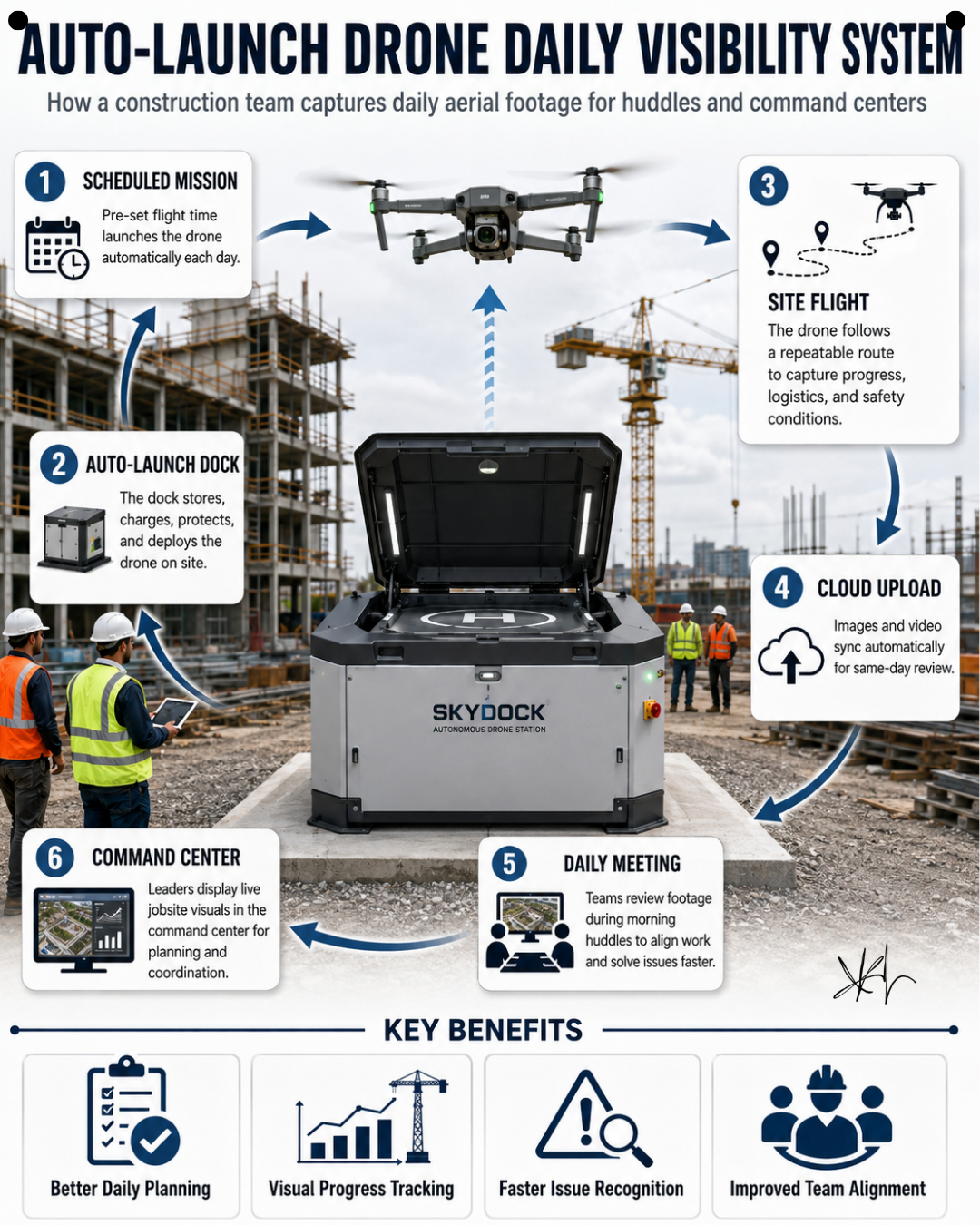
The scheduled mission starts the entire loop automatically. A pre-set flight time launches the drone every day, with no person needing to remember or be available to trigger it. This single design choice removes the dependency on human memory that undermines most manual visibility efforts. The drone flies whether or not anyone thought about it that morning.
The auto-launch dock stores, charges, protects, and deploys the drone on site, functioning as a fully self-contained piece of infrastructure rather than equipment someone has to manage, transport, or maintain manually. Set it and forget it is not an exaggeration here. The dock exists specifically to remove every point of friction that would otherwise require a person’s ongoing attention to keep the system running.
The site flight follows a repeatable route to capture progress, logistics, and safety conditions, and the repeatability is what actually makes the footage valuable. A different flight path every day produces inconsistent, hard-to-compare footage. The same path, flown at the same time, every single day, creates a visual record where change becomes immediately apparent, because the baseline never shifts, only the site does.
Cloud upload syncs images and video automatically for same-day review, meaning the footage is available before the day’s work has even really started, rather than arriving days later once someone finally has time to download and review it. Same-day availability is what makes this footage a planning input rather than a historical record.
The daily meeting is where the footage actually earns its value. Teams review it during the morning huddle to align work and solve issues faster, replacing a stale mental picture with an actual, current image of the site that the whole team can look at together, rather than relying on one person’s secondhand description of conditions they walked yesterday.
The command center displays live jobsite visuals for ongoing planning and coordination beyond the morning huddle itself, giving leadership a continuously available reference point throughout the day rather than a single snapshot reviewed once each morning.
Why This Is Not About the Drone
Here is the one thing that matters more than any piece of hardware in this system. This is not about the drone. It is about Mieruka, making the work visible so the whole team can see reality and respond to it. The drone, the dock, the cloud upload, all of it is simply the mechanism. The actual value is the principle underneath the mechanism, that a team working from an accurate, current, shared picture of reality makes better decisions than a team working from assumption, memory, or secondhand description.
This is the exact same principle running through every visual management practice covered across this series, the project KPI tracker, the Circle of Trust, quality at the source floor markings. Each one exists to replace a hidden or assumed condition with something visible that the whole team can reference together. A drone system simply applies that principle to the physical condition of the entire site itself, captured automatically, consistently, and daily, rather than relying on anyone’s manual effort to walk it and remember what they saw.
Most Coordination Problems Are Visibility Problems, Not Effort Problems
Most coordination problems are not problems of effort. They are problems of visibility. A trade that stacks up behind another trade, a logistics conflict that develops overnight, a safety condition that emerges without anyone noticing in time, none of these happen because anyone failed to work hard enough. They happen because nobody had an accurate, current picture of the site at the moment the decision that led to the conflict was actually made.
When everyone is working off the same picture of the site, progress, logistics, safety, better daily planning, visual progress tracking, faster issue recognition, and team alignment stop being aspirations and start being the default outcome of the system, rather than something a particularly diligent team manages to achieve through extra effort. The system produces the outcome. The team does not have to fight for it.
Signals Your Project Is Flying Blind
Look for these patterns on your current project:
- The morning huddle is built from a mental picture of the site that is more than a day old
- Coordination conflicts between trades or logistics are discovered in the field rather than caught the day before they become a problem
- Drone footage, when it exists at all, gets used only for milestone photos or occasional investigation rather than daily planning
- Leadership’s understanding of current site conditions depends heavily on secondhand reports rather than direct, current visual data
- The team has no consistent, repeatable method for seeing the whole site every single day before the first task begins
Each of these signals a visibility gap, and that gap is exactly what an automated, daily aerial capture system is built to close.
We Don’t Guess Our Way to Flow
We do not guess our way to flow. We make the work visible, then we go solve the constraint. This connects directly to everything this factory has covered about drum buffer rope and Takt planning. You cannot protect a constraint you cannot see clearly. You cannot manage flow you cannot observe consistently. An automated daily visibility system gives a project exactly the kind of current, reliable, shared picture of reality that every other Lean practice in this series depends on to function well. If your project needs superintendent coaching, project support, or leadership development, Elevate Construction can help your field teams stabilize, schedule, and flow. Jason Schroeder and the LeanTakt team build visibility systems like this because a team that genuinely sees the site, every single day, solves problems the day they appear instead of the week after they compound.
Build Your Daily Visibility Loop This Month
Here is your challenge. Whether or not an automated drone system is within reach for your project right now, build the habit this system represents. Capture the actual current condition of your site consistently, daily, before the morning huddle, and bring that real picture into the room instead of a memory from yesterday.
Taiichi Ohno said it plainly: “Data is of course important in manufacturing, but I place the greatest emphasis on facts.” A stale mental picture is an opinion about what the site probably looks like. A current photograph is a fact. Build the system that gives your team facts every single morning, and watch how much faster the real problems actually get solved.
On we go.
FAQ
Does a project need expensive drone infrastructure to apply the underlying principle here?
No. The core principle, capturing the actual current condition of the site consistently and bringing that real picture into daily planning, can start with a manual daily walk and photo capture before investing in automated infrastructure. The automated system simply removes the dependency on someone remembering to do it, which matters most once a project reaches a scale where manual consistency becomes difficult to sustain.
Why does the repeatable flight path matter so much?
A consistent route creates a comparable baseline from one day to the next, which makes change immediately visible. A different path every day produces footage that is interesting but hard to compare, since the viewer cannot easily tell whether a difference reflects an actual site change or simply a different camera angle.
How is this different from periodic drone footage used for owner progress reports?
Progress reports are typically occasional and retrospective, documenting milestones after they happen for an external audience. A daily visibility system is continuous and forward looking, feeding the team’s own planning and coordination decisions every single morning, before problems have a chance to compound.
Who should be responsible for reviewing the footage each morning?
The same people who are already making daily coordination decisions, typically the superintendent and field leadership team, reviewing the footage together as part of the existing morning huddle rather than as a separate, additional meeting. The value comes from integrating the footage into decisions that are already being made, not from creating a new review process layered on top.
How does this connect to the Drum Buffer Rope and Takt planning practices covered in this series?
Both of those practices depend on an accurate, current understanding of where the actual constraint sits and how the work is genuinely flowing through the site. A daily visibility system is the mechanism that makes that understanding possible and current, rather than based on assumption or outdated memory. You cannot protect a constraint or manage a Takt rhythm effectively without first seeing, clearly and consistently, what is actually happening on the ground.
If you want to learn more we have:
-Takt Virtual Training: (Click here)
-Check out our Youtube channel for more info: (Click here)
-Listen to the Elevate Construction podcast: (Click here)
-Check out our training programs and certifications: (Click here)
-The Takt Book: (Click here)
Discover Jason’s Expertise:
Meet Jason Schroeder, the driving force behind Elevate Construction IST. As the company’s owner and principal consultant, he’s dedicated to taking construction to new heights. With a wealth of industry experience, he’s crafted the Field Engineer Boot Camp and Superintendent Boot Camp – intensive training programs engineered to cultivate top-tier leaders capable of steering their teams towards success. Jason’s vision? To expand his training initiatives across the nation, empowering construction firms to soar to unprecedented levels of excellence.